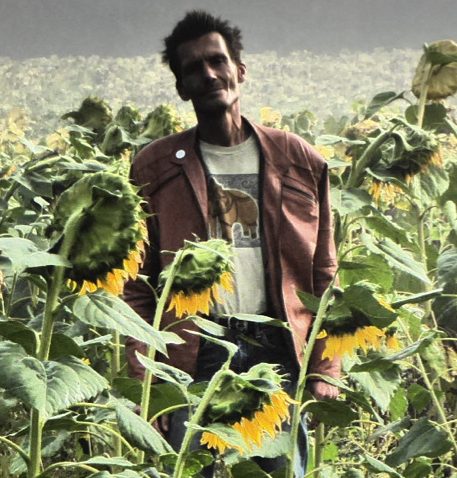

In just 48 hours, I explored Seoul, the world’s most curated capital which thrives on stunning contrasts. In this story we will deep dive into futuristic ‘Space Brewing’ architecture, iconic markets, Korea’s obsession with appearances, essential “traveler’s survival tools,” and the “death row meal” in every corner of the city. A hands-on, visual guide for the modern traveler.
Returning home from the Philippines (read my earlier stories HERE, HERE, and HERE), I took advantage of a two-day layover in Seoul, the capital of South Korea. Honestly, at that point, my knowledge of this country was limited to two distinct reputations. First, the nation’s obsession with “appearances,” which has turned Seoul into a global destination for fashion and cosmetology. Global proliferation of K-culture has helped this obsession to gain international recognition.
Second, I knew about Korea’s lightning-fast transition from a manufacturing economy (like basic electronics) to a high-tech powerhouse. Today, the country ranks #1 in the world for the number of researchers per 1,000 employees. By the way, if you are using some AI today, it is likely running on Korean-made semiconductor memory – an area where Korea holds undisputed global dominance.
So, I was curious: how does the capital of a nation defined by both an obsession with aesthetics and a reverence for cutting-edge innovation actually look on the ground?
- A Pinch of History: Understanding Korean Identity
- Top “Positives” and “Negatives” of Living in Today’s Korea
- A “Survival Kit” for Visiting Seoul
- Forget About Your Diet: A “Death Row Meal” in Every Corner of the City
- Unfiltered Seoul: A Journey Through the Markets
- Three Historic Landmarks You Shouldn’t Miss
- My Three Favorite Frames in the Instagram-Obsessed City
- Flying Over Seoul
- A Farewell to Seoul: Steam and Stream
A Pinch of History: Understanding Korean Identity
Koreans claim that their nation dates back 5,000 years. On October 3, Gaecheonjeol (“Festival of the Opening of Heaven”) commemorates the founding of Gojoseon, the first Korean kingdom in 2333 BC.
It was also back then that a tiger appeared in a legend as a symbol of both power and good luck. Historically, Koreans viewed this giant cat as a guardian that could ward off evil spirits, and it eventually became the official national animal.

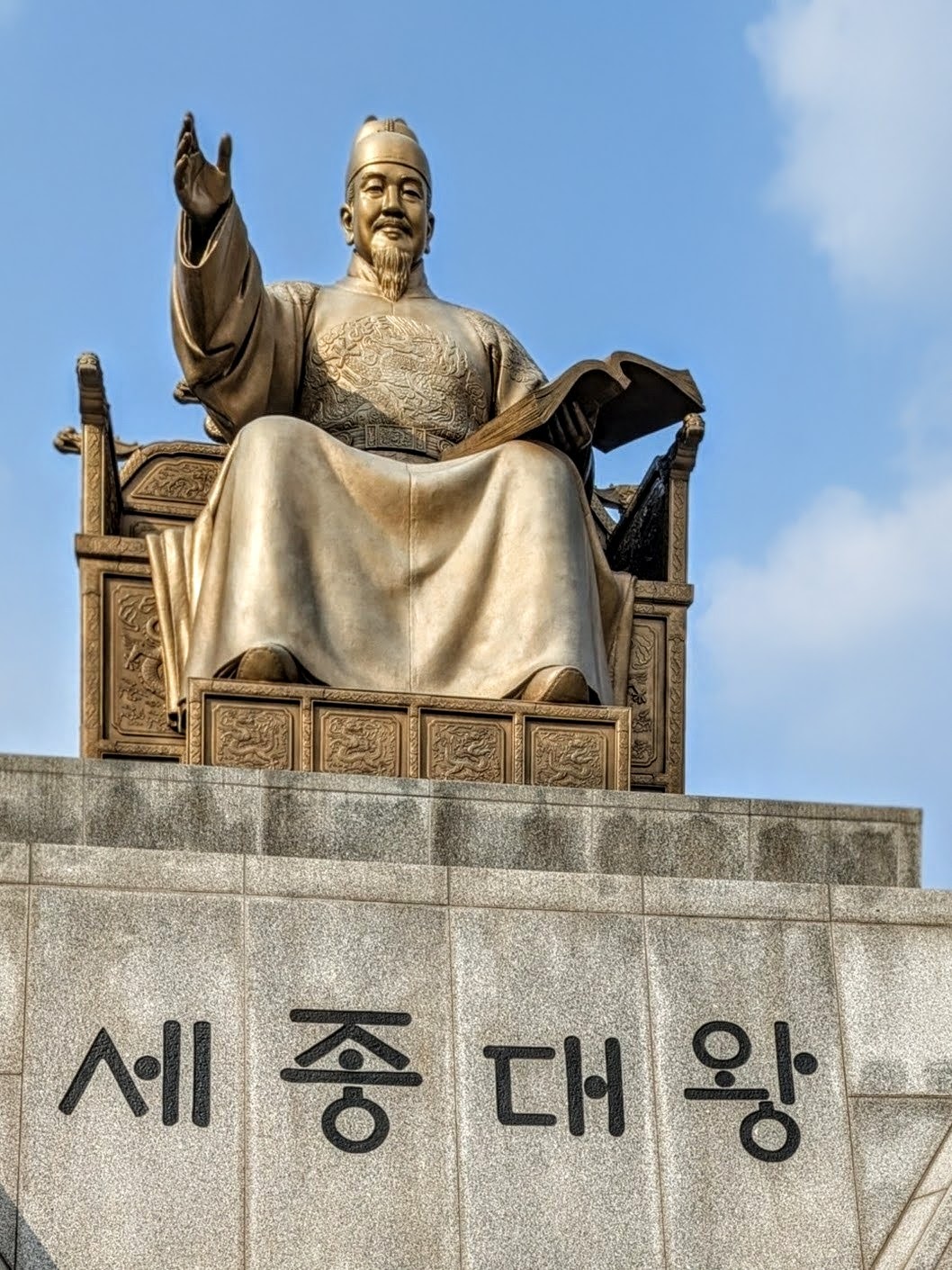
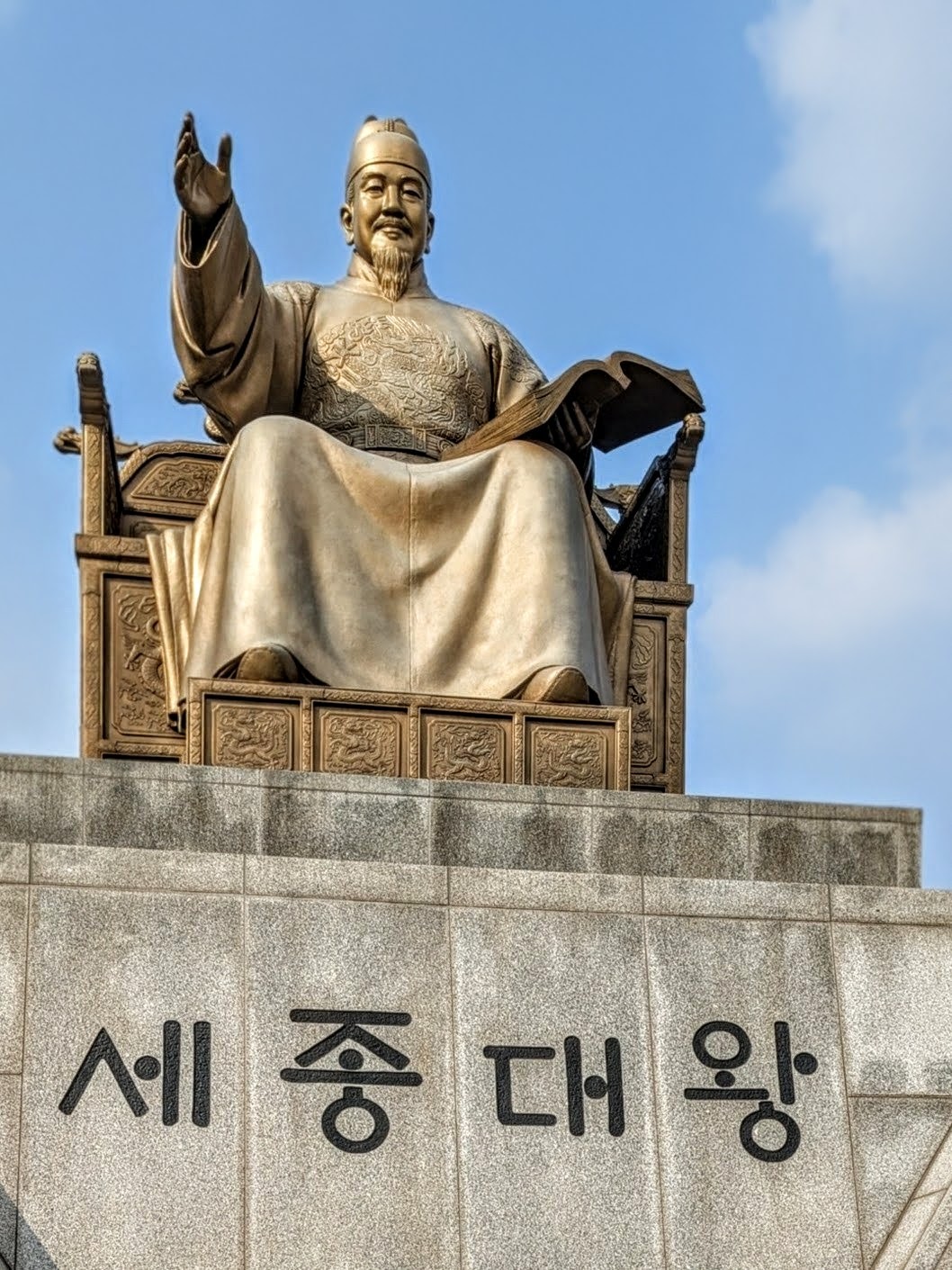
The last royal dynasty to rule Korea was the Joseon (1392–1910). While the dynasty had 27 kings, the most revered of them is King Sejong the Great (r. 1418–1450). His greatest achievement was the invention of the “Hangul” alphabet. Prior to that, Koreans used Chinese characters, which were difficult for the common people to learn. With Hangul’s introduction, every citizen could become literate.
Sejong was also remarkably progressive for his time, granting 100 days of maternity leave to state female slaves and 30 days of “paternity leave” to their husbands. In 1430, Sejong even conducted what is considered the world’s first public opinion poll, surveying 170,000 people across the country to determine whether a new tax law was fair.
In 1897, the Korean Kingdom underwent a symbolic transformation when King Gojong proclaimed himself Emperor and changed the name of the state to “The Great Korean Empire.” This was an attempt to achieve a stronger footing with China (which had great influence on Korea) and to put the Korean monarch on an equal level with the Emperors of China and Japan.
The imperial period, however, was short-lived. In 1905, the Russian Empire, the main guarantor of Korea’s independence, lost a war with Japan, and Gojong was forced to abdicate. The last Korean monarch, Sunjong, was fully controlled by the Japanese and eventually (1910) signed the annexation treaty. Korea become a Japanese colony.
The new suzerain used Korea as a major supplier of raw materials and food to the Japanese metropole. During WWII, Korean men were conscripted into the Japanese army. The most tragic chapter of this period, however, was the story of “comfort women.”
Beginning in the 1930s, the Japanese military established a system of “comfort stations.” An estimated 50,000 to 200,000 women were recruited through deception, coercion, or kidnapping. They were transported across the Japanese Empire to serve as sexual slaves for soldiers. If you have a chance, watch this great movie
After Japan’s surrender in 1945, Korea was divided into two occupation zones, with the Soviet Union controlling the north and the United States managing the south. The Cold War prevented the unification of the country, leading instead to the establishment of the Communist Democratic People’s Republic of Korea (North Korea) and the Republic of Korea (South Korea).
This division was solidified by the bloody Korean War (1950–1953), in which an estimated 3 million Koreans lost their lives. The war ended in an armistice, but a peace treaty was never signed, leaving the two nations separated by a heavily fortified Demilitarized Zone (DMZ).
The 2004 South Korean film Tae Guk Gi: The Brotherhood of War follows two brothers drafted into the war, and it is widely considered the best ever movie on the subject.
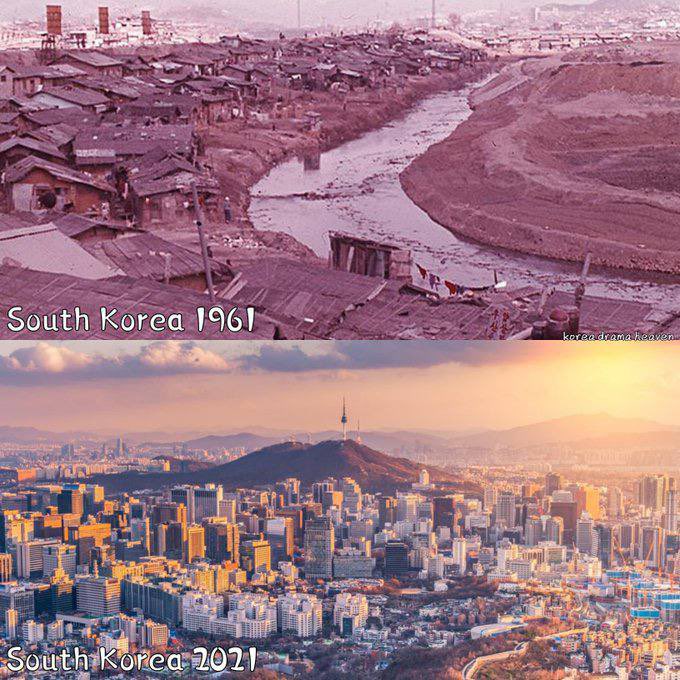
The nascent Republic of Korea (aka “South Korea”) entered the 1960s as an economically and socially backward nation, with a GDP per capita lower than that of Haiti or Ethiopia and a life expectancy of a mere 52 years. But the next two decades witnessed what has become known as “Miracle on the Han River” – one of the most dynamic periods of economic growth in human history.
If you are interested what triggered this phenomena and what the outcomes were, watch this short video.
In 1962-1979, the economy grew at the astonishing rate of 9-10% per year. From a closed, agrarian society, South Korea shifted to an export-oriented nation with a worldwide imprint.
Just as one example, starting from almost zero in the 70s, by the early 1980s, South Korea became the world’s 2nd largest shipbuilder (after China). It holds this rank up to the present, being also an absolute monopolist in the construction of certain types of vessels (e.g., Liquefied Natural Gas carriers).

Meanwhile, the “social landscape” underwent equally dramatic changes. Between 1960s and present, life expectancy grew from 52 to 85 years (ranking 5th in the world), the share of urban population increased from 28% to 82%, and the consumption of meat and fish per capita spiked from 14 to 120 kilograms (31 / 265 pounds) a year.
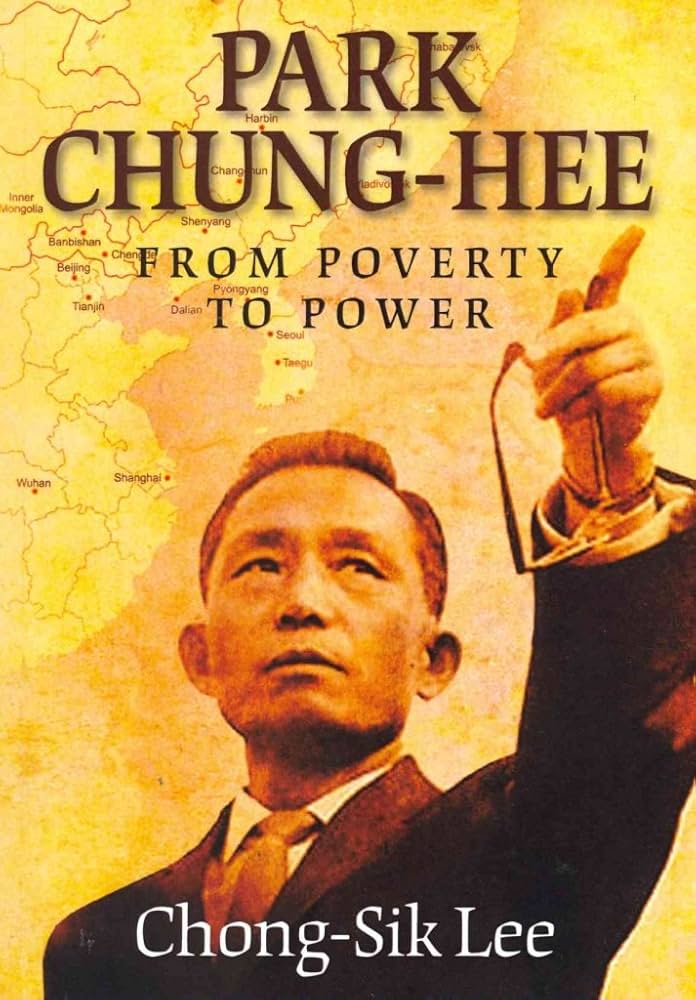
Yet, in terms of politics, it has taken much longer to arrive at the current South Korea, a nation of highly functioning democracy as measured by Freedom House, EIU Democracy, or V-Dem Institute indexes. Back in the 1960s-80s, the country was essentially a military dictatorship. The two most prominent leaders, Park Chung-hee (1961–1979) and Chun Doo-hwan (1980–1988), followed the same scenario. They first seized power through a military coup, then resigned from the military to run as “civilian” candidates, and finally held elections that were heavily staged or restricted to ensure they would win.
Heavily backed by the military, both presidencies were “hyper-executive,” with almost no checks on the leader’s power. The President could issue “Emergency Measures” that suspended the constitution, allowed for the arrest of protesters without warrants, and banned all criticism of the government.
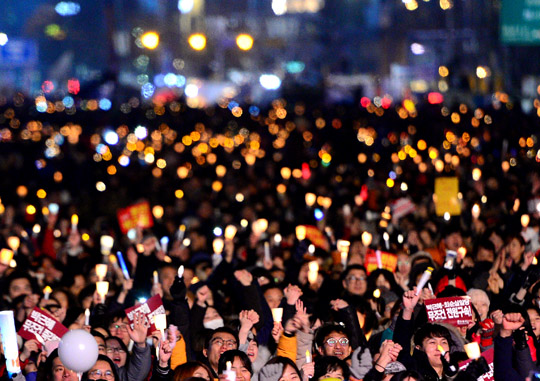
The Big Bang for modern Korean democracy happened in 1987. After the government killed two student activists and attempted to abolish direct elections altogether, the public outcry resulted in demonstrations lasting for 20 days and involving over 5 million people. The protesters weren’t just student activists, but also white-collar workers, and clergy signaling to the military that they had lost the support of the general public. Facing international pressure ahead of the 1988 Seoul Olympics, the regime capitulated.
The June 29 Declaration restored direct presidential elections and fundamental civil liberties, while the new (1987) Constitution established a “one and done” rule where the President is elected for a single five-year term. Most importantly, the events of 1987 cemented in the Korean psyche the idea of “street protest” as a legitimate and highly effective tool for social and political change.
Top “Positives” and “Negatives” of Living in Today’s Korea
Preparing for my trip to Seoul, I looked on YouTube for various resources on today’s South Korea. What struck me was that the country appeared to be a newly popular destination for immigration: digital nomads and retired expats alike told their stories about finding their new perfect place to live. But how close to reality is this perception?
I asked my AI (Gemini) to find the three most common “positive” and “negative” stereotypes about living in South Korea. Remarkably, the answers of my “digital friend” were extremely consistent with what I observed later in Seoul.
You will definitely appreciate South Korea for:
- Convenience, Efficiency, and Speed. Korea is a “Pali-pali” (hurry-hurry) culture. Everything, from gigabit-speed internet to 24/7 food delivery and lightning-fast government services, is designed for maximum efficiency.
- Safety and Low Crime. South Korea is one of the safest places in the world. It is common to see people leave laptops or phones on cafe tables or benches in a park, confident that the items will still be there when they return.
- World-Class Public Infrastructure. The public transit system (subway and buses) is clean, affordable, and always on time. The healthcare system is also praised globally for being high-quality and surprisingly inexpensive compared to Western models.
And here are three things which may not look as appealing to many people:
- High-Pressure Work/Study Culture. The extreme social pressure to succeed is obvious. Think about “cram schools” for children – the private, for-profit after-school educational institutions. Such schools exist in many countries, but the South Korean version is famous for its intensity, ubiquity, and the amount of money parents spend on them. Another example is climbing the corporate hierarchy, which includes long hours, mandatory after-work drinking (hoesik), and a high level of stress.
- Homogeneity and Xenophobia. Yes, the country has become a welcoming tourist-oriented destination, but it remains a “closed” society for those who live there permanently. If you are a “transplant,” you may feel like a perpetual outsider and experience subtle discrimination in housing and employment.
- Obsession with Appearance. While South Korea is often stereotyped as the “plastic surgery capital of the world,” this also means that there is immense pressure to conform to very specific beauty standards. In many ways, your “specs” (physical appearance and pedigree) directly affect your professional and social success.
A “Survival Kit” for Visiting Seoul
Truth be told, the title of this section is an exaggeration. Seoul is a modern, clean, and very safe city with efficient and inexpensive public transportation. Yet, the five things I describe here will make your visit truly seamless and enjoyable.
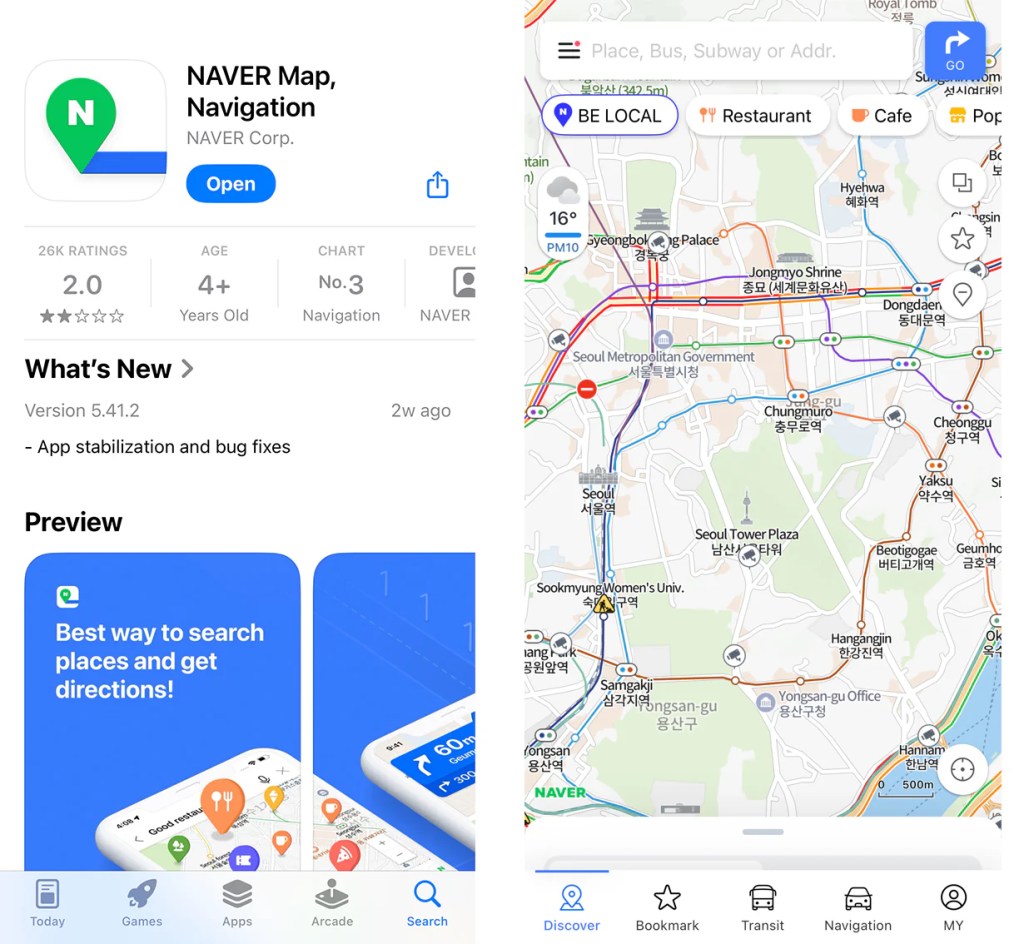
First, download from the Apple/Google online stores, and install on your smartphone “NAVER” – the Korean version of “Google Maps.” Due to government security regulations, Google Maps do not function properly here, and the walking/driving/public transit directions won’t work at all.

If you are familiar with Google Maps, learning how to use NAVER won’t take any time, as its layouts is very similar to Google’s. Further, I found NAVER even more user-friendly than Google Maps when it comes to walking directions in the city.
You can download and use NAVER Maps without creating a personal account and profile. However, if you do, you will be able to use more functions. For me, while exploring Seoul, the option to save on the maps “favorite spots” (places to eat, tourist destinations, markets) was extremely helpful.
Second advice is about paying for public transportation, which includes the widespread subway and a dense network of city buses. If you want “one easy solution for everything,” purchase a Climate Card – an unlimited public transportation pass that is good for 1, 3, or 5 consecutive days.
The “climate card” is amazingly cheap. The five-days version costs only 15,000 Korean won (KRW) – equal to $11 USD / 10 Euro.
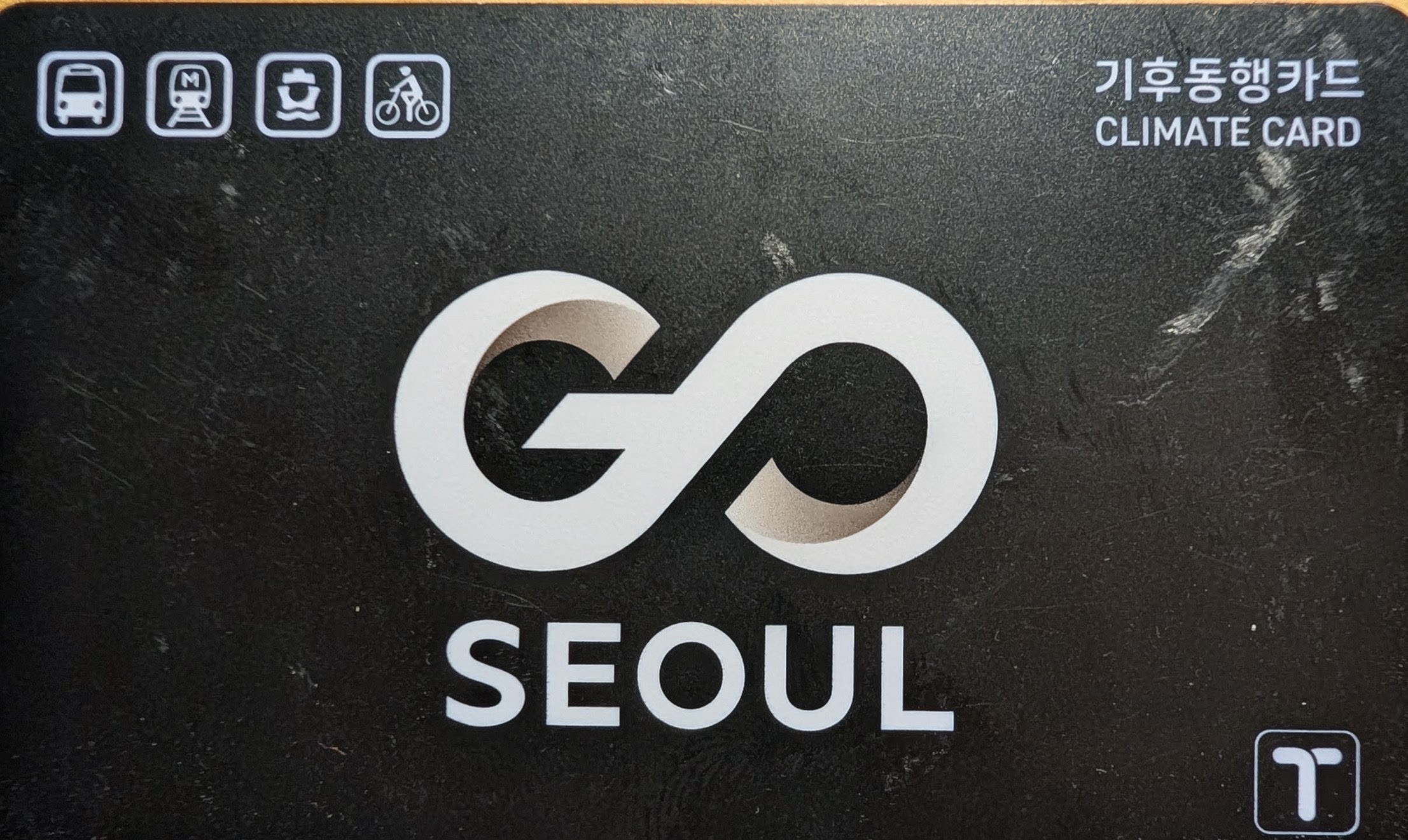
Keep in mind, when using Climate Card, you should tap it BOTH when entering and leaving either bus or subway. Climate Cards are sold at numerous ticket vending machines at the subway stations. Purchasing them is a two-step procedure.
First, switch the machine’s interface to the English language and navigate through the various options to Climate Card. Then, pay 3,000 KRW and get a physical Climate Card. Second, put it back into the ticket machine and “load” with the amount of money for either 1, 3, or 5 days. Clearly, Climate Cards can be reloaded and used over and over again.
My third advice is: while in Seoul, do not rely on paying everywhere with your international credit card. Make sure that you have a supply of the local currency – the Korean won (KRW).
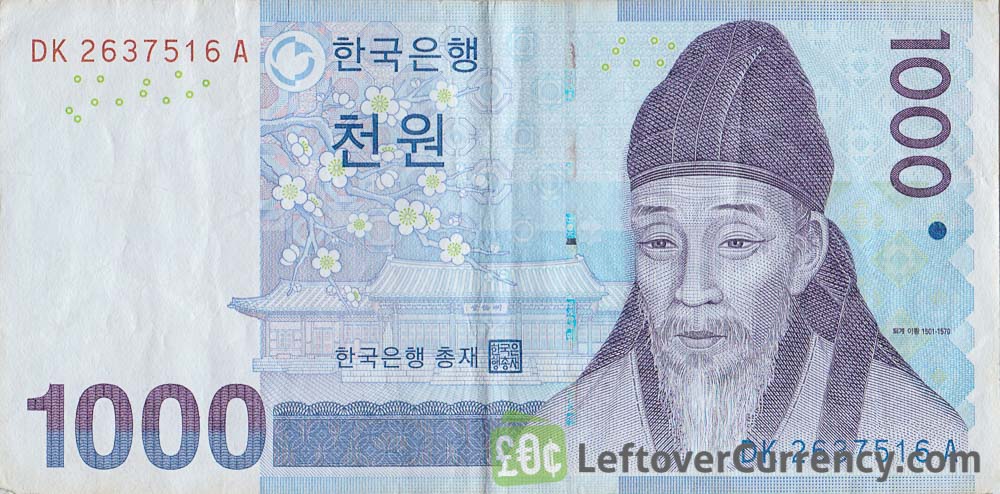
International credit cards are widely accepted in chain stores, supermarkets, museums, and most cafes and restaurants. Yet, small street shops and food stalls, as well as sellers at Korea’s traditional markets won’t accept them. Instead, you will need cash.
And don’t be alarmed by the staggering number of “zeros” on the price tags. The exchange rate is about 1,500 KRW for $1 USD or 1,700 KRW for 1 Euro. Overall, I found South Korea very affordable to travel: definitely significantly cheaper than Japan or Singapore.
The next thing to keep in mind is the linguistic barrier. Frankly, I thought that in such modern high-tech city many more residents would be fluent in English, but this was not the case. Not a big deal, though: either use Google Translate or simply try to ask more people. Eventually, you will find someone able to converse fluently.
The last recommendation is: learn how to use and take full advantage of Seoul’s excellent – extensive, clean, efficient – subway system. Essentially, if you are also willing to walk a little bit, you can reach any point in Seoul simply by riding the subway (no need for buses).
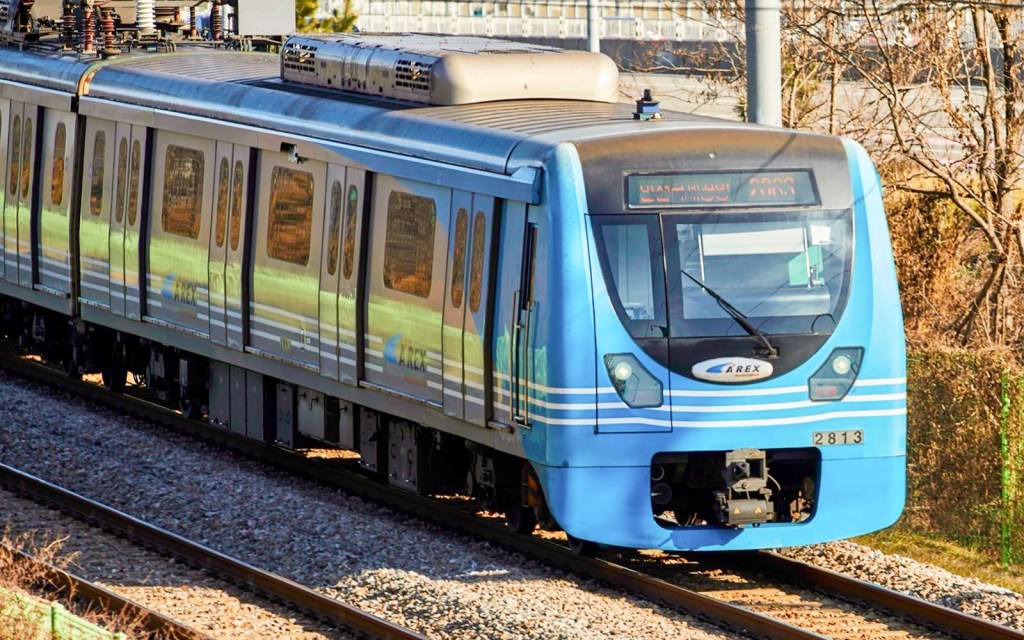
Talking about the subway, the AREX train line connecting Seoul with the international airport (Incheon) is also integrated into the metro system, making it really easy to reach city center, change for the subway, and go to your final destination.
However, AREX is not covered by the Climate Card, because Incheon airport is technically outside of Seoul. When taking the AREX train, you have two options: express (more expensive, faster, with designated seats for each passenger), or all-stops train which is also used by regular commuters living in Seoul’s suburbs. I personally preferred all-stop train: it is cheaper, runs very frequently (the express train departs only twice per hour) and the time difference to reach Seoul from the airport is only 15 min.
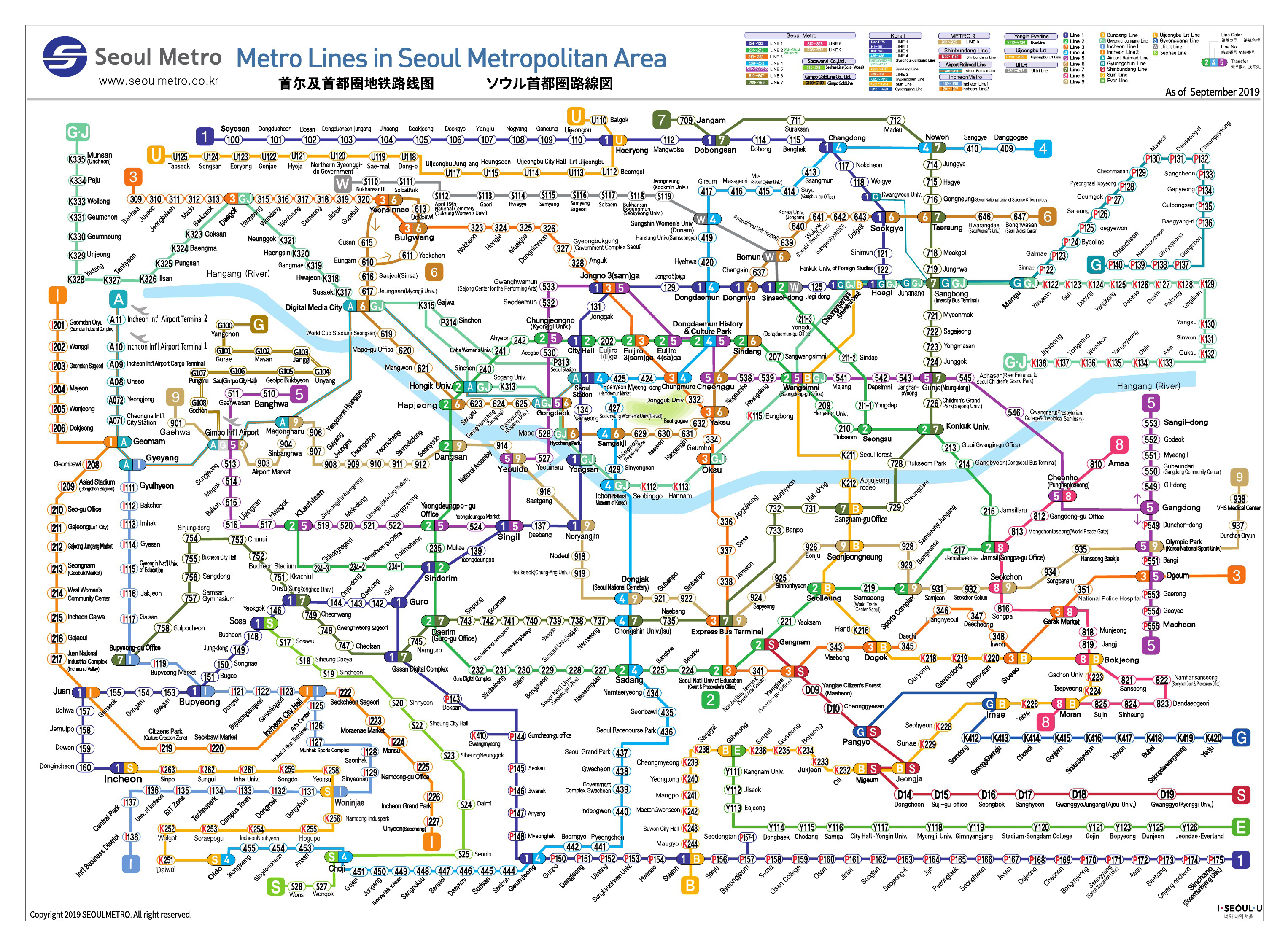
Here is the map of Seoul’s subway system and link to online version of it:
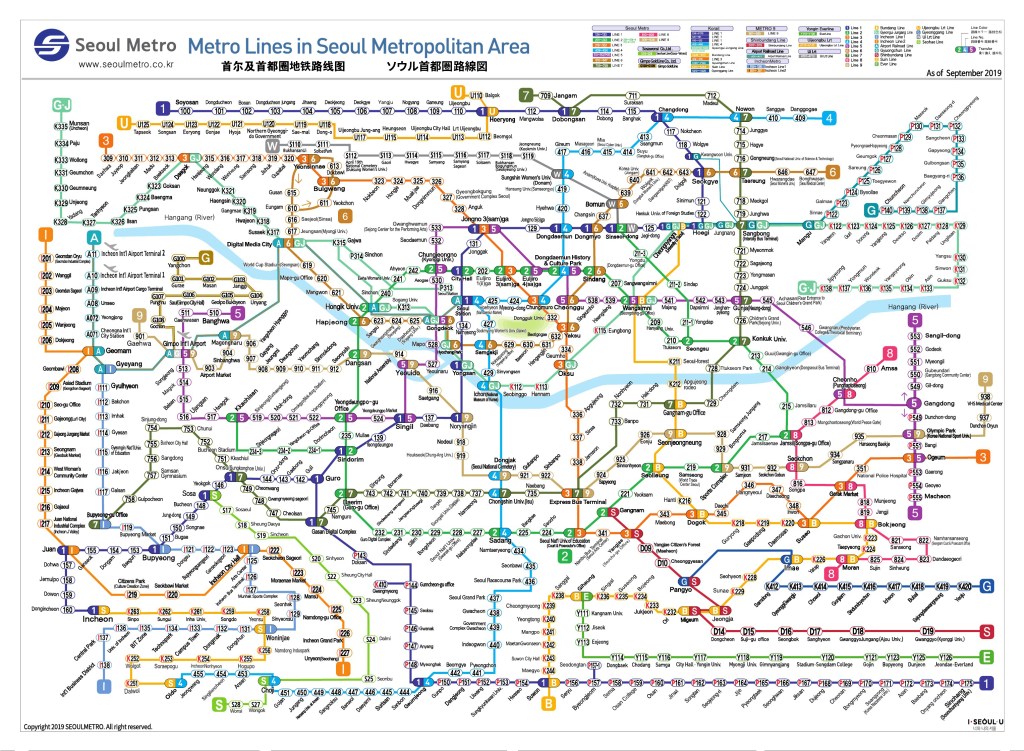
This web of lines may look overwhelming, but if you have used the metro in Paris, London, or Berlin, it will take no time at all to grasp Seoul’s subway. All signs – on platforms, passageways, inside trains, video screens – are both in Korean and Latin characters.
Here are a few more tips on using the subway in Seoul. First, download the Korea Subway app. Technically, NAVER Maps is sufficient to plan your trip via subway, but I found this designated app even more helpful with the added advantage of having a high-resolution metro map right in my pocket.
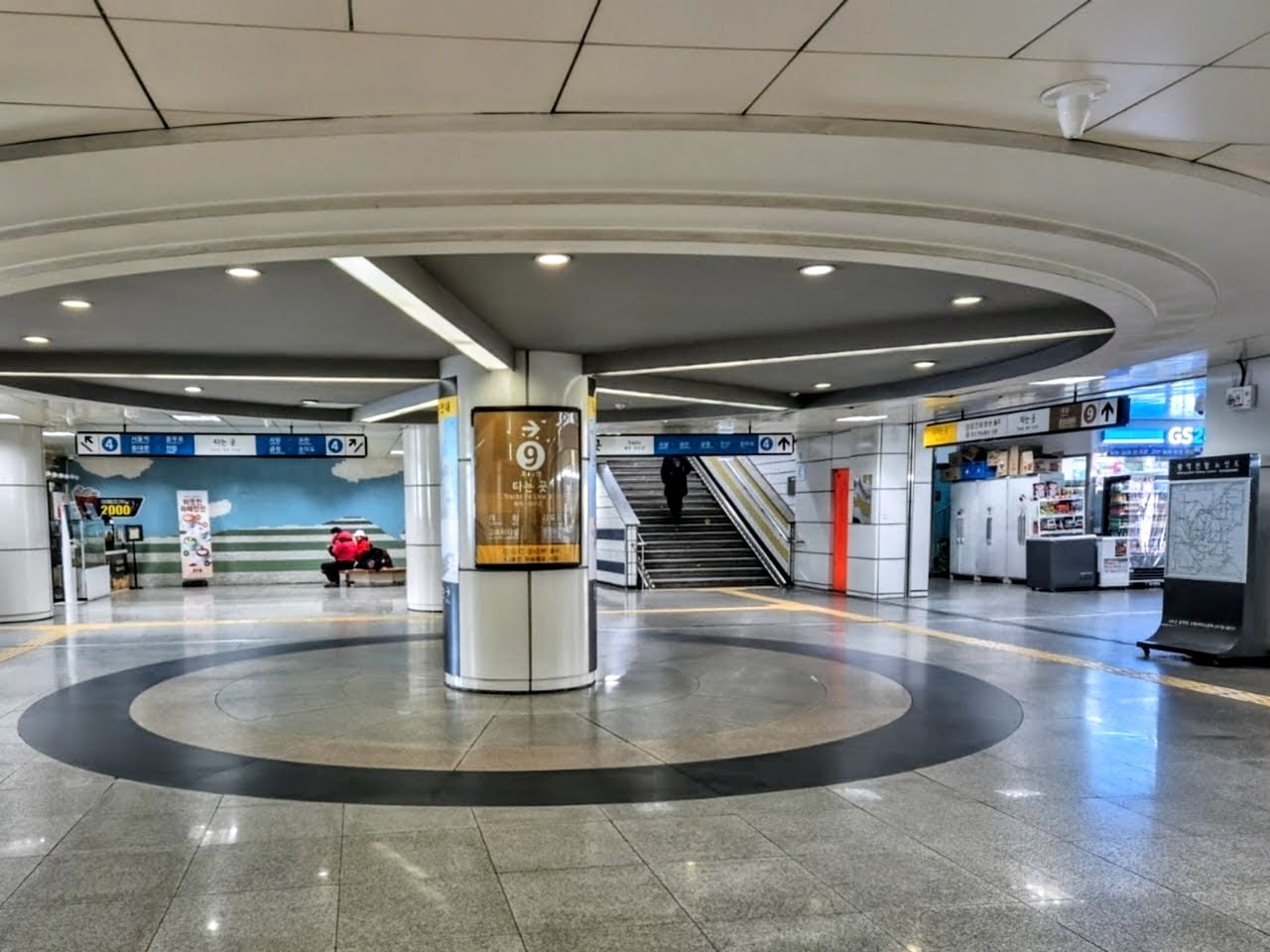
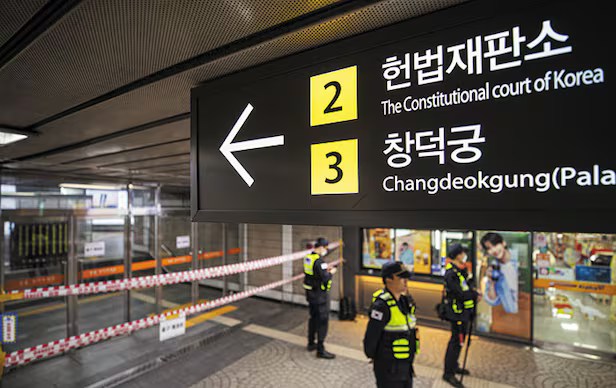
Second, unlike most European metro systems, each station in Seoul has a lot of exits/entrances: often 10-15. This may be confusing for first-time visitors, because these exits are often fairly apart above ground.
The good news is that all exits are clearly numbered and have signs indicating the street/square/landmark where they lead. Also, when using the Naver Maps the app will indicate which metro exit/entrance to use and give directions to it.
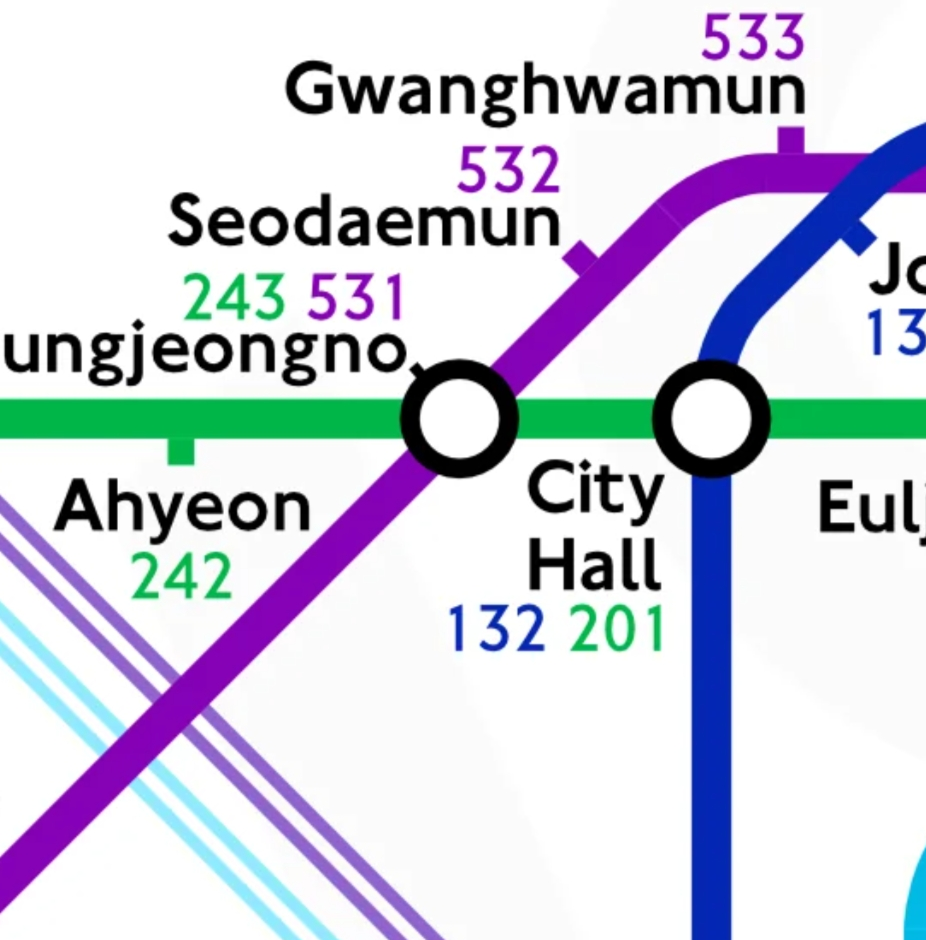
Third, all subway lines are color-coded and numbered. Subsequently, each station is also coded with three digits, where the first digit is the number of the line. For example, the green line encircling central Seoul is line #2. Accordingly, all stations on this line are numbered from 201 (City Hall Station) to 243 (Chungjeongno Station).
If a station serves as an interchange between several lines, it will be coded with several numbers – one for each line. On the below picture, City Hall is a station on the #1 (dark blue) and #2 (green) lines. Therefore, it has two numbers: 132 (for line #1) and 201 (for circular line #2).
Fourth and most importantly, the subway isn’t just a “transportation system.” It is almost like a second, “underground” Seoul. For example, many stations are fully “integrated” into various multi-level shopping malls.
As a result, when changing lines or even walking between exits/entrances of the same station, you will often go through various shops and services. At times, it can be annoying and distracting, but it is what it is.
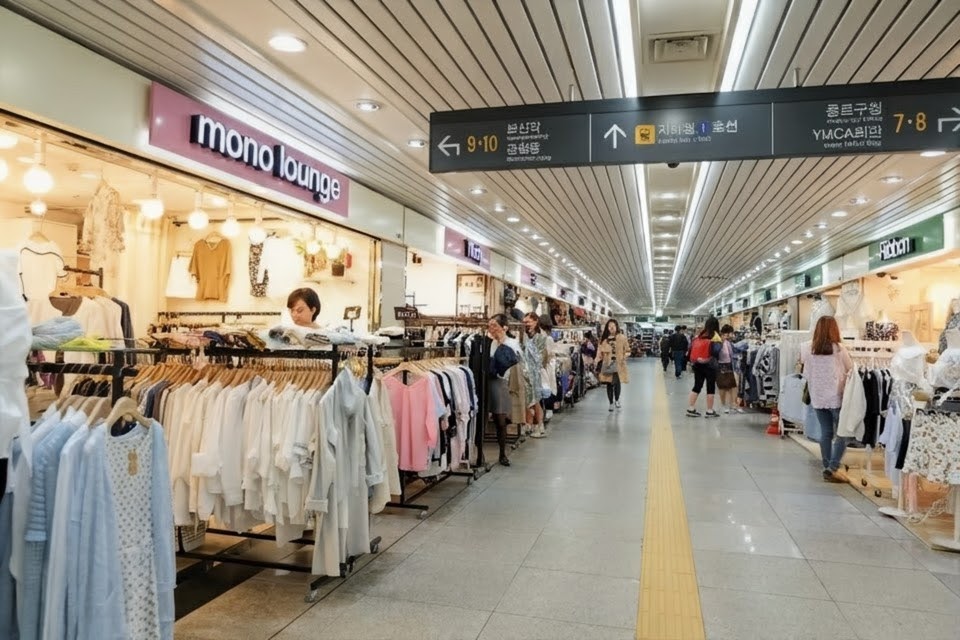
By the way, if shopping is “your cup of tea,” here is great article specifically on Underground Shopping in Seoul.
What makes the Seoul metro truly helpful to visitors is that each station has free public restrooms, as well as lockers where you can store luggage for a few hours or even several days.
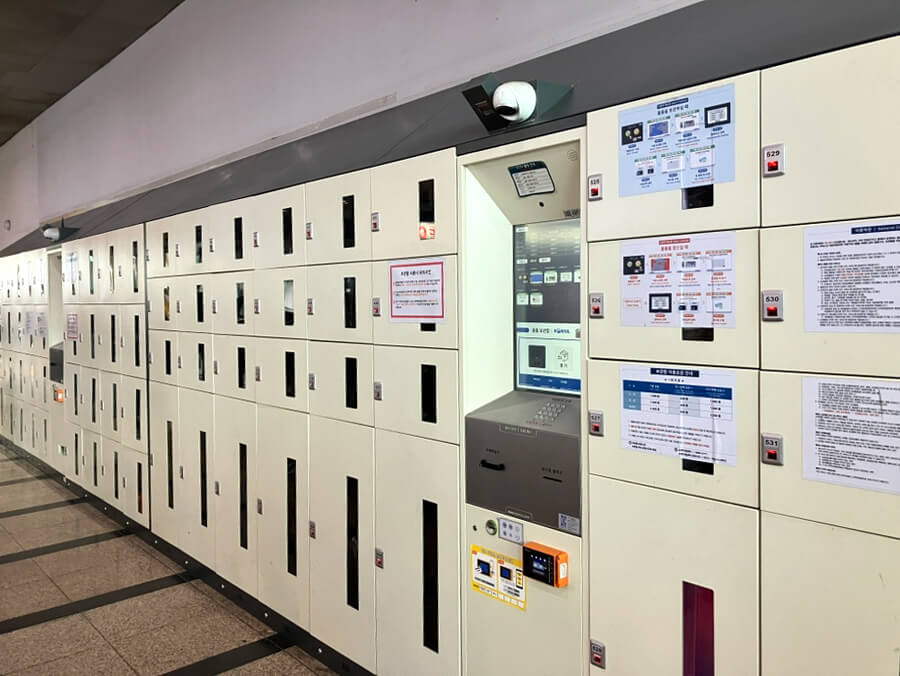
With regard to storing luggage at metro stations, you can even reserve and pre-pay for a locker at particular station by using T locker app. As an additional bonus, this app also allows you to lock and unlock the locker using your phone, eliminating the need for paper receipts or memorizing codes.

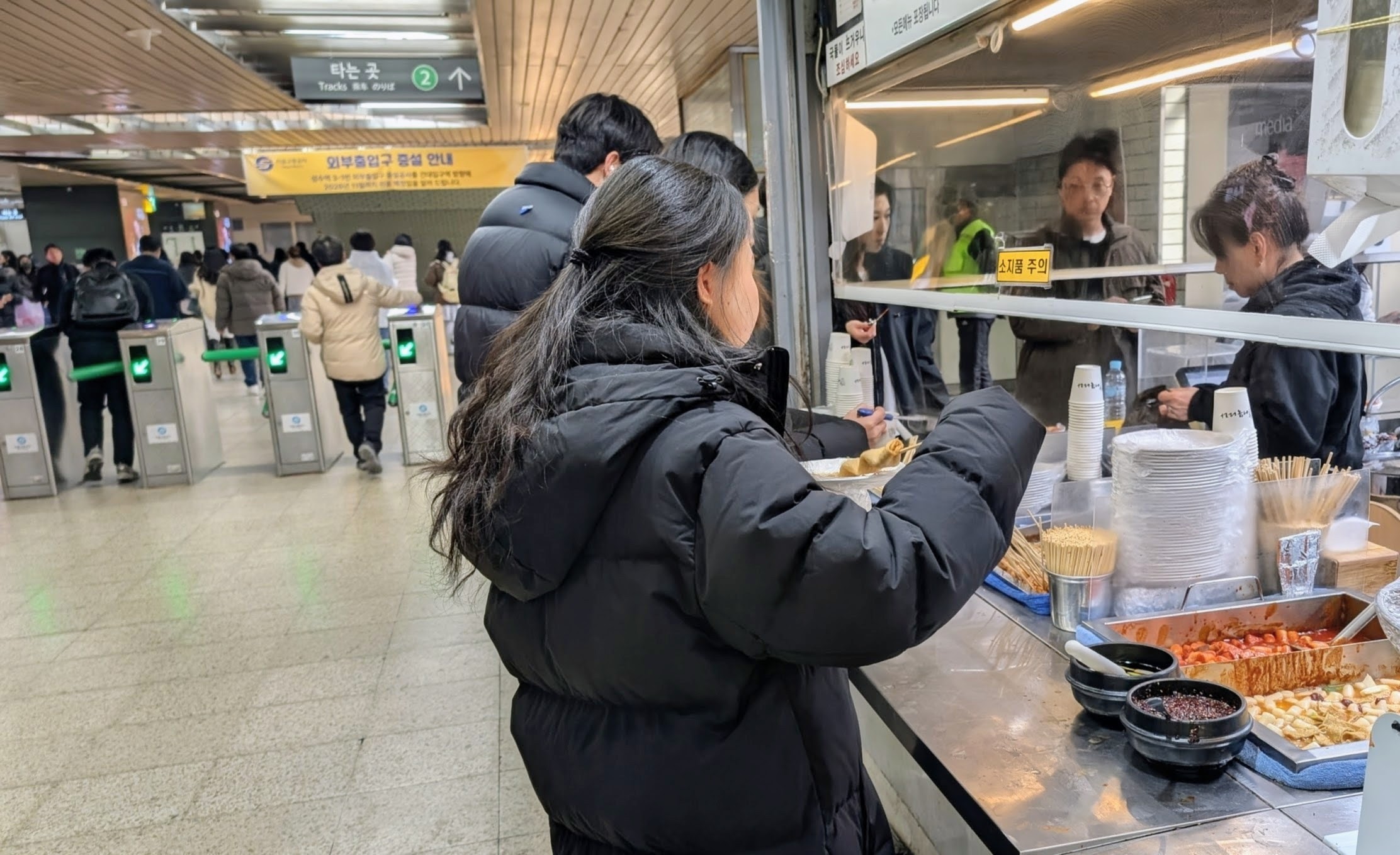
And, of course, subway stations offer a good selection of places to eat: various cafes and snack bars preparing food right in front of you.
One more suggestion. When using subway, try to follow certain rules as the locals do. The most important is that some seats are reserved for certain categories of passengers: disabled or elderly people, and pregnant women.
Even if the car is totally full, don’t use these seats unless you belong to one of these categories.
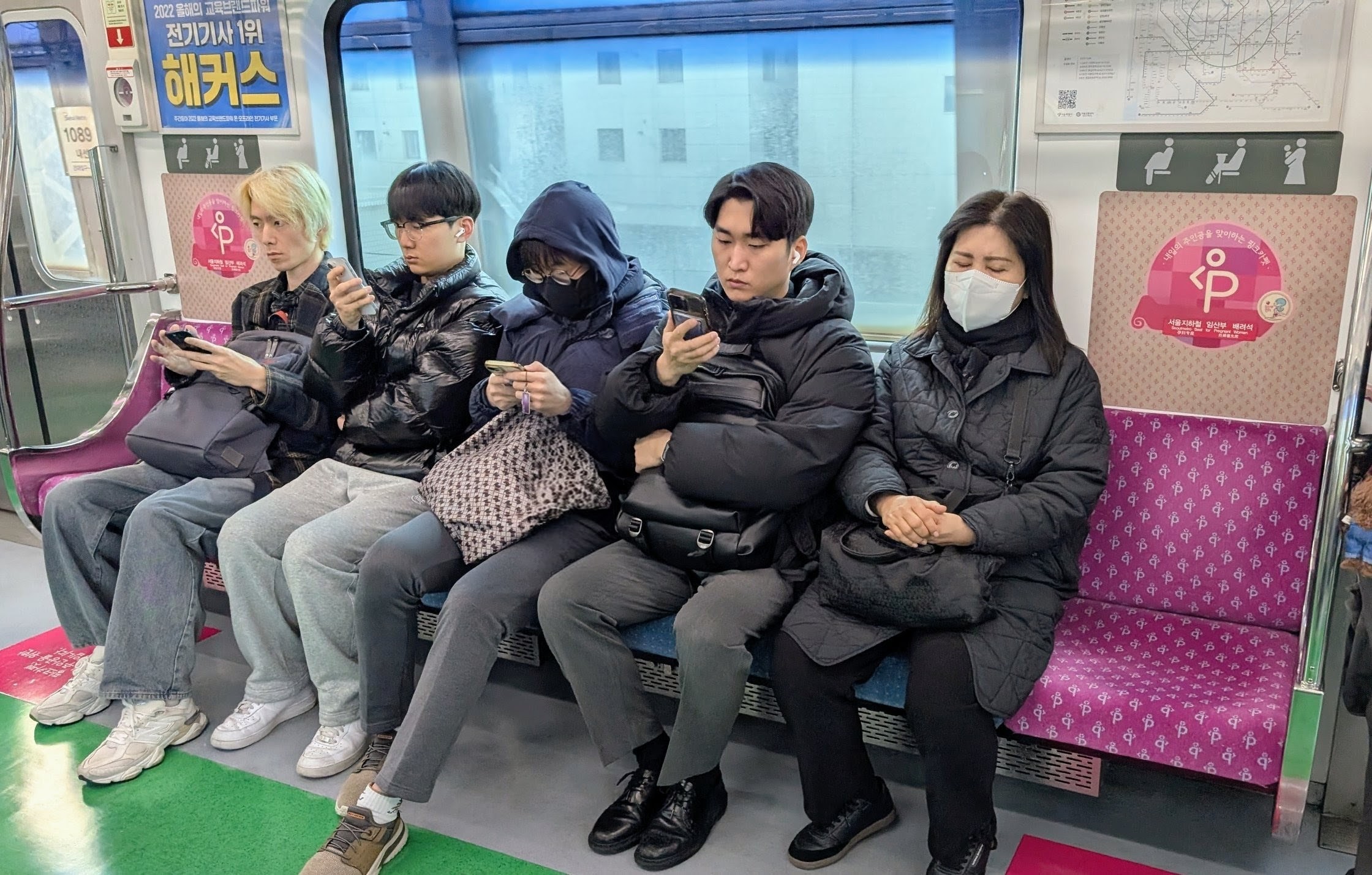
Finally, about one more “fun service” offered by Seoul’s metro. At many stations, walking along platforms you will see rectangular “open face” booths with benches and, sometimes, tables inside. Here is an example.
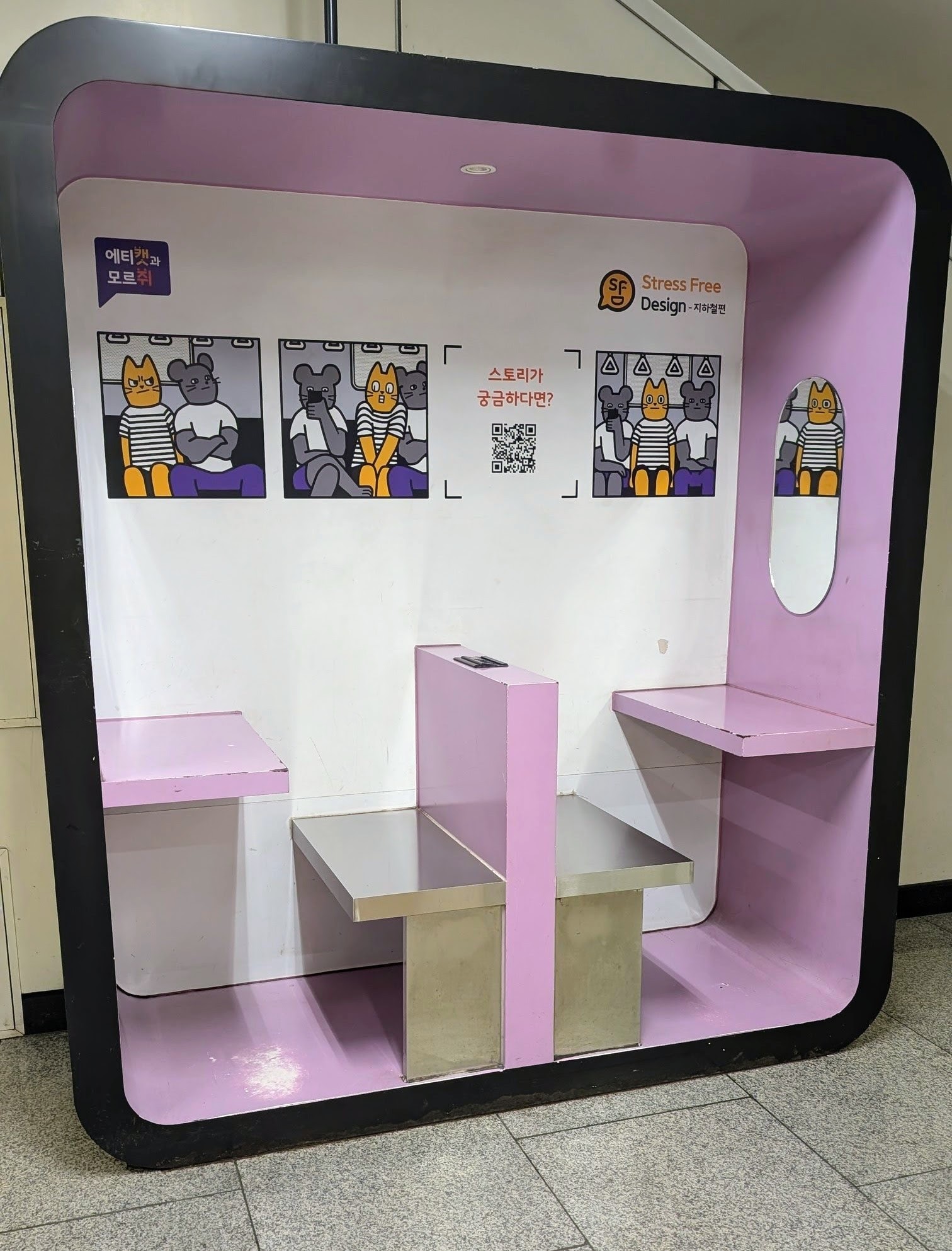
These booths are “Stress Free Zones.” They are designed as small oases of respite for passengers in high-traffic stations. The intention is to provide a quiet, semi-private space to sit down and take a breather from the crowded platforms.
Most of them are equipped with electrical outlets and USB ports, making them a good place to quickly handle an urgent message, or charge mobile devices. The mirror on the side allows you to quickly check and “fix” your appearance (important in Korea!) before a meeting or social gathering without needing to find a station restroom.
“Stress Free Zones” serve also for education in public etiquette. On their walls you can see two cartoon characters and a QR code.
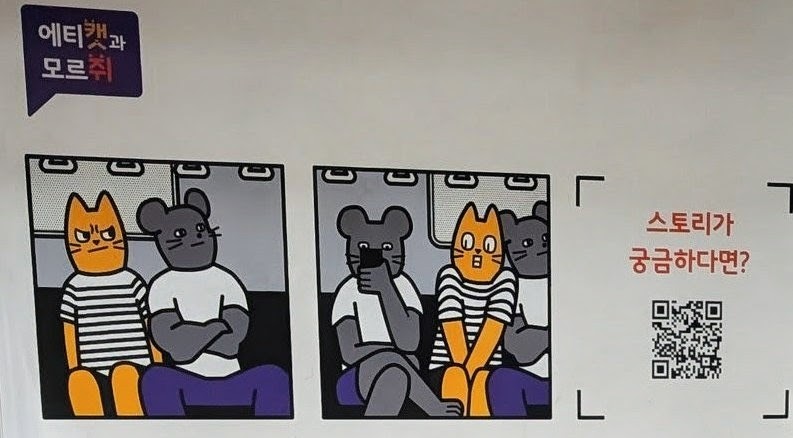
These characters are “Etiquette Cat” and ” Meok-Choo” (a mouse). The former represents a well-mannered person who follows all the rules. As to the latter, his name is a pun on the Korean phrase “I don’t know.” This character often violates various subway protocols, like blocking doors or talking loudly on the phone. The QR codes next to the cat and mouse lead to digital comics on proper behavior.
So, go and explore the Seoul subway being a real “Etiquette Cat!”
Forget About Your Diet: A “Death Row Meal” in Every Corner of the City
Alongside fashion and cosmetics—neither of which is my ‘cup of tea’—the other true religion of Seoul is food, where nearly every meal is so good that it deserves to be your last one. However, before delving into “what and where to eat,” I will make two disclosures.
First, in today’s Korea, meat is a fundamental part of the food scene. In 2024, for the first time, meat consumption surpassed rice consumption —marking an end to the country’s traditional “rice-first” model. However, I do not eat meat and, regrettably, won’t be able to offer you insights into any carnivore delicacies like traditional Korean barbeque.
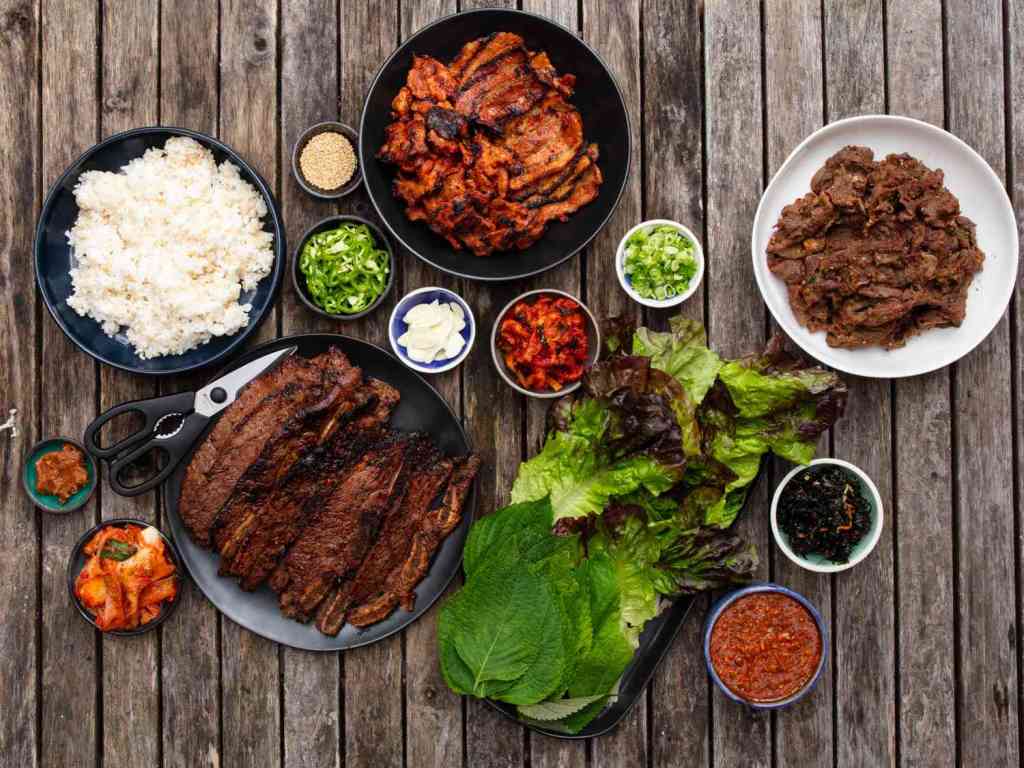
Second, bear in mind that I was in Seoul for only two full days – a ridiculously short time for gastronomic adventures in a city which is crazy about food.
Thinking about Korean food, the first thing likely coming to mind is “kimchi” – fermented vegetables seasoned with a pungent blend of chili powder, garlic, ginger, and other spices. This cultural icon serves as the probiotic-rich digestive backbone of almost every meal.
In Seoul, you will quickly make two discoveries about this everyday staple. First, typically in restaurants serving Korean food, kimchi is offered for free as an unlimited side dish.
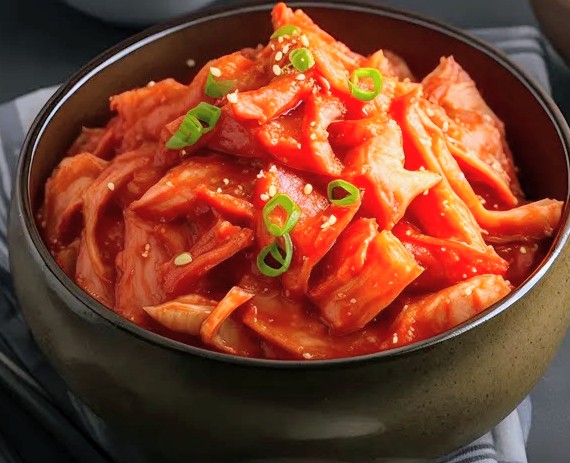
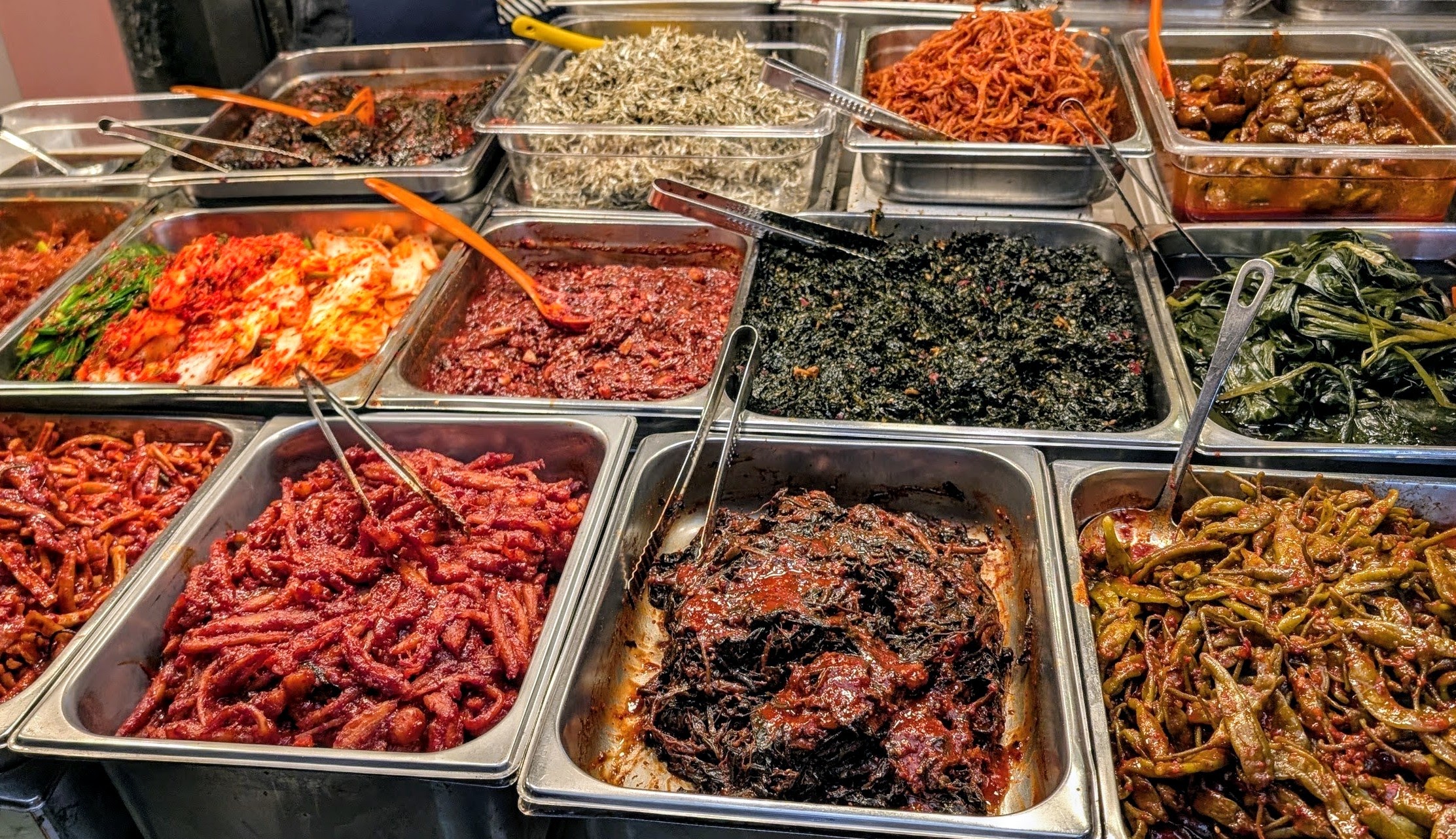
Second, the most common kimchi is made of napa cabbage or radishes, but there are also many more versions of this dish. Some include only vegetables, some have added fermented seafood, and some consist mostly of fermented seafood or fish.
The best way to explore this variety is to visit one of Seoul’s markets and find a kimchi vendor. Not only will you be able to look at all options at once, but typically the seller will offer free samples of all the products.
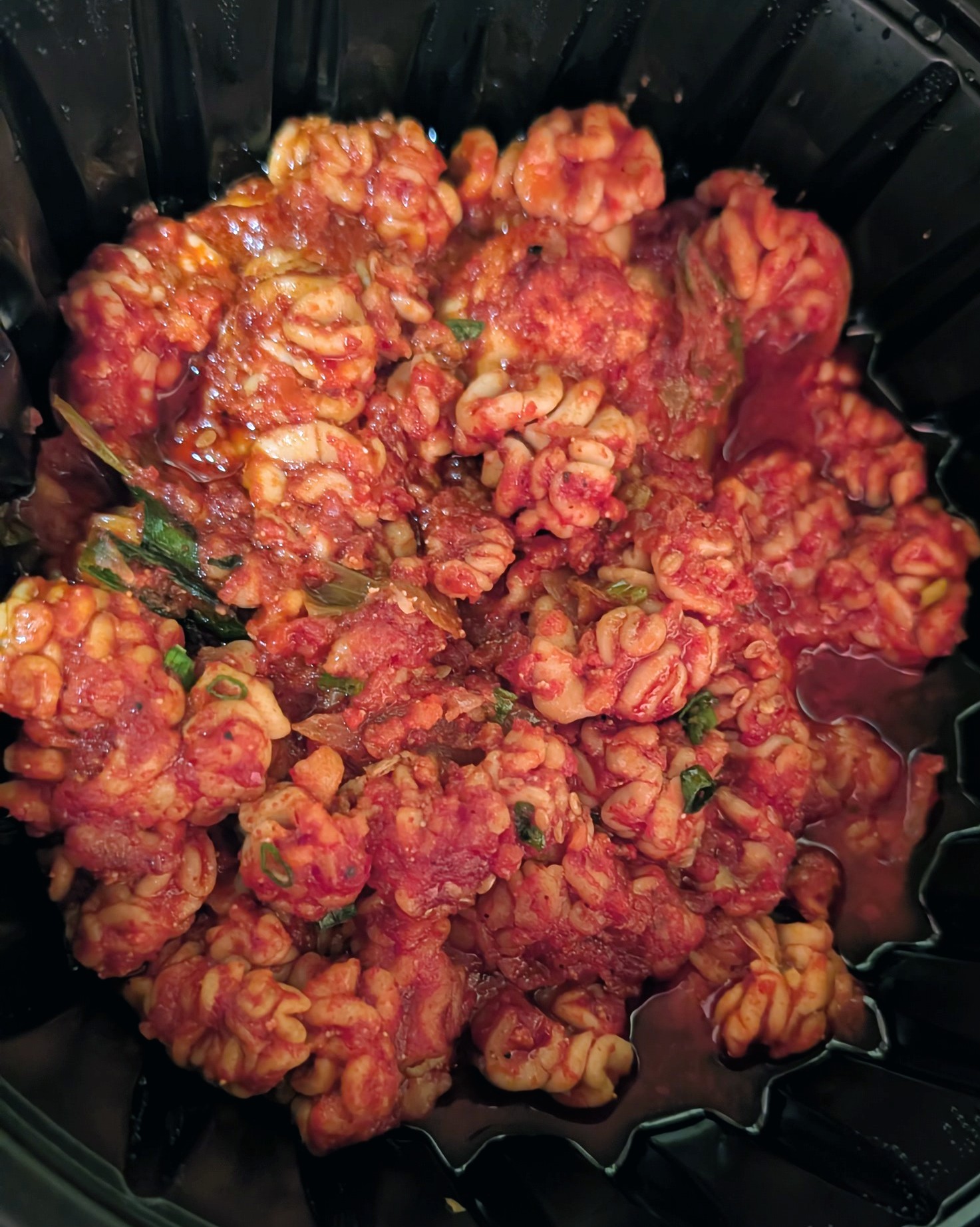
Less known to the outside world, but frequently eaten in Korea are fish eggs (i.e., fish roe), with pollock being most common source. From the nutritional perspective, they are a real “superfood:” low in calories, and high in protein and valuable microelements.
I am personally a big lover of fish eggs and, being in Seoul, enjoyed two versions of this delicacy. One is entire pouches which are slightly salted and cured. They can be eaten as they are or with rice. Often, you can buy them from the same people who sell kimchi.

The second option to enjoy pollock roe is pan-fried version. Mixed with aromatic herbs and pungent seasonings, it makes for a flavorful but not heavy meal.
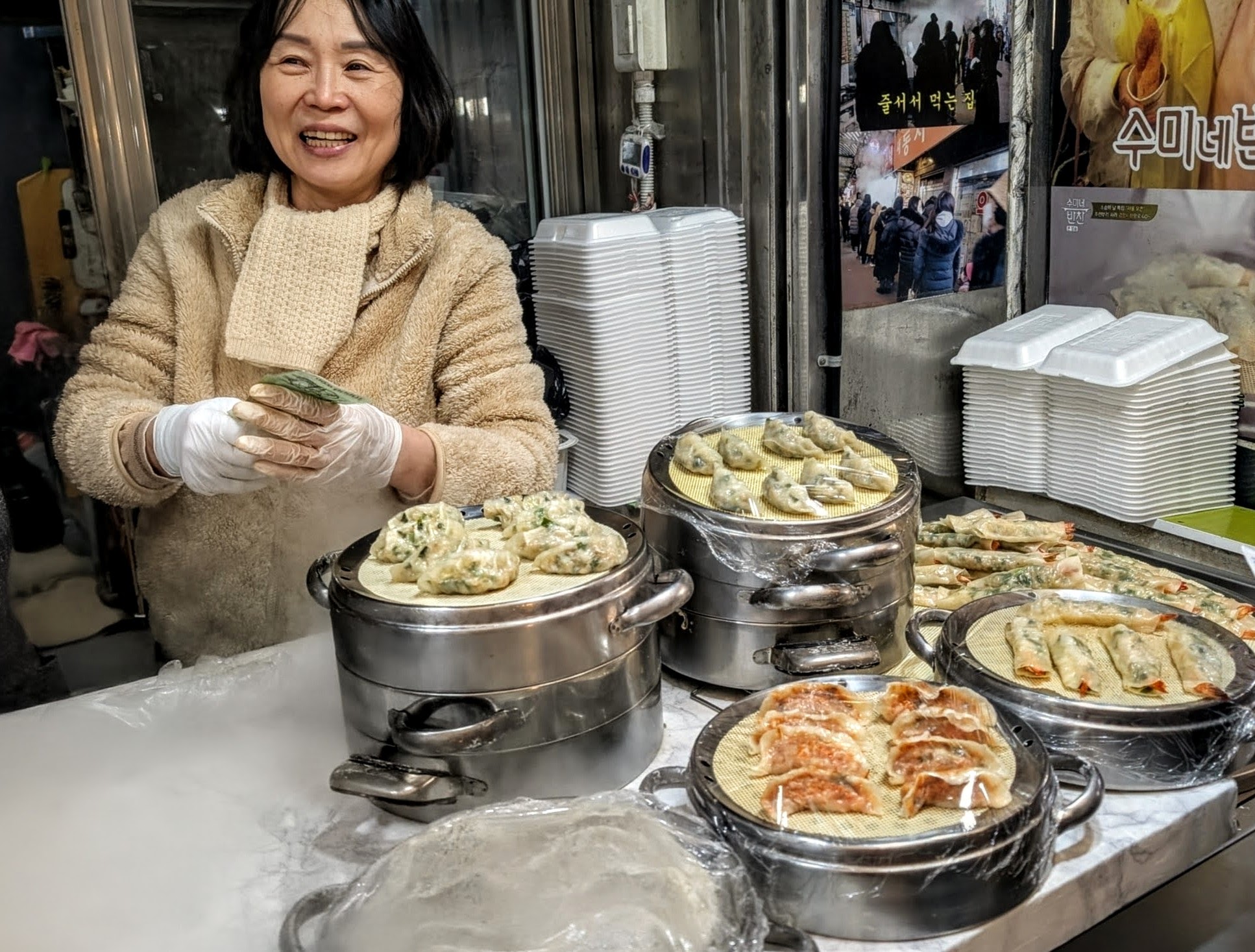
For people who feel that either spicy kimchi or things like fish eggs are “too adventurous,” I suggest check-out various Korean dumplings (mandu) offered both in restaurants and from food-stalls at traditional markets.
They are typically filled with ground pork, “pork-kimchi” mixture, vegetables, or shrimp.
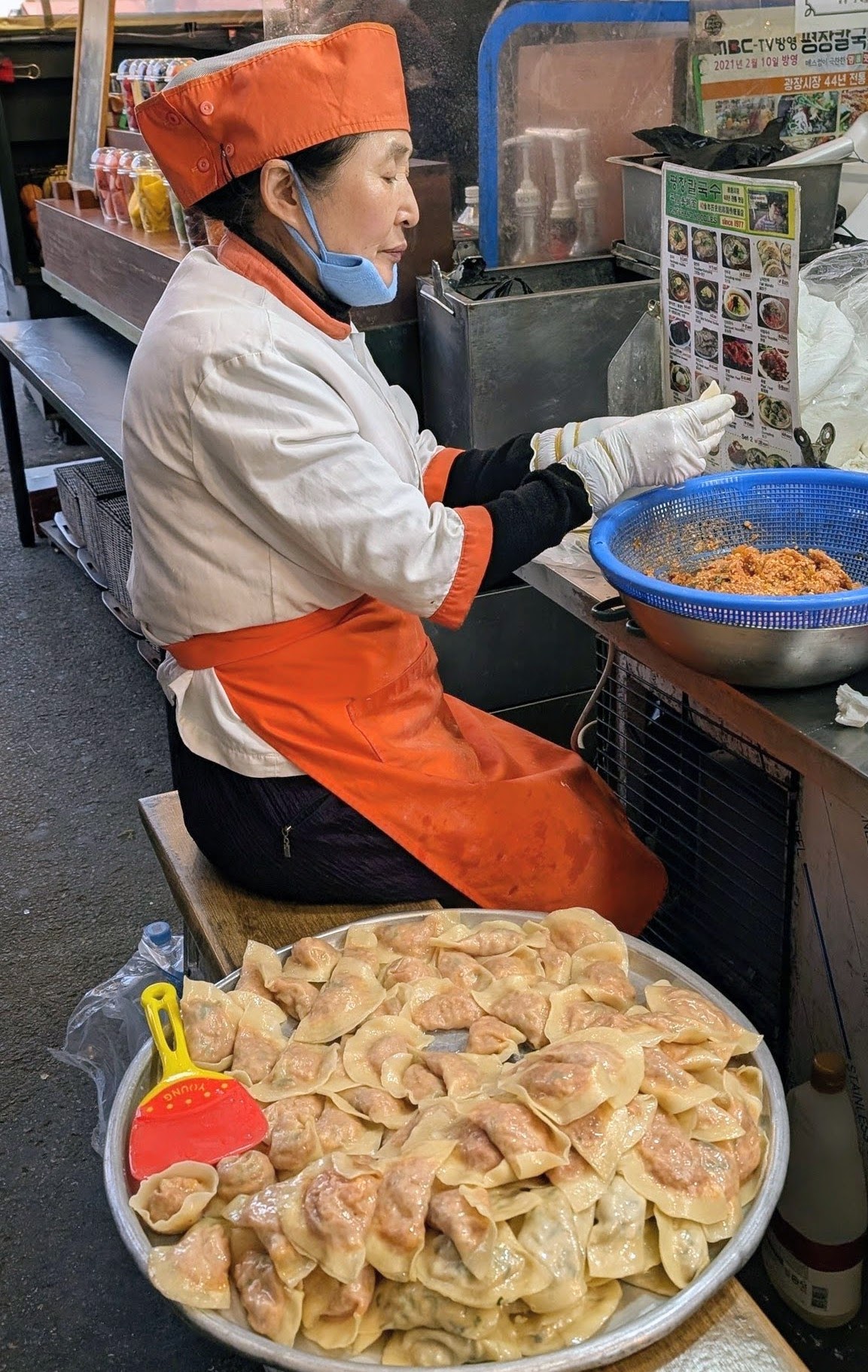
Depending on your preferences, freshly made dumplings are either steamed or pan-fried. They are usually served plain, and it is up to you to add some kimchi, sauce, or any other condiment.
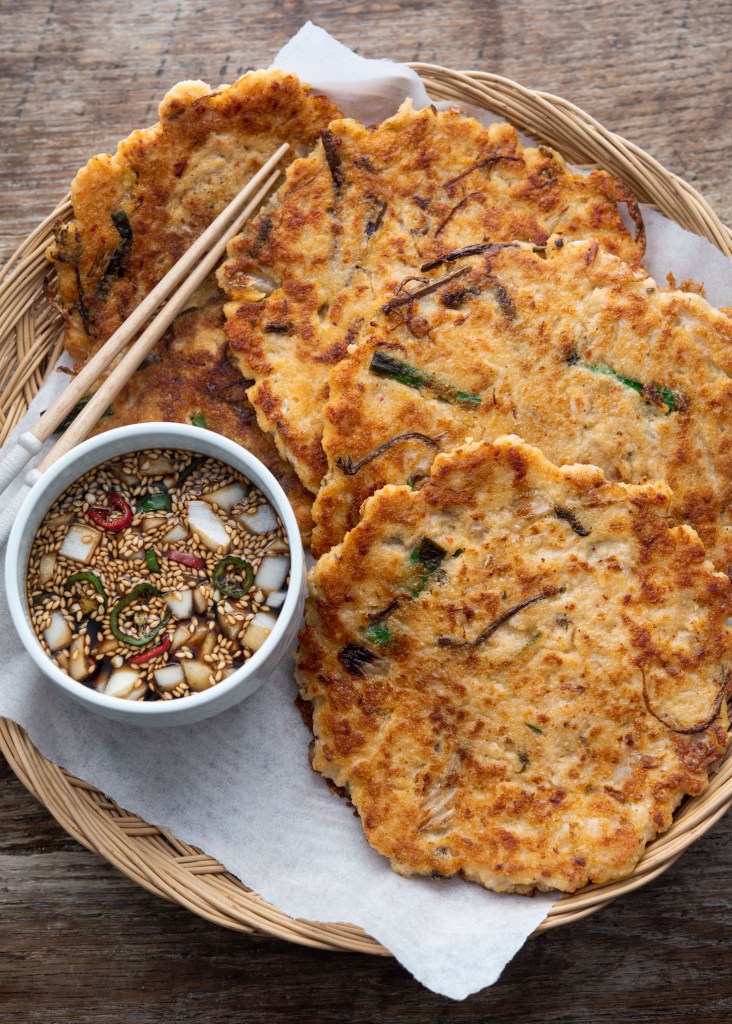
On many menus, you will see “jeon” as a part of the dish’s name. “Jeon” is essentially a thick pancake, but depending on ingredients and the way of preparation, there are different “jeons.” Most traditional for Seoul is the mung-bean pancake Nokdujeon, also called “Bindaetteok.” For its batter, dried mung beans are soaked and ground into a thick paste using traditional stone mills.
Other ingredients include bean sprouts, kimchi, and sometimes ground pork or scallions. Bindaetteoks are deep-fried in oil, resulting in a disc that is crispy and golden outside but soft and slightly nutty inside. The best condiment to put on the side is onion-soy dipping sauce (yangnyeom-jang).
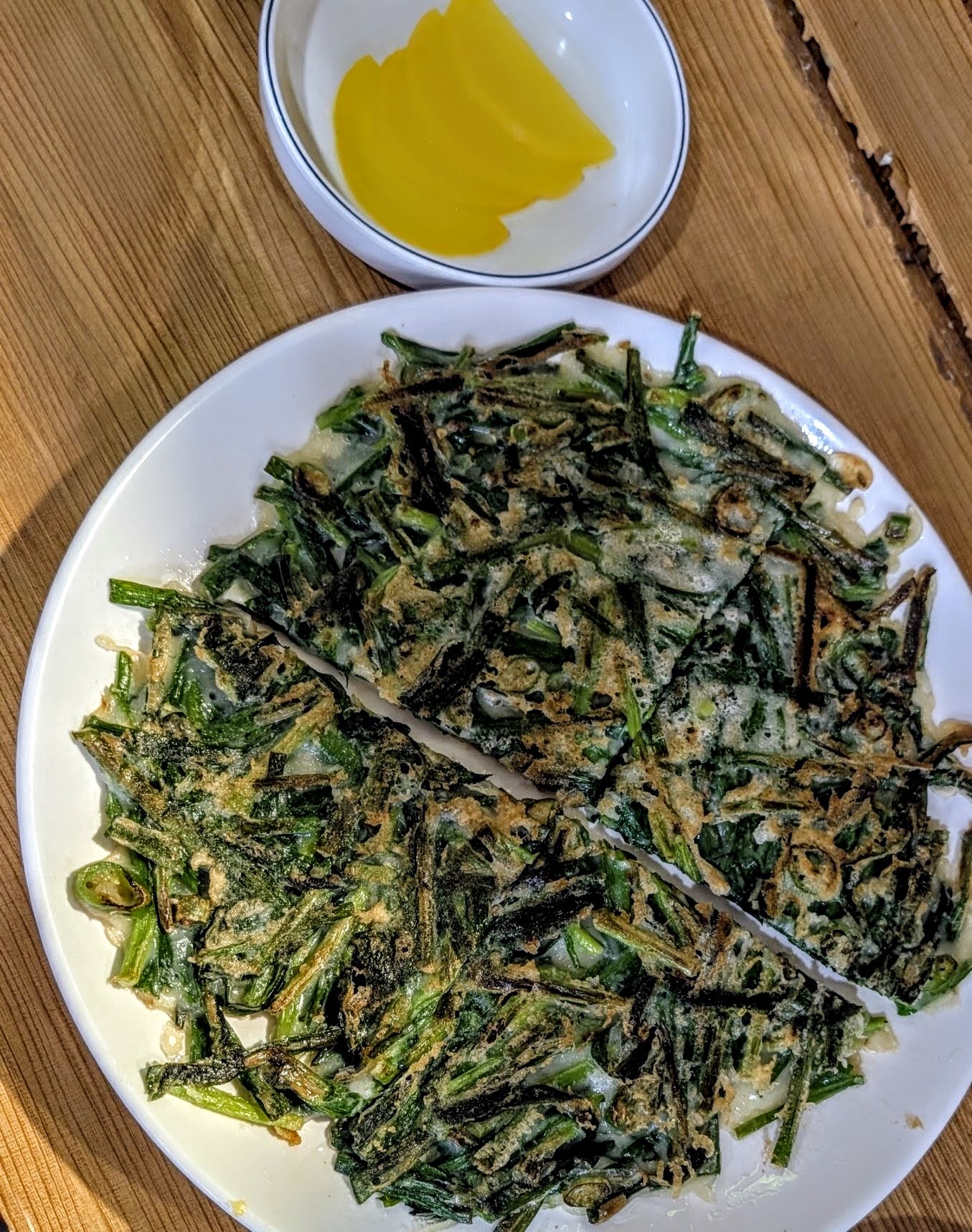
Its fame aside, I found Bindaetteok a bit too heavy. My favorite in the world of “jeons” was Buchujeon – the pancake made primarily with garlic chives (buchu), which are mixed into a light, seasoned flour batter and pan-fried until golden. Because of the high ratio of vibrant greens to batter, they are light, thin, and crispy.
Buchujeon is tasty on its own, but a tangy soy-vinegar dipping sauce will bring all the flavors to a full perfection.
The other “jeon” options in Seoul are Kimchijeon (made, as you would guess, with plenty of kimchi), Gamjajeon (potato pancake), and Memiljeon (buckwheat pancake which is pan-fried with whole stalks of napa cabbage or green onions).
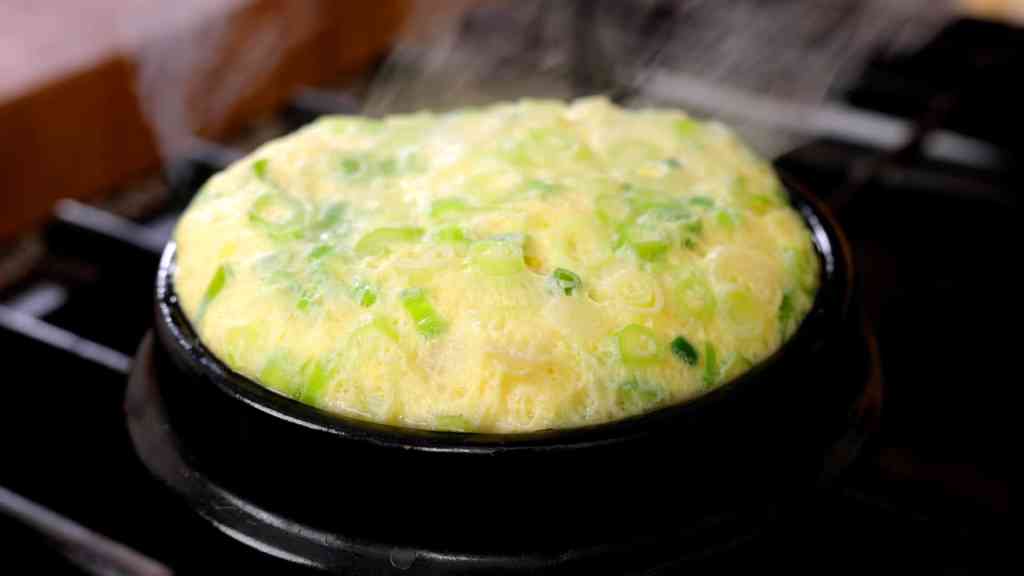
When roaming Seoul’s markets (we will talk later about them), I also came across three dishes which I had never heard about but liked right away. One was “Gyeranjjim” which is made of steamed eggs and has a surprisingly light, souffle-like texture. It was seasoned with salted fish sauce and served bubbling hot in a ceramic pot, expanding over its edges like an airy dome.
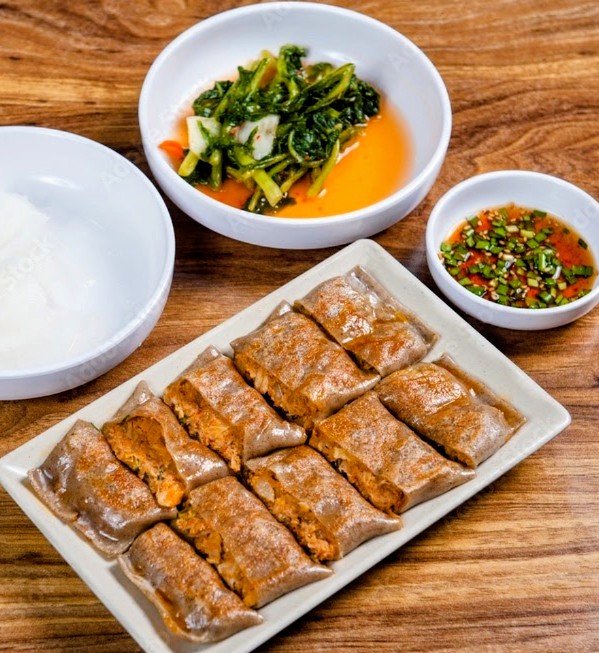
The other “food-discovery” was “Memil-jeonbyeong” which can be described as Korean answer to Mexican burrito. It is a rolled buckwheat crepe stuffed with a mixture of chopped kimchi, radish, glass noodles, sometimes also seasoned pork or squid, and then quickly pan-fried.
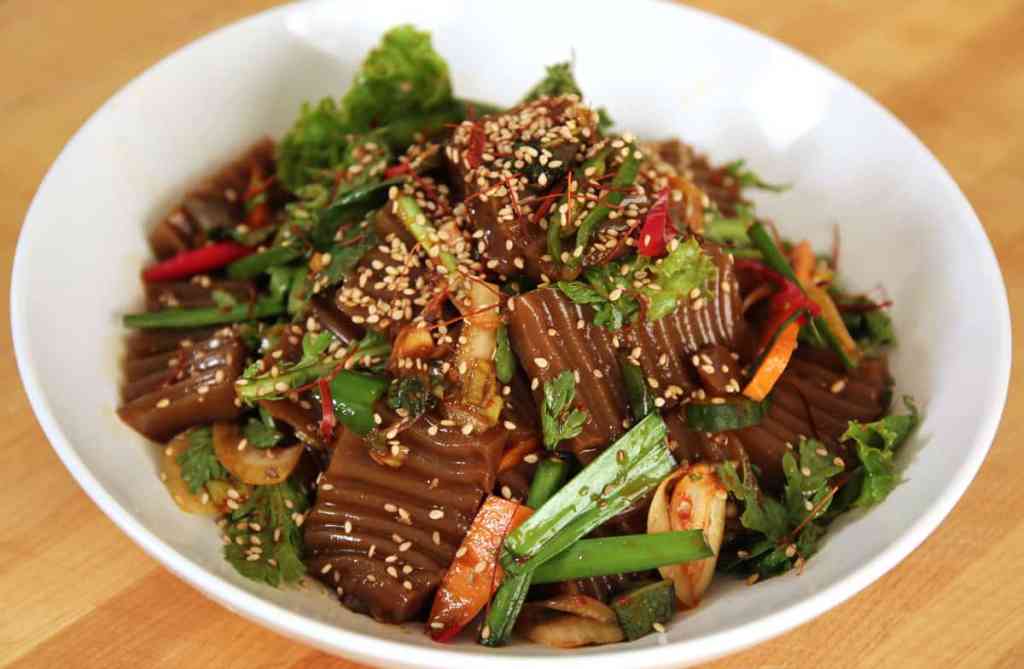
Finally, I enjoyed “Dotorimuk” – a firm jelly made from acorn starch which has a smooth texture and a slightly bitter aftertaste. Dotorimuk is not eaten on its own, but used as a key-ingredient for other dishes. In my case, it was Dotorimuk-muchim, a refreshing salad.
To make it, dotorimuk was sliced into bite-sized pieces and tossed with a mix of cucumbers, carrots, and some greens I did not recognize. This blend was then mixed with soy sauce, chili flakes, minced garlic, sugar, and toasted sesame oil.
One thing about food in Seoul which truly surprised me was the proliferation of elaborate bakeries. They are everywhere, offering fine pastries and cakes in polished sit-down environments. As I learned later, bread in Korea has undergone a fascinating evolution from an exotic food to a daily staple, and then to even becoming an indicator of social status.
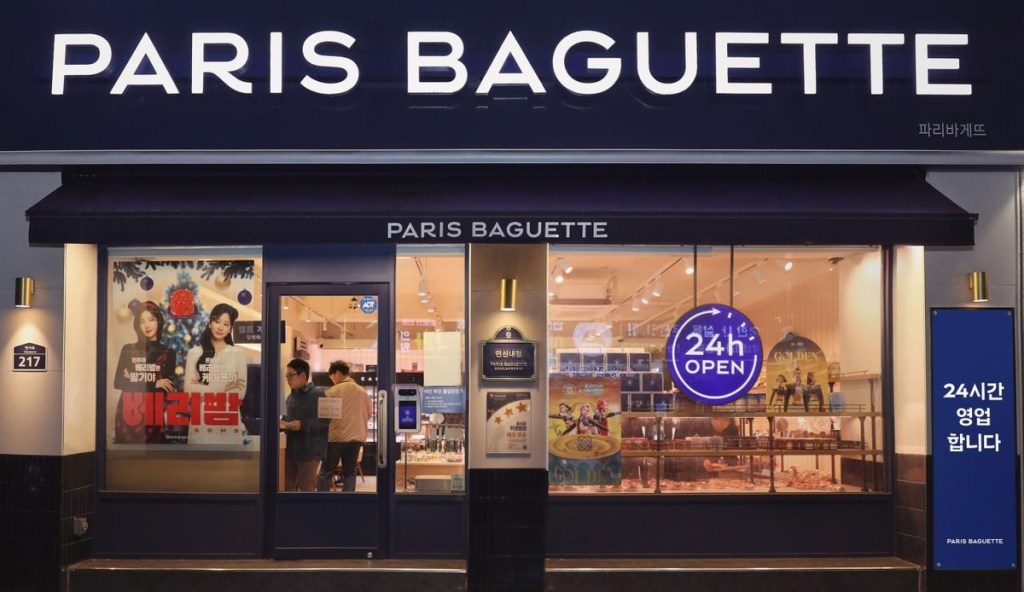
In the 1960s, as food aid, the U.S. provided massive amounts of wheat flour to the newly born Korean state. Facing a rice shortage but having a huge surplus of wheat, the government launched a “Flour Consumption Promotion” telling the population how valuable and good bread was.
In the last decade, bread suddenly shifted from “just food” to “lifestyle luxury,” when social media fueled the so-called Ppang-ji-sun-rye: Bread Pilgrimage. Based on pictures posted on Instagram and other platforms, Koreans began to travel across the country to visit particular boutique bakeries.
These are architecturally stunning cafes that focus on artistic, picture-perfect cakes and pastries. Here is a fun video about the history and Seoul’s modern bakery scene.
After learning about this new obsession with artisan breads, I decided to visit “Cheongsudang,” one of the trendiest and “most instagrammable” bakeries in Seoul. It opens at 10.30 am, but people line up an hour before to assure that they will get a table and their “picture perfect” meal.
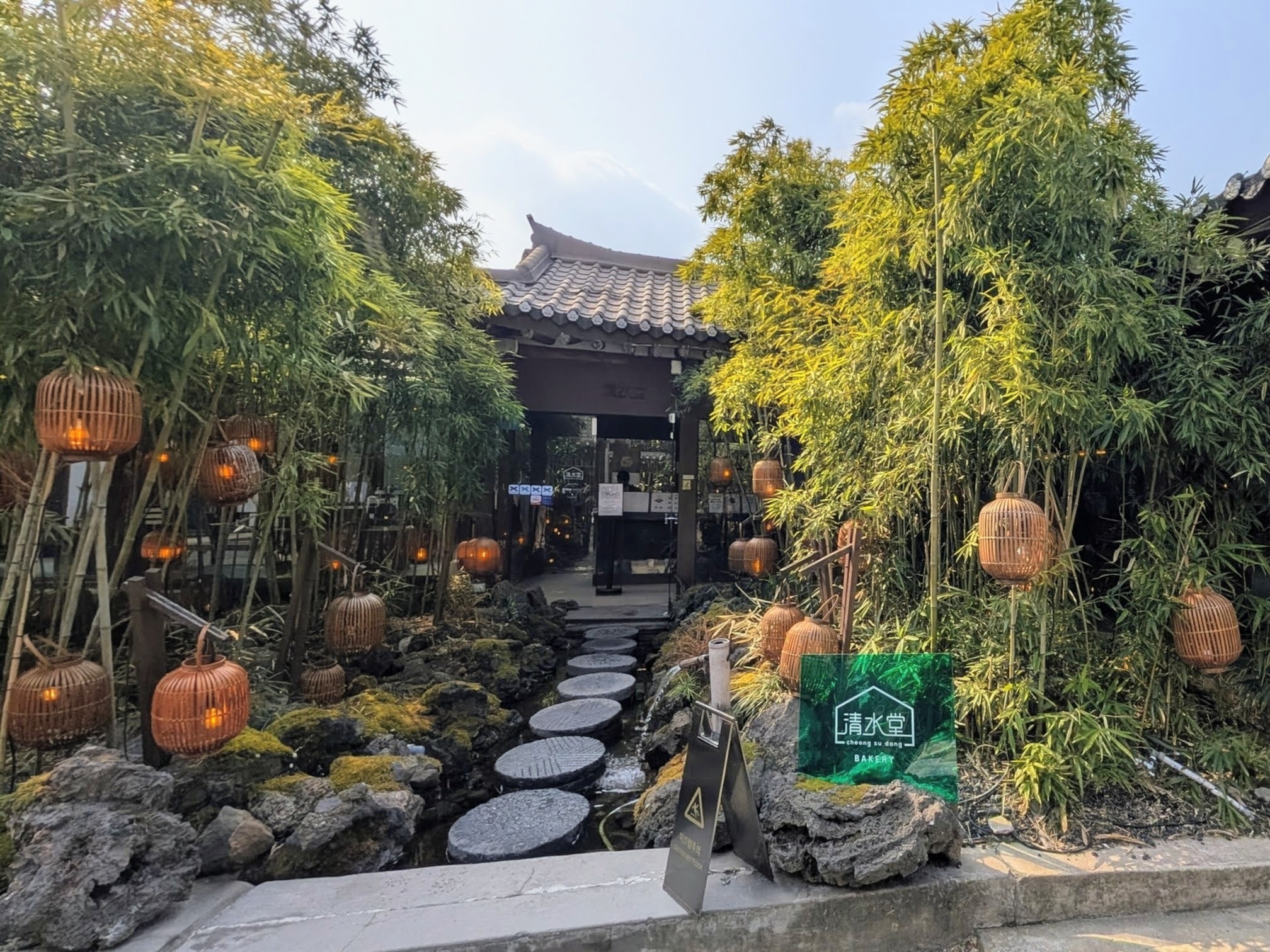
After opening, the protocol was like this: find a table and sit, look at the menu, go to the counter and place your order, and wait for electronic beeper to announce that your order is ready.
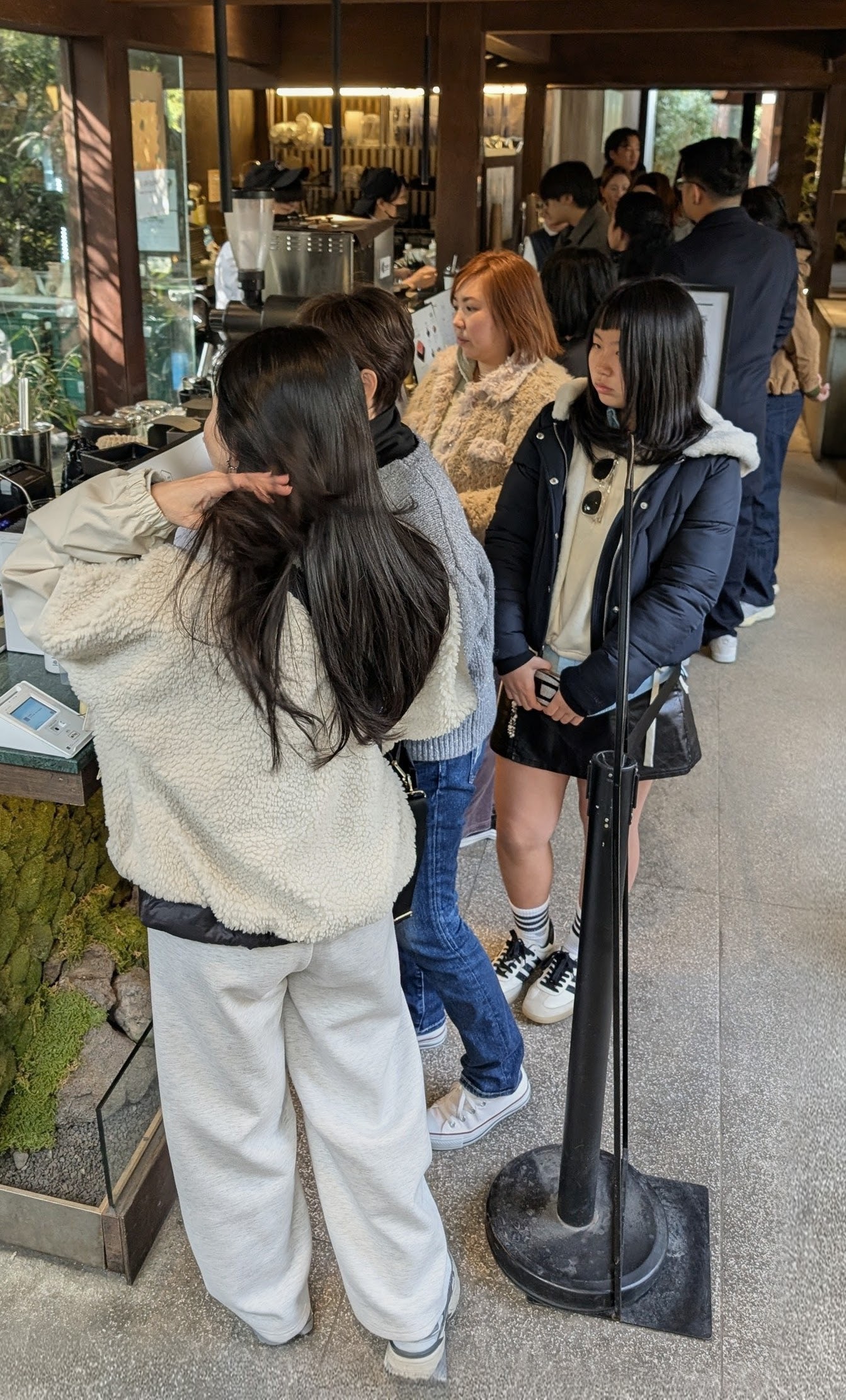
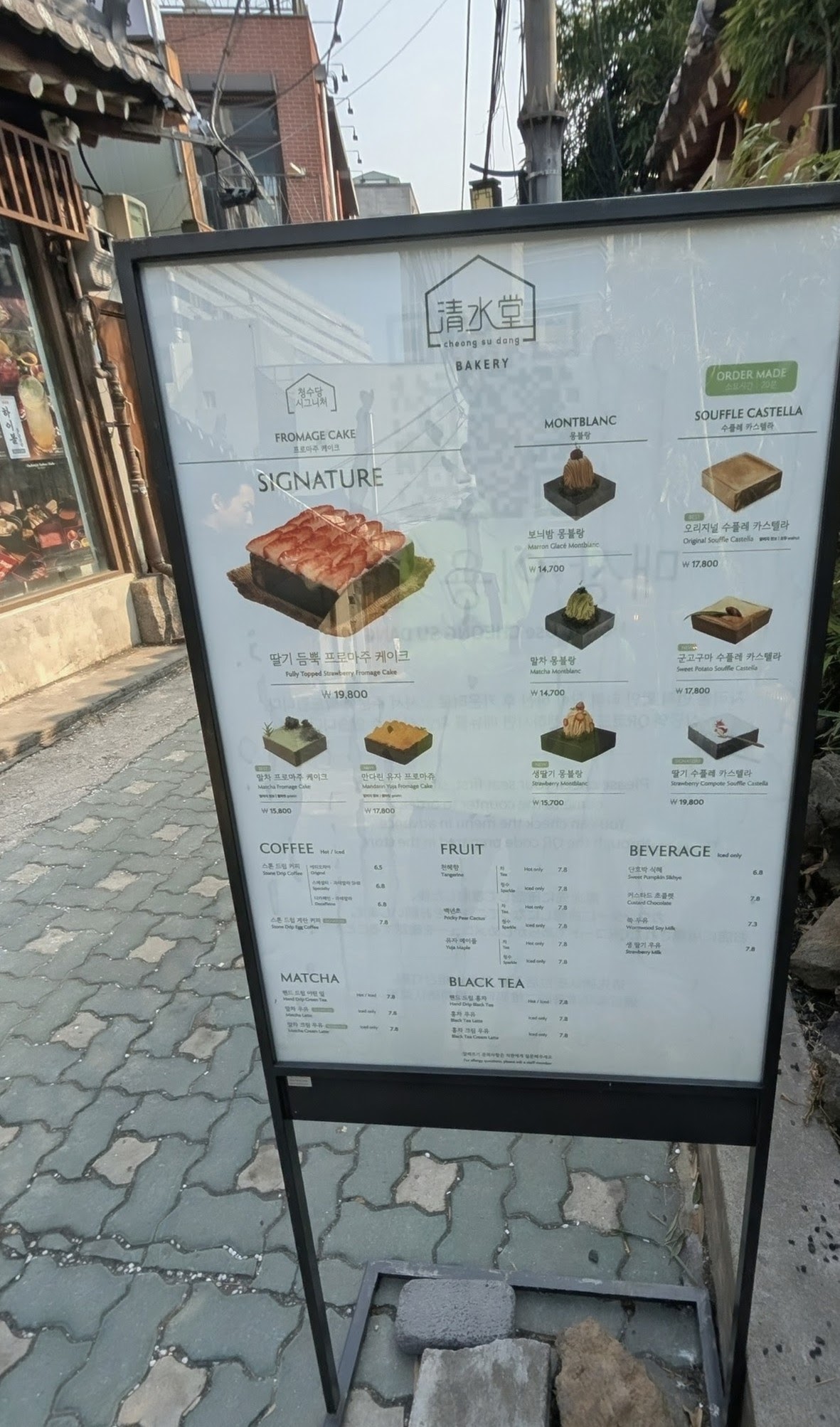
I looked at the prices, and decided that paying over $10 USD for a piece of cake in Korea – where food is generally so affordable – is somewhat extravagant even considering all the hype about this place.
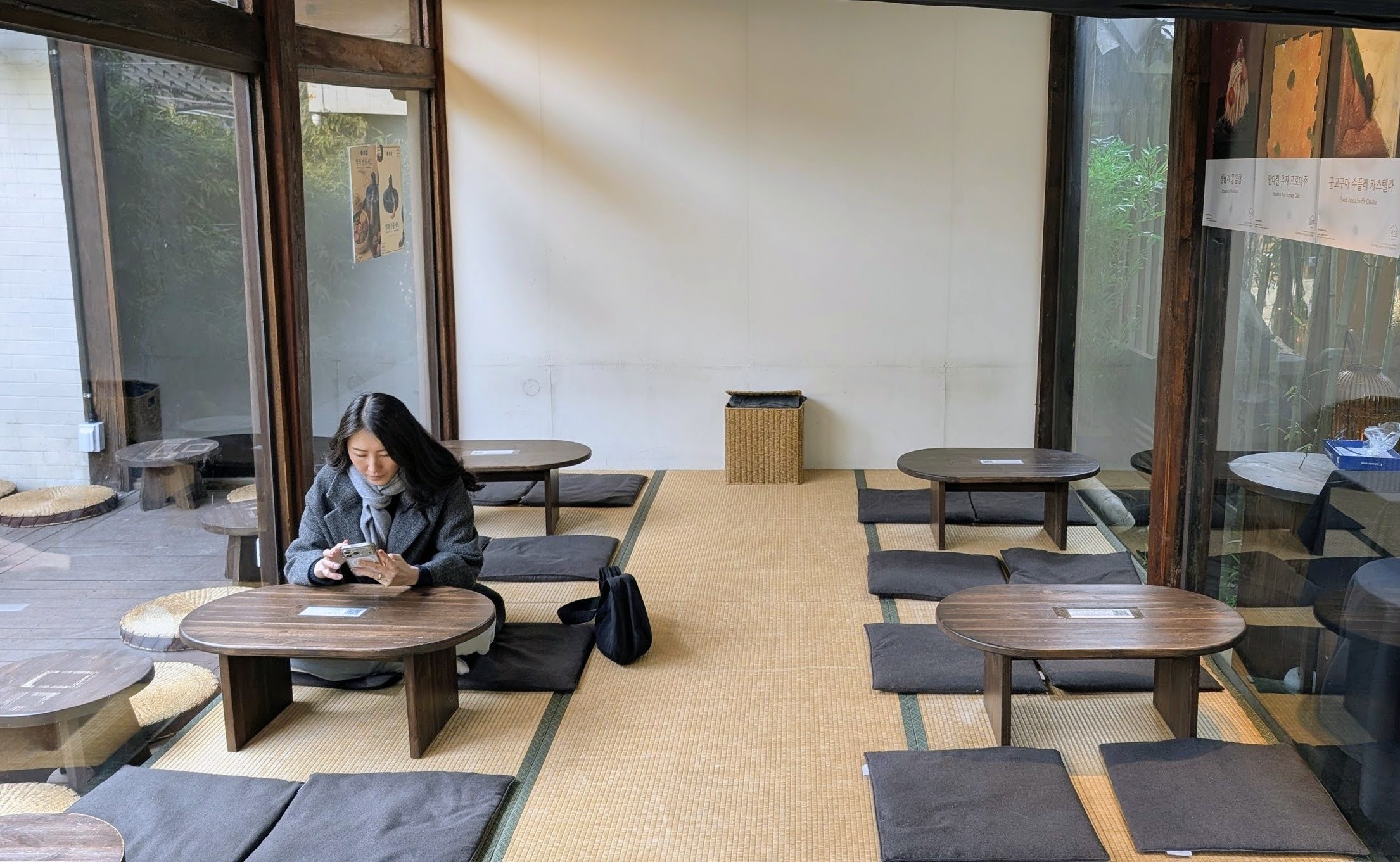
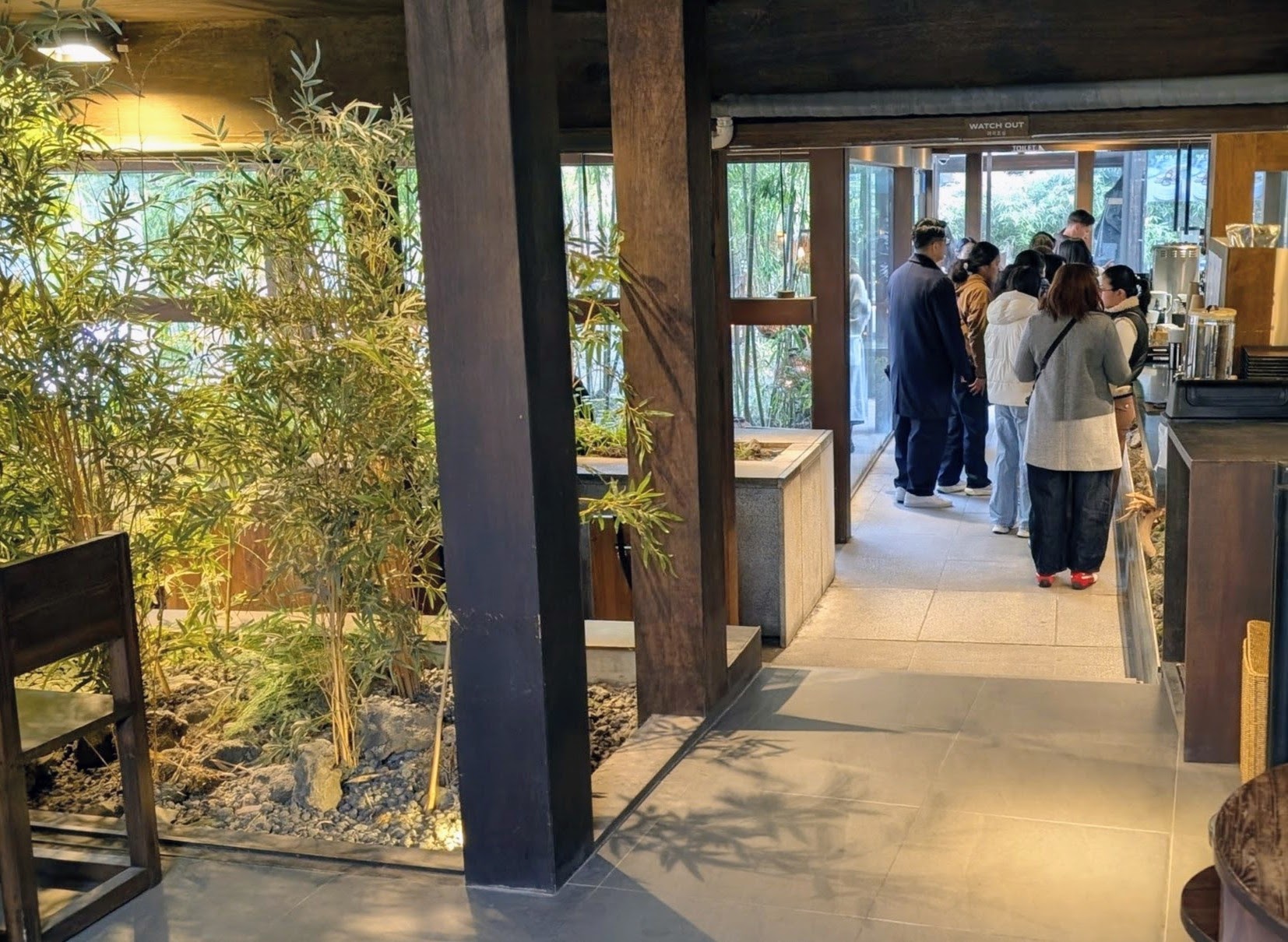
Instead, I simply walked around and took a few pictures. No doubt, the interior was cool and elegant, with several differentl-looking rooms and sitting options.
After leaving Cheongsudang, I began walking towards Bukchon Hanok village (we will talk later about this place), and literally in two minutes stumbled upon another bakery called “ETF Bakery” which stands for “Express Trade Farm.”
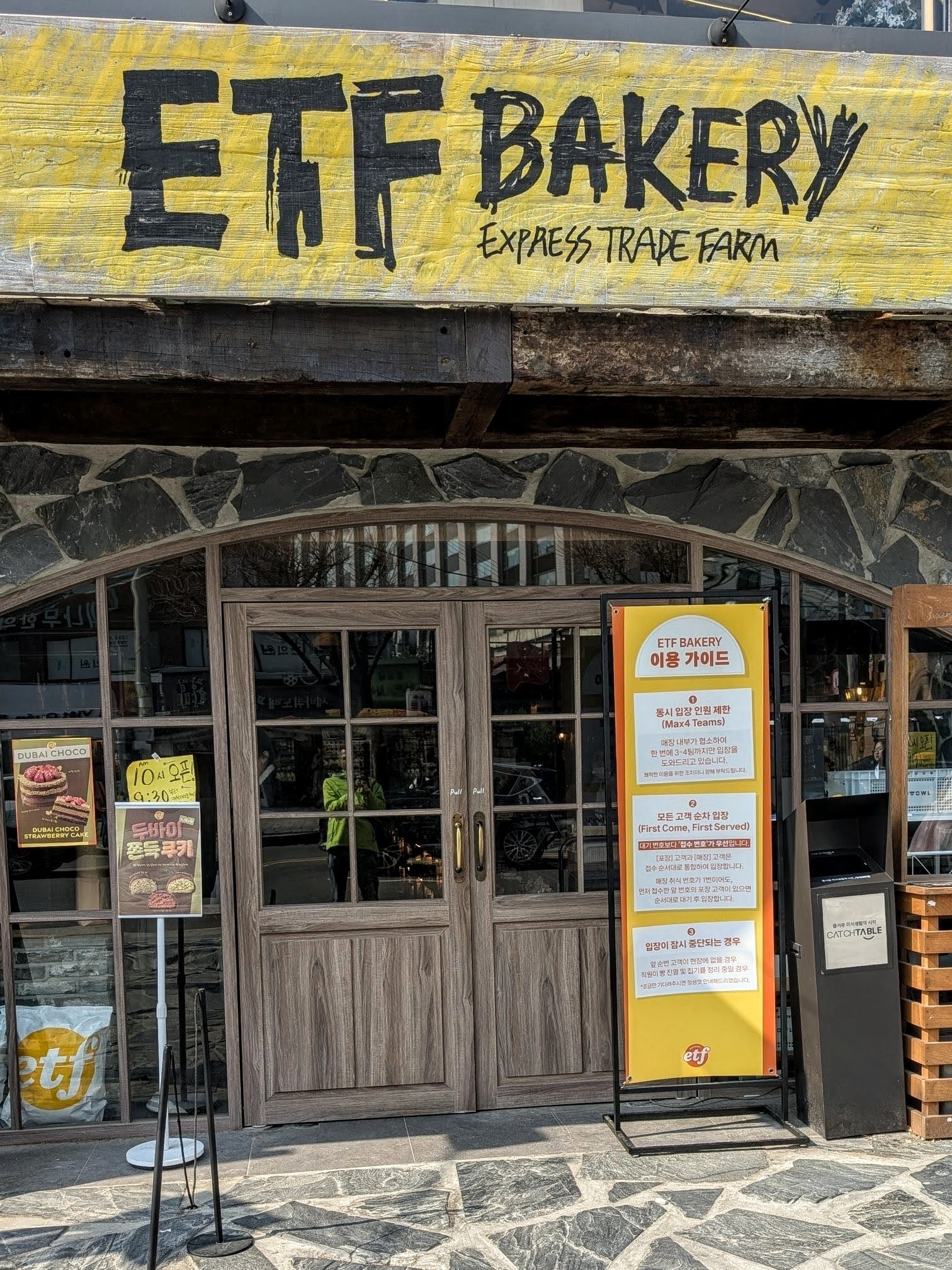
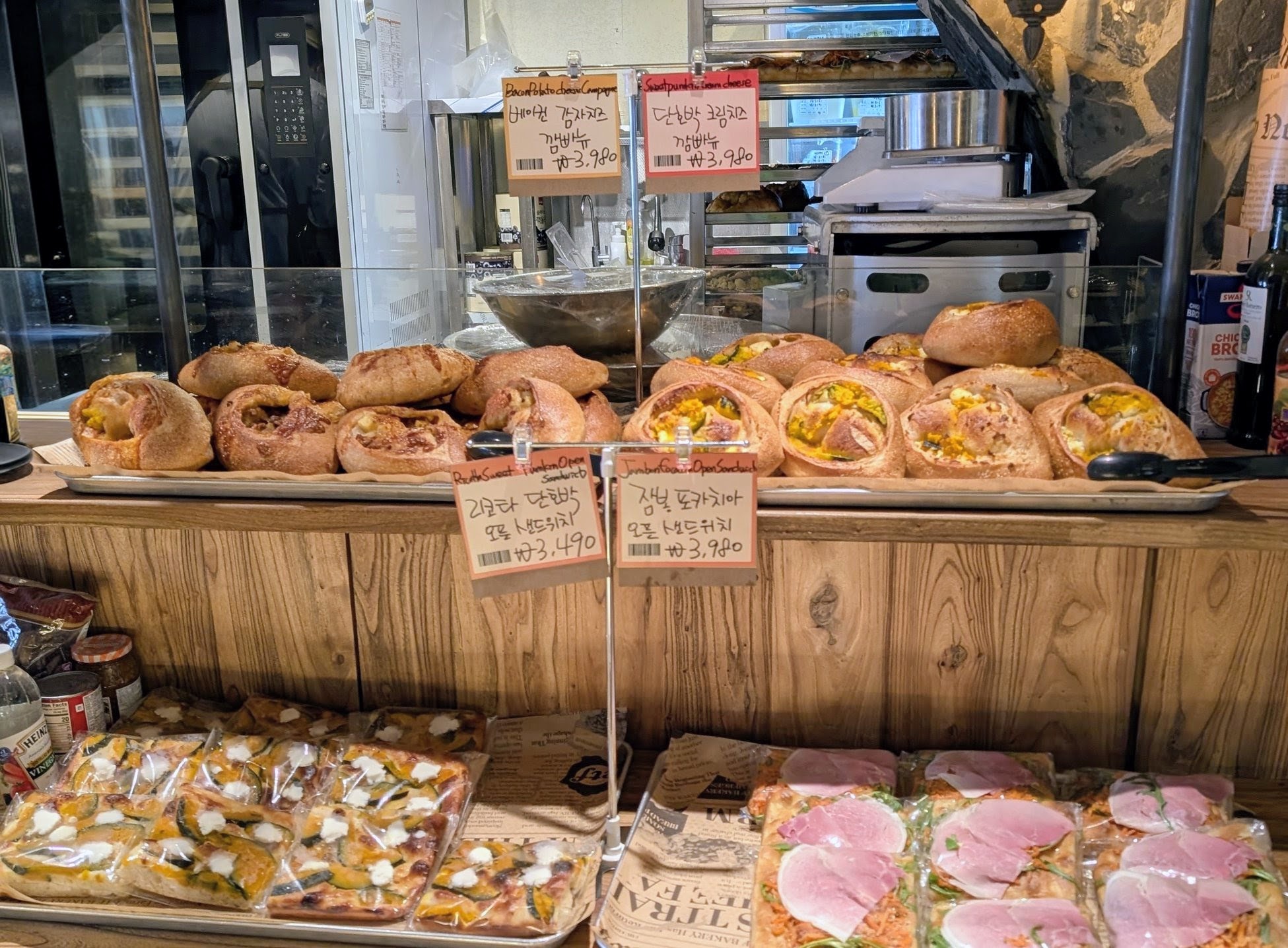
I walked inside and knew instantly that this is my kind of place: dimmed lights, cozy environment, soft music, and tantalizing aromas of freshly baked goods. The selection of pastries and breads was impressive, with prices being about 4 times lower than those at Cheongsudang.
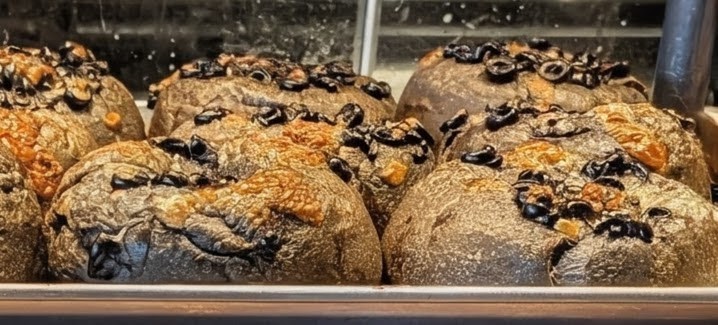
I ordered an olive-cheese bagel which was infused with squid ink, resulting in a nearly black color. A hint of honey on the top was a nice touch: the interplay of saltiness and sweetness was perfect.
While waiting for food, I made a quick research on the ETF story. The bakery was founded by a popular YouTuber Syuka World, whose channel often discusses Exchange-Traded Funds (ETF). He used this acronym for a bakery name, but referred to its operational philosophy: sourcing ingredients directly from Farms and using an Express distribution method (skipping traditional wholesalers) to Trade high-quality baked goods at lower prices.
I liked a lot using “Wall Street language” to market good breads for affordable prices. Even more, however, I liked my bagel, and, as a result, splurged for one of ETF’s signature “Cream Buns.” Out of several options, my choice was the Black Sesame Bun, which was coated in black sesame powder and filled with nutty, savory-sweet cream.
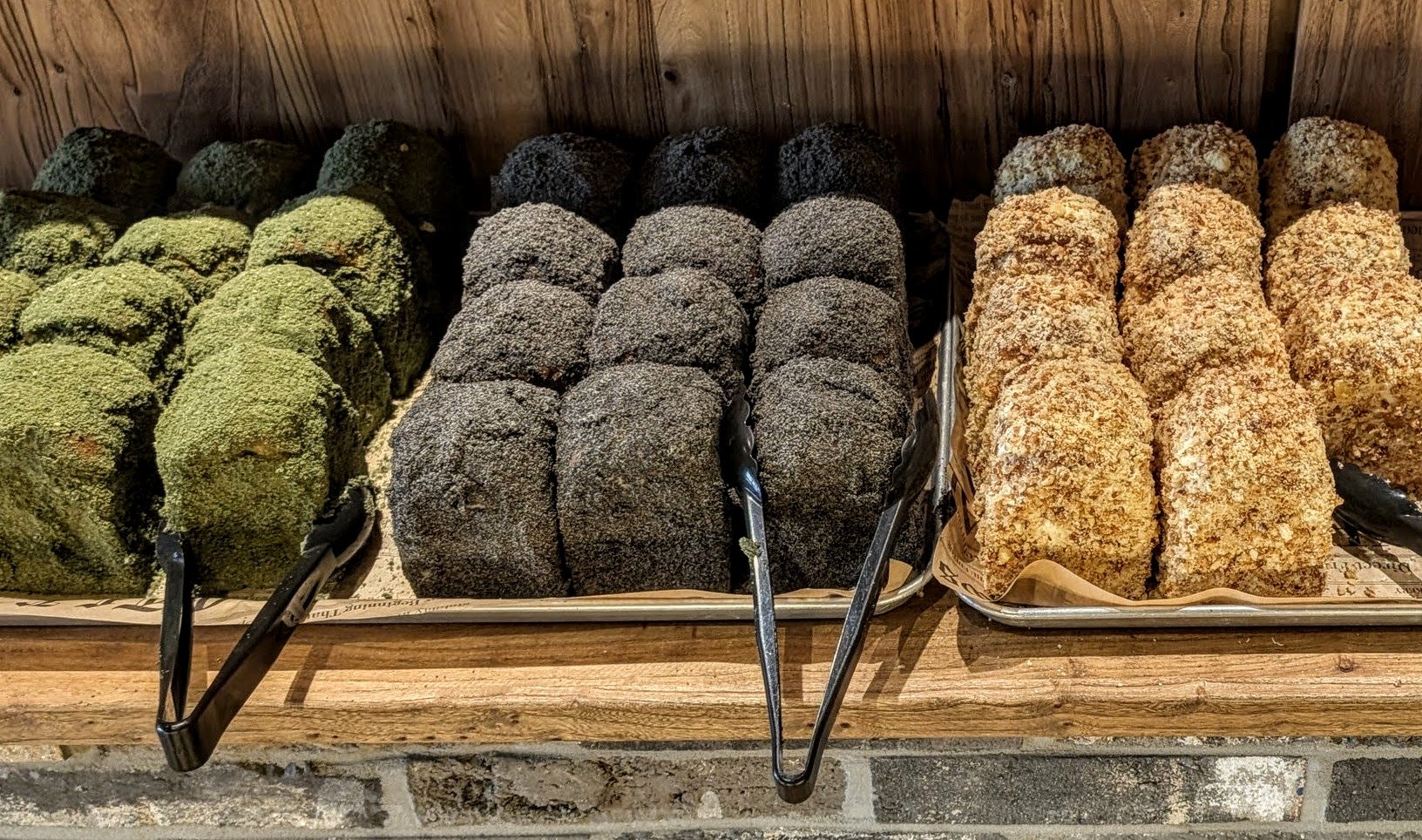
The conclusion? When visiting Seoul, definitely check out bakeries: they offer excellent pastries and breads and are now firmly incorporated into the Korean food scene. However, there is no need to waste money on “top Instagram” places. This city has plenty of other choices like ETF Bakery.
Returning to the more general question – “Where to eat in Seoul?” – the short answer is that you will get a good meal nearly everywhere: both at a snack bar in a subway station and at a high-end restaurant. As an example, here is a story about my first lunch in Seoul.
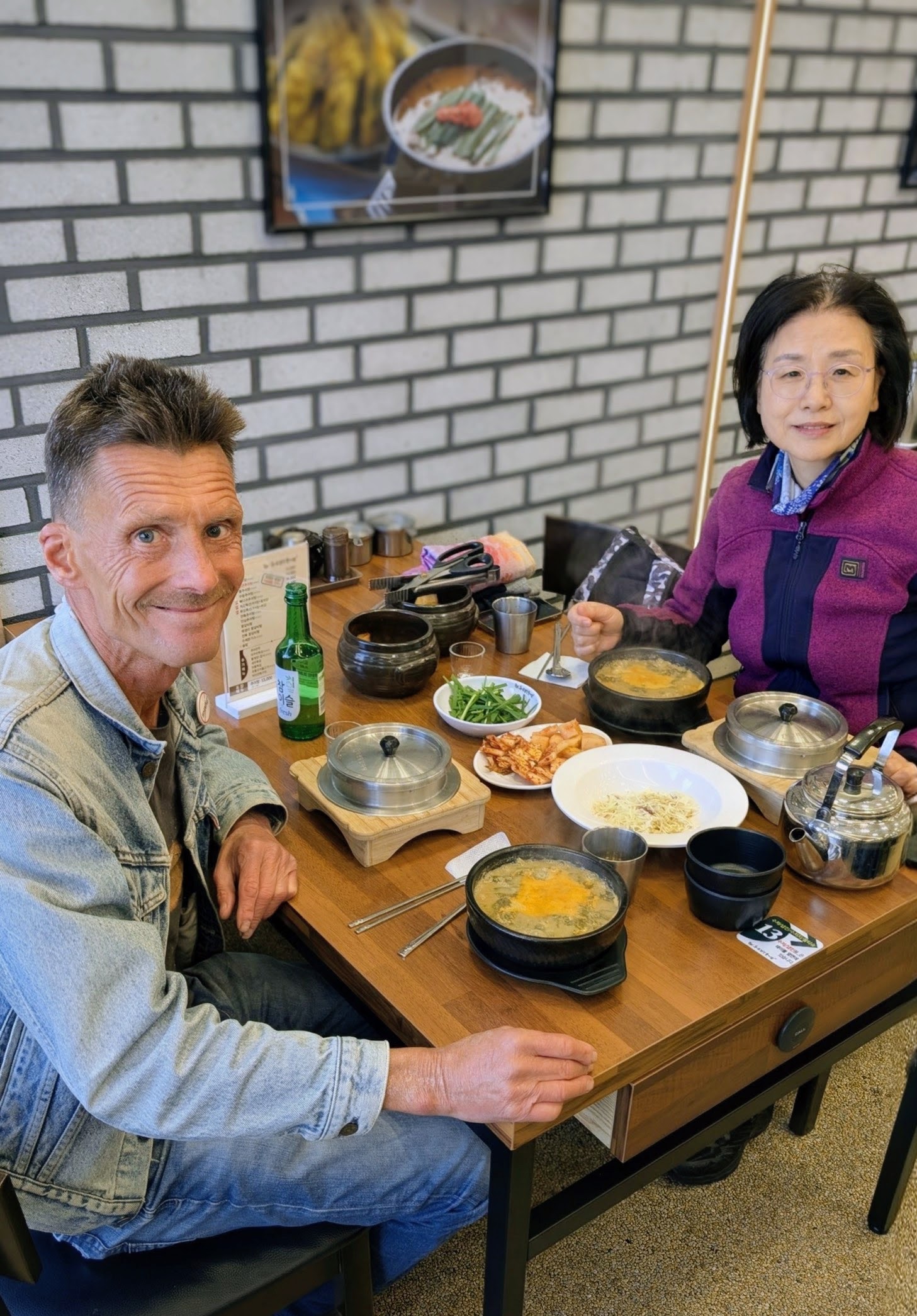
My plane landed at 8 am, and after checking into the hotel, I met with a local member of SERVAS – a worldwide hospitality organization. Eunsuk (her name) invited me to her local seafood restaurant. The menu was only in Korean, and instead of using Google Translate, I simply randomly pointed at some line on the list. In about 10 minutes, I was served a huge bowl of a perfect oyster stew.
One area of Seoul, however, has a particularly high concentration of restaurants and attracts all kinds of food lovers: both Koreans and foreigners. Called “Ikseon-dong Hanok Village,” it features many small traditional-looking houses which look especially appealing when brightly lit at night.
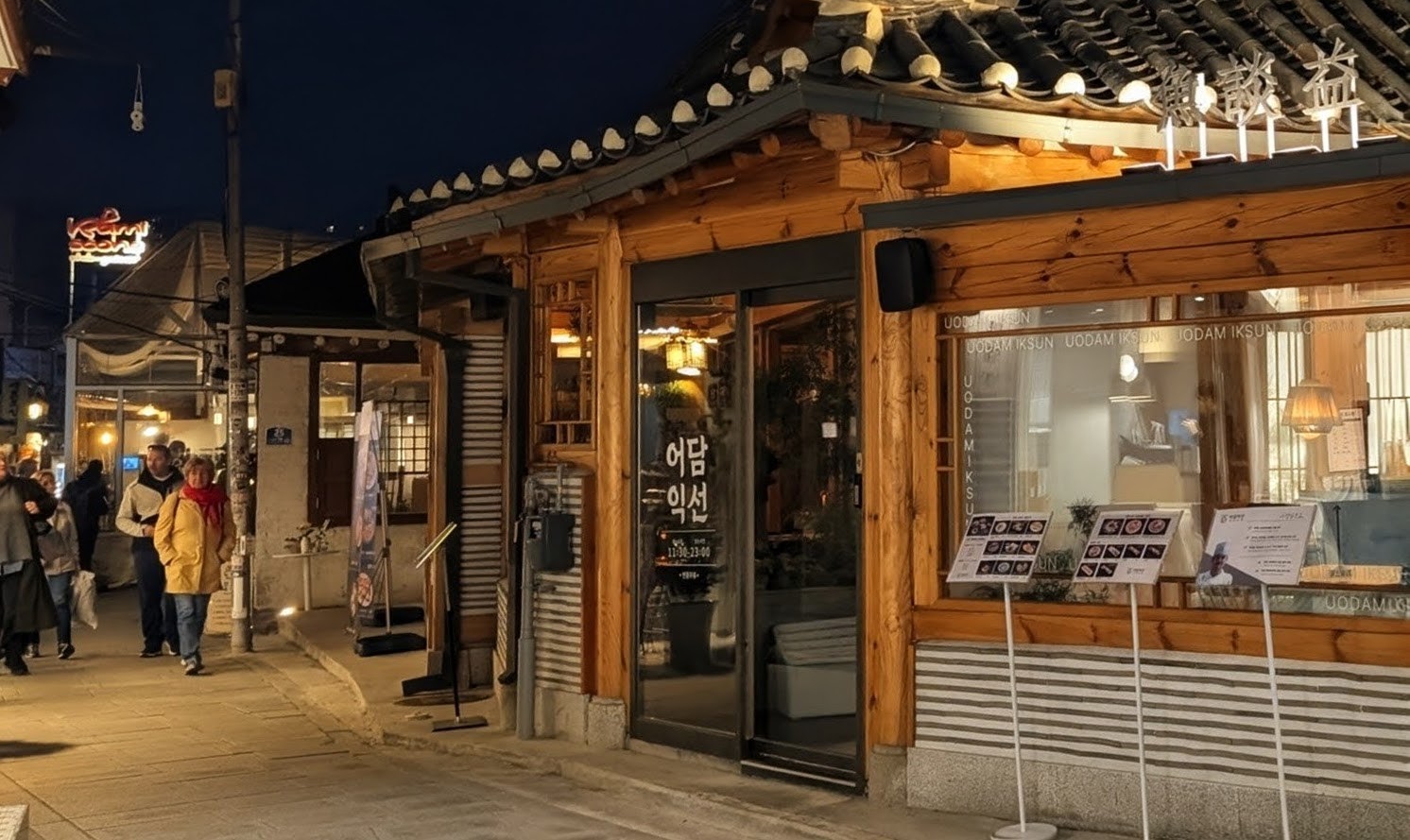
In order to decide where to eat, you can simply walk along the streets and look at what each place has to offer. Typically, it is very clear from the big posters or electronic screens placed in the windows or on the roofs of the restaurants.
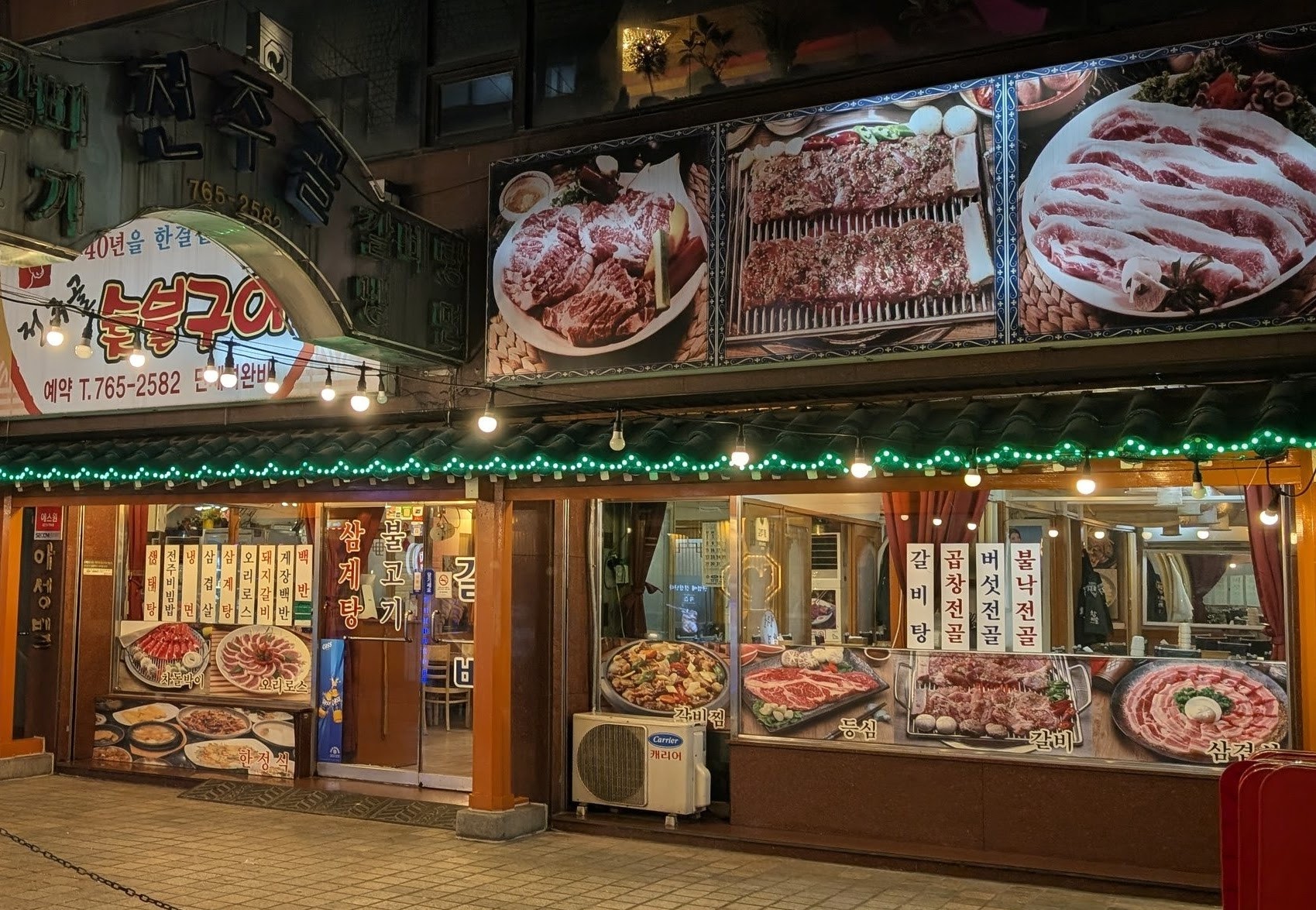
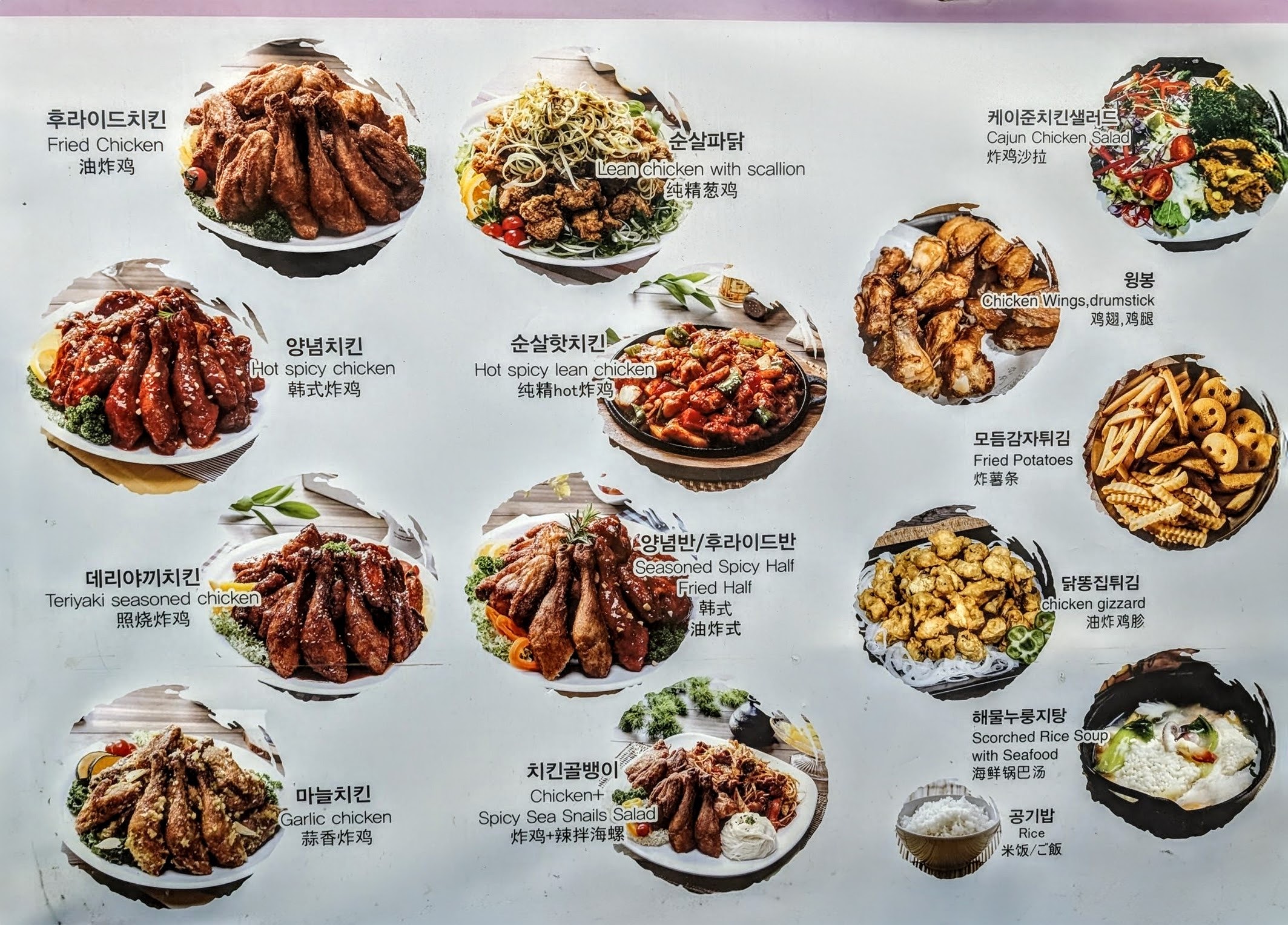
Further, most menus in Ikseon-dong also offer pictures of all the dishes they serve. In short, making the choice of “what and where to eat” is both easy and fun.
I personally had two dinners at the seafood restaurant called “Jagalchi Makhoe House.” Despite its very humble appearance, it was full of customers (always a good sign), and the dishes on their tables looked both interesting and appetizing.
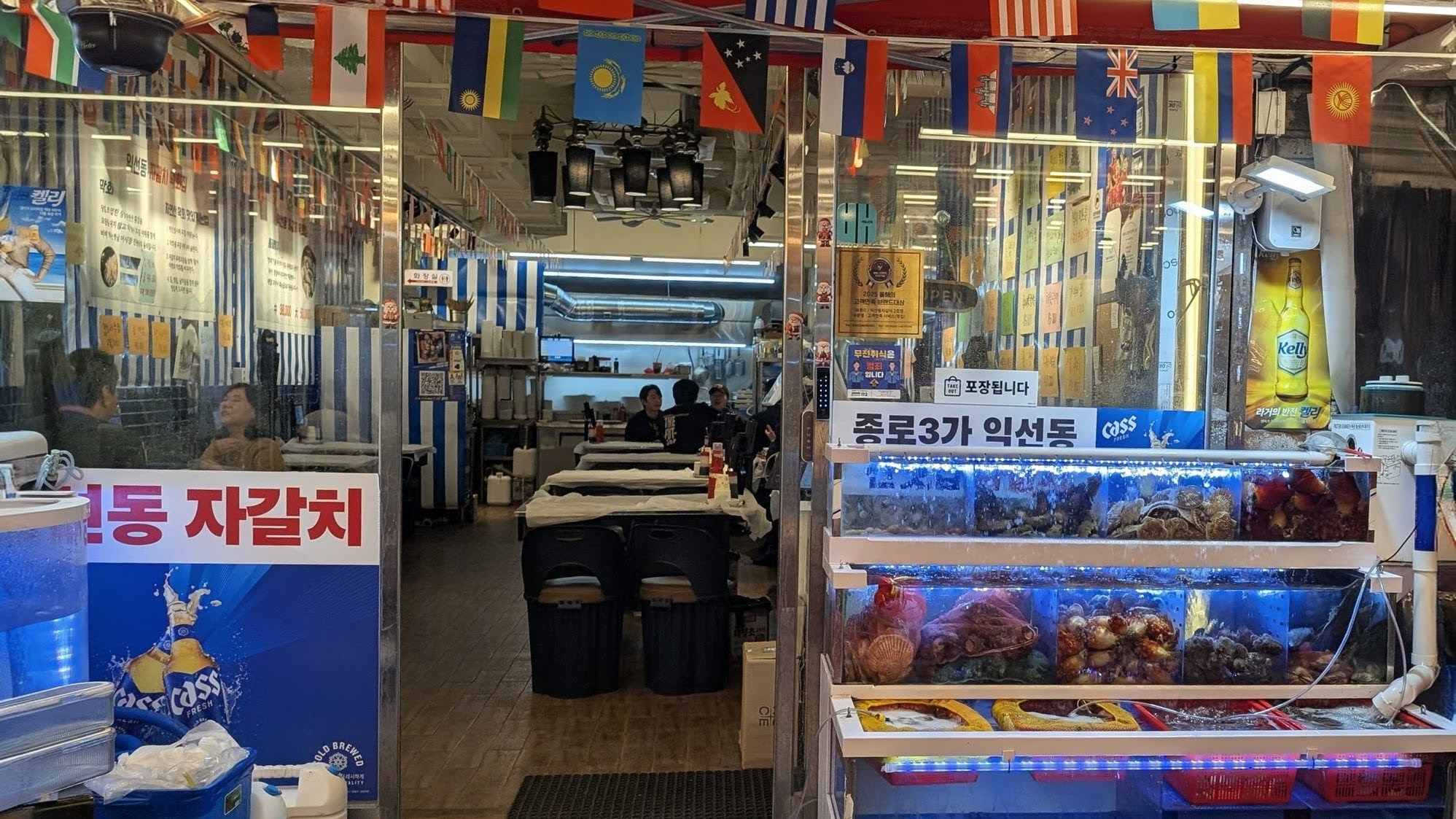
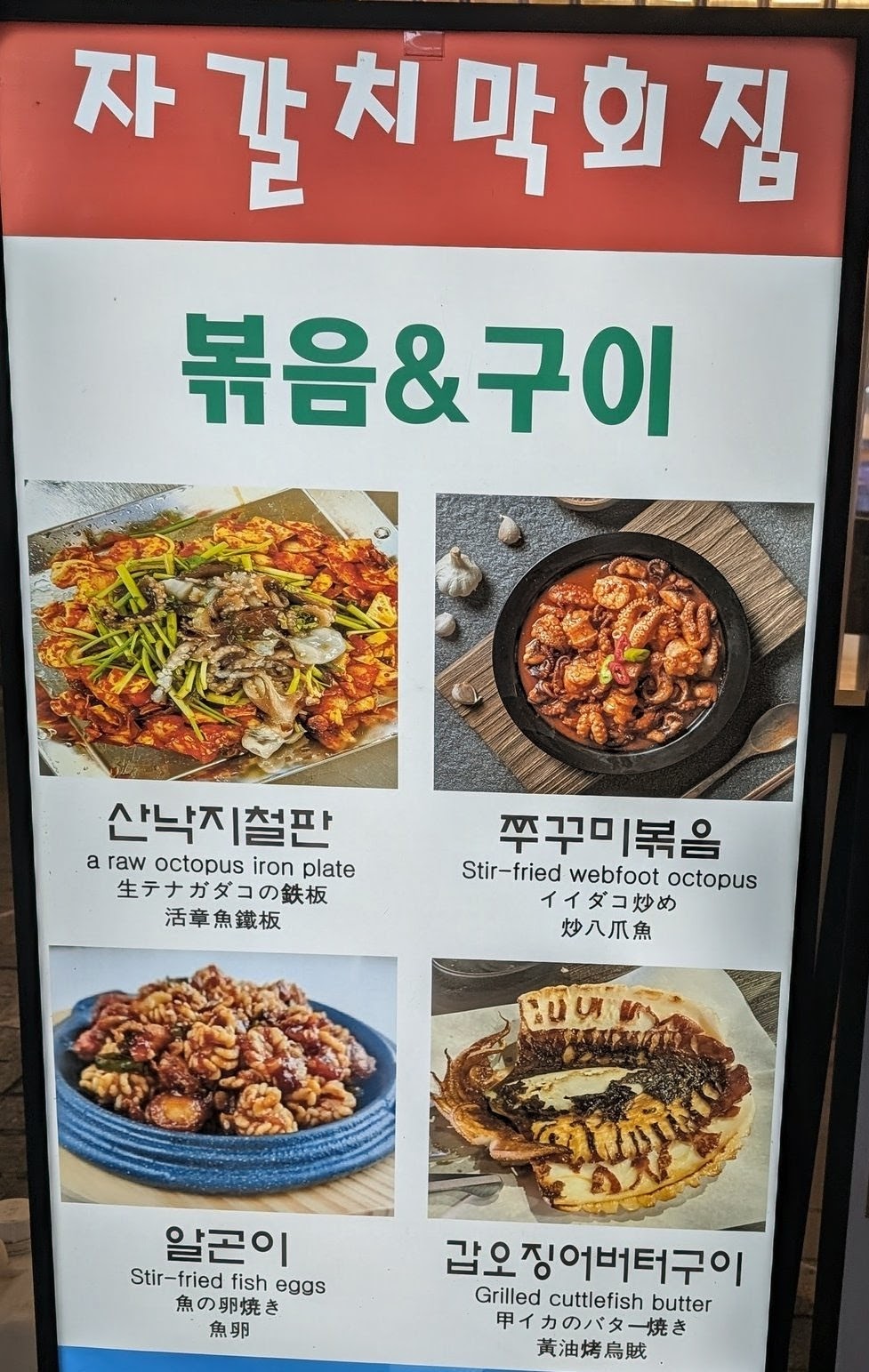
The menu in this restaurant is fairly long, but four dishes are considered its main “specialty.” And these four items are proudly featured on a billboard right next to the entrance.
Besides a plethora of cafes and restaurants, the other option to eat like the locals do is to head to one of Seoul’s covered markets. They specialize in various items (from fashion and cosmetics to dried fish) and operate at different hours, but all have numerous food counters and stalls.
There, for a fraction of a restaurant’s price, you can sample all Korean “food treasures.” I will tell you more about these markets in the next section.
Unfiltered Seoul: A Journey Through the Markets
Let’s start with a firm truth: you haven’t seen Seoul until you’ve checked out its traditional markets. This is the authentic core of the city, standing in gritty contrast to its flashy and high-tech exterior.
That said, don’t aim for all of them — aim for the ones that are right for you. Their beautiful, natural chaos and the sensory overload can easily become overwhelming. Do your research and pick a few. To help with your homework, here is a good YouTube video depicting five markets largely overlooked by tourists.
If your goal is to see the nation’s largest market, go to Namdaemun Market. It sells everything from clothes to kitchenware. If you are interested in fashion and cosmetics, visit Dongdaemun Market. It is known for brand-name clothes, textiles, and facial products.
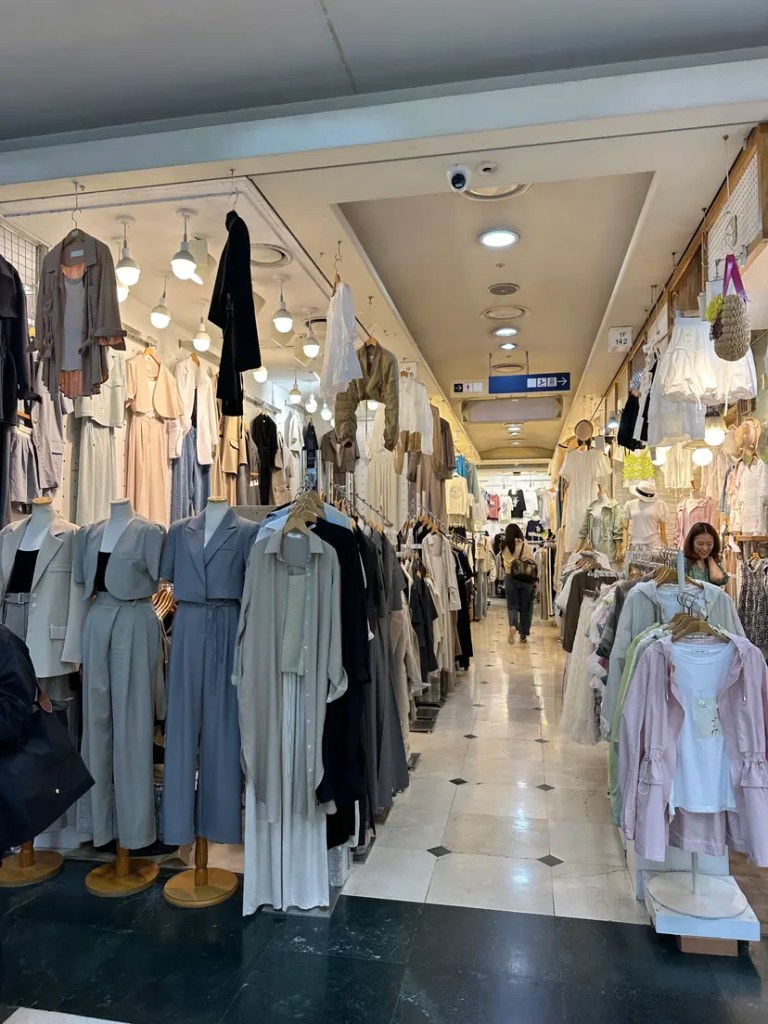
To experience a working non-tourist atmosphere, check out Noryangjin Wholesale Market. This multi-level market is dedicated entirely to fresh seafood.
For something more unique, Gyeongdong Market is a good choice. First, it is the primary destination for traditional medicinal herbs and remedies. Besides shops, you will also find a number of clinics where practitioners consult with visitors and prepare custom herbal blends.
Gyeongdong is also home to a unique coffee shop – Starbucks built inside a former movie theater. The original layout was preserved, including the high wooden ceilings and the tiered seating—so every table feels like being in the audience and looking down at the stage. The coffee counter is where the movie screen used to be, making the baristas the stars of the show.
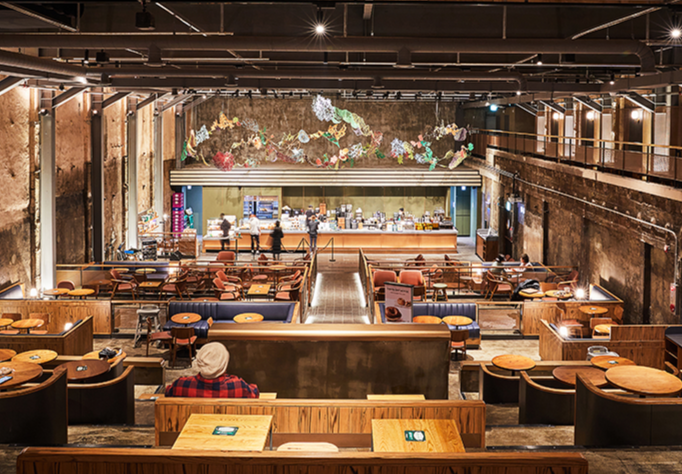
Where did I go during my two days in Seoul? I went to Gwangjang, Jungbu, and Tongin markets.
Gwangjang is, perhaps, the best known and most tourist-oriented market in Seoul. While increasingly criticized for higher prices and crowds, it remains a prime destination for an impressive variety of traditional Korean food.
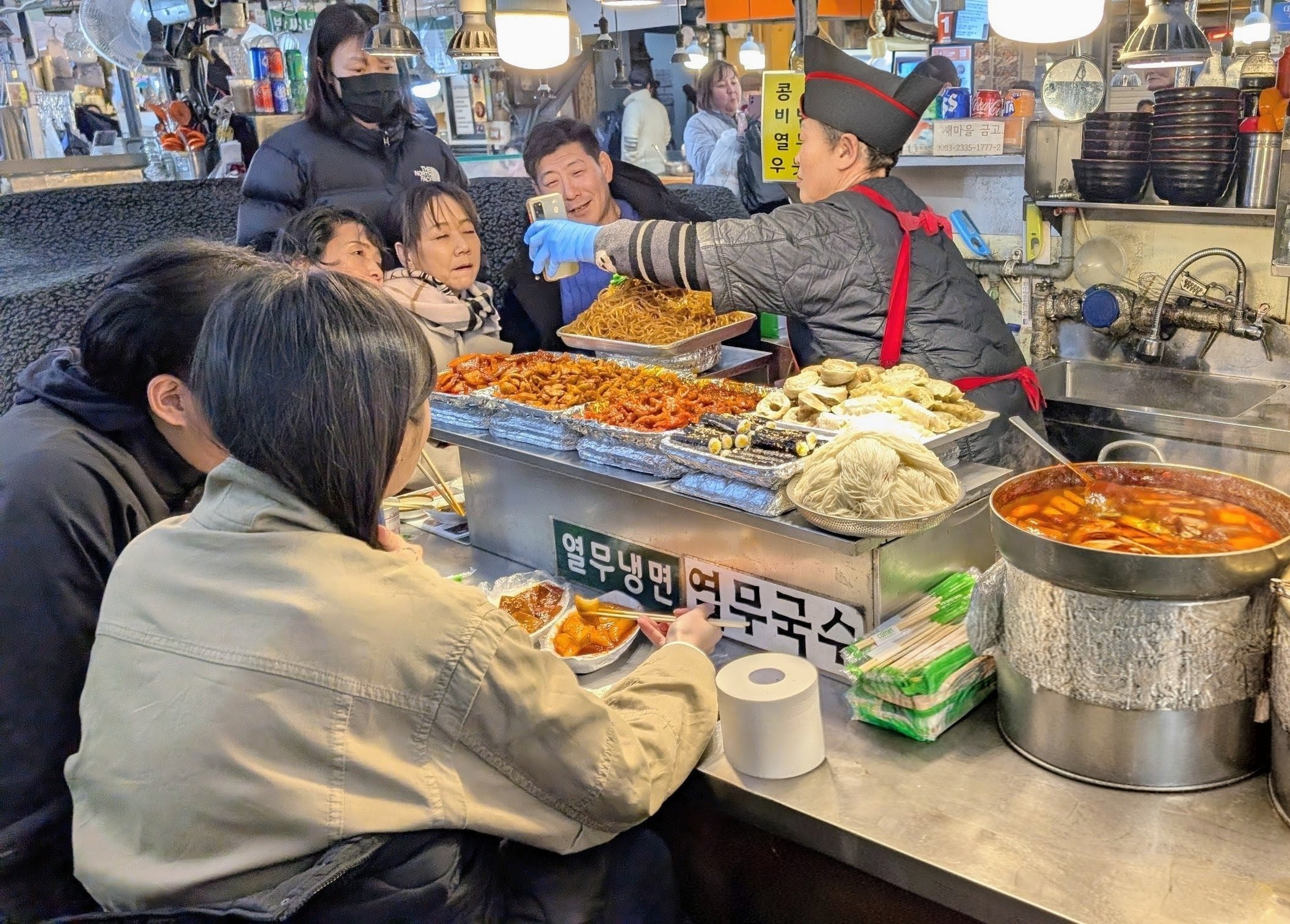
Here you can find and enjoy virtually all iconic dishes: bindaetteok (mung bean pancakes I described previously), mayak gimbap (seaweed rolls), yukhoe (beef tartare), all kinds of dumplings and kimchi, and much more.
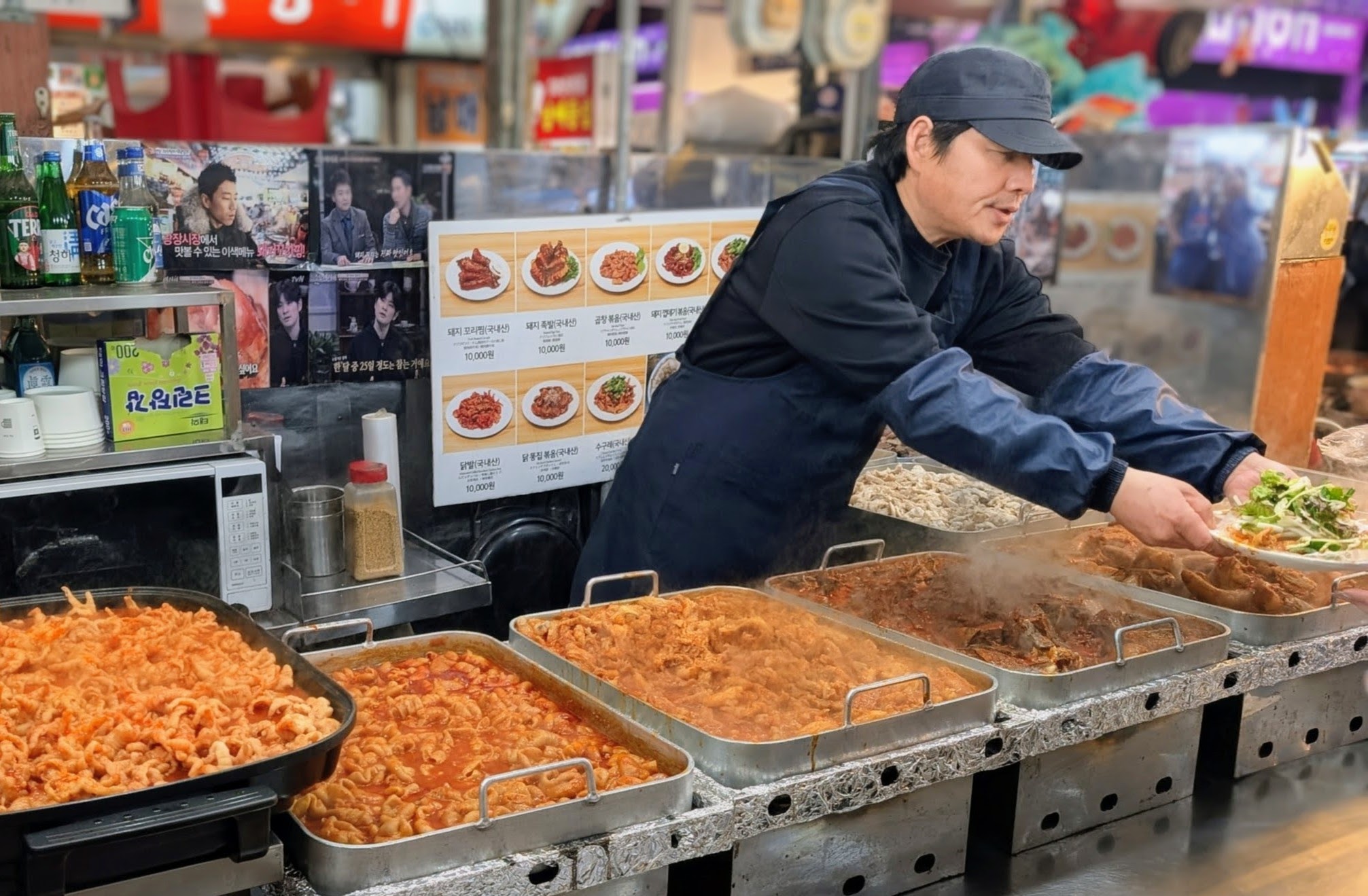
Jungbu Market is only a 10 minute-walk from Gwangjang, but it offers an entirely different vibe and products. It is quieter, smaller and feels more like a “market” rather than an endless food court.
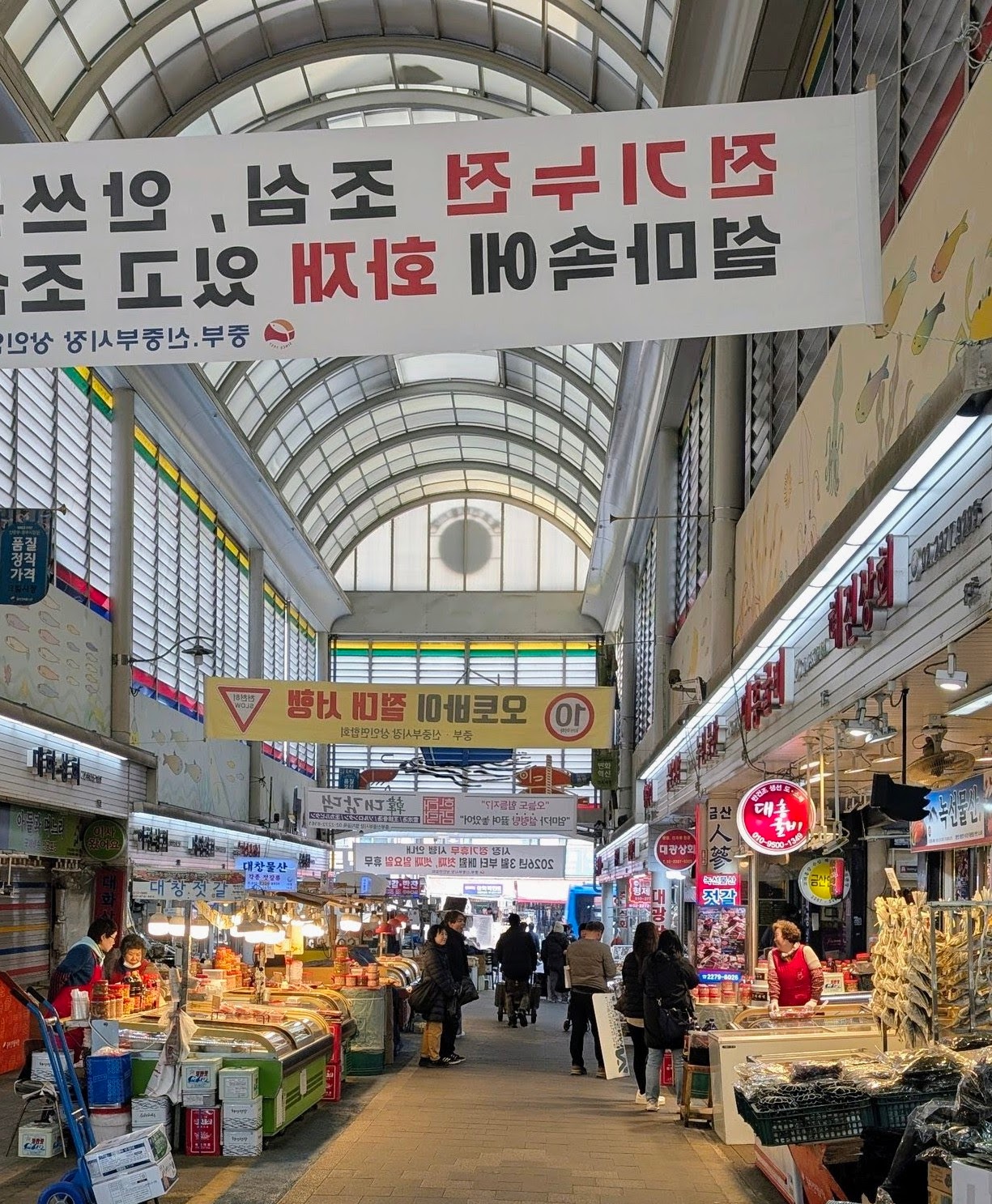
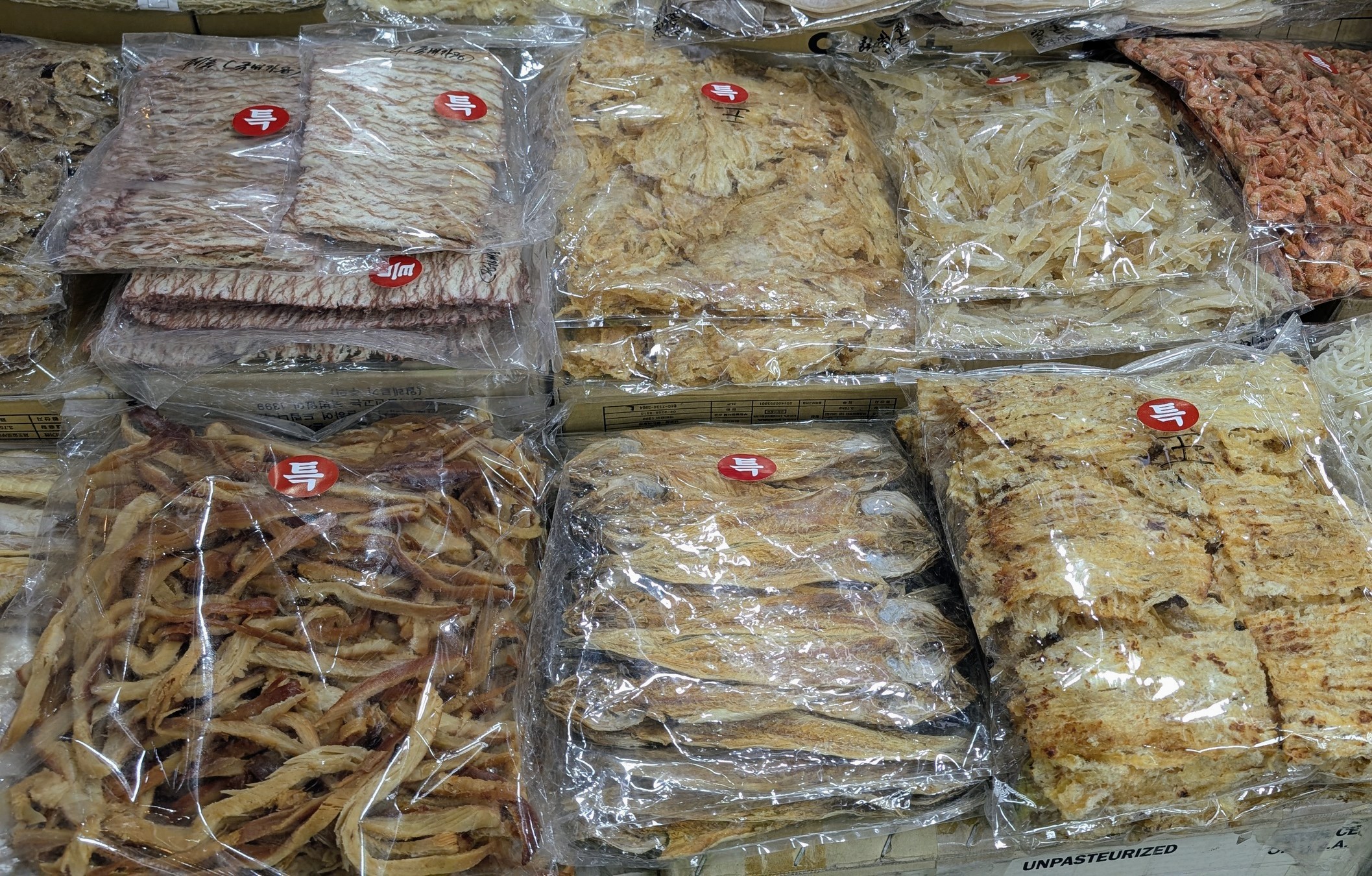
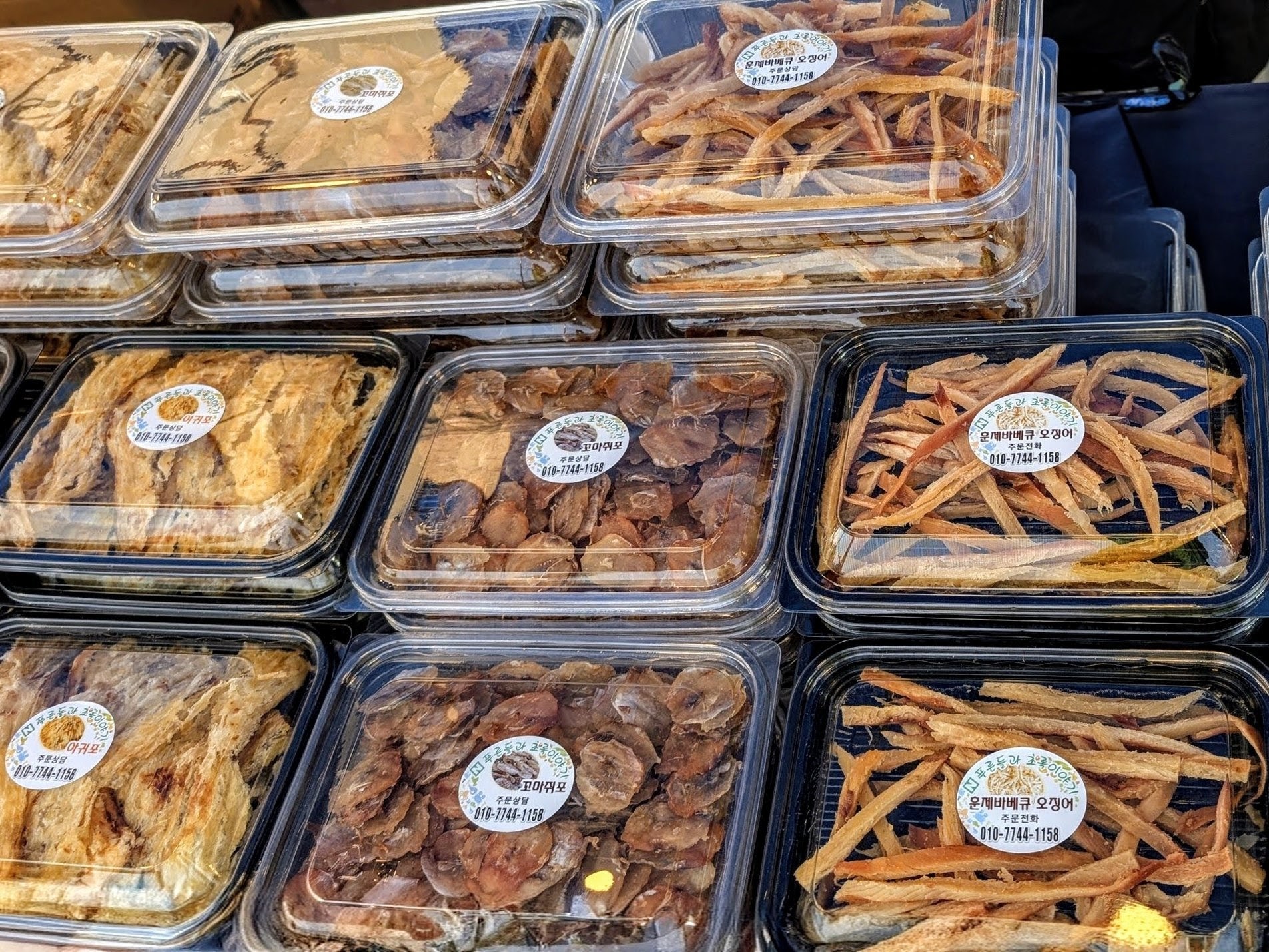
Why did I go there? I wanted to buy and take home some dried fruits and also dried squid and fish. Jungbu is a good place to get both.
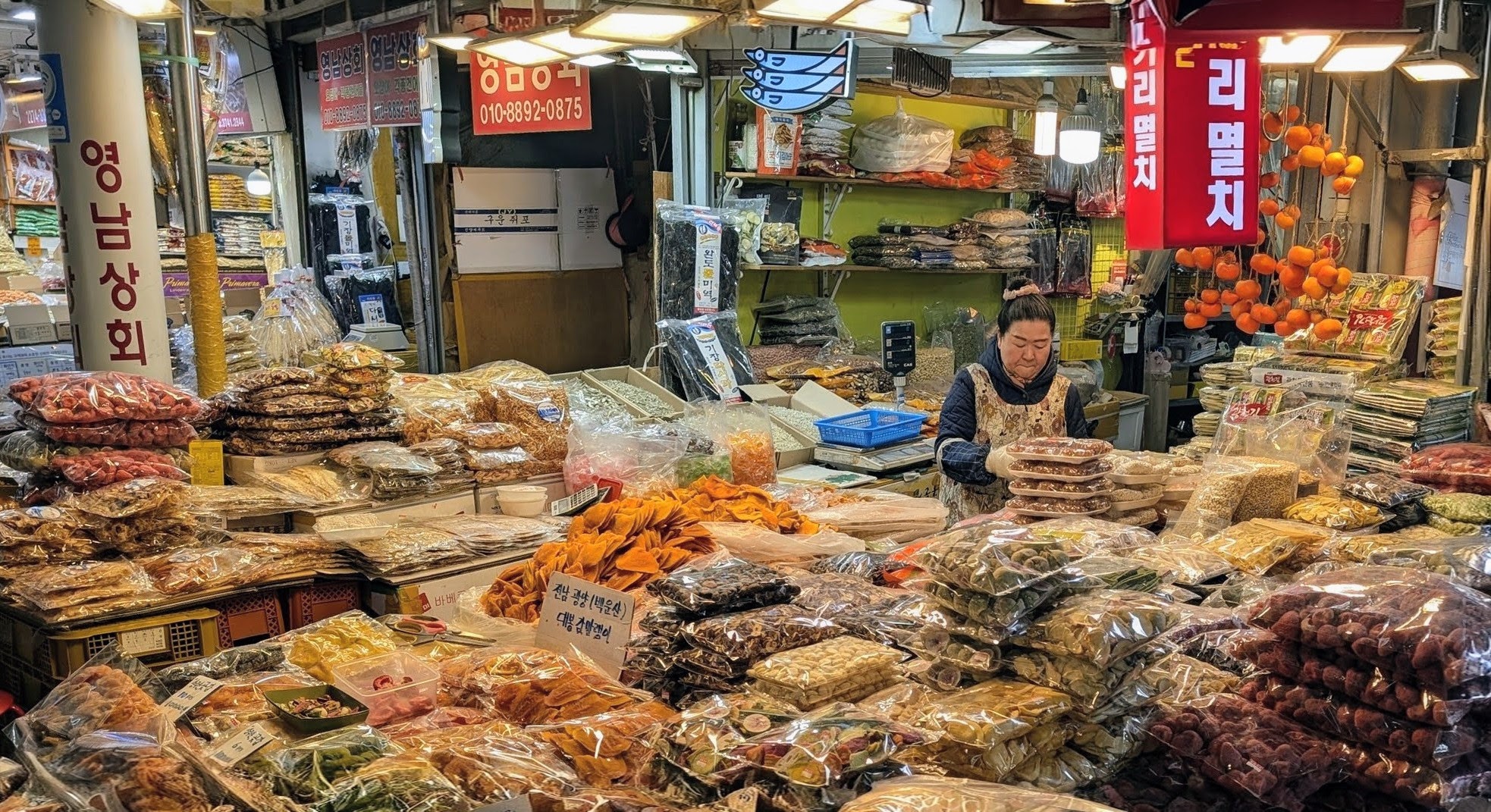
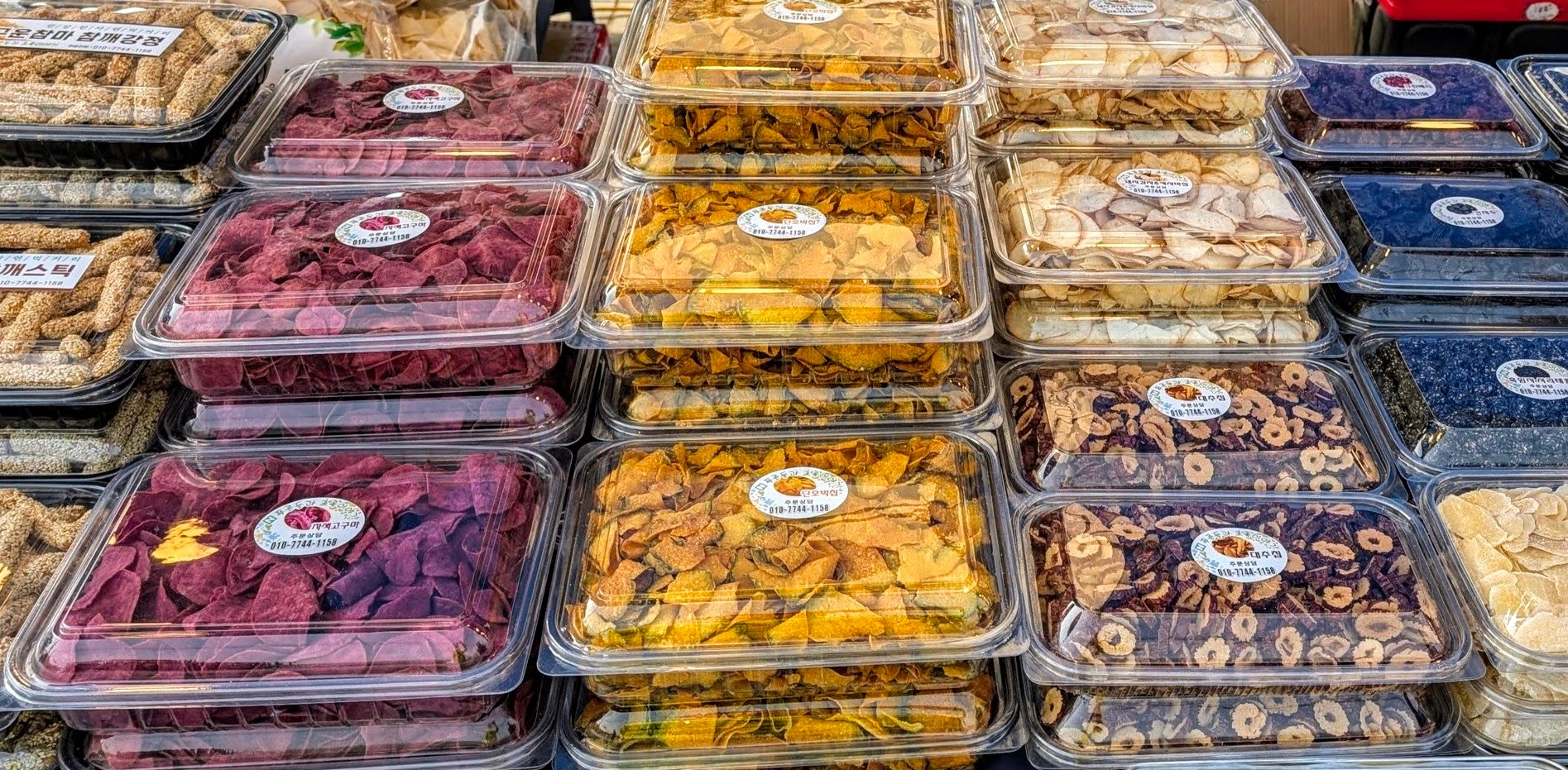
Regarding the dried fish and seafood offered at Korean markets, some of it requires further preparation and cooking, but some can be eaten right away as a healthy and tasty snack. Think about it as a Korean version of meat jerky that is so popular in the US.
When properly prepared, the texture of such snacks is not hard or crunchy, but pleasantly chewy. As for the taste, the slight saltiness is usually perfectly balanced with a touch of sweetness and possibly a “punch” of some spice.
And finally: why did I go to Tongin Market? The answer is, I simply wanted to see a genuine “neighborhood market,” where most shoppers are people who live nearby and not visitors of any kind. Tongin definitely fell into this category, plus it was located in the “Sejong Village” neighborhood.
Sejong is best known as the birthplace of King Sejong the Great (I wrote about him HERE previously), but it also has a claim to being home to various Korean poets, painters, and scholars – sort of a bohemian and artsy neighborhood. It is one of Seoul’s areas with many traditional Hanok houses tucked into a maze of narrow alleyways.
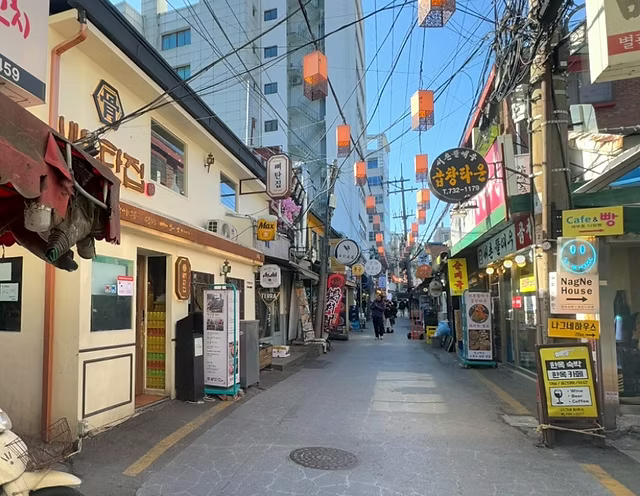
After random roaming through Sejong’s streets, by lunchtime, I arrived at Tongin Market. It was significantly smaller than either Gwangjang or Jungbu, and offered a predictable mix of “a little bit of everything:” vegetables and fruits, kimchi and rice, various snacks, etc.
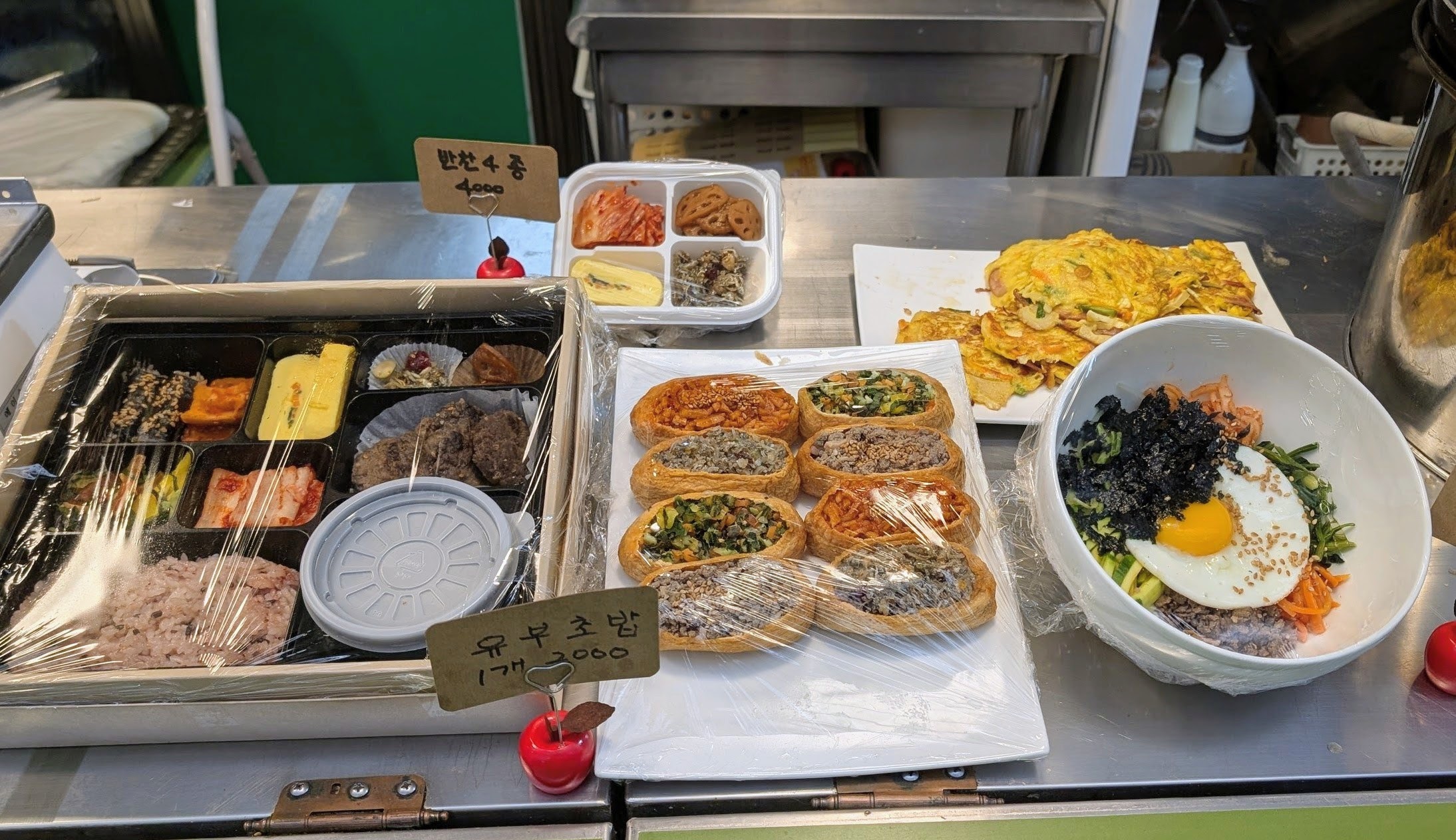
And then I noted something interesting. Compared to the other two markets, there were much fewer food stalls here, but they looked – how should I say? – nicer and more sophisticated.
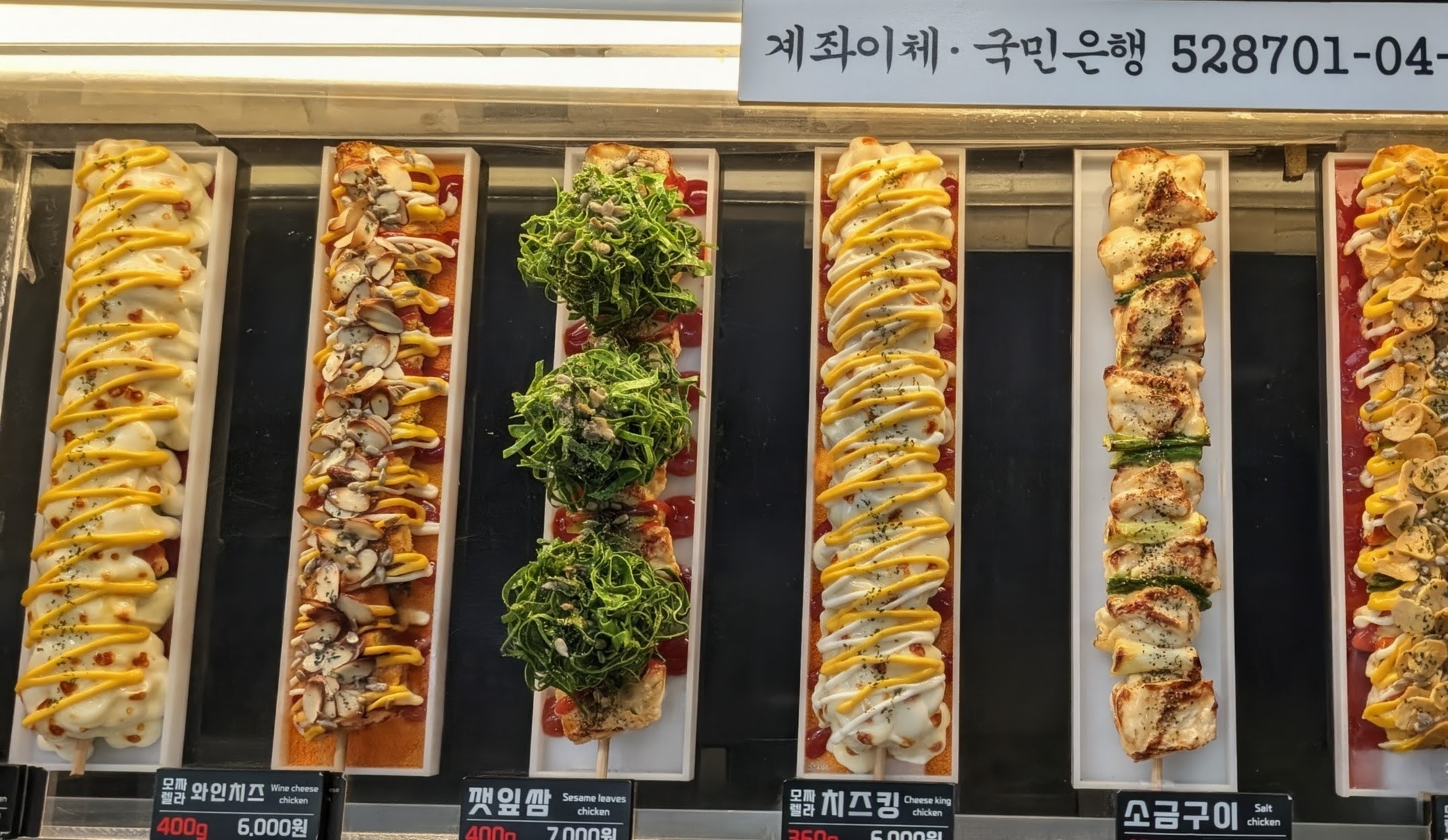
Look, for instance, at this artistic presentation of six different chicken skewers. At the price tag of KRW 6,000 / $4 USD, this was definitely a steal.
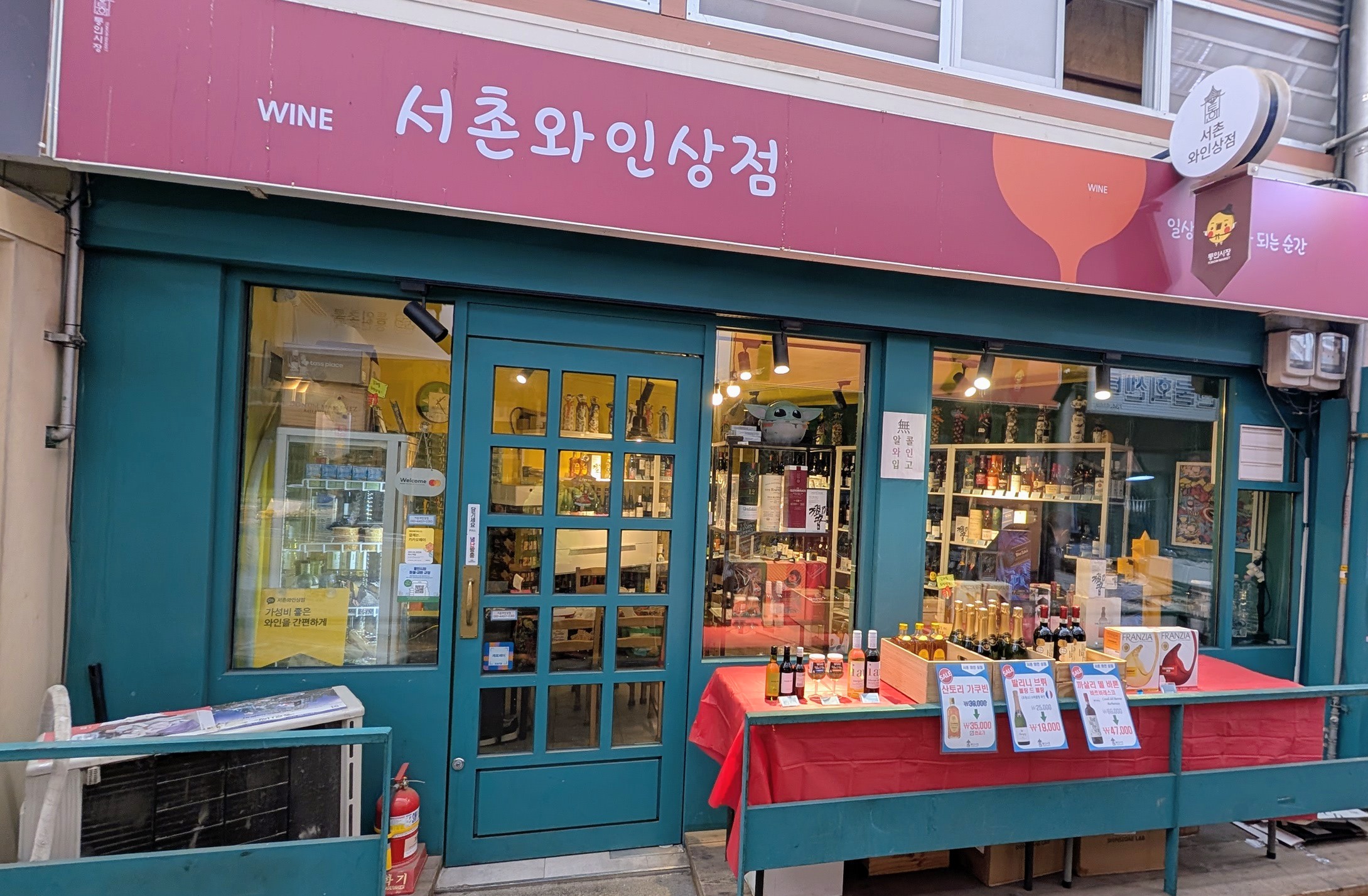
Walking through Tongin’s single covered passage, I ended up at a shop that also surprised me. It was a wine shop – something I would not expect to see at a traditional market.
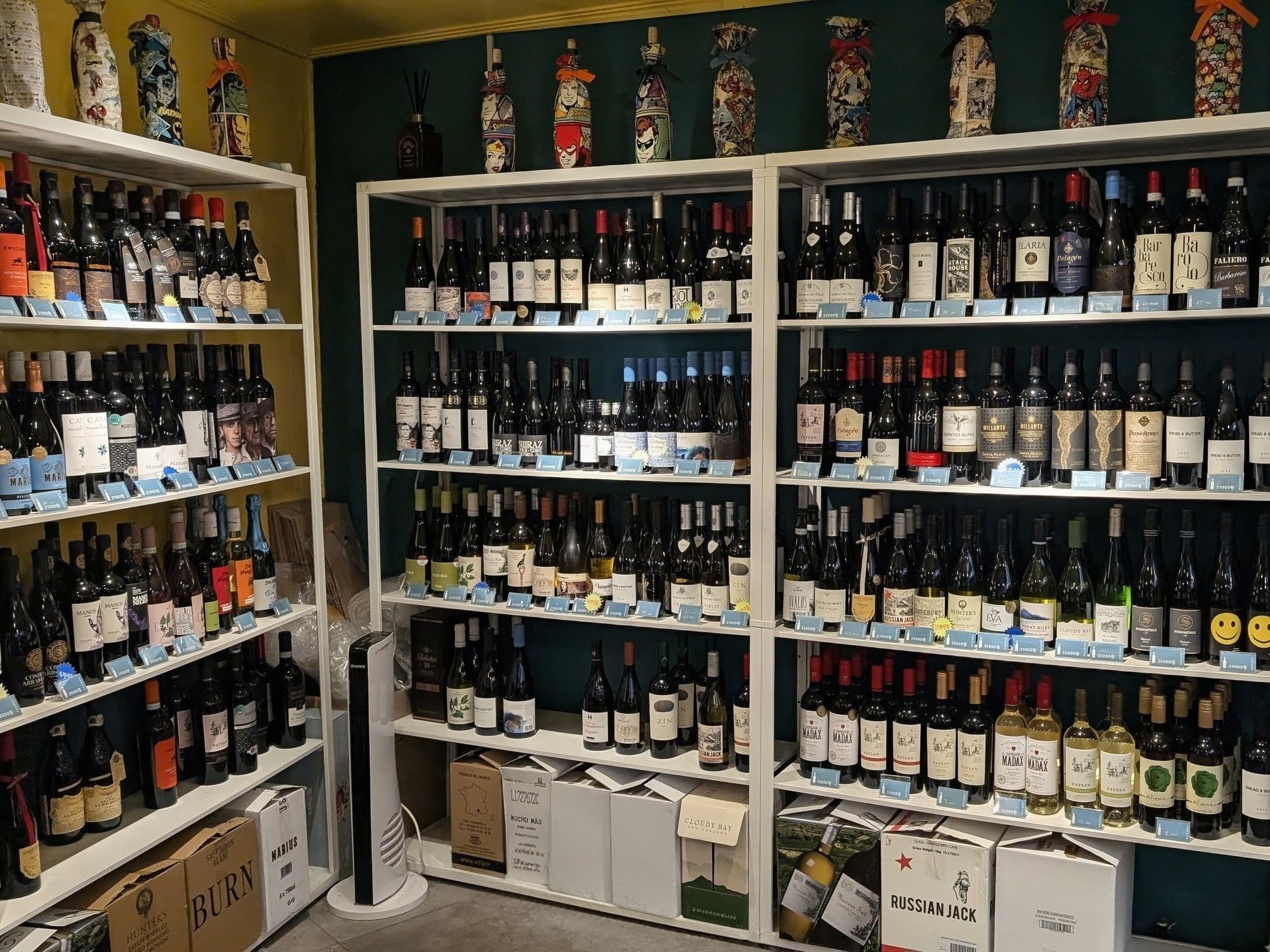
I went inside and looked at the wine selection. It was big, with most bottles being fairly reasonably priced (wine in Korea isn’t cheap).
When I expressed my astonishment and asked the owner who his customers were, he was in turn surprised by my question. According to him, many locals come to his store while shopping for other items at the market. So, it appeared that Koreans have developed a taste not only for artisan pastries but also fine wines.
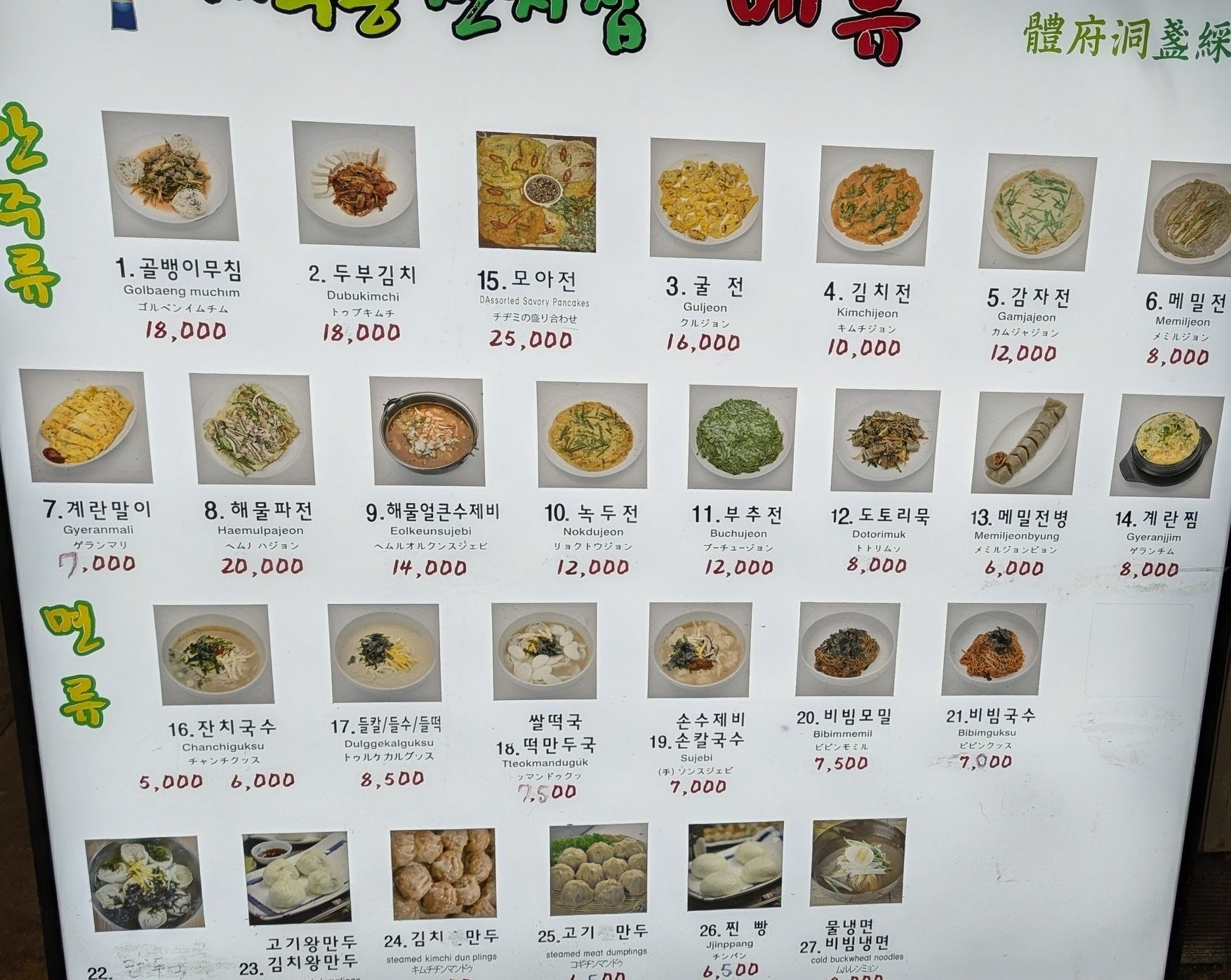
It was time to find a place for lunch, and instead of a food counter, I went to one of Tongin’s sit-down cafes. My choice was based on the visual (with pictures) menu placed by the entrance. Many items on the list were different from what I have seen thus far in the more tourist-oriented spots. If you read the previous section on food, most of the dishes I described were present in this small caffe.
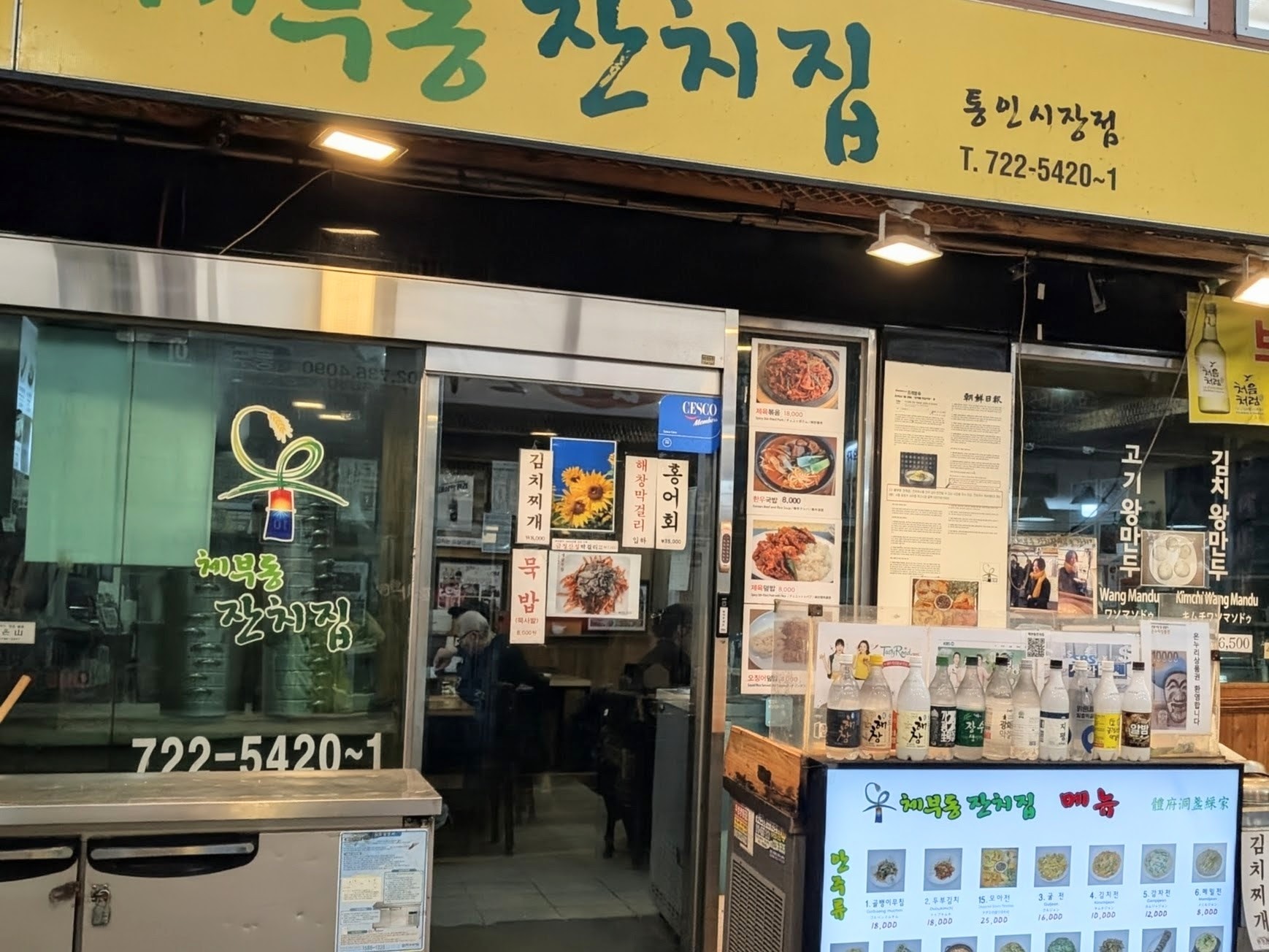
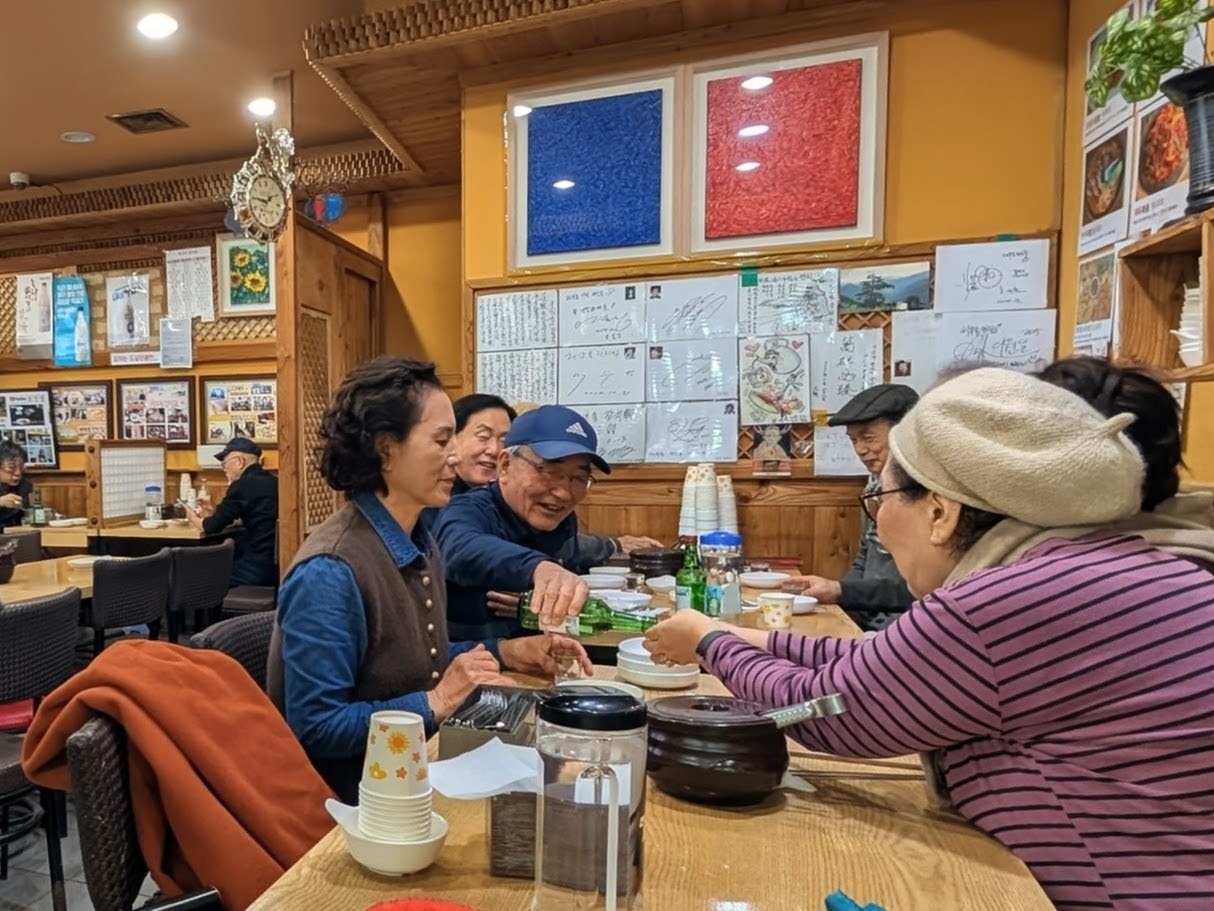
I entered and looked around. The caffe definitely felt like a popular neighborhood place. By the way patrons talked to each other and to the cooks, it was clear they come here regularly.
One table was occupied by a group of people who were celebrating something, toasting with “Soju” (traditional rice wine), laughing, and simply having a good time.
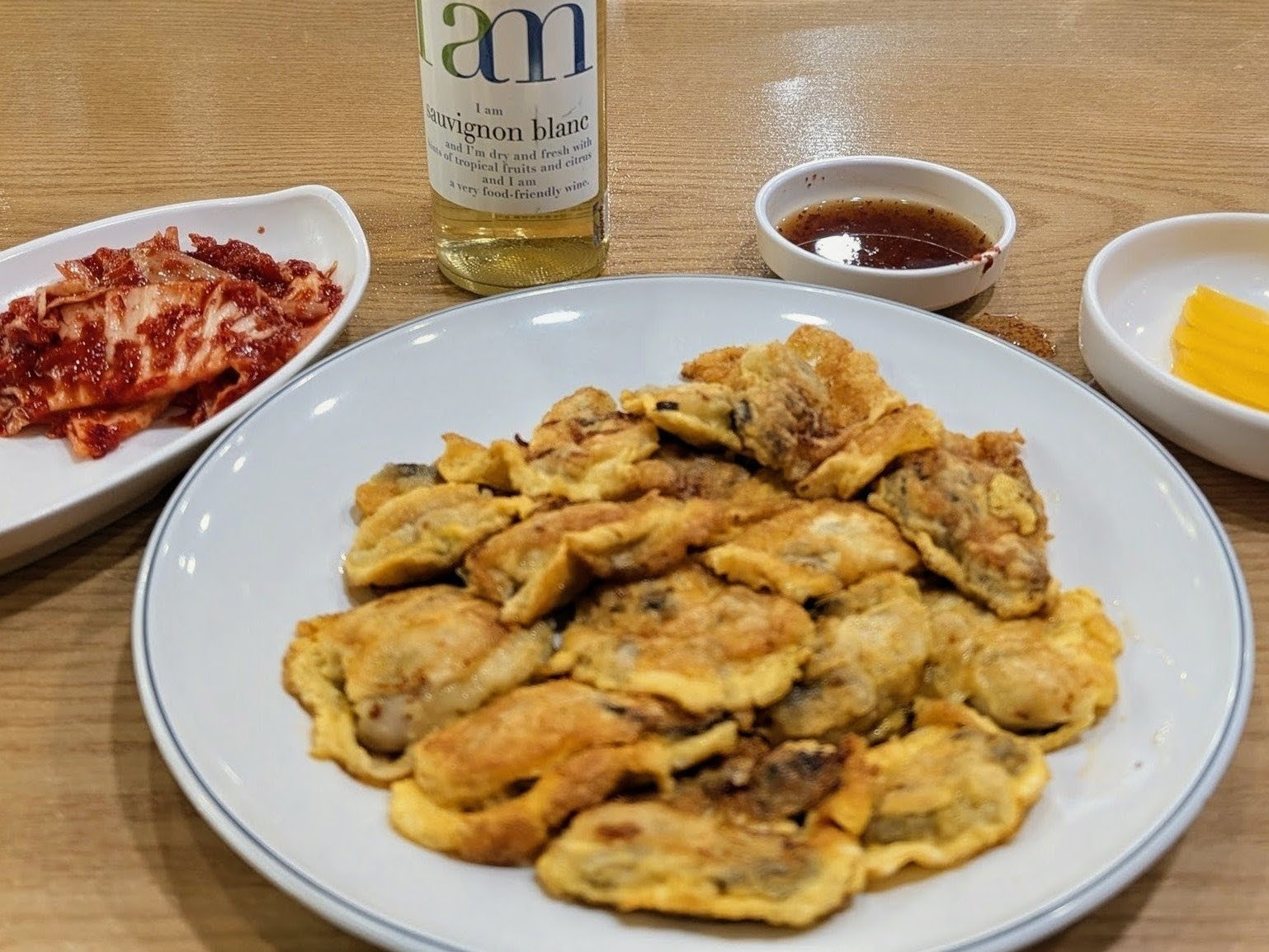
I ordered “Guljeon,” a kind of oyster fritter. Known as “milk of the sea,” oysters are popular in Korea, and winter is the best time to enjoy them. To make Guljeon , fresh oysters are coated in flour, dipped in a seasoned egg mixture (with scallions or chili peppers), and then pan-fried until golden and plump. I had never had Guljeon previously, but, as far as I can tell, the dish was executed perfectly.
From the outside, the fritters were golden, soft, and with just a hint of crispness at the edges. As for the oyster filling, I was impressed with how plump, juicy and almost creamy it felt. Combined with the Romanian Sauvignon Blanc I bought at the wine store and tangy soy-vinegar sauce, my lunch definitely deserved at least one Michelin star.
The conclusion? Definitely go to some of Seoul’s “famous markets,” but also spare some time to visit more humble local ones.
Three Historic Landmarks You Shouldn’t Miss
Seoul has a plethora of historic places and monuments. But similarly to traditional markets, trying to see too many in a short period of time will be exhausting. Pick a few that will convey a sense of the country’s historic and cultural heritage and enjoy them leisurely “with heart and mind.” I limited myself to three destinations.
For some ethnography and a feel of how people used to live in the past, the most iconic spot in Seoul is Bukchon Hanok Village. It is a living (not museum) residential neighborhood with hundreds of traditional Hanok houses.
Developed in the 14th century, they are visually characterized by wooden frames and curved tile roofs that create a sense of lightness and flow. Inside, Hanok houses smartly integrate a hot-floor heating system (ondol) for winter with a cold-floor hall (maru) for summer.
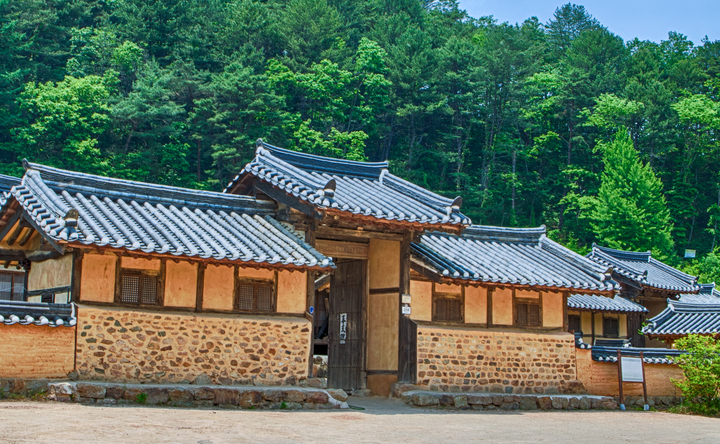
When planning a visit to Bukchon Village, bear in mind that – as a visitor – you can go there only between 10 am and 5 pm. This curfew was imposed because of extreme tourist popularity and to protect some measure of privacy for local residents.
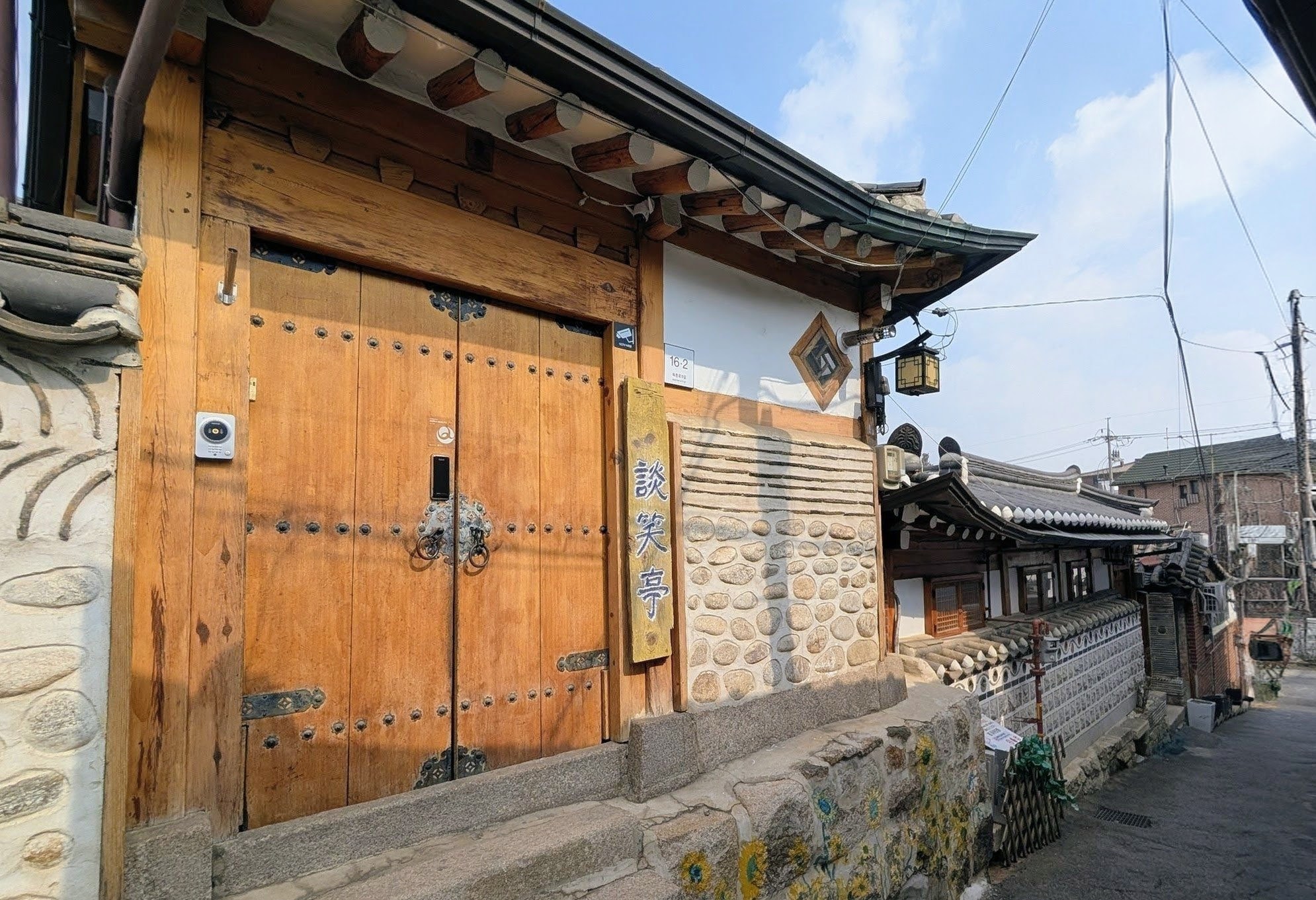
If you look at Bukchon Village on Google or NAVER Maps, you will find eight (yes, they are numbered!) “scenic views” – the spots where you can capture best pictures of Hanok houses with the modern Seoul skyline in the background.
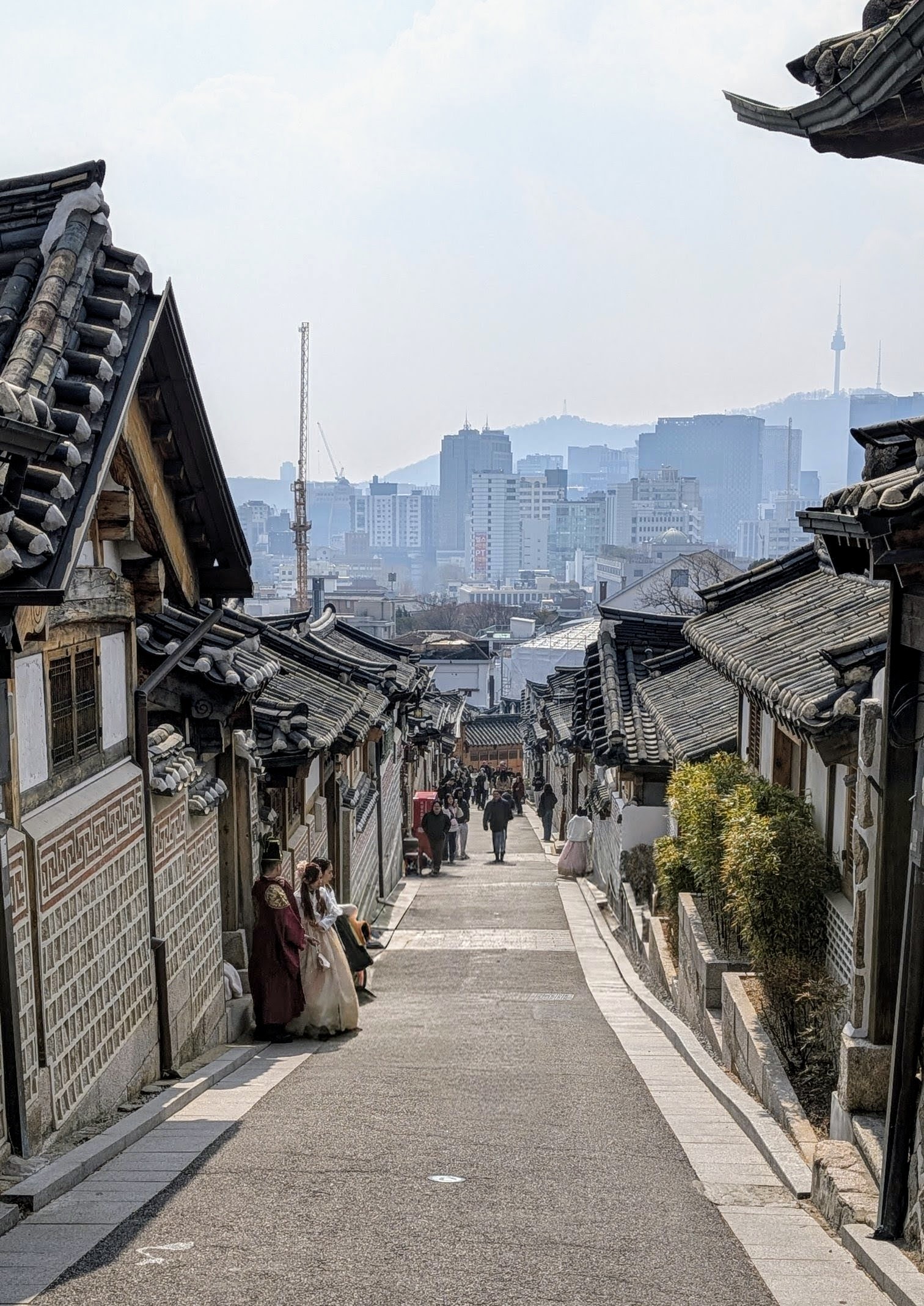
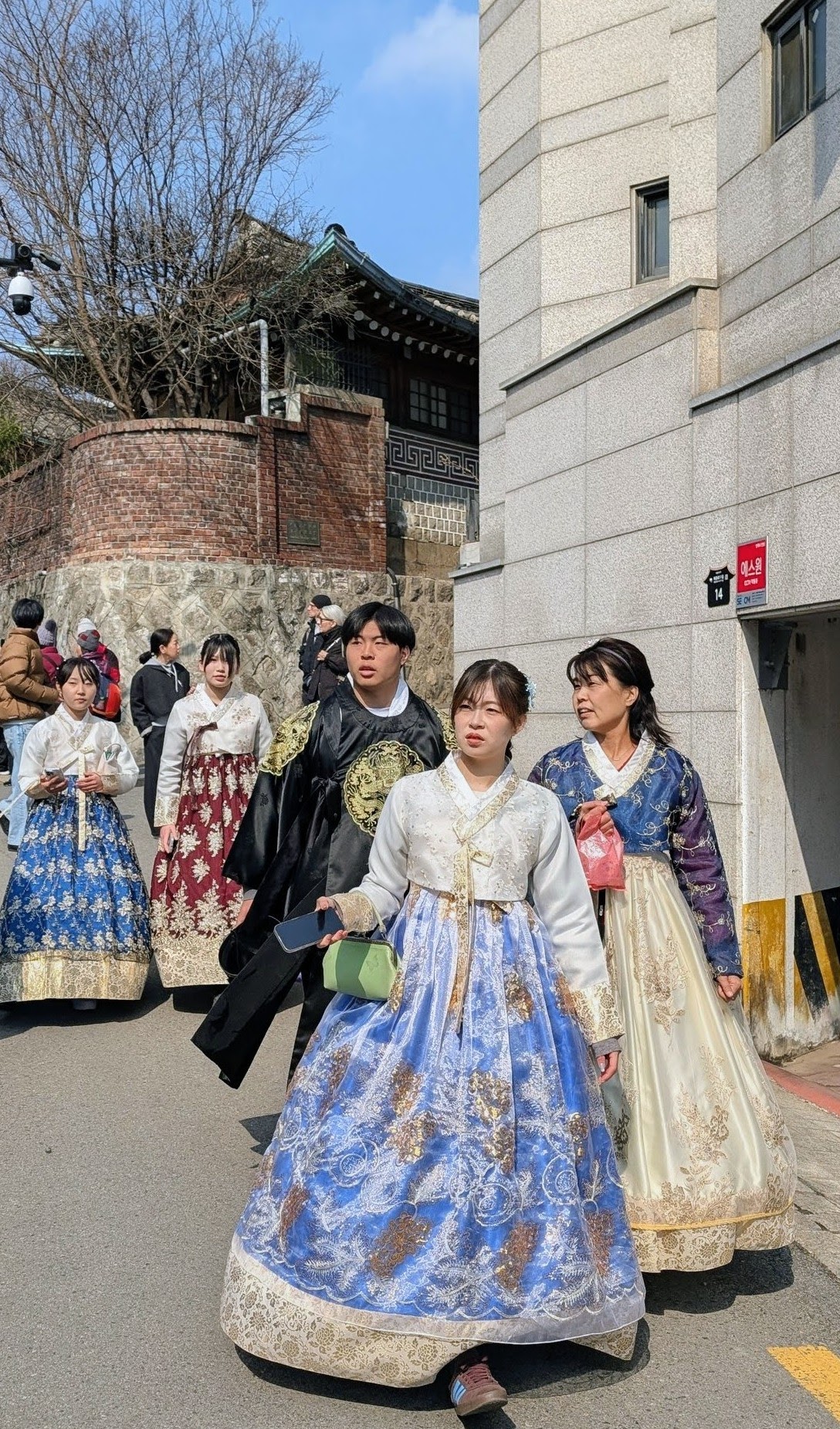
Walking the streets and narrow passages of Bukchon Village, you will also see young Korean people wearing traditional historic costumes. These are “devoted instagrammers” who traveled significant distances to come here with a sole purpose: to get a fine shot for social media.
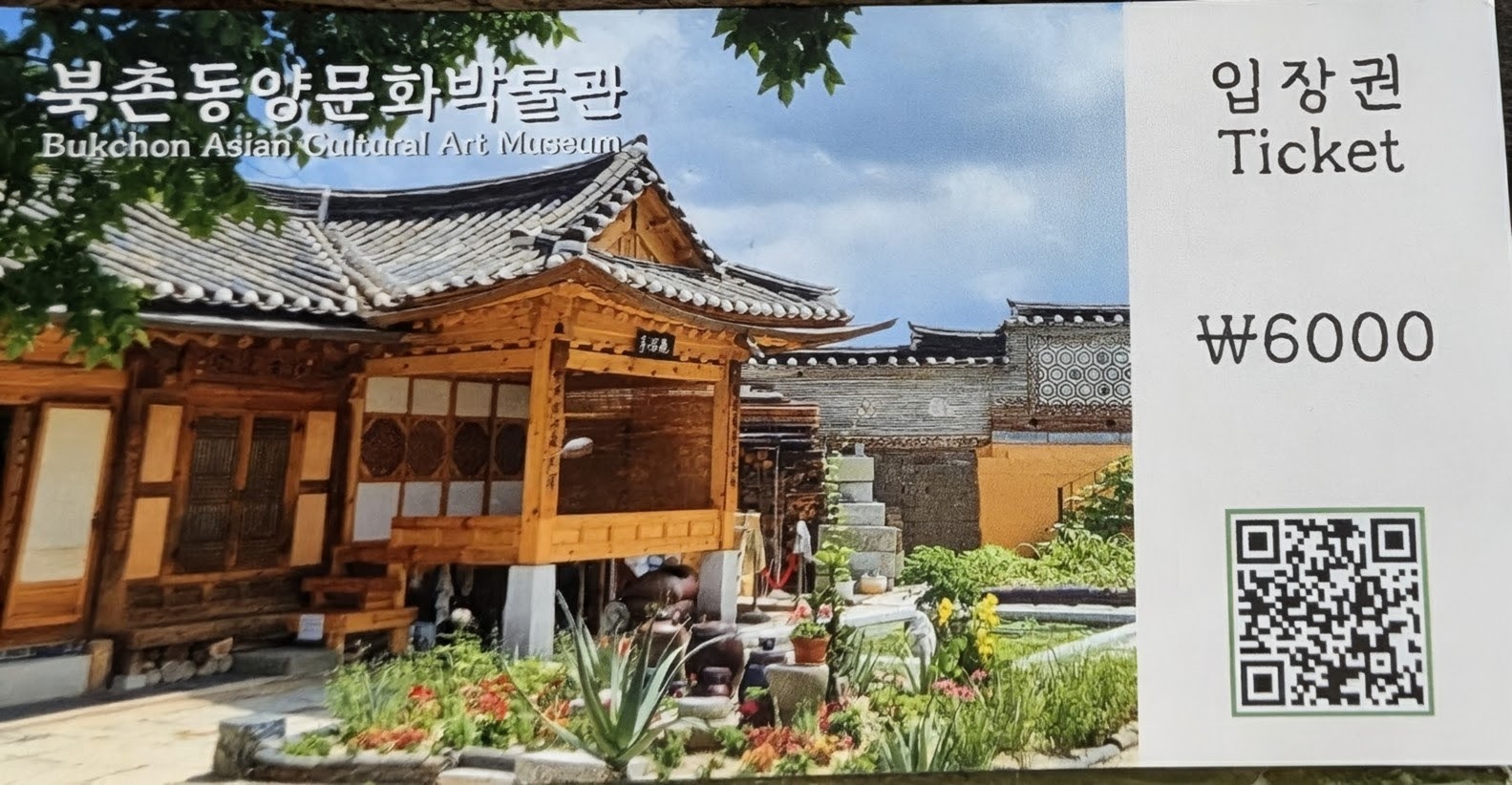
As you can guess, during permitted hours, Bukchon Hanok Village is full of visitors. There is, however, one place that attracts surprisingly few visitors, but offers quiet respite, elegant interiors and great panoramic views. This is the “Bukchon Asian Cultural Art Museum.”.
From the outside, it is just a big two-story house surrounded by a stone garden.
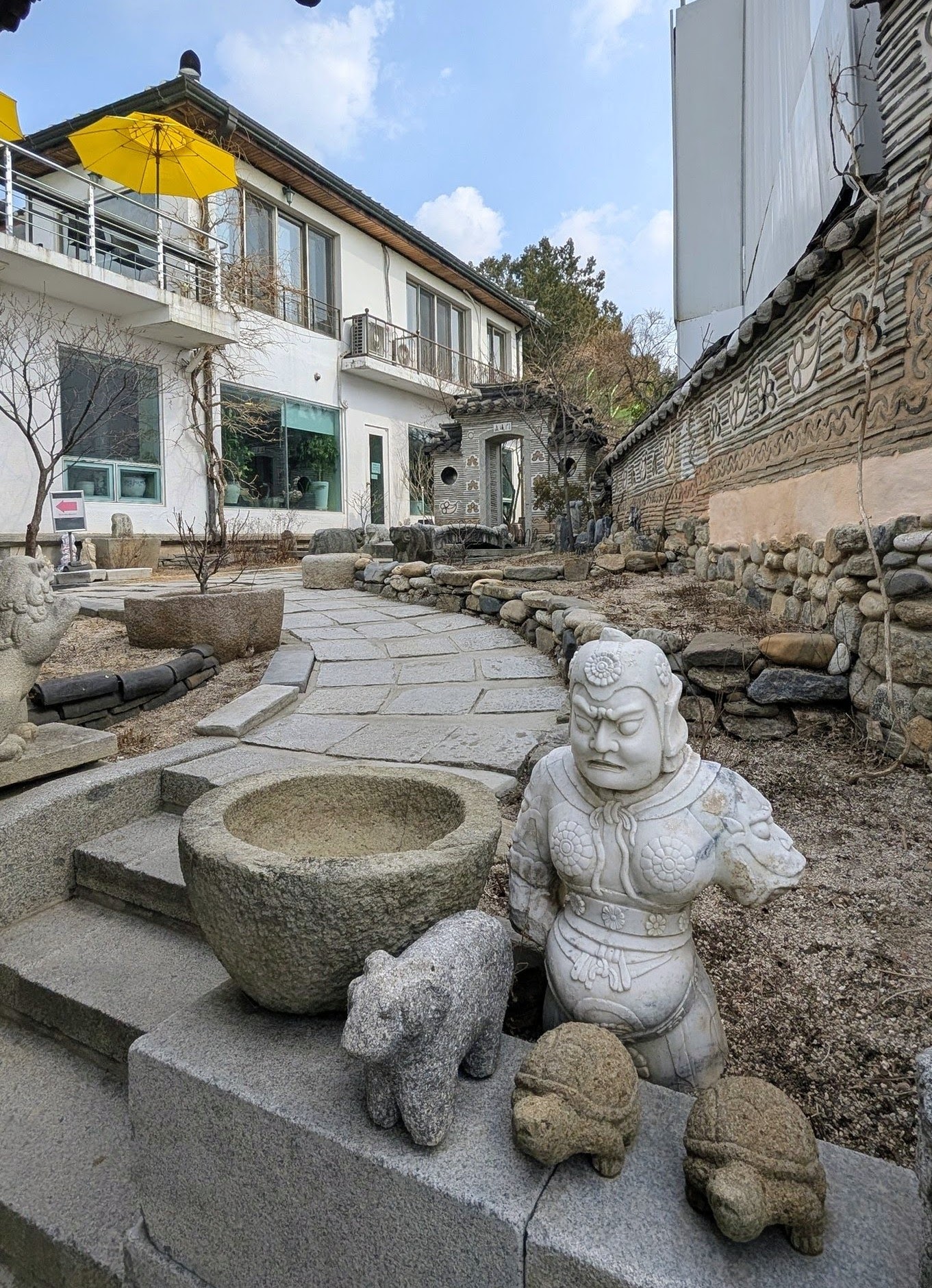
The shop on the first floor sells the usual selection of tourist memorabilia. What you need to do is pay KRW 6,000 / $4 USD, which will give you a free drink (coffee, tea, juice) and access to the second floor.
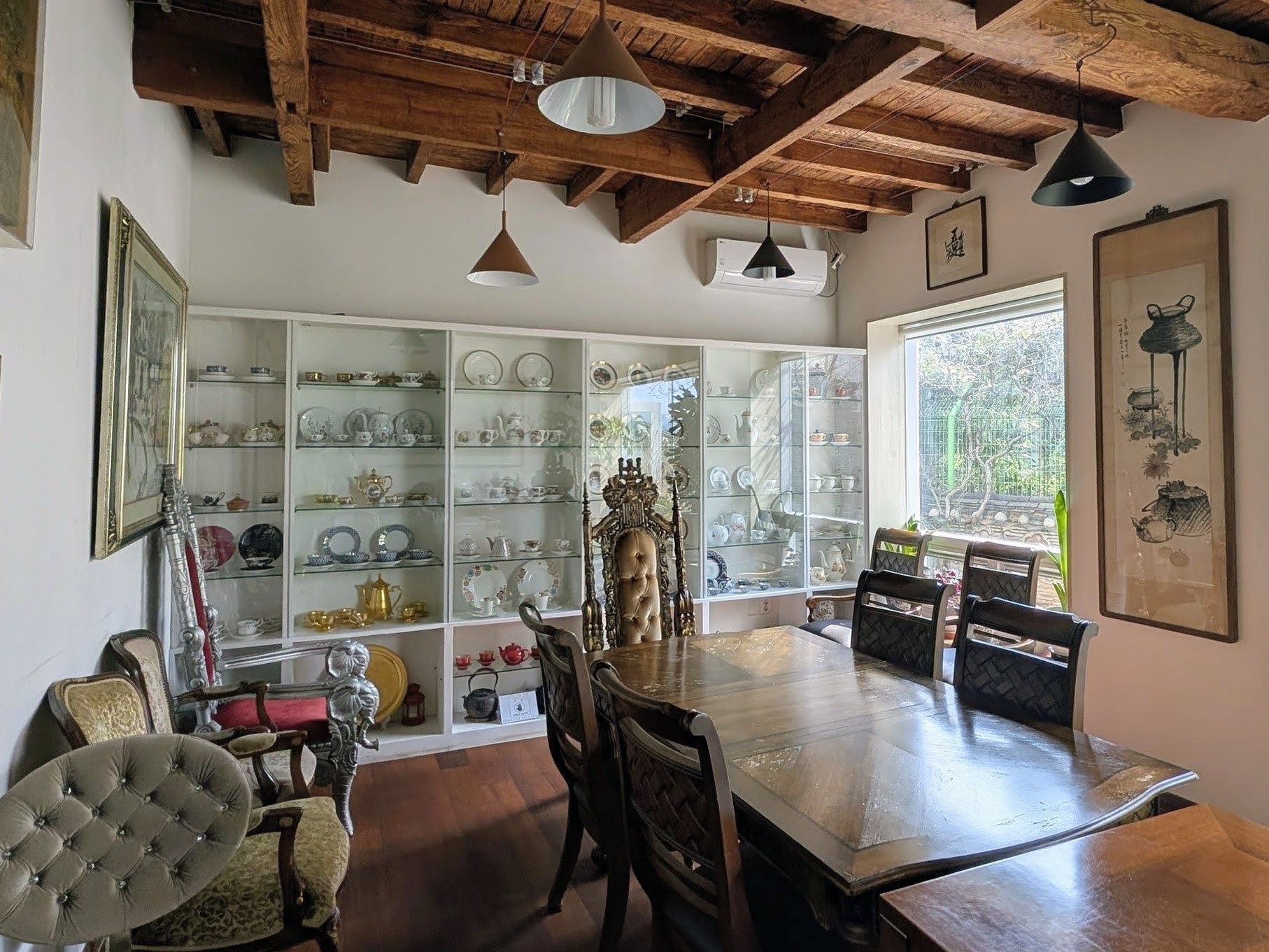
The second floor is divided into several antique-looking rooms. They are not for “viewing” – they are actually for sitting and relaxing.
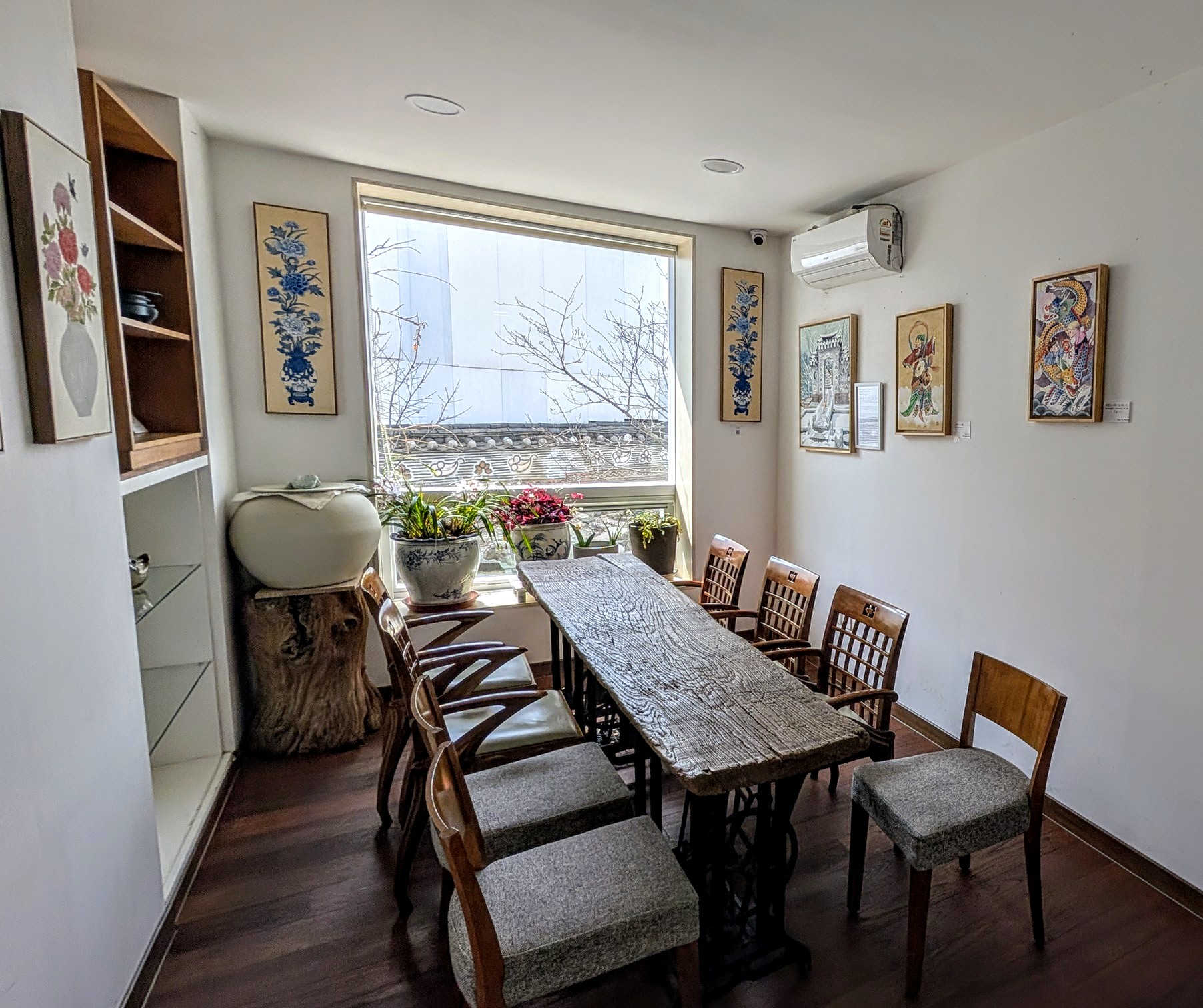
As to the claim of being a “museum,” there is not much of it, except that the walls are lined with shelves showcasing old ceramics and earthenware.
The real treasure of this place, however, is not the art collection, but huge panoramic windows and outdoor balcony that offer nearly 360 degree unobstructed views of Bukchon’s tiled roofs with modern Seoul and distant mountains in the background.
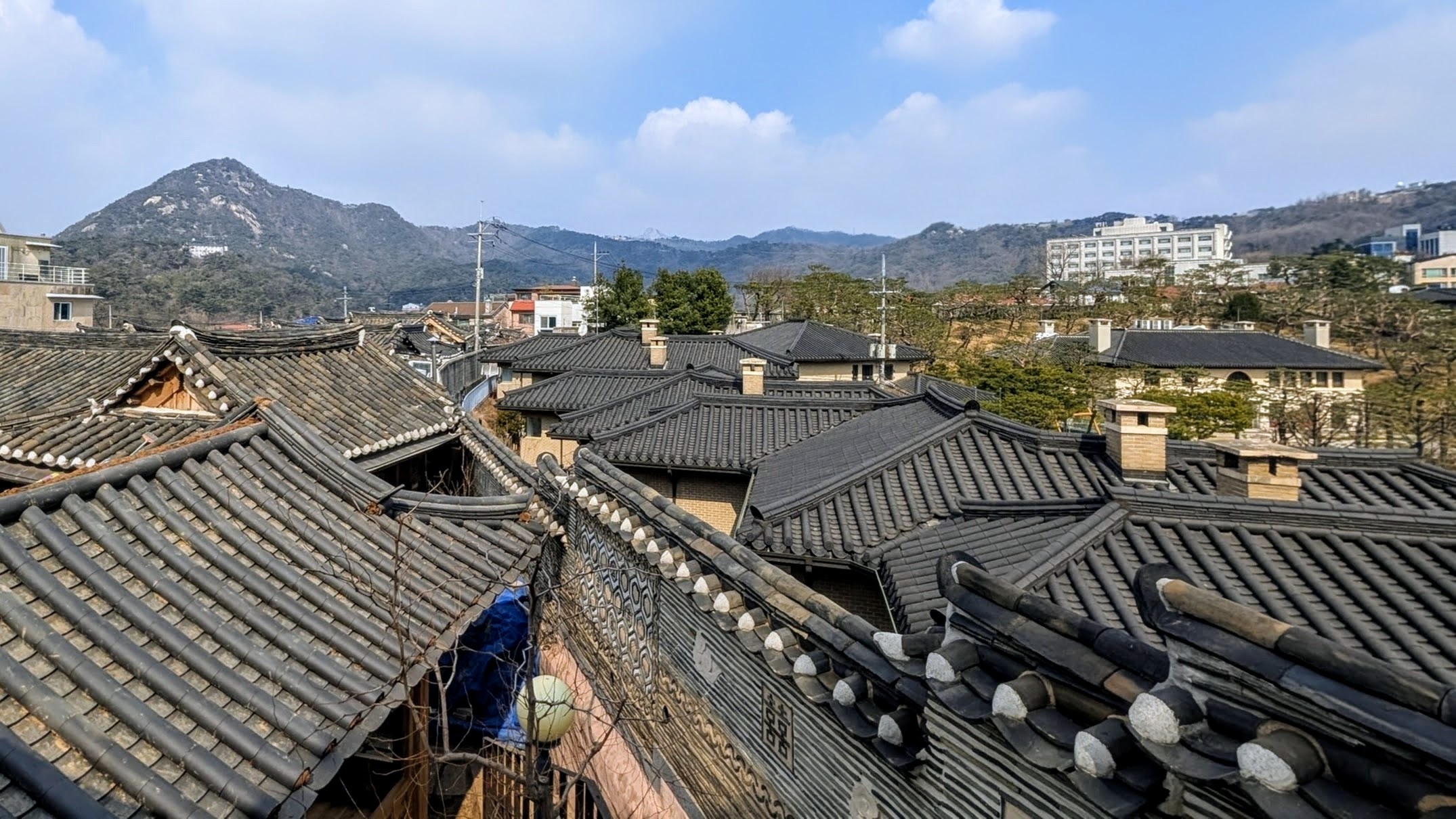
Pick up the drink of your choice (included in the ticket), sit on the outside balcony, and simply absorb the surroundings while planning the rest of the day.
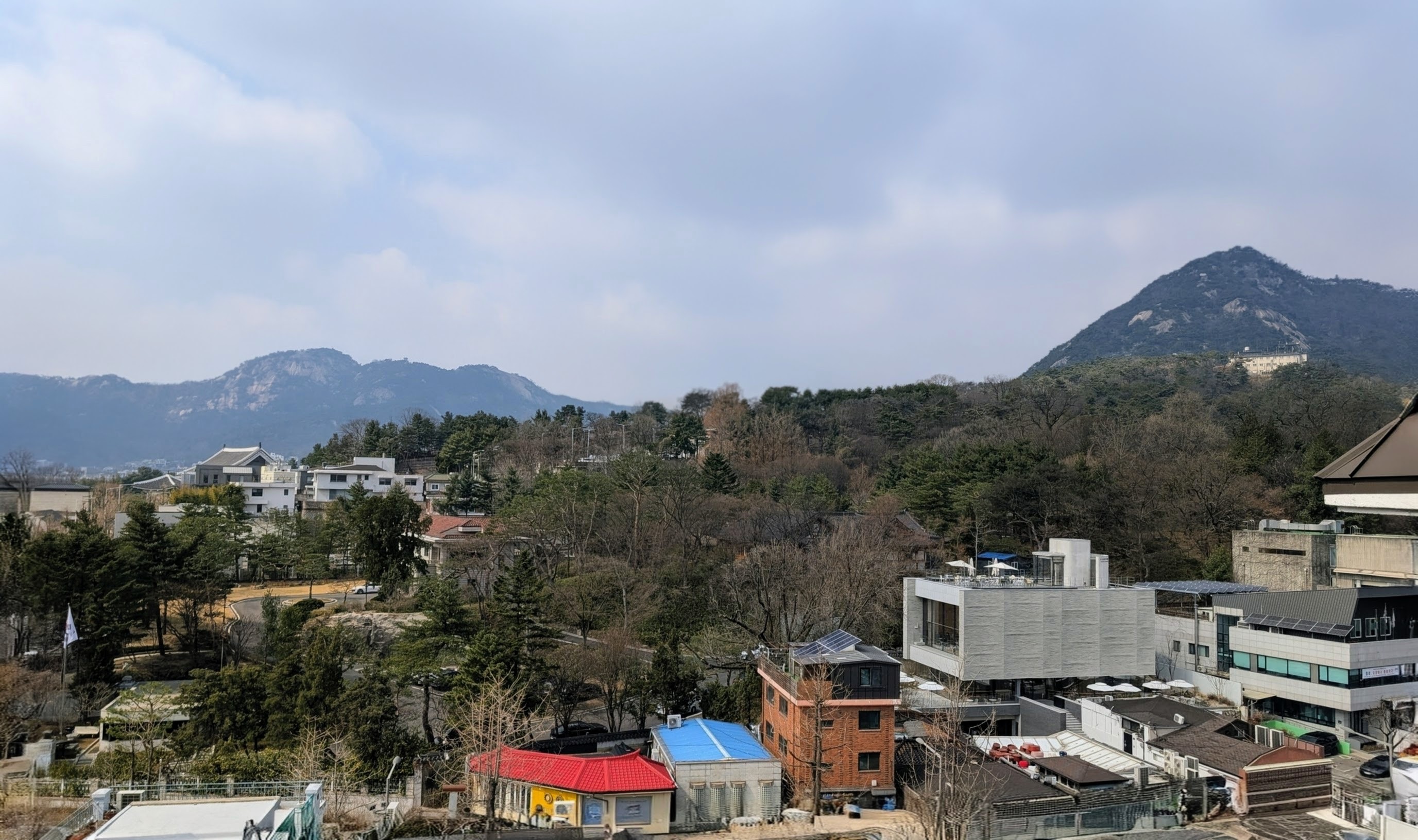
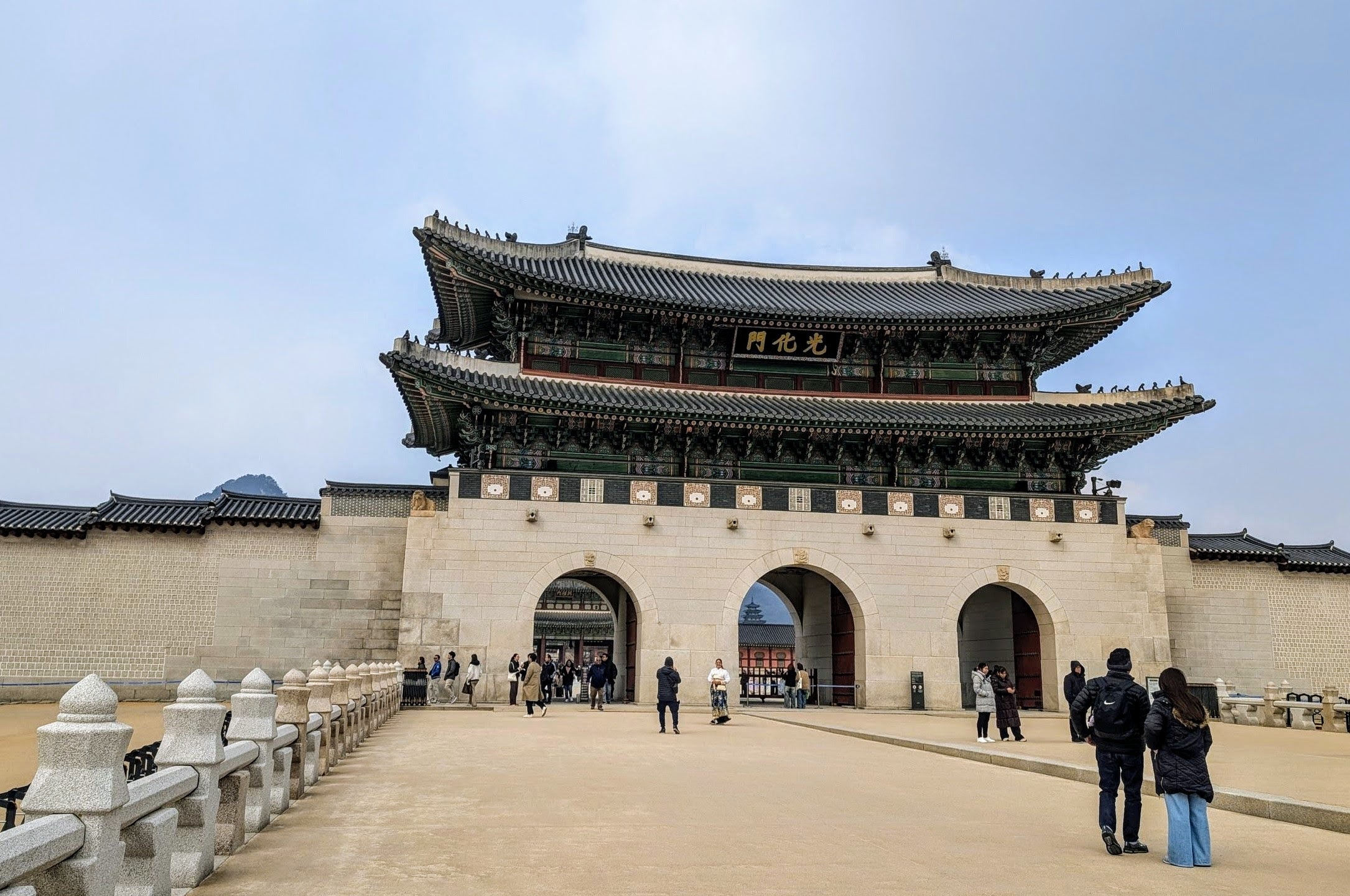
My second “historic destination” in Seoul was Gwanghwamun Square described by many as the heart of Seoul. Another popular cliche defines it as a “bridge between Seoul’s royal past and its vibrant present.” Visually, there is a good reason for such a definition. The northern part of the 550 meter / 1,600 feet long and flanked by modern skyscrapers square is occupied by a former royal palace, now housing a museum of folklore and culture.
In front of the palace’s main gate, you will see Gwanghwamun Woldae – an elevated platform where the King would meet with his people, oversee military parades, or greet foreign envoys.
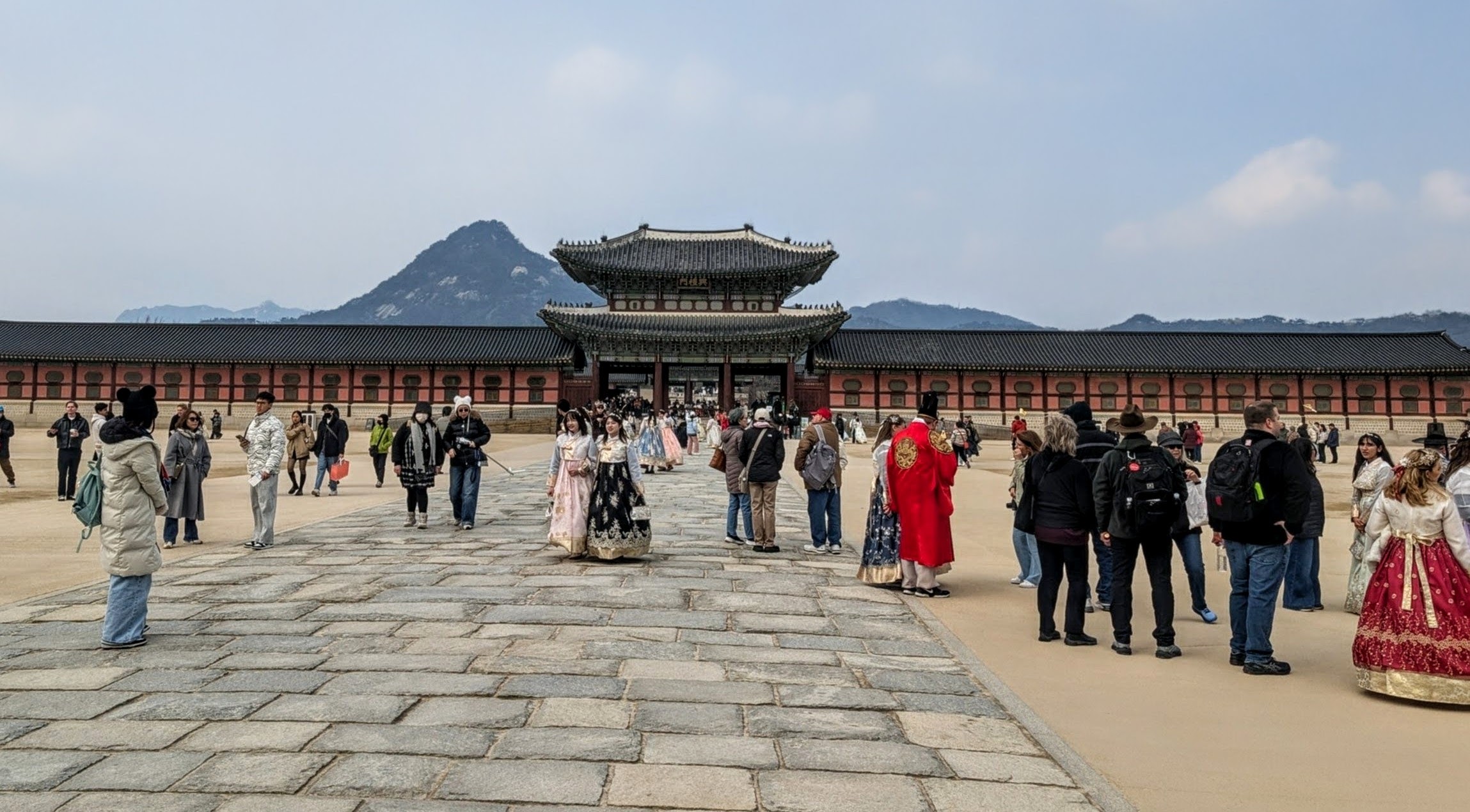
The access to the grounds of the palace is free and, similarly to Bukchon Village, many young people dressed in traditional costumes go there for another Instagram-destined shot with the majestic mountains in the background.
Back on the square, take a look at the bronze statues of Korea’s two most revered historical figures. One is King Sejong the Great, the creator of Hangeul (the Korean alphabet). I wrote about this monarch (HERE) previously.
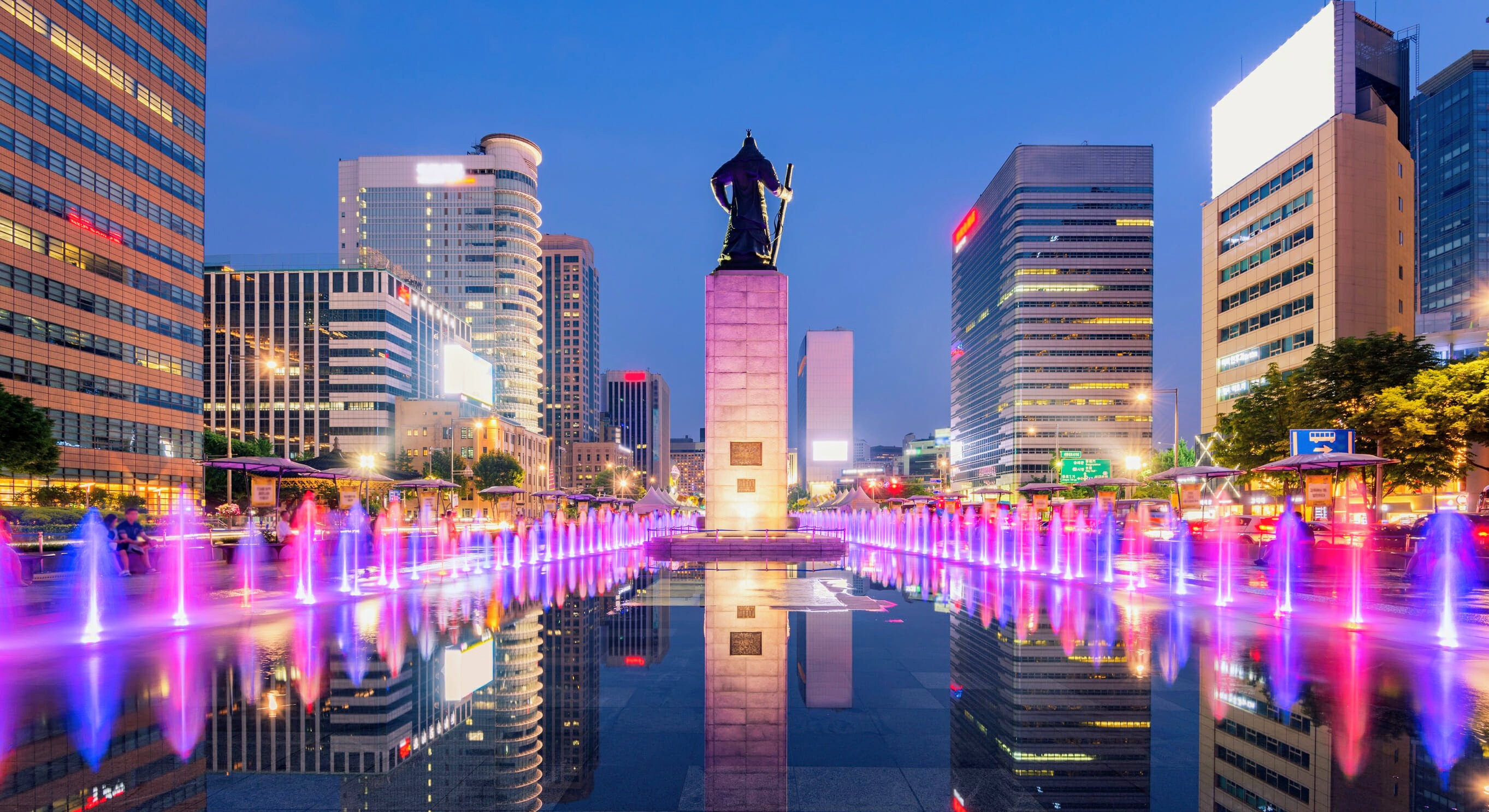
The second giant statue depicts Admiral Yi Sun-sin, a 16th century naval hero who defended Korea against invasions from Japan, a nation with a long history of tensions with Korea. In front of him is the 12.23 Fountain, named for the 23 battles he won with only 12 warships.
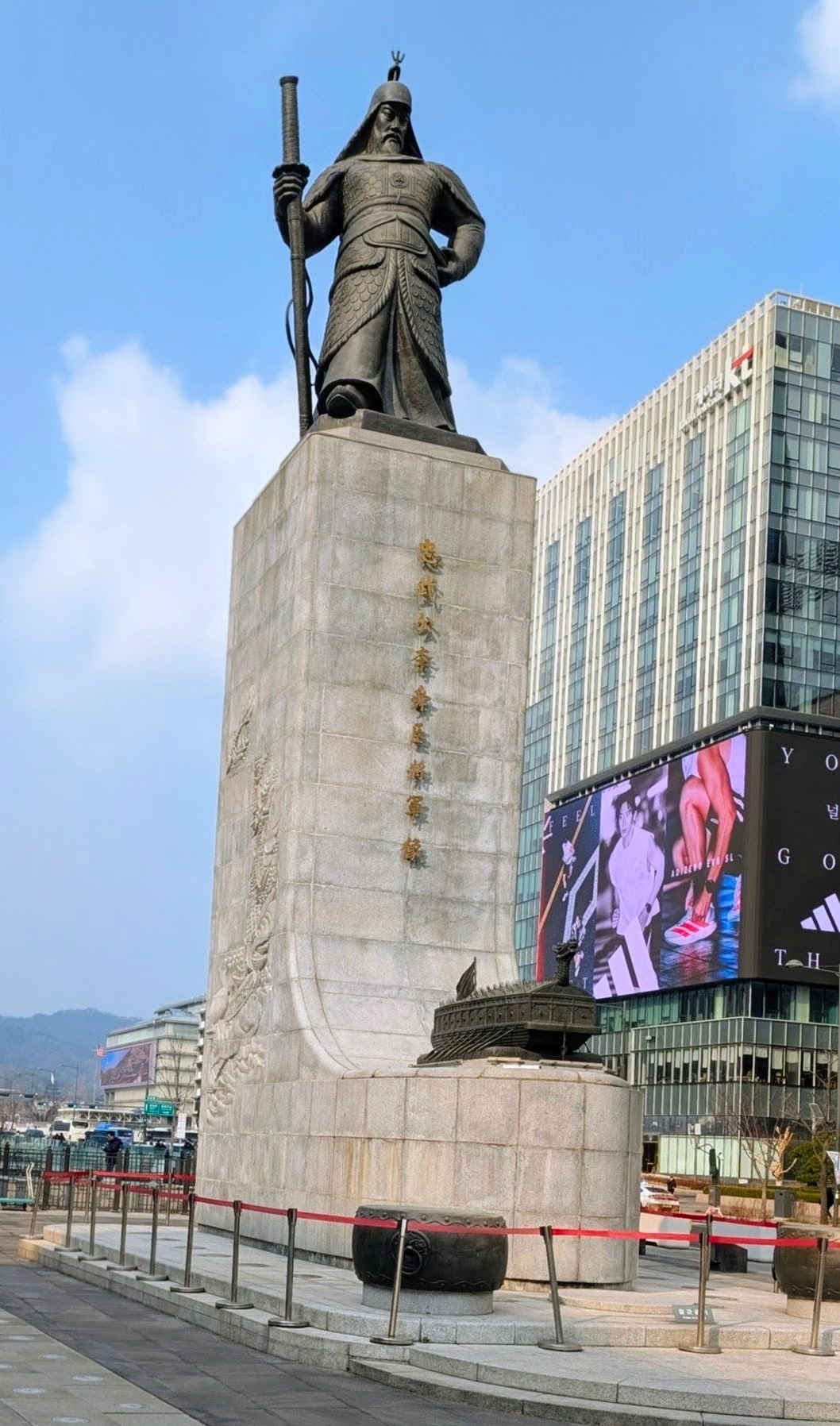
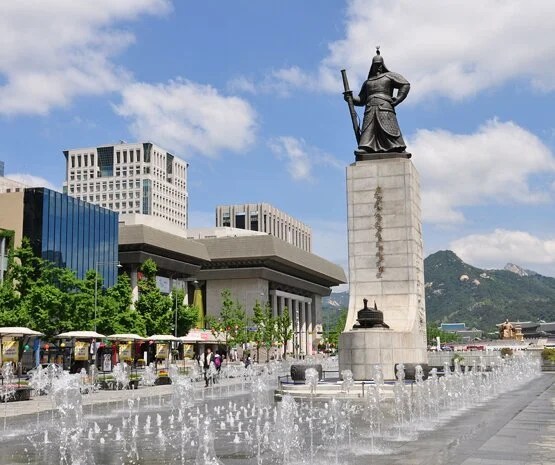
Even if you are not interested in Korean history at all, Gwanghwamun is still worth visiting. It is a spot where modern buildings contrast with the granite peaks of Bugaksan Mountain.
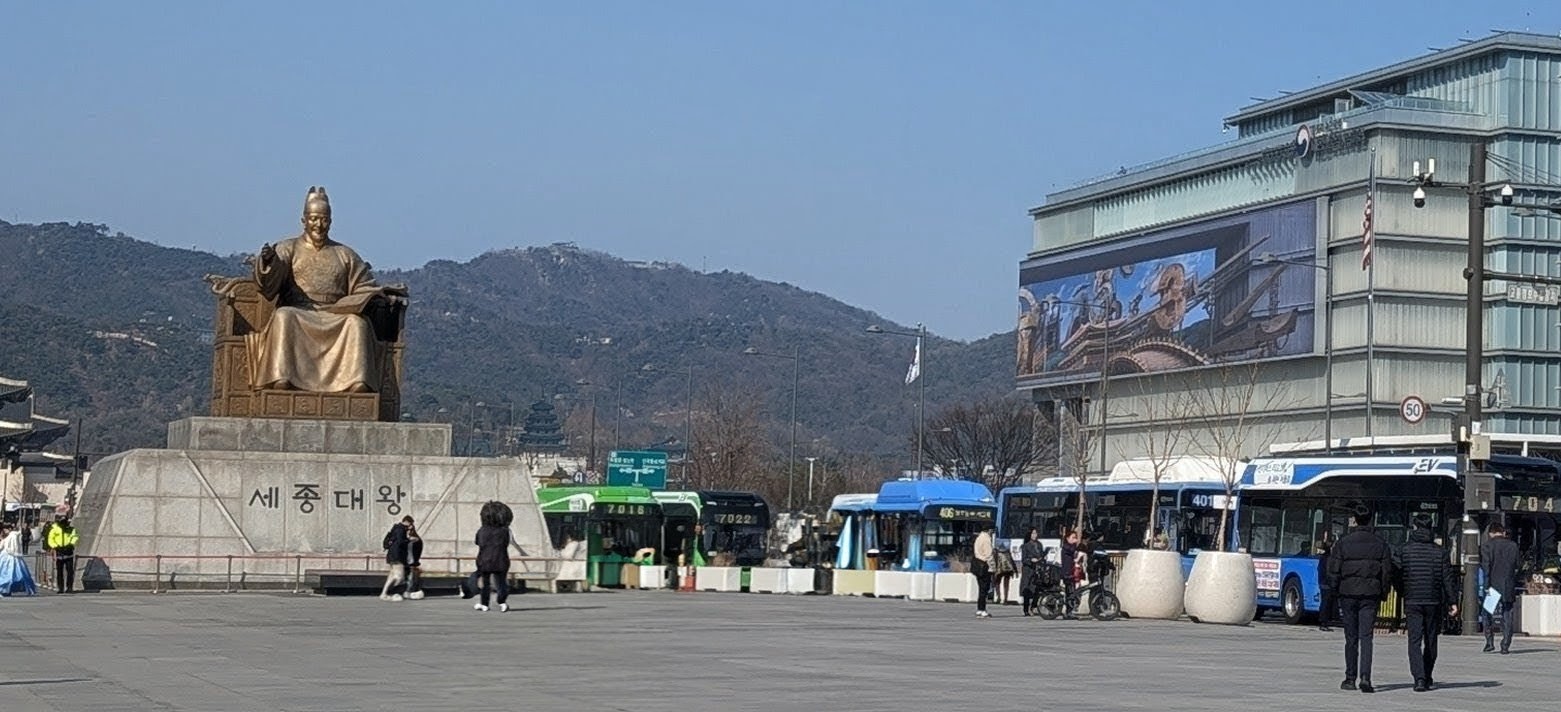
Time permitting, also try to come back at night. You will see how the square transforms into a much more modern and flashy version of itself with large-scale media facades and giant LED screens on surrounding buildings.
While both Bukchon Hanok Village and Gwanghwamon Square are main tourist drags, my third historic destination in Seoul was a place that remains overlooked by most tourists. I am talking about the National Cemetery.
Located along the Han River, it is relatively far from central Seoul. The best way to get there is to take the subway to Dongjak Station. The cemetery was established in 1955 as the country’s “Nation’s Sanctuary” to honor those who sacrificed their lives for Korea.
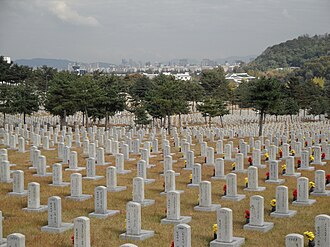
Alongside over 170,000 military people and other patriots, the National Cemetery is the burial site for four Korean presidents.
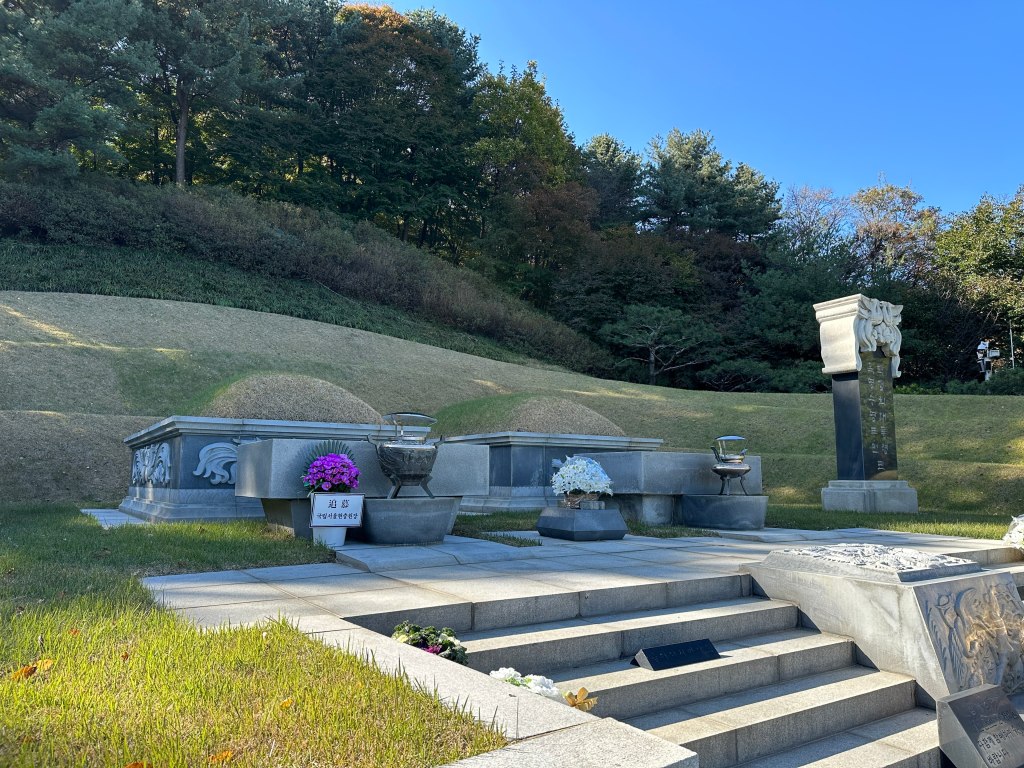
The most visited memorial belongs to the controversial President Park Chung-hee. A dictator and longterm military ruler (1961-78), he is at the same time credited with the “Miracle on the Han River,” which transformed Korea from a war-torn agrarian society into an industrial powerhouse.
He rests beside his wife, First Lady Yuk Young-soo, who was assassinated in 1974 by a North Korean sympathizer while attempting to protect her husband during a speech.
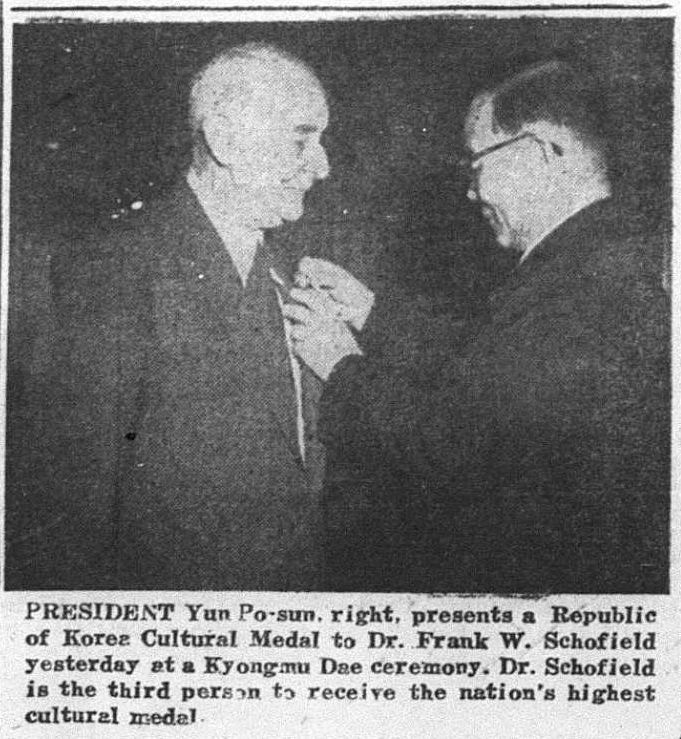
Despite the strict provision restricting burial to Koreans only, there is one non-Korean buried here. This is Frank Schofield. A Canadian missionary and veterinarian, he was deeply engaged in the March 1st, 1919 Independence Movement and the first major peaceful protest against Japanese colonial rule which lasted from 1910 to 1945.
Frank risked his life to photograph and document Japanese atrocities and then smuggled the evidence out to the world. In recognition of his exceptional contribution to Korea’s fight for independence, he was even given the Korean name Seok Ho-pil.
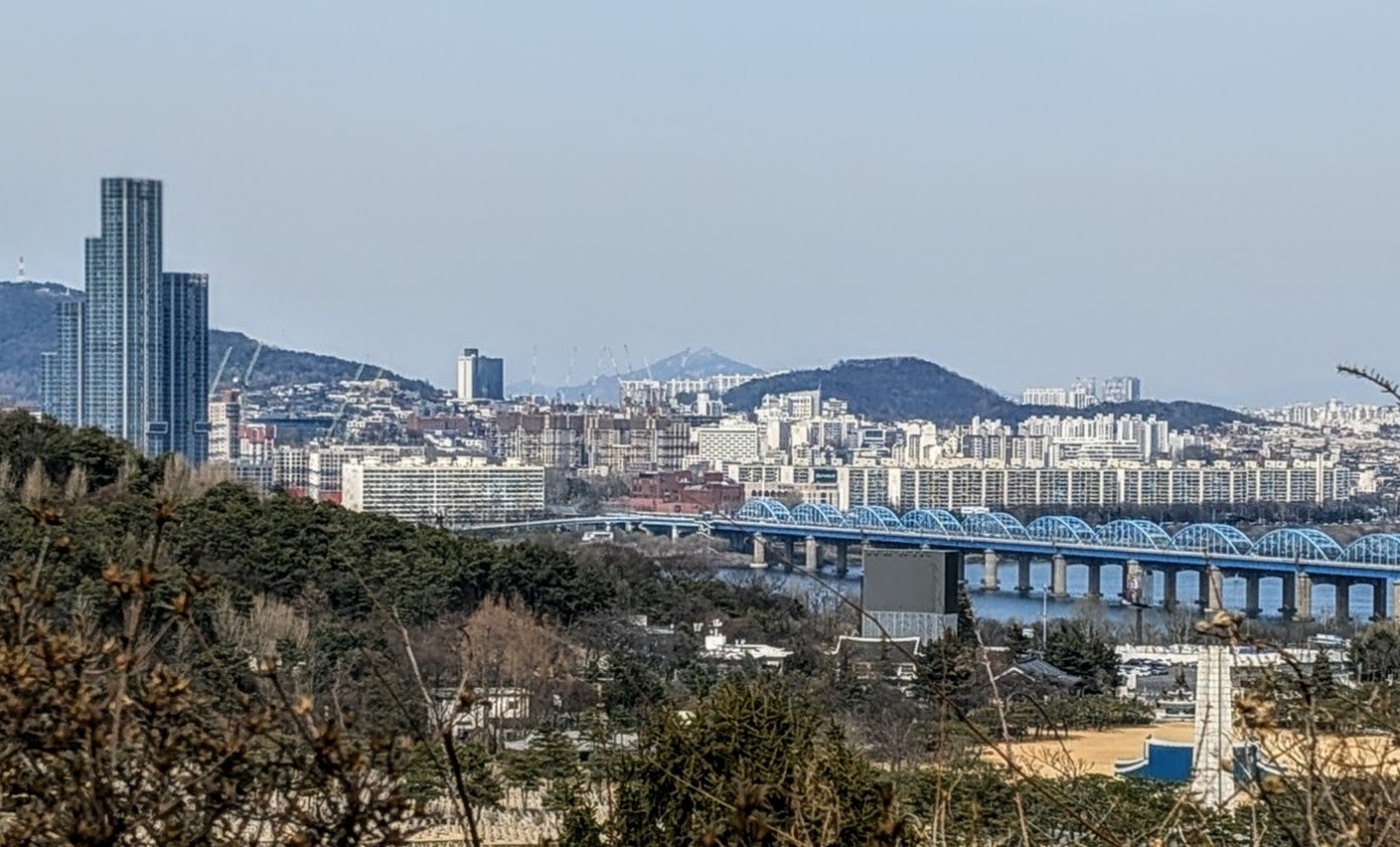
Occupying an impressive 1.43 million square meters (roughly 353 acres), the National Cemetery has many hills, trails, and patches of forest. Walking there feels like being very far away from the giant city that is literally “around the corner.”
I learned later that the geographic layout of the National Cemetery uses a “feng shui” approach, an ancient Chinese practice of arranging environments in a manner that harmonizes with natural energy (chi) and promotes happiness and prosperity. Apparently, the ridges surrounding the Cemetery form a U-shape said to resemble a phoenix protecting its eggs.
Regardless, I had a great time exploring this place and learning about many personalities who shaped recent Korean history.
My Three Favorite Frames in the Instagram-Obsessed City
I noted already that people in Seoul are devoted “instagrammers.” Many of them would go long ways to capture the best possible shot and share it on social media. That is actually for a good reason. Seoul is full of visually appealing spots: from futuristic architecture to various art installations.
In 2026, the Korea Tourism Organization launched a new “Space Brewing” initiative. The idea is to shift from mere sightseeing to ‘immersive density,’ which means to fully experience a place rather than simply looking at it. Just as coffee brewing requires specific conditions to fully extract flavors, “Space Brewing” seeks to “extract” the maximum emotional connection to a place and create environments that stimulate all senses.
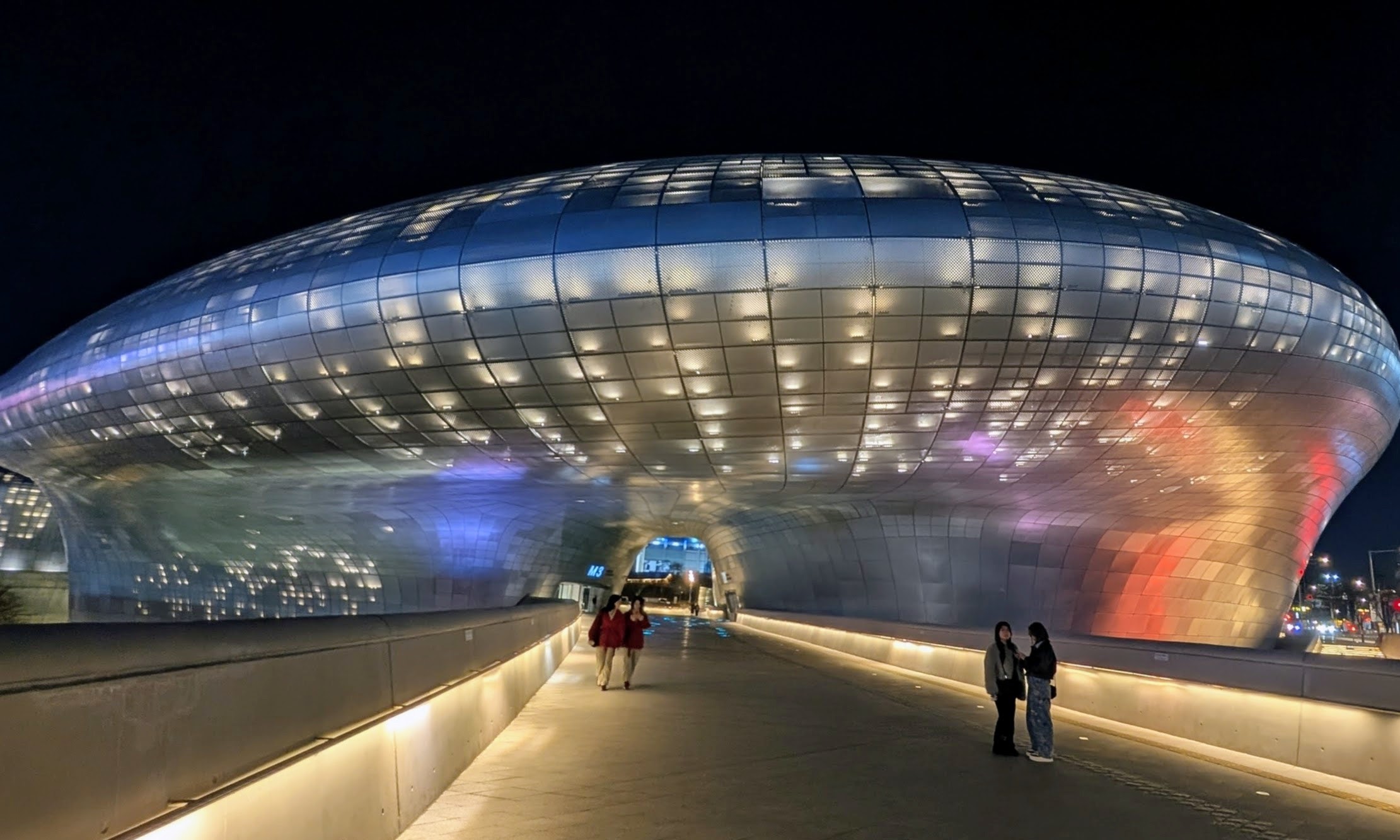
My three favorite picture-perfect spots all fit into this new concept although they came into existence a while ago. The first is Dongdaemun Design Plaza (DDP). It is both a square in central Seoul and the massive multi-level complex which looks like a giant silver bullet or alien spaceship.
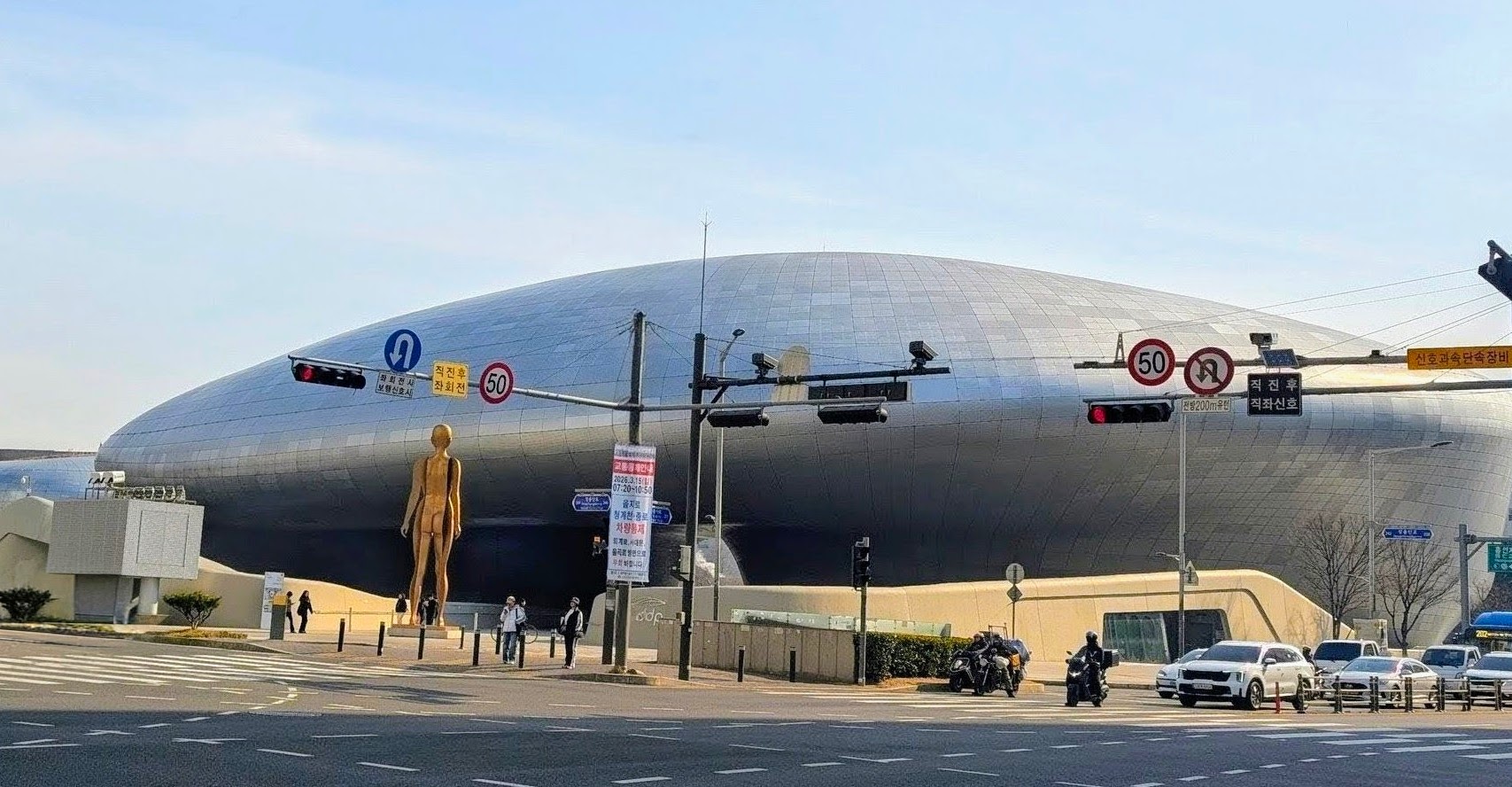
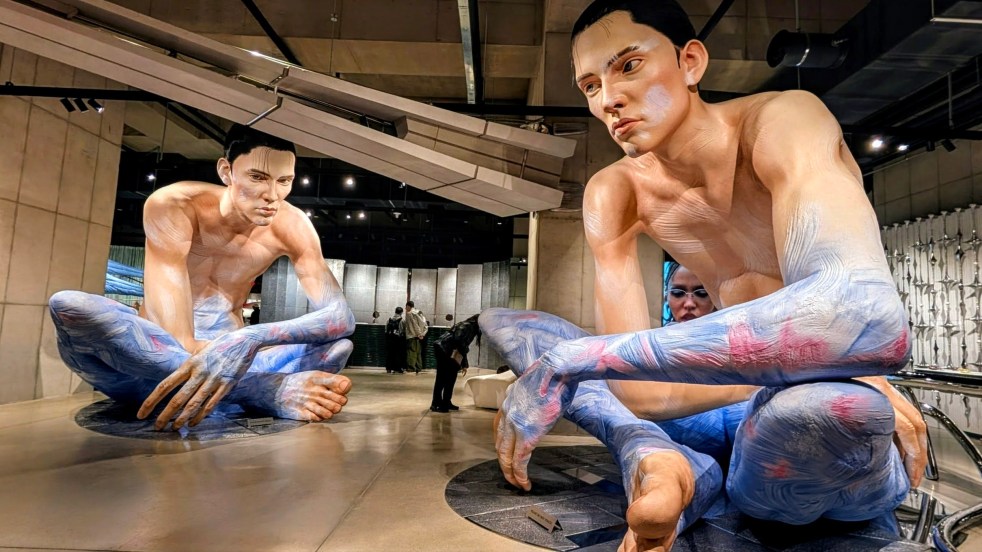
Over 45,000 shining aluminum panels create a curving facade that feels like flowing waters. Combined with a giant bronze “humanoid” statue in front of it, the whole setting turns into what can be best described as a “meditative landscape.”
Later I learned that this statue is called “Shadow of Shadow – the Road”, and it was created by the same sculptor who authored a much more traditional monument of King Sejong the Great at Gwanghwamun PLaza. As futuristic as it looks, however, the “Shadow of Shadow” was inspired by the ancient Zen Buddhist concept of “form is emptiness, emptiness is form.”
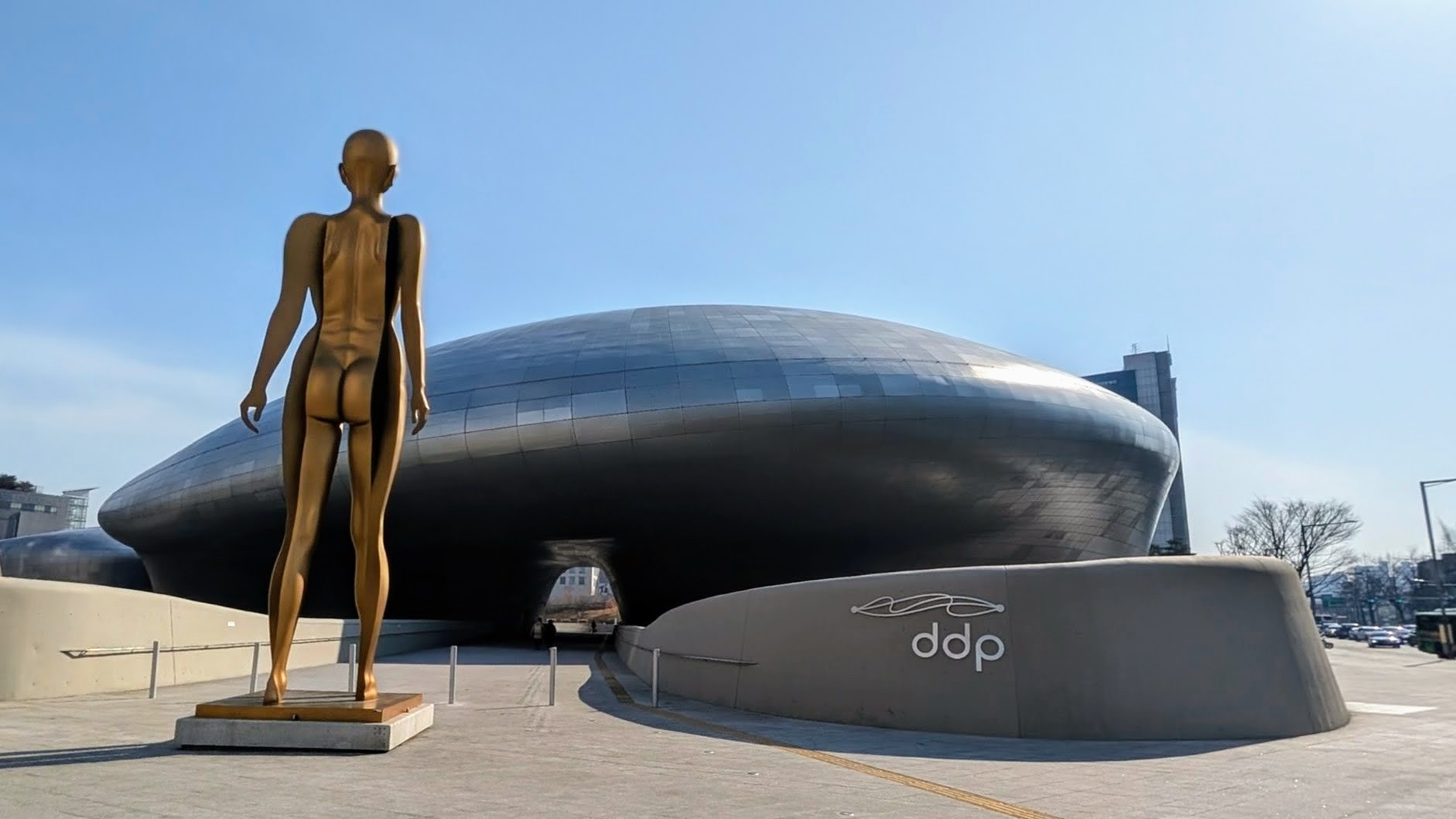
The four levels above and three levels below the ground of Dongdaemun Plaza are packed with various attractions: design shops and labs, art halls, exhibition spaces, places to eat, and much more.
If you have time, I suggest joining the tours offered by the Museum of Dongdaemun Plaza. One focuses on the building and surrounding art installations, while the other takes visitors to the rooftop for a walk and a 360-degree view of the city skyline. Use this official website to get tour tickets and find out about various events at Dongdaemun PLaza.
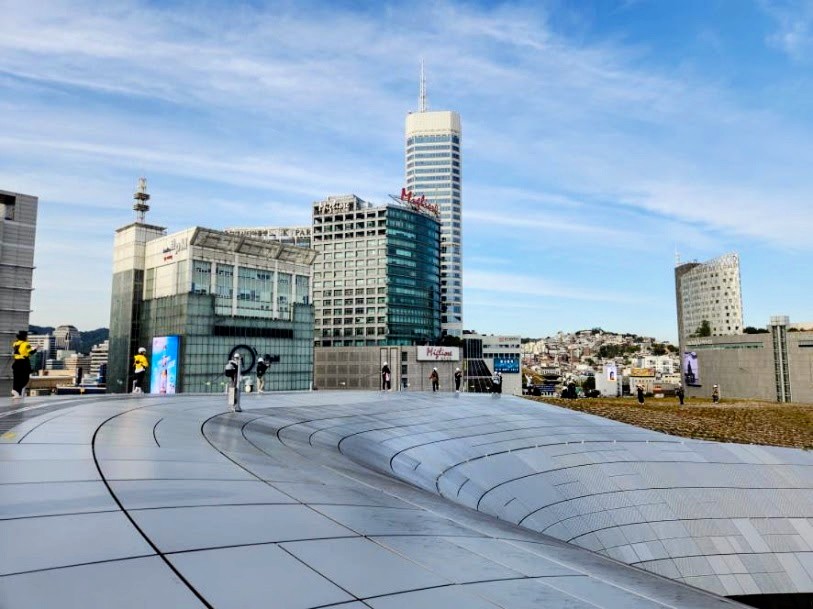
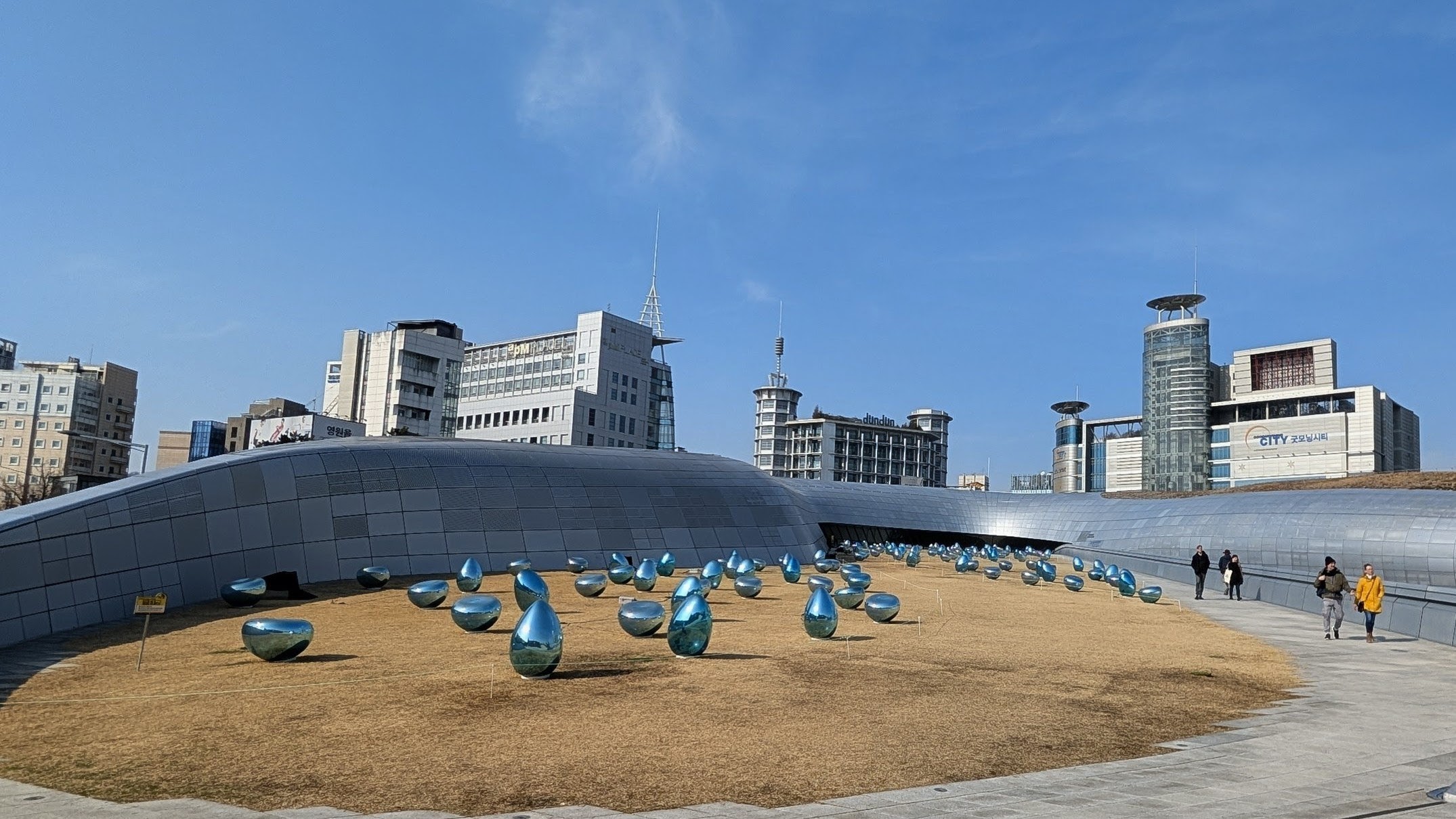
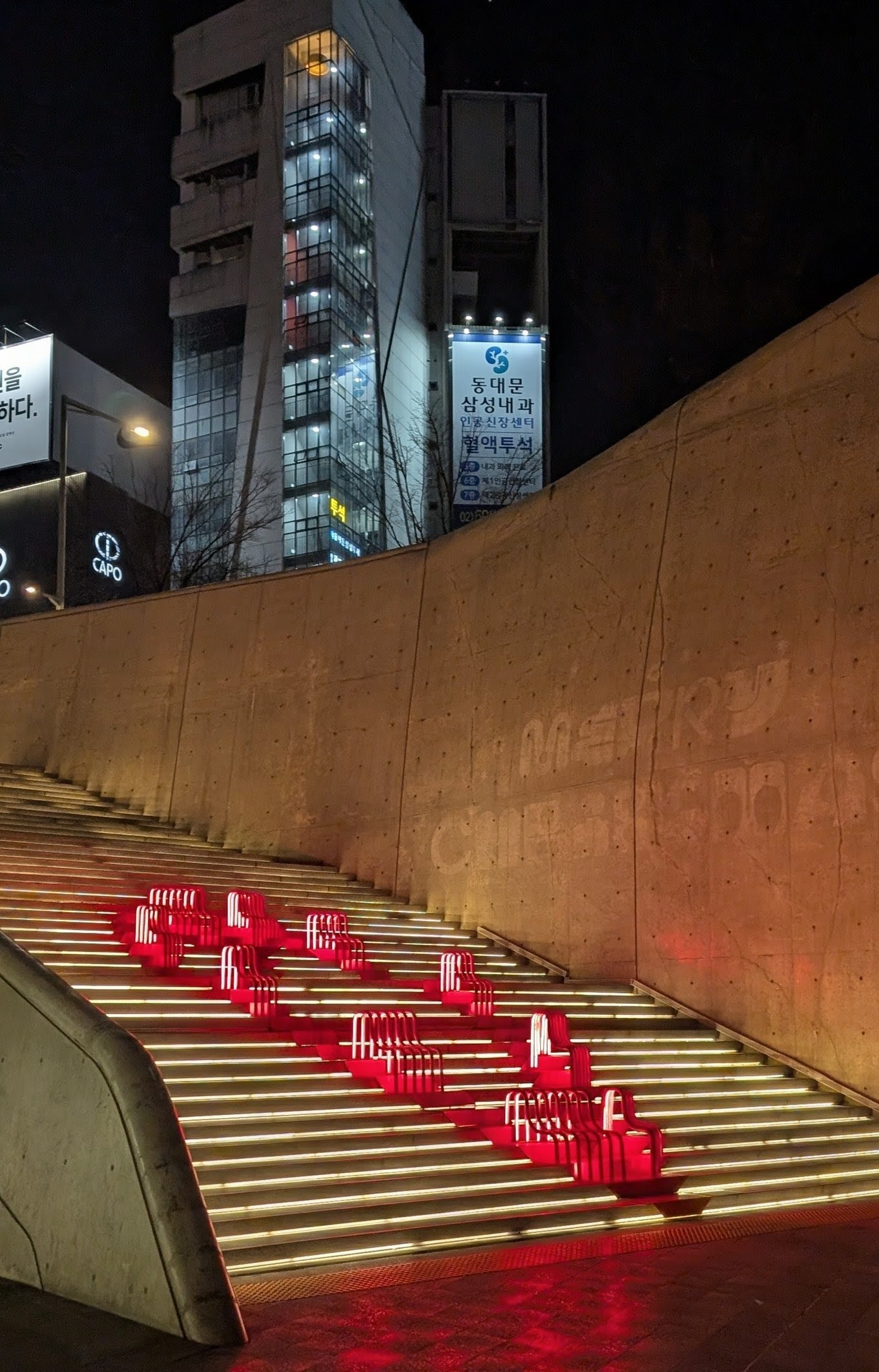
If your time is limited, simply walk through the passage in the middle of the building and around the Plaza. Each turn will give a different perspective, plus you will discover some cool outside art installations.
One more recommendation. Dongdaemun Plaza is in the center of the city, and the Dongdaemun History & Culture Park subway station is integrated into the lowest level of the building. So, it won’t take much time to return after dark.
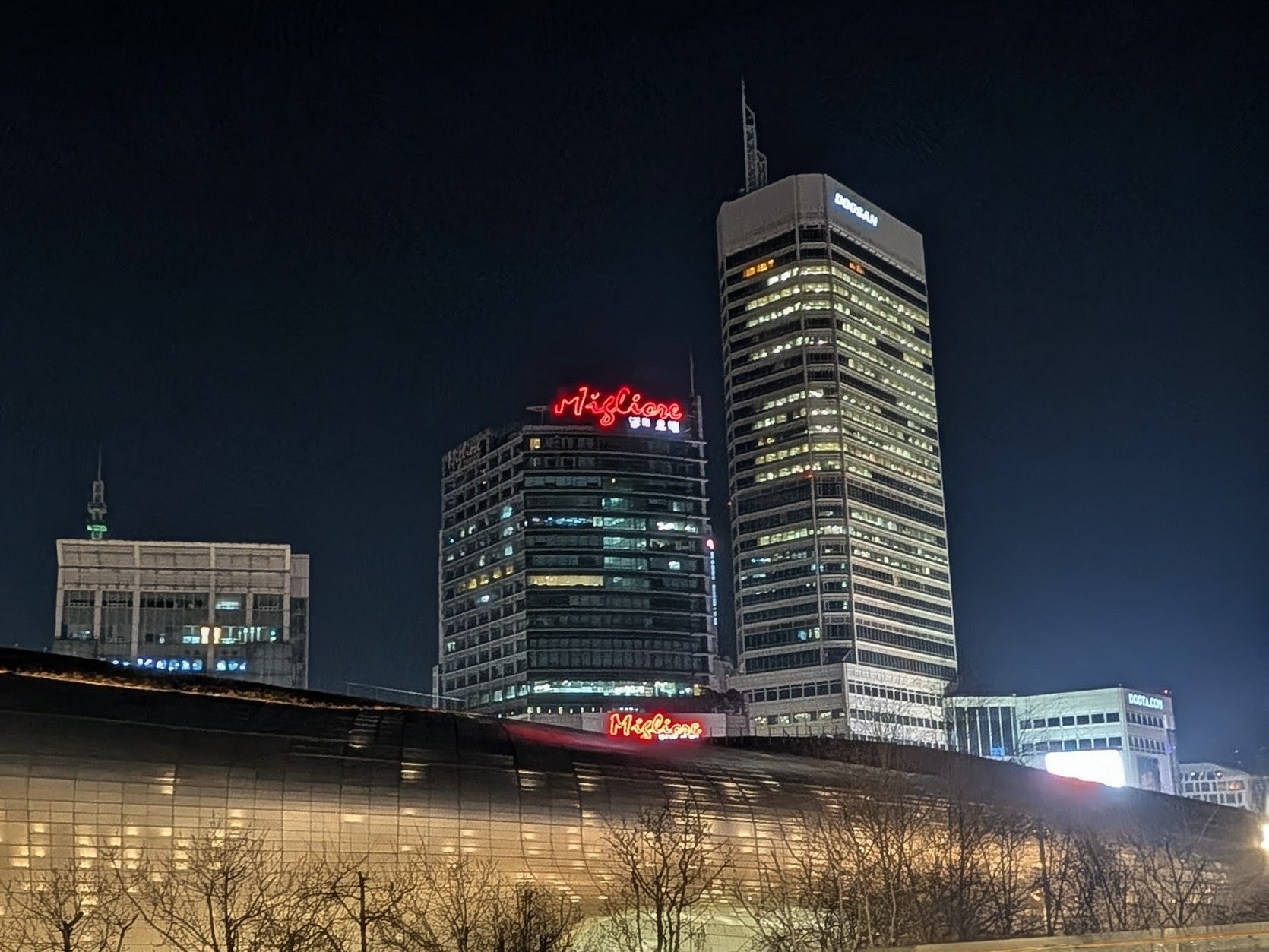
I promise that exploring this place at night will be an even more “immersive and futuristic” experience than the one during daylight.
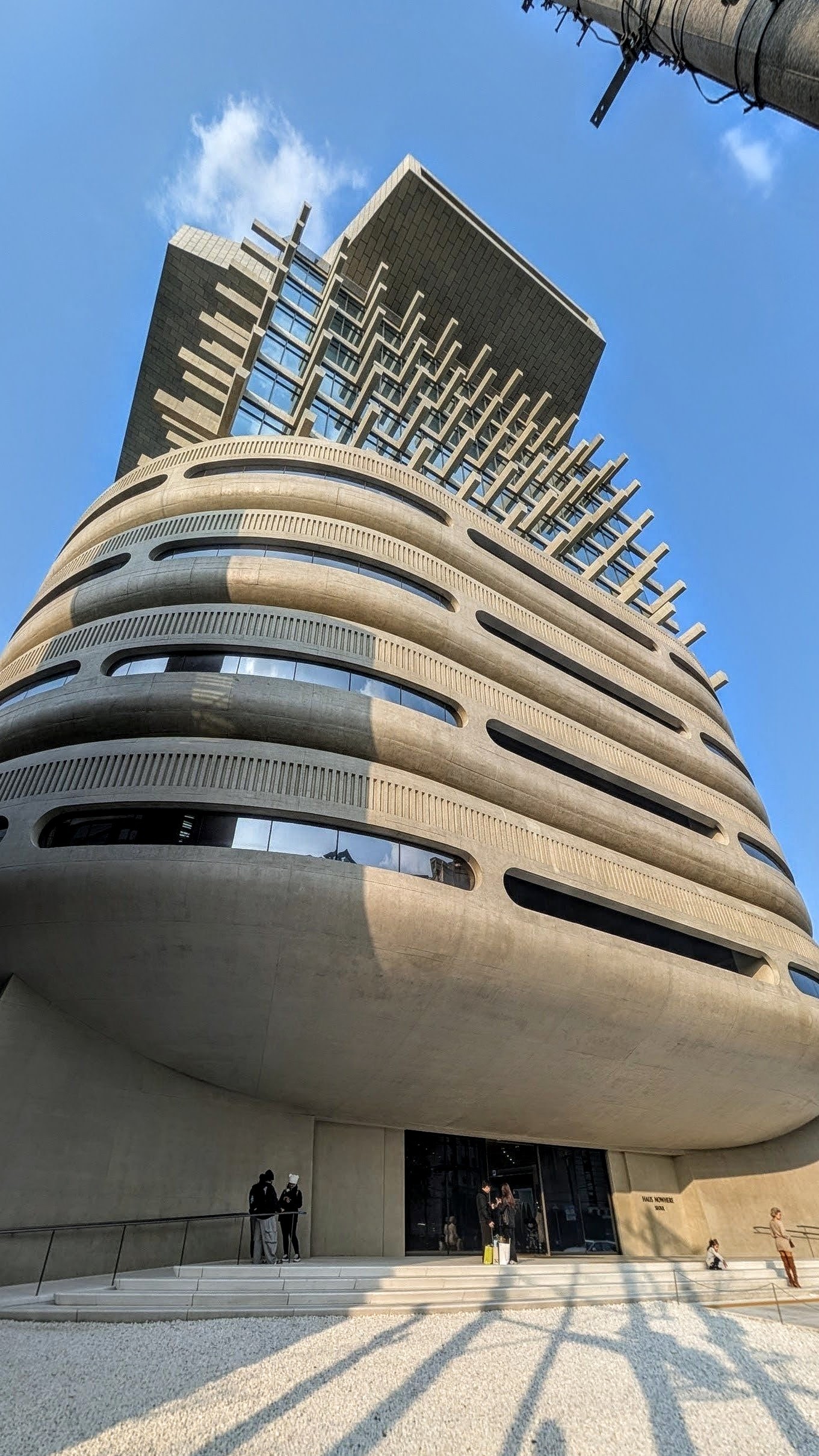
The other great destination for a “visual spectacle” and “immersive wonderland” is House Nowhere Seoul. It is a 14-story brutalist tower designed by IICOMBINED, the creative company behind the global fashion brands Gentle Monster, Tamburins, and Nudake.
House Nowhere is an embodiment of the company’s “Future Retail” philosophy. This concept replaces traditional commercial spaces with immersive surrealist environments and gallery-like stores. In essence, House Nowhere is a place that blends shopping with an otherworldly environment created by massive animatronic sculptures and kinetic art installations.
On the entrance level, I was greeted by a giant and cheerful Mickey Mouse – a photo opportunity I was unable to resist.
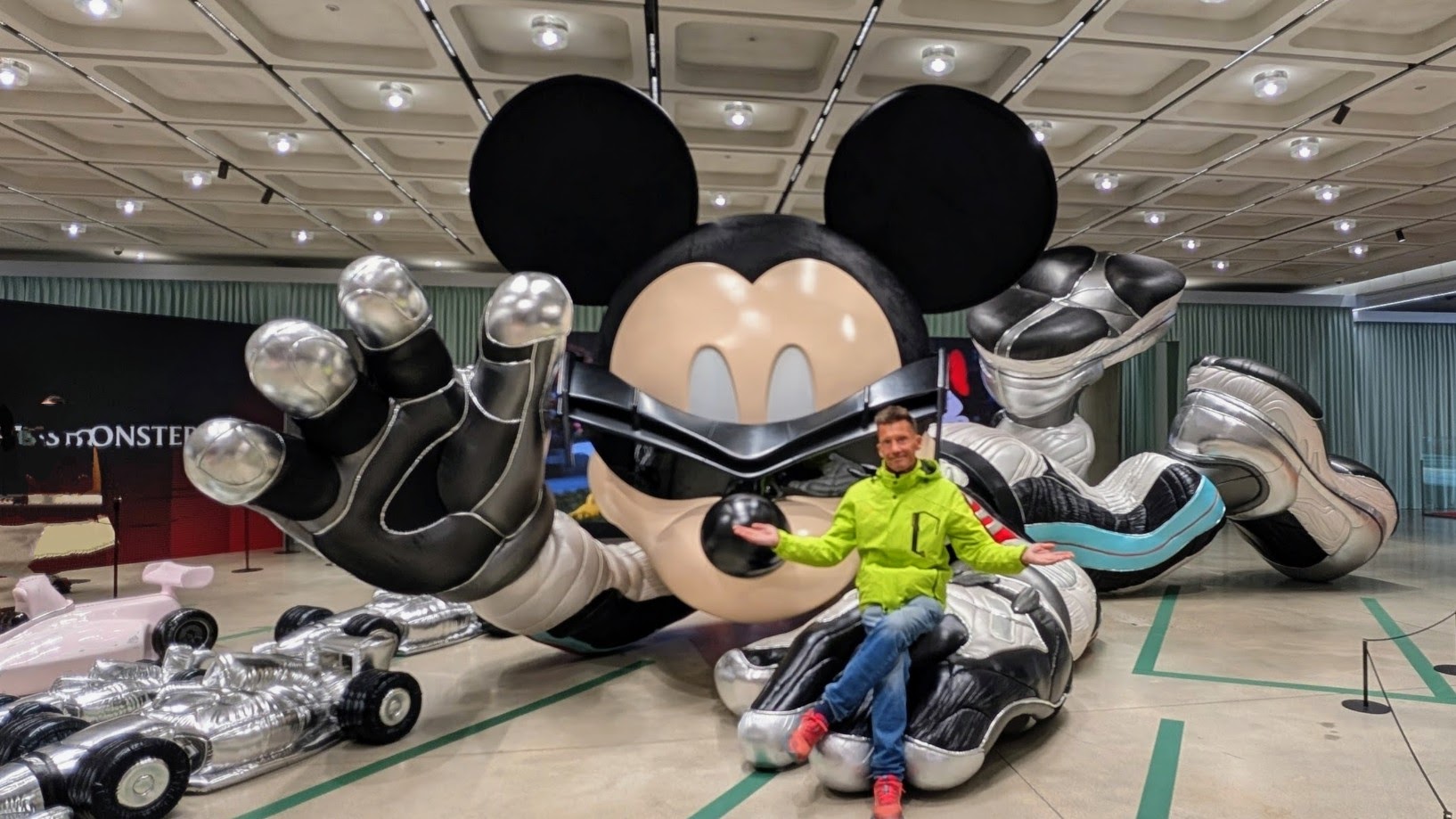
The second floor is given to Gentle Monster, a luxury eyewear brand that has gained global fame by blending high-end fashion with an avant-garde aestetic.
In its name, “gentle” refers to wearable, sophisticated products, while “monster” indicates experimental and sometimes absurd creativity. The core philosophy is that eyewear is a form of artistic expression rather than just a medical or fashion accessory.
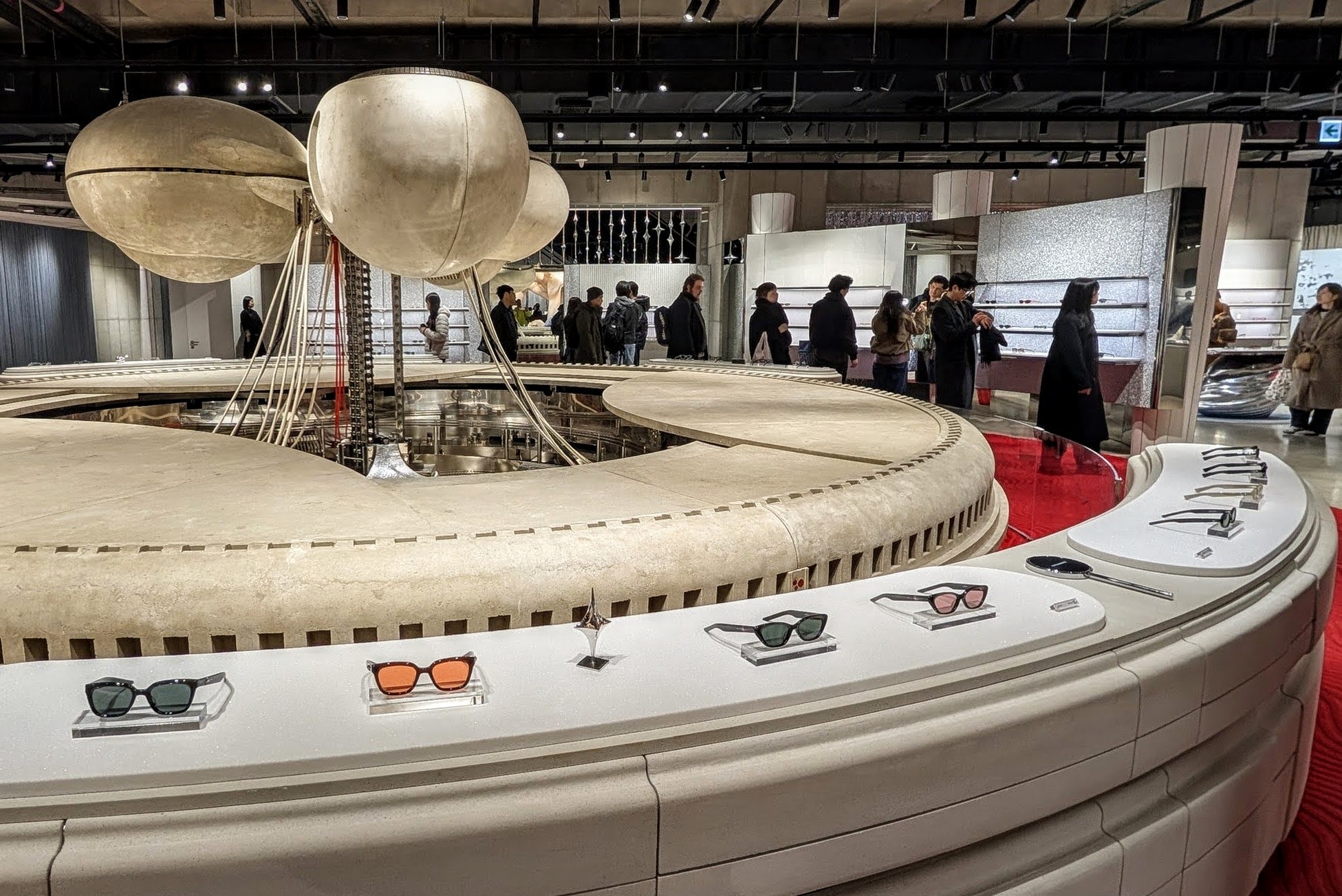
Gentle Monster is known for frequent changes of interiors and designs in its stores, which gives customers a reason to visit again and again even if they aren’t planning to buy anything.
I don’t use eyeglasses of any kind, but spent a good chunk of time admiring the artwork and installations.
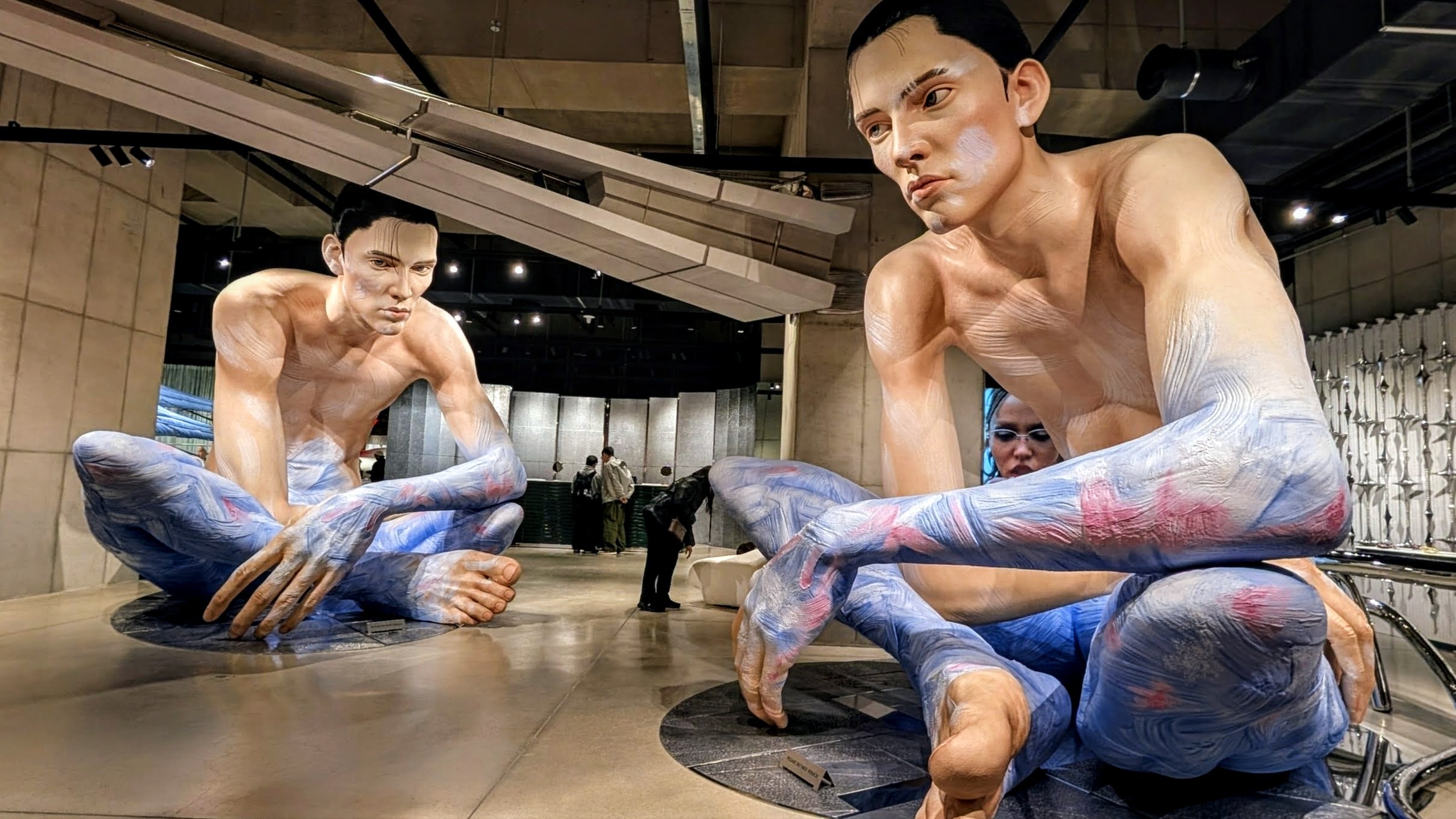
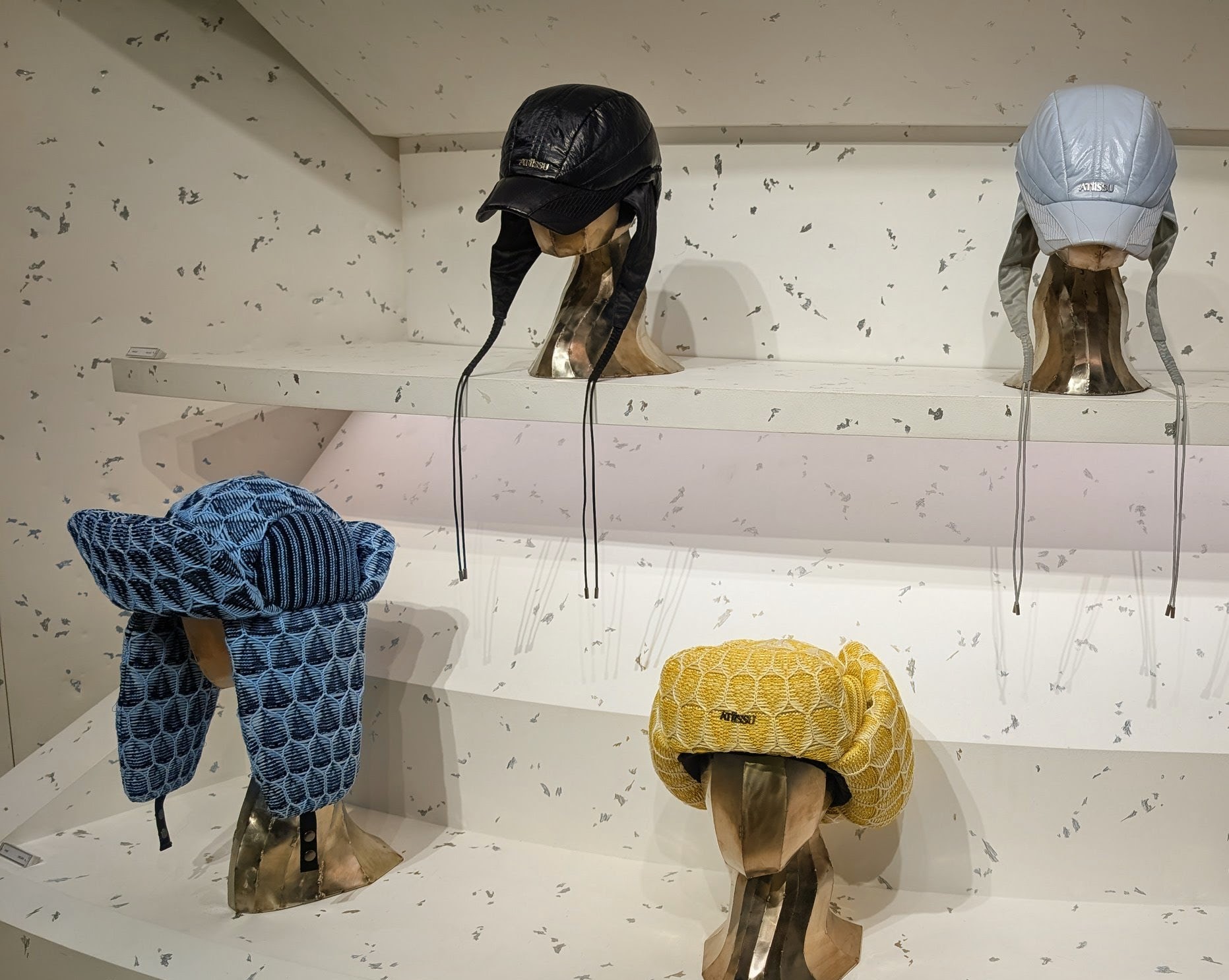
The next floor was shared between ATiiSSU (headwear) and Nuflaat (tableware) brands.
Nuflaat’s slogan – “Dress your table!” – implies that tableware is more like fashion objects rather than just utility items. I liked a lot the minimalist white ceramics, bold black rims, and wavy shapes – all resulting in a “surrealist spin” on everyday dining.
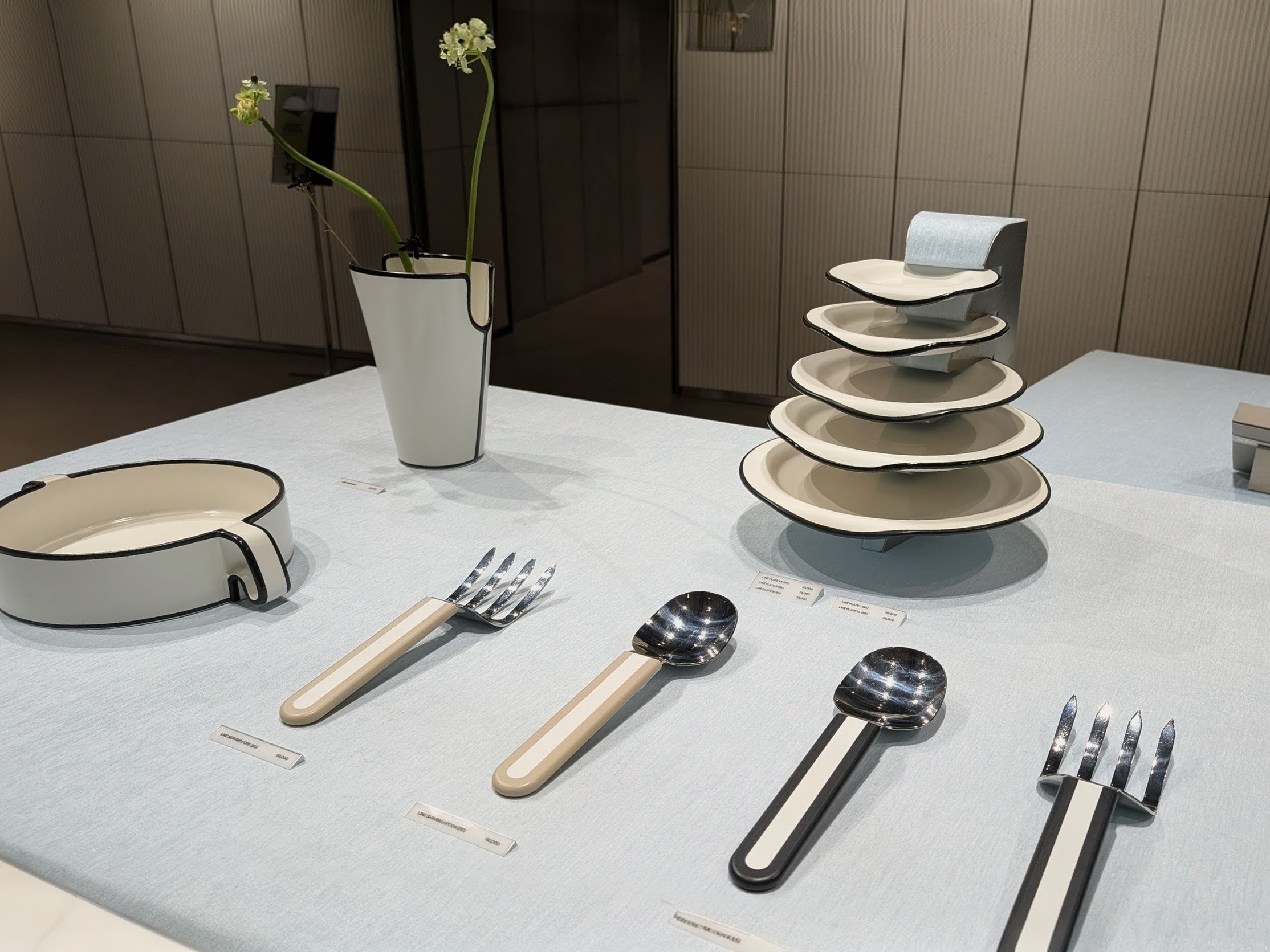
Regrettably, the price tag for Nufalat dishes and silverware was above my paygrade, and I simply looked at the installations which were as impressive as the ones I saw at the Gentle Monster store.
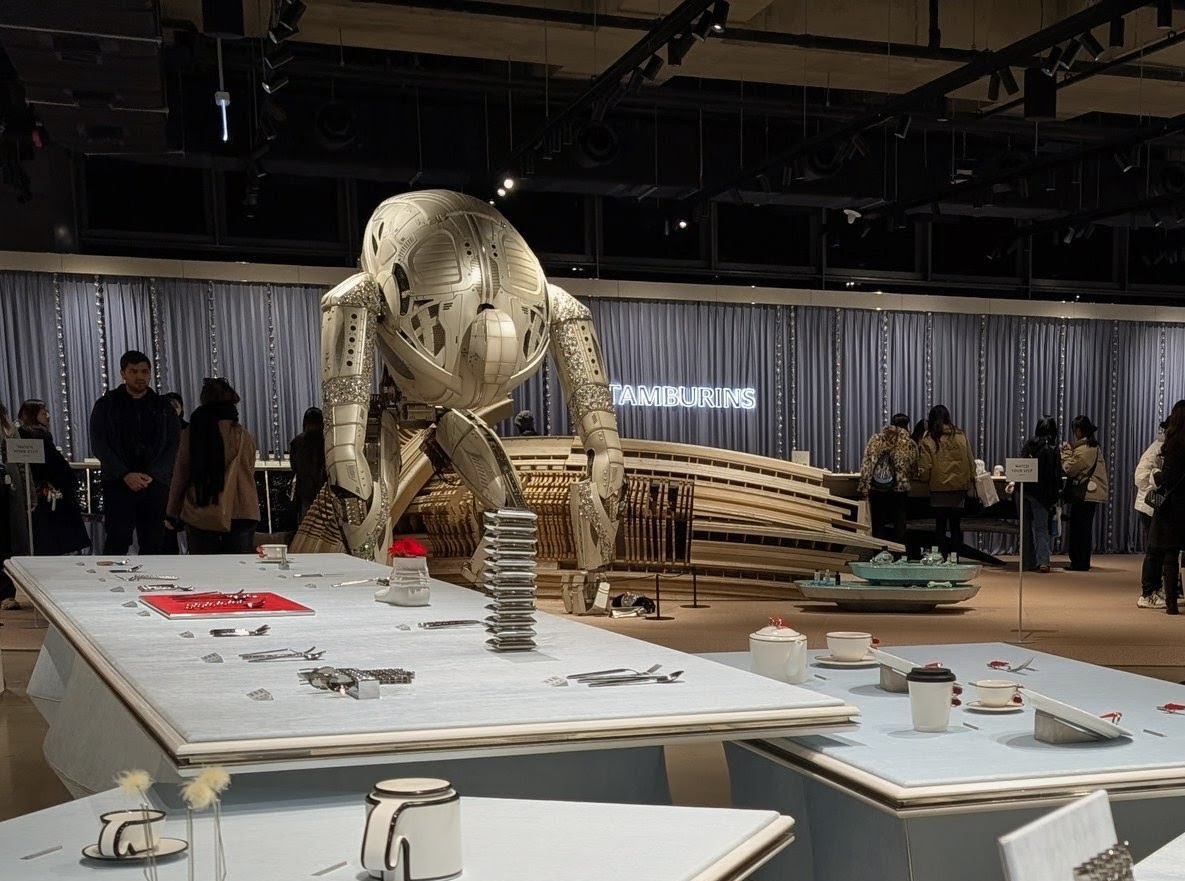
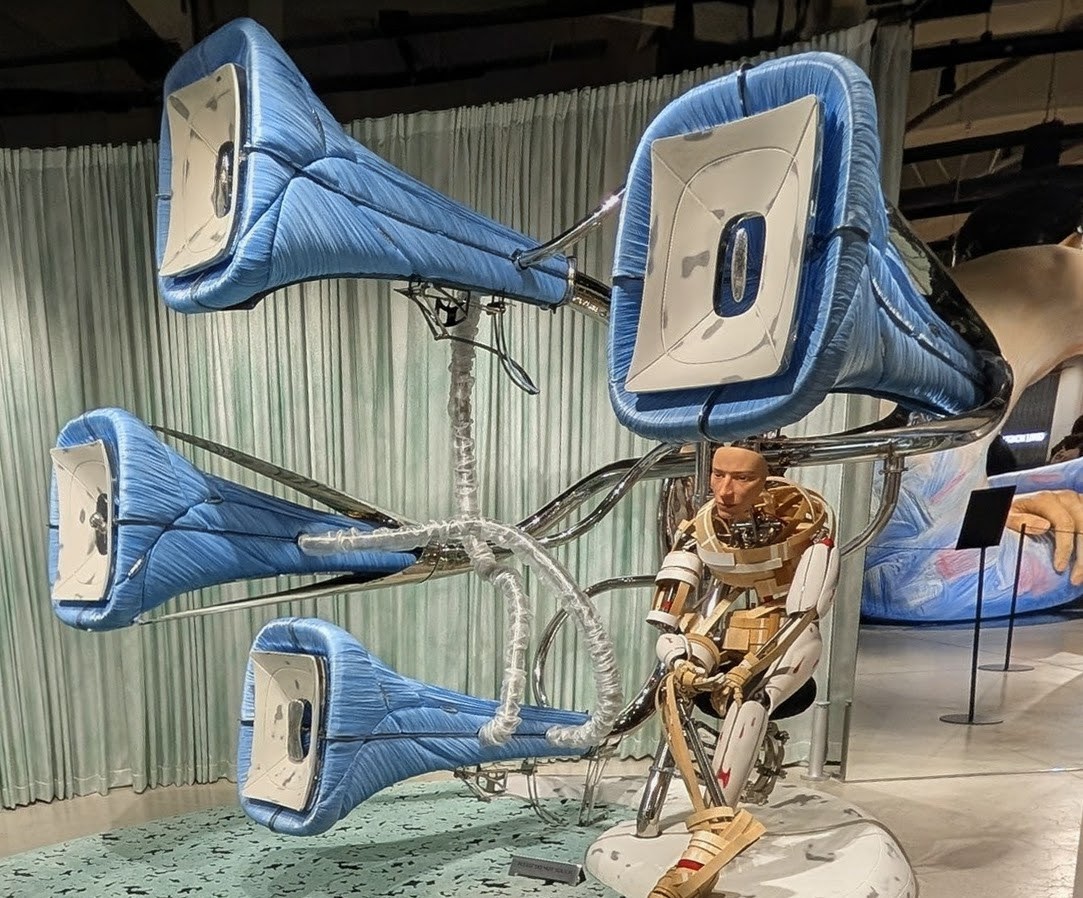
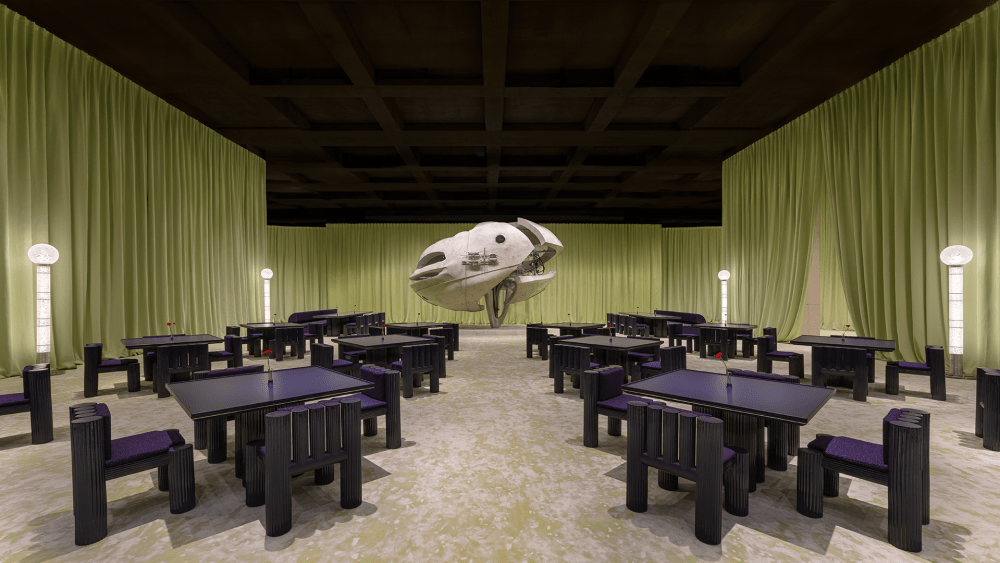
My time was limited and after seeing two floors, I ended my visit in the Nudake Teahouse. Located on the 5th level of House Nowhere, it is an experimental cafe that focuses on what is described as a “sensory tea experience.”
In order to fully focus on this goal the space is designed in a minimalist style, while various desserts are intended to be properly paired with scented teas.
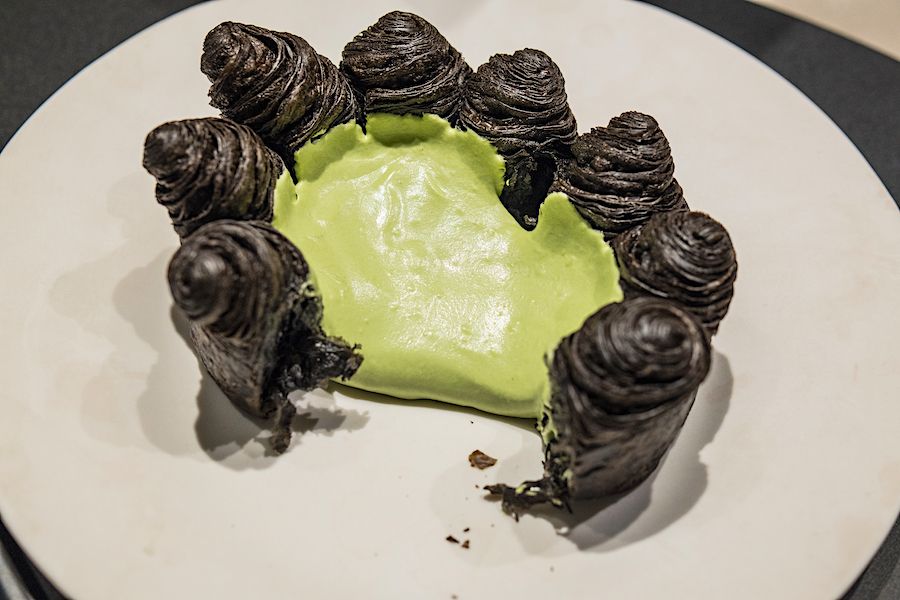
I chose Nudake’s classic Peak Cake, which is made of squid-ink mini-croissants with a matcha cream filling in the center. The “crust” was pleasantly flaky, and, although colored with squid ink, didn’t taste like seafood. Instead, it was slightly salty, buttery, and savory rather than sweet.
As to the filling, “matcha” is a finely ground powder of green tea leaves, and, as expected, the cream had a strong and earthy green tea flavor . All in all, it was a classic “sweet and salty” combination. And, indeed, a big part of the enjoyment was a suggested pairing with the #88 tea-blend, which was a mixture of green and black teas with added mint and citrusy yuzu fruit.
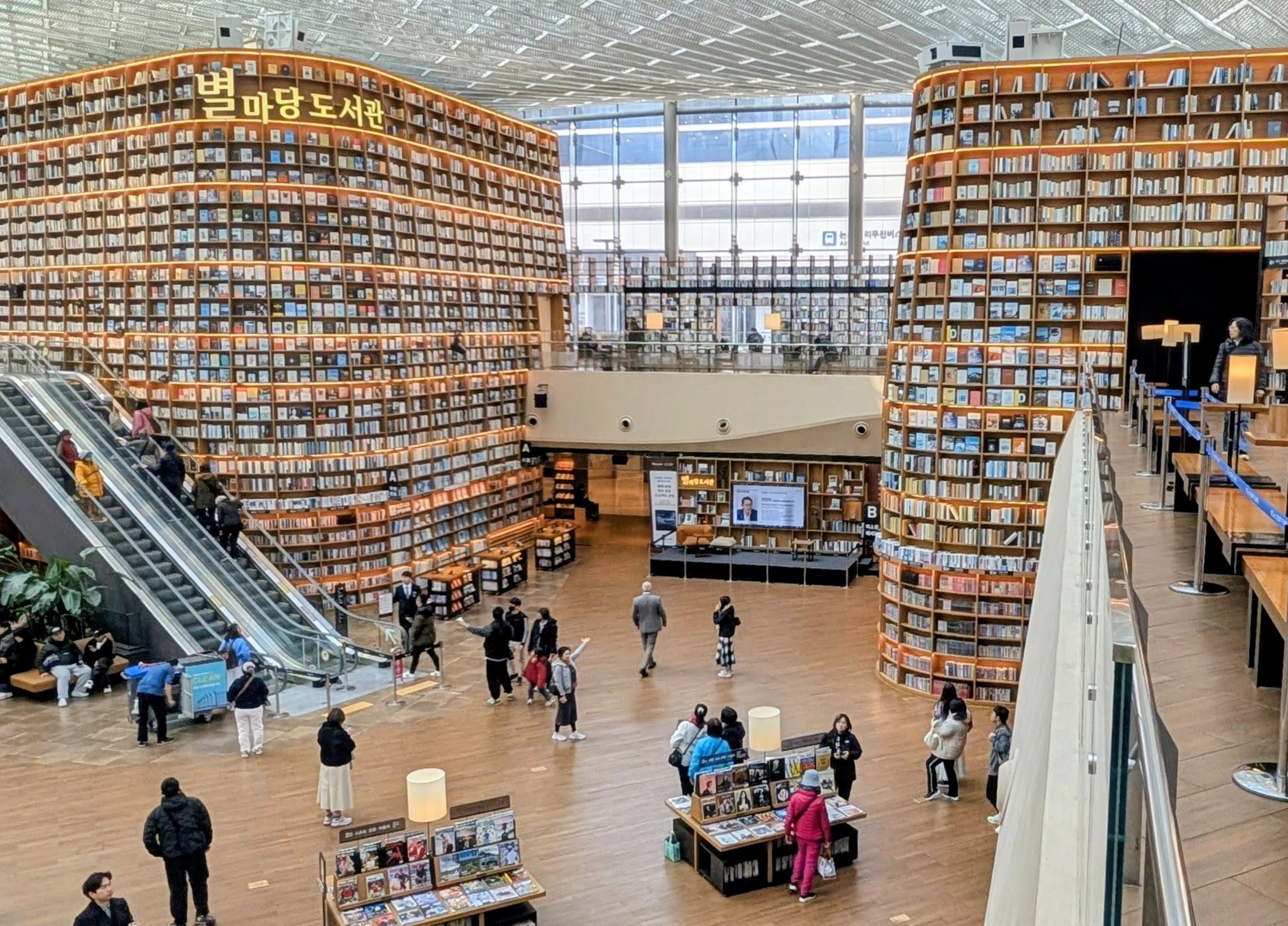
My third “instagrammable” visit in Seoul was to the Starfield Library, an immense public space in the very heart of the COEX shopping mall. Usually, when people hear “library,” their first thought is about quiet closed spaces with a single focus on reading or working. Starfield is very different both in appearance and function.
Its enthralling look comes from several elements. The first is the “walls,” which are made of floor-to-ceiling, 13 meter / 42 feet tall bookshelves holding over 50,000 books and magazines. The second is a multi-story “open square” layout inside a bustling mall. Finally, natural light flooding the space from the massive glass ceilings creates a sense of the skies unfolding right above you.
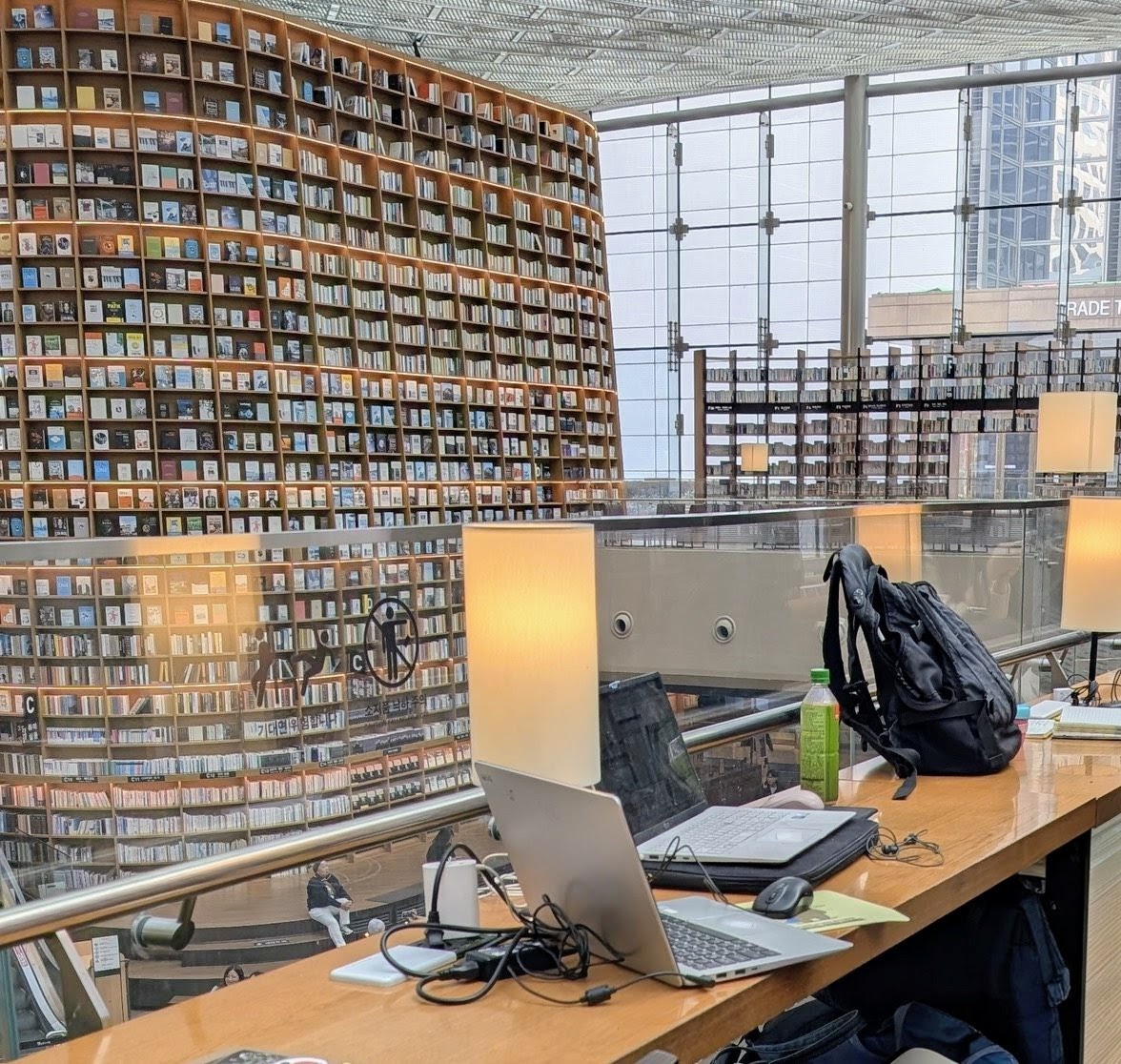
Was this space created solely “for fun?” The answer is: definitely “no.” On the one hand, it is designed as a social hub where people can meet or attend various cultural events (author talks, concerts). On the other hand, however, I saw many people who actually come here to read and work.
By the way, walking around and seeing many “abandoned” laptops, I was again impressed with the level of safety in Seoul. Even in the middle of a shopping mall, people were not afraid to leave their valuable belongings for an extended period of time.
Besides the Starfield Library, the COEX shopping mall has another arresting artistic landmark – the massive bronze monument dedicated to the 2012 global hit song “Gangnam Style.” The song’s viral success was driven by the accompanying “horse-riding” dance, which was later performed by many celebrities, athletes, and even political leaders (including Barack Obama and David Cameron).
If you missed and never heard “Gangnam Style,” here is the original performance by Korean singer Psy.
The Gangnam Style sculpture sits on the outdoor plaza right next to the east gate of the mall and depicts two giant, overlapping golden hands frozen in this “horse-riding” move. The base of the statue is equipped with motion sensors. When you stand under the hands, “Gangnam Style” automatically begins to play.
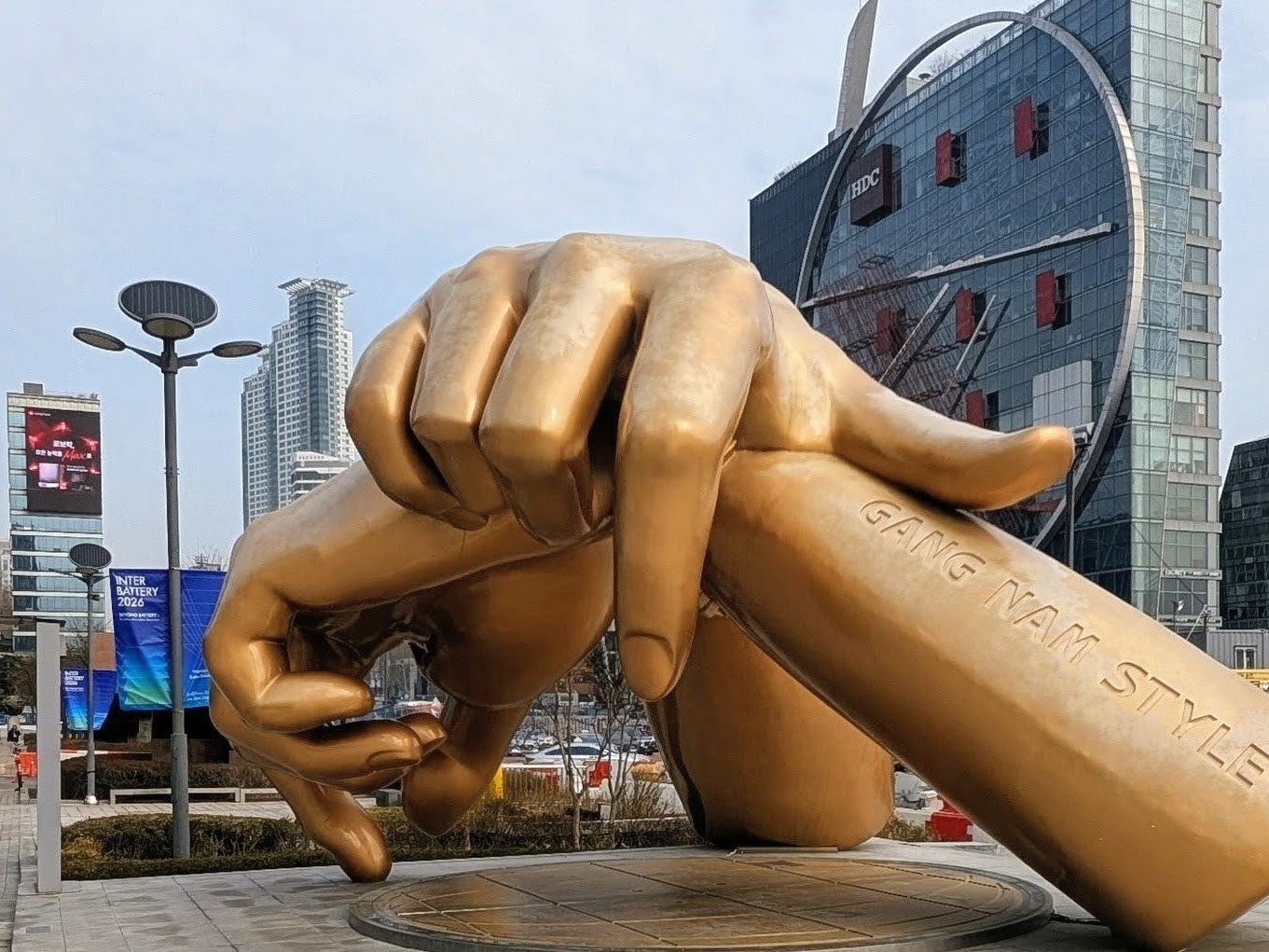
From the air, the hands appear to be wrapped around a globe, symbolizing the song’s worldwide impact. Indeed, it was the first YouTube video to surpass one billion views, and it held the title of the most-viewed YouTube video for nearly five years until July 2017.
Look, I introduced you to just three visually captivating landmarks of the Korean capital, but the whole city feels like a gallery of architectural and artistic juxtapositions. Being in Seoul, one constantly runs into places where a shimmering, futuristic ‘present’ stands in stark contrast to a more restrained and deeply rooted ‘past.'”
Flying Over Seoul
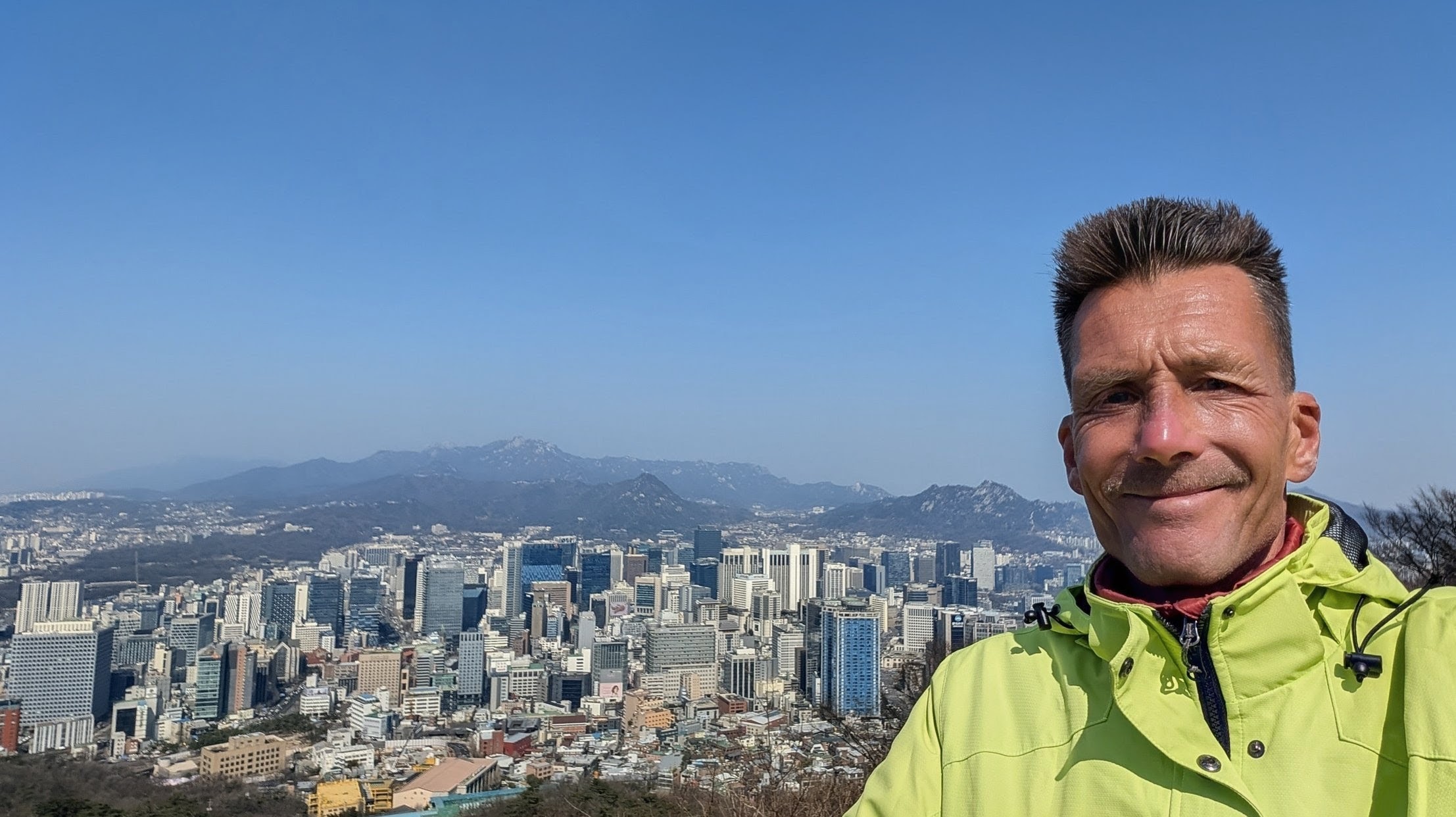
I take it back: I did not “fly” over Seoul. However, two places in the city will make you feel as though you are “soaring” over the South Korean capital. These are the N Seoul (“Namsan”) Tower and the Seoul Sky Observation Deck at Lotte World Tower (the 6th tallest in the world). The first offers a bird’s-eye perspective from 480 meters / 1,575 feet up, while the second will take you to an outdoor viewing platform at 486 meters / 1,600 feet.
As you can see from the picture, the Lotte Tower is much taller than Namsan Tower, but the latter is perched on the summit of Namsan Mountain. As a result, their observation decks are at almost the same elevation.
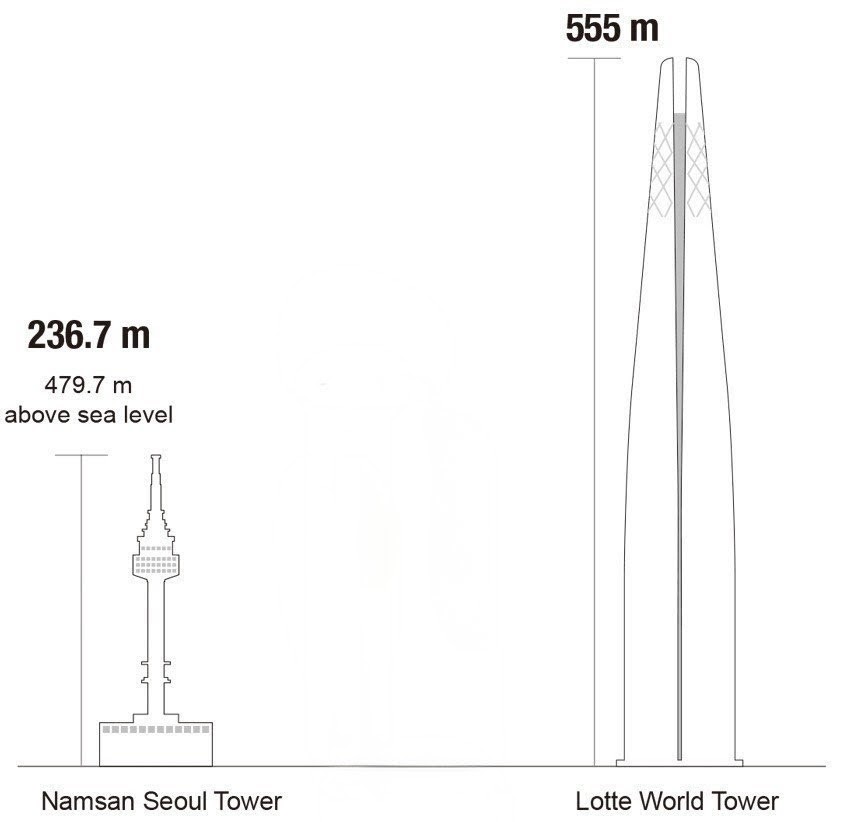
The settings of these towers are also quite different, each offering a unique atmosphere. My recommendation is to visit both: Namsan during the day and the Seoul Sky at sunset.
Namsan Tower sits in the middle of Seoul’s largest public park of the same name. With forested hiking trails and several interesting landmarks, Namsan Park is a popular destination on its own. As a result, when visiting Namsan Tower, the experience also includes getting to it and returning to the city.
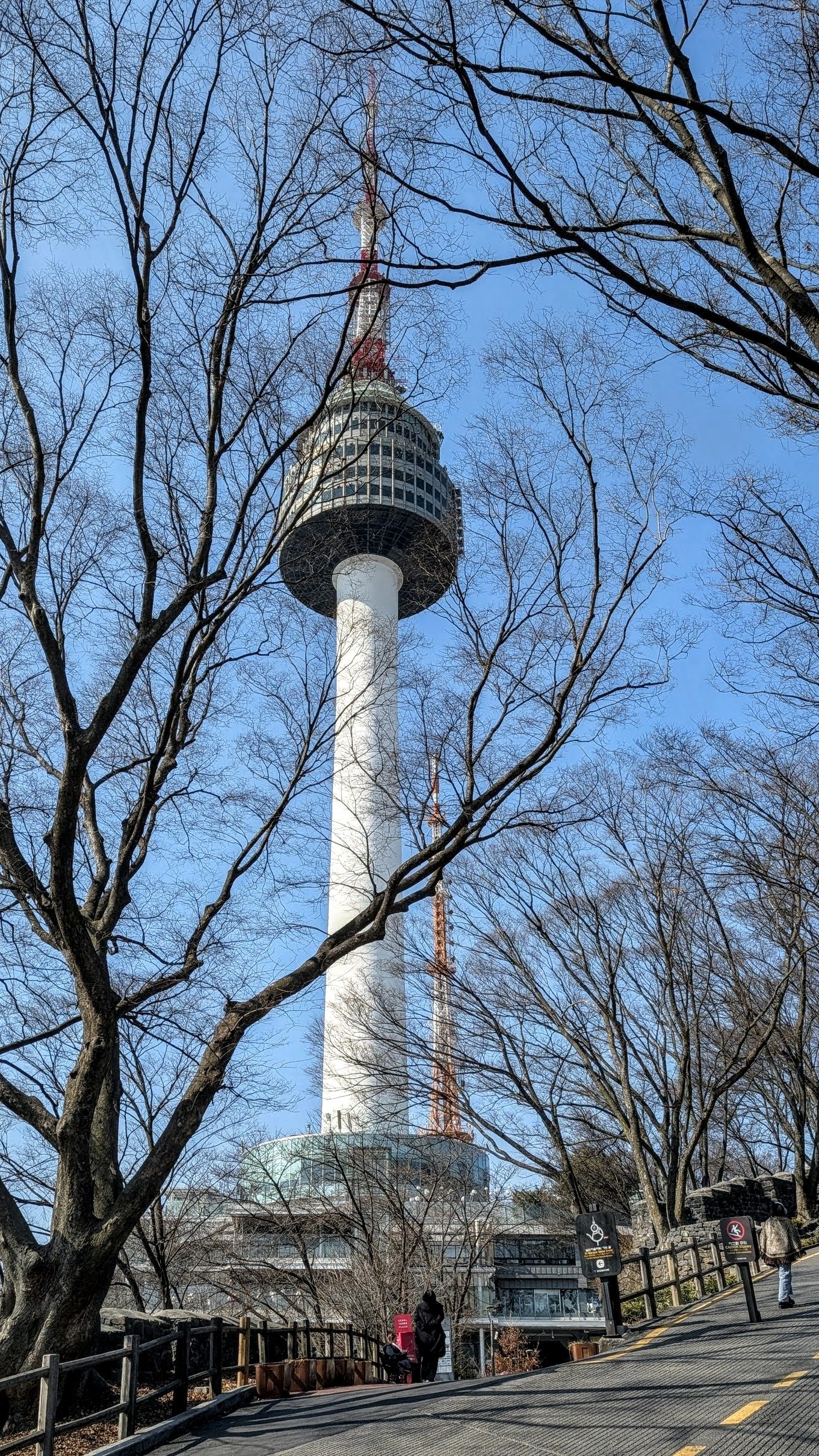
There are three ways to get to Namsan Tower. One is an uphill hike from the bottom of Namsan Park. The path consists of stone stairs and paved walkways winding through the forest, and you will need about 45 minutes to reach the tower. The second option is a shuttle bus (Yellow Bus #01) which runs very frequently from the Chungmuro or Dongguk University subway stations.
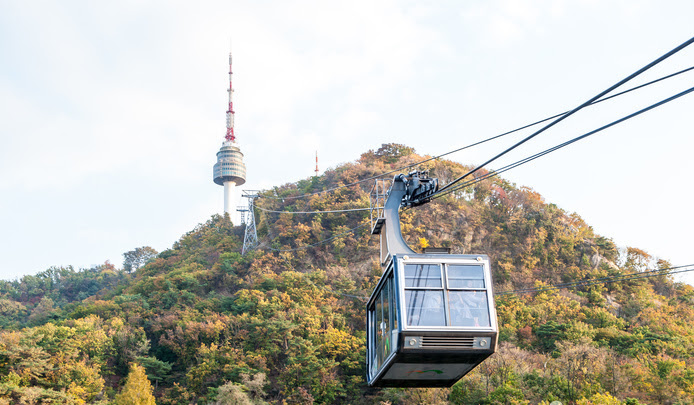
The most fun (and fastest) way, however, is to use a cable car which costs KRW 12,000 / $8 USD. Its lower embarkation point is near the Myeongdong metro station, and it takes only three minutes to travel a straight distance of 605 meters / 2,000 feet. Easy, fast and with great aerial views of the park beneath you.
Regardless of how you arrive at the tower, walk first around the plaza surrounding it. At the outdoor wooden deck you will notice of colorful padlocks attached to its fences. These are “Locks of Love” brought by couples as a symbol of their eternal romantic relations.
Also Seoul’s view from this “bottom” level offers a different perspective, with the city’s high-rises having a nice back-drop of distant mountains.
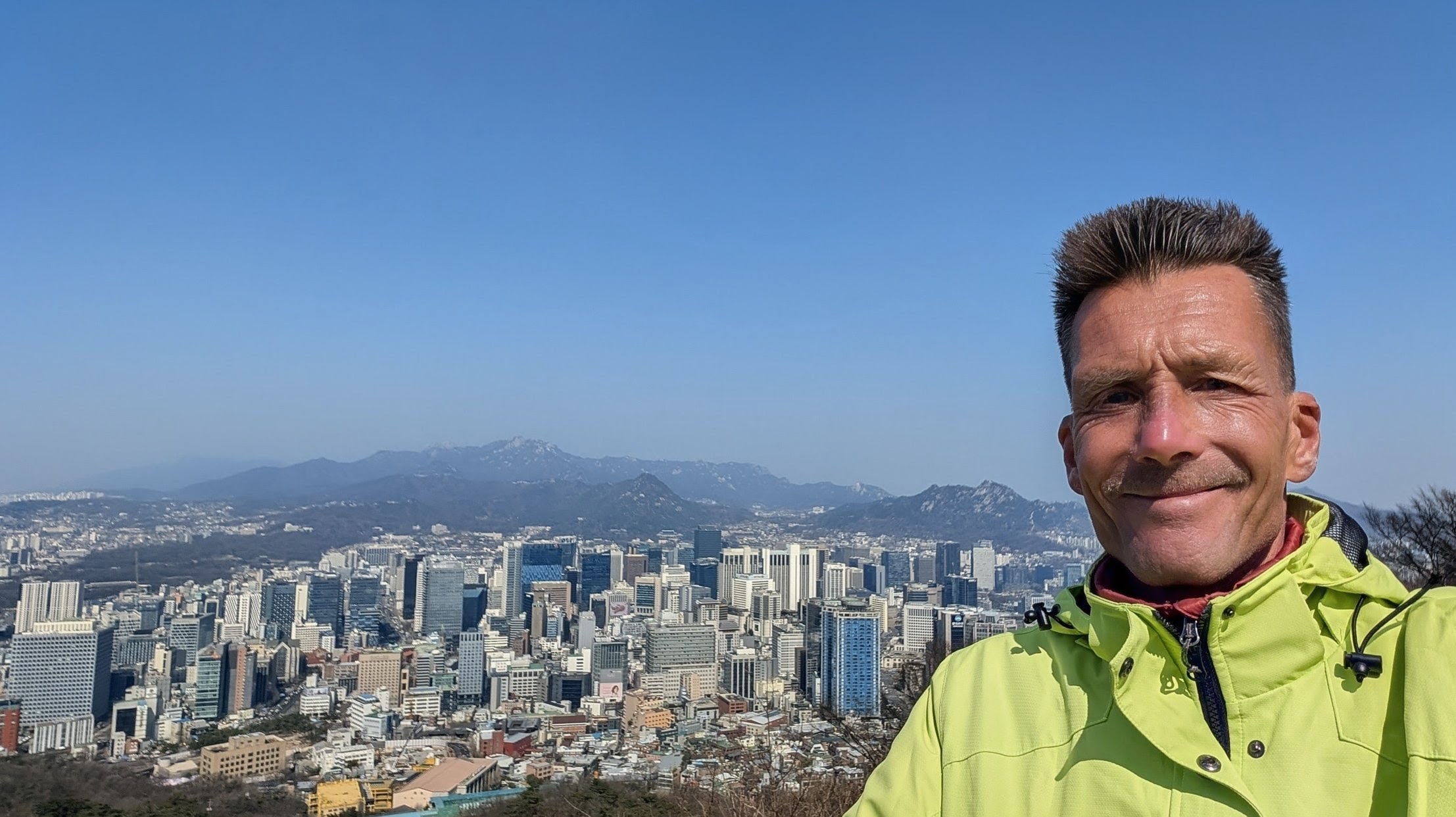
After visiting the lower plaza, purchase tickets (KRW 21,000 / $15 USD), take the elevator to the main observation deck, and walk the entire circumference of the giant floor-to-ceiling windows. On clear days (I had one), you can see as far as Songaksan Mountain in North Korea.
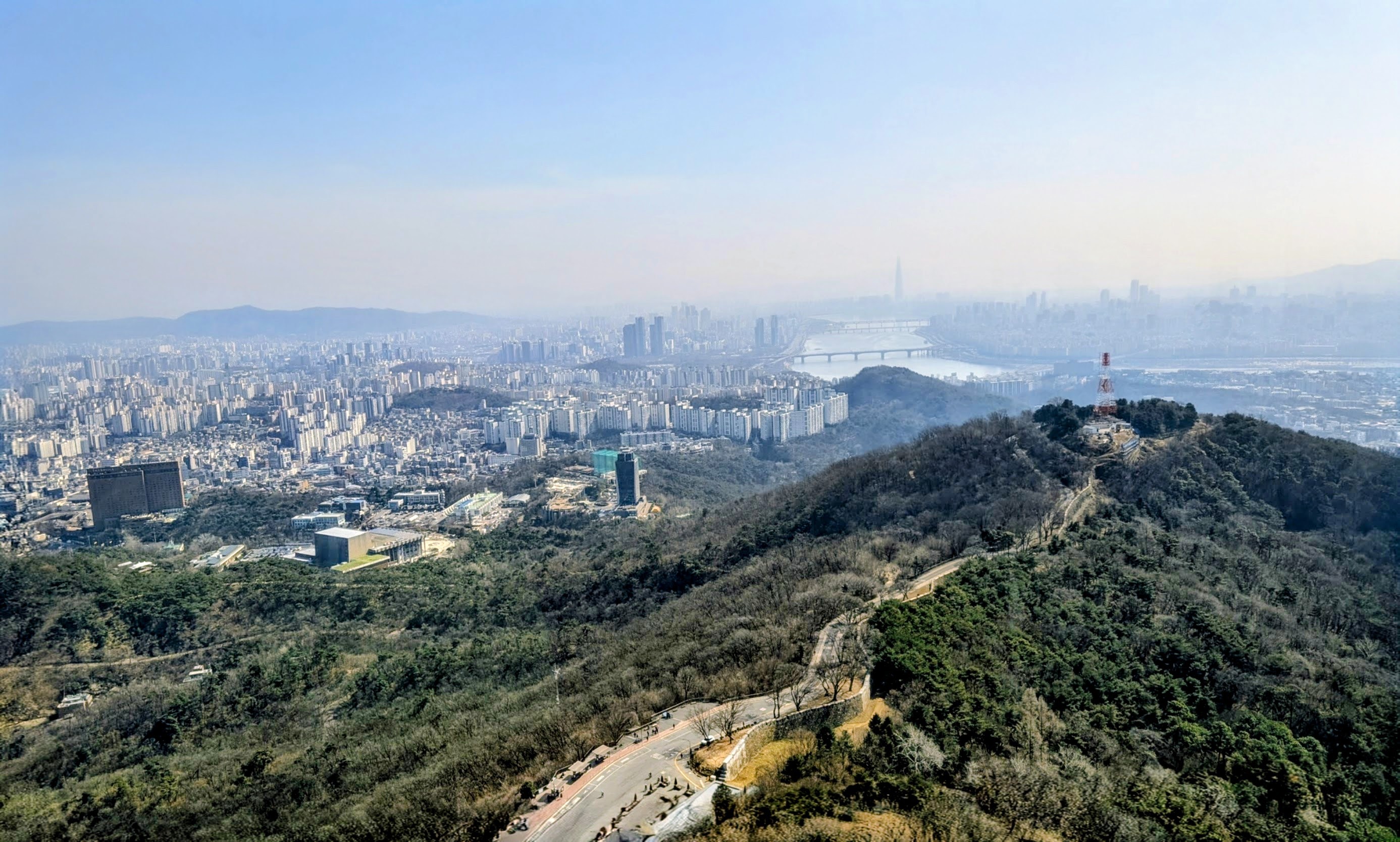
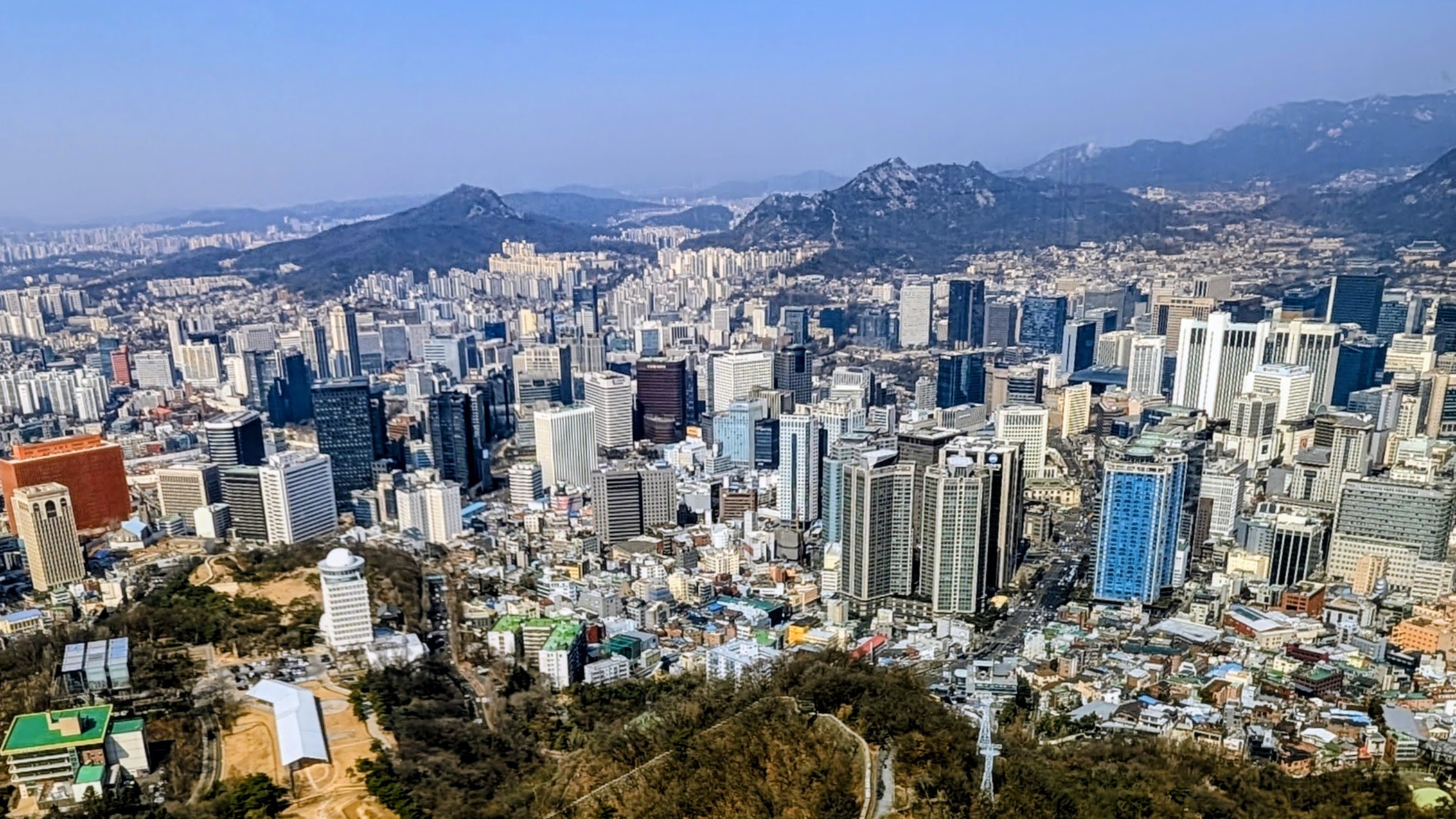
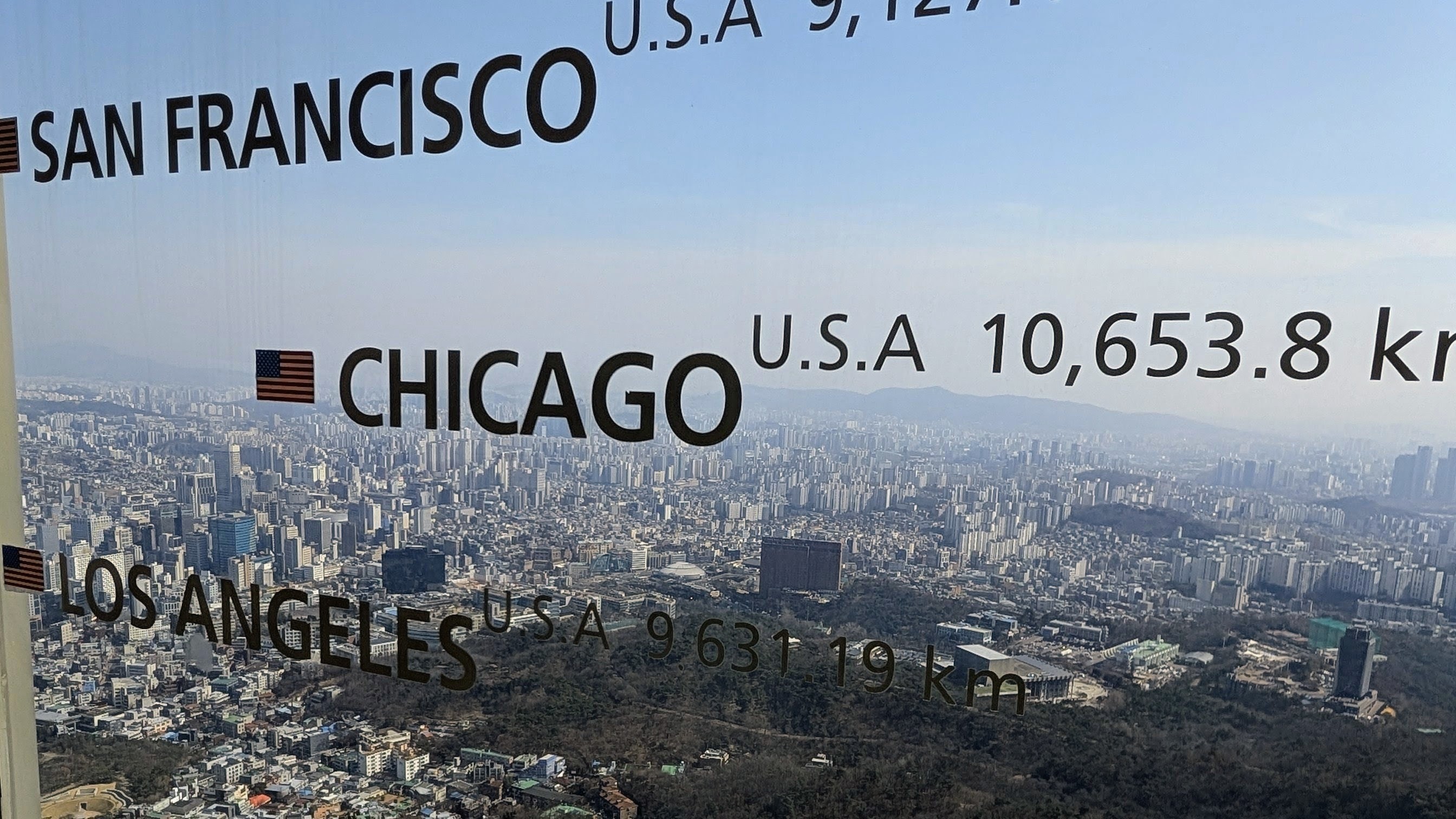
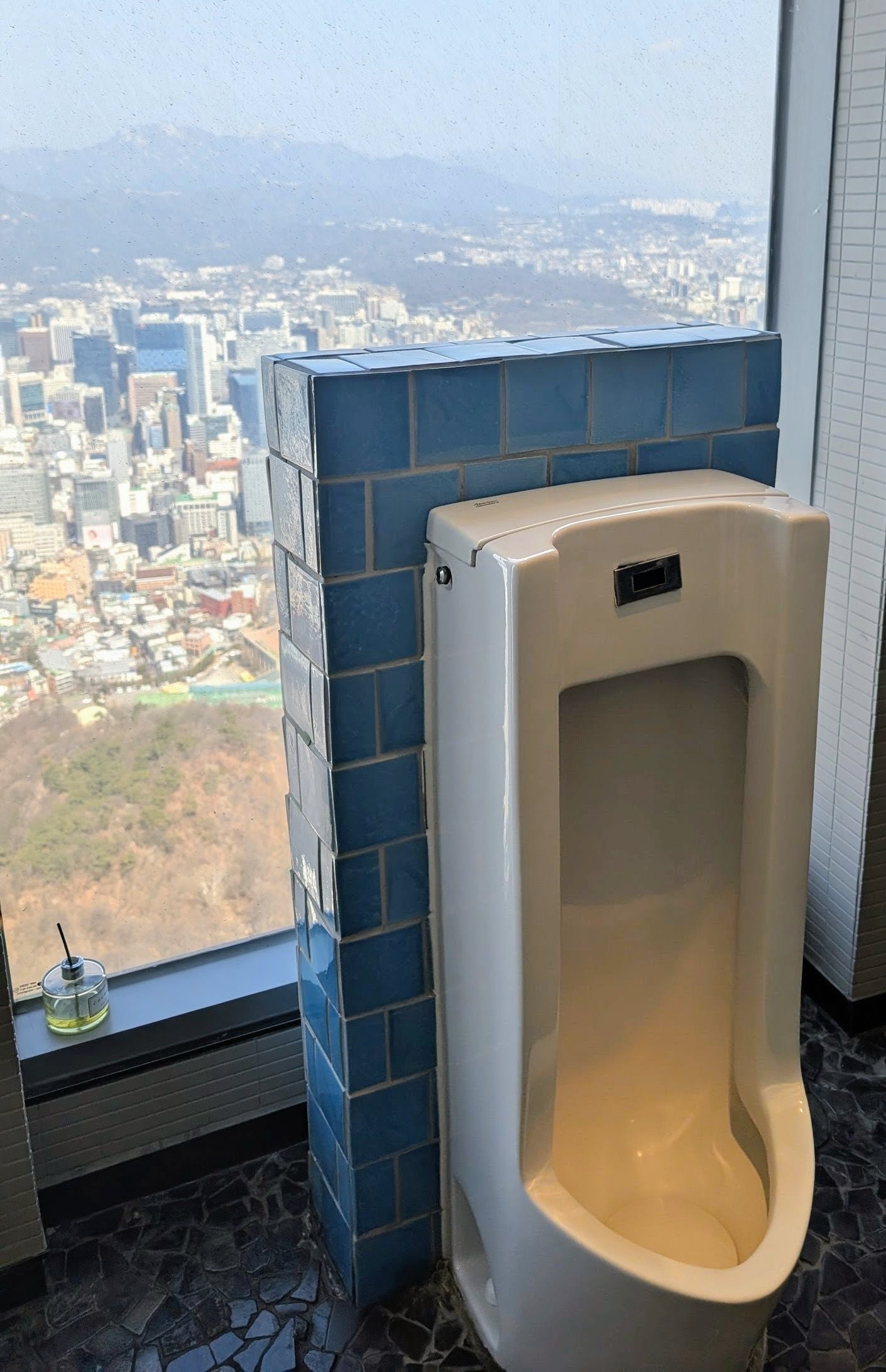
One more tip: definitely visit the public toilet on the viewing floor of the tower. Even restrooms here have floor-to-ceiling windows, giving them the reputation for having the “best view from a bathroom” in the city.
To go back to the city, you can use the same cable car. In fact, a round-trip is only KRW 3,000 / $2 USD more expensive than one-way ticket. I recommend, however, going for an easy (20-25 minutes) and pleasant downhill hike through the forest on the slopes of Namsan Mountain.
The first part of it is composed of wide wooden stairs. At certain intervals, you will find platforms equipped with chairs and tables – a good option for a picnic in the fresh air and with a good view.
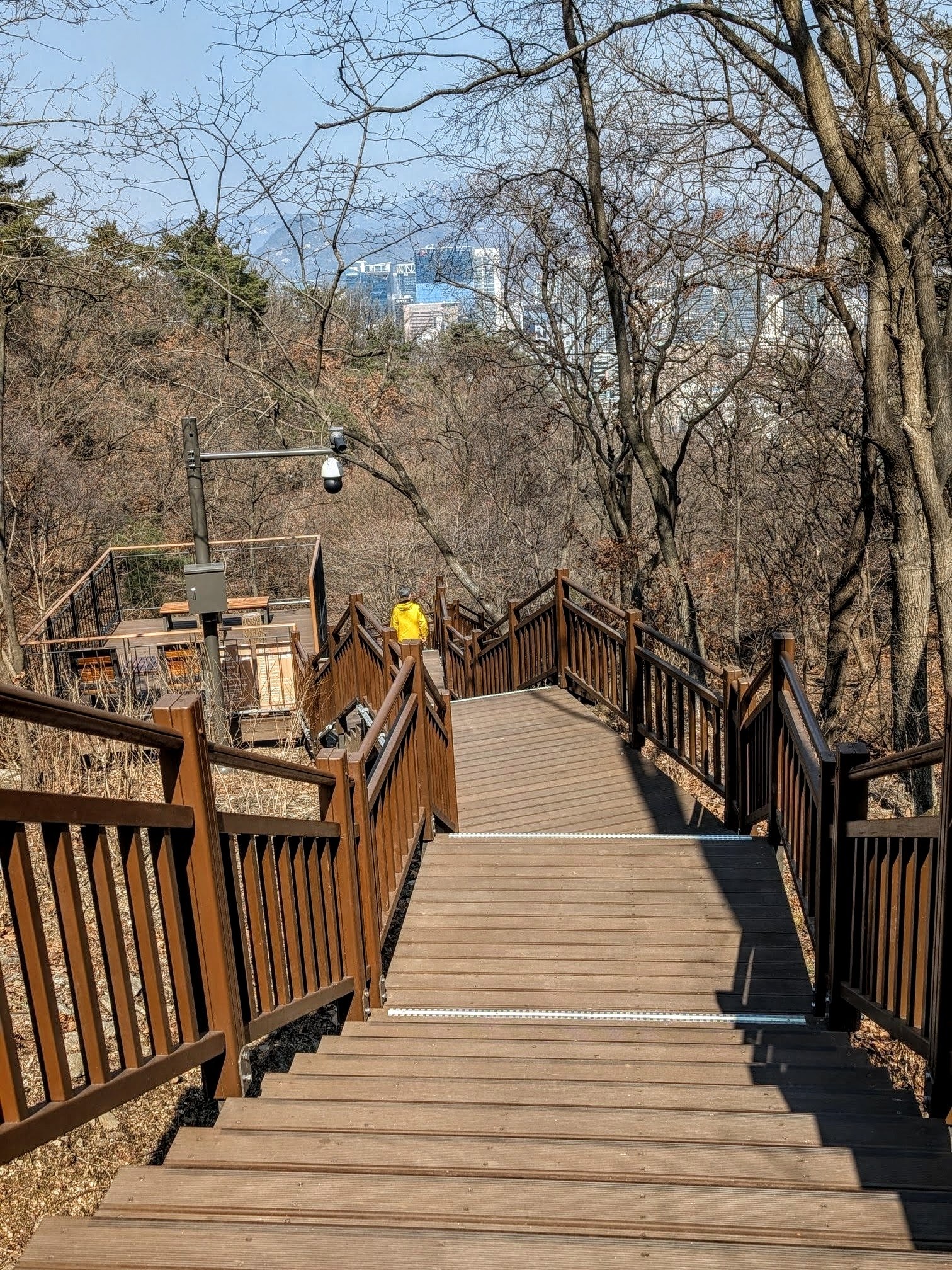
At the bottom of the hill, the stairs come to a T intersection with a wide paved path. I randomly turned left, and, just after a couple of minutes, noted something interesting. On the left side of the path and up the hill, there was a structure that looked as a temple.
A small sign revealed that this is “Samseonggak Shrine,” which honors three Korean folk deities who are in charge of wealth (Mountain Spirit), longevity (Seven Stars), and fortune (Hermit Sage).
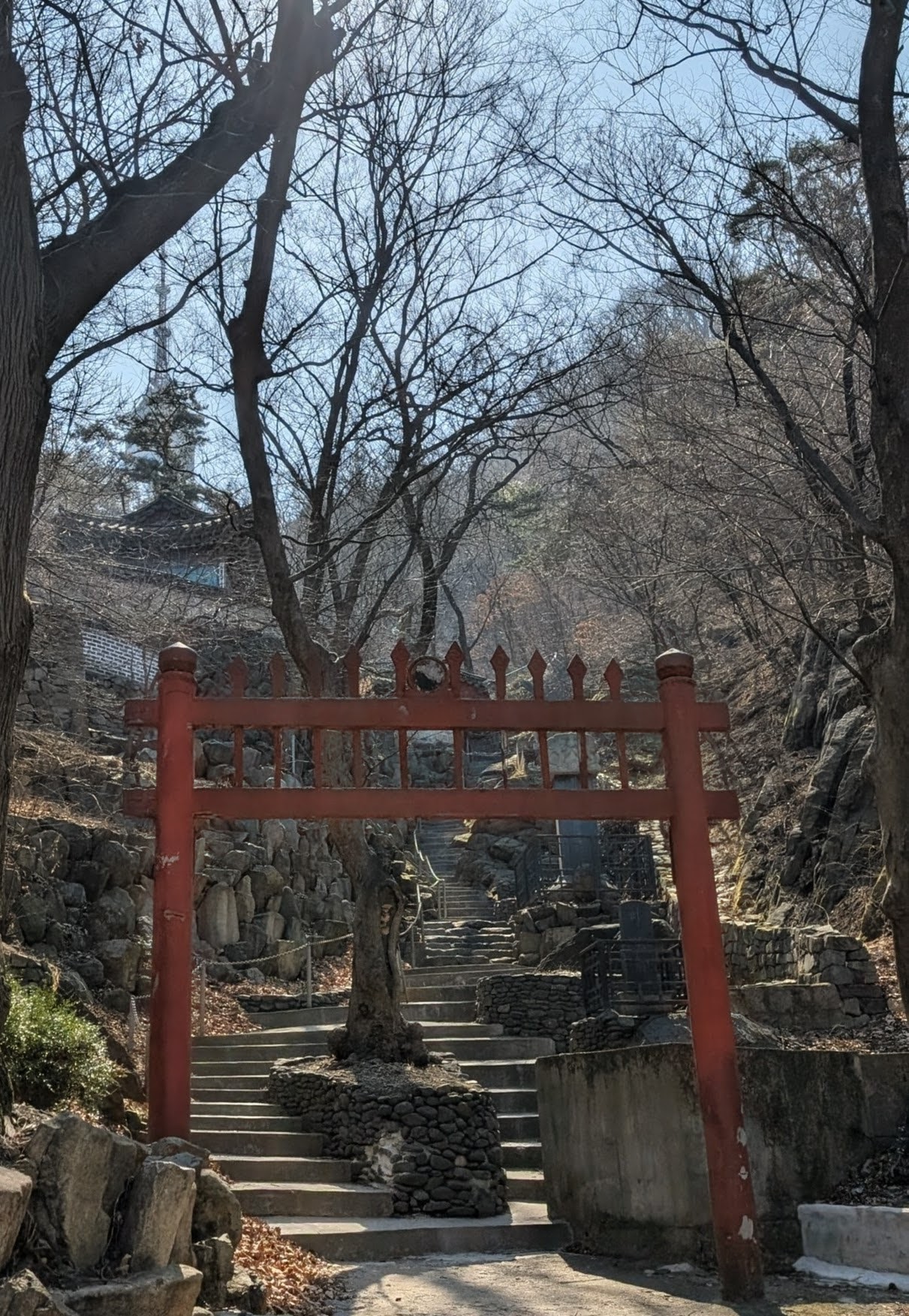
I climbed the stairs and discovered that the shrine was divided into three levels, each having a temple – perhaps, for one of the three deities?
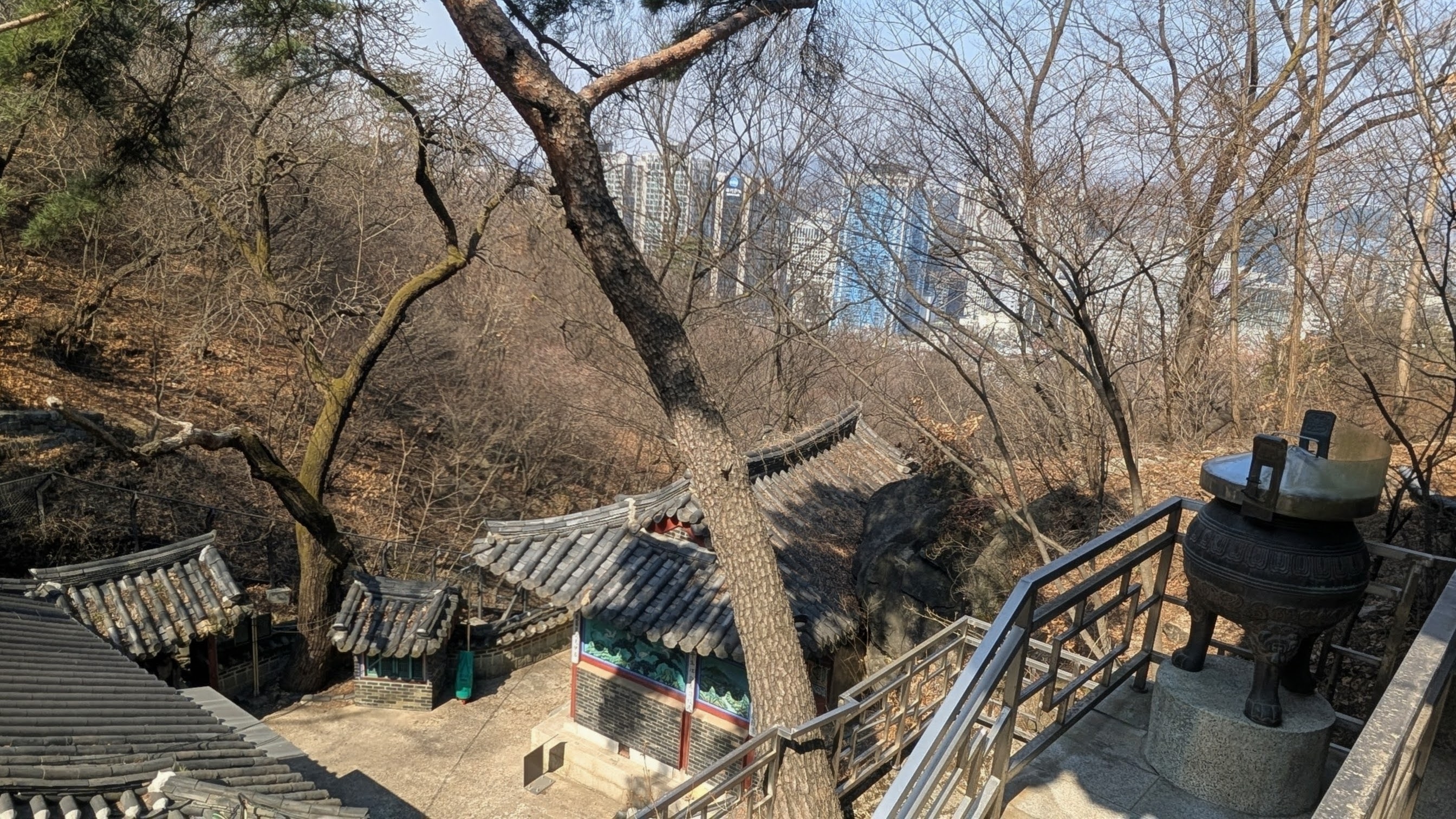
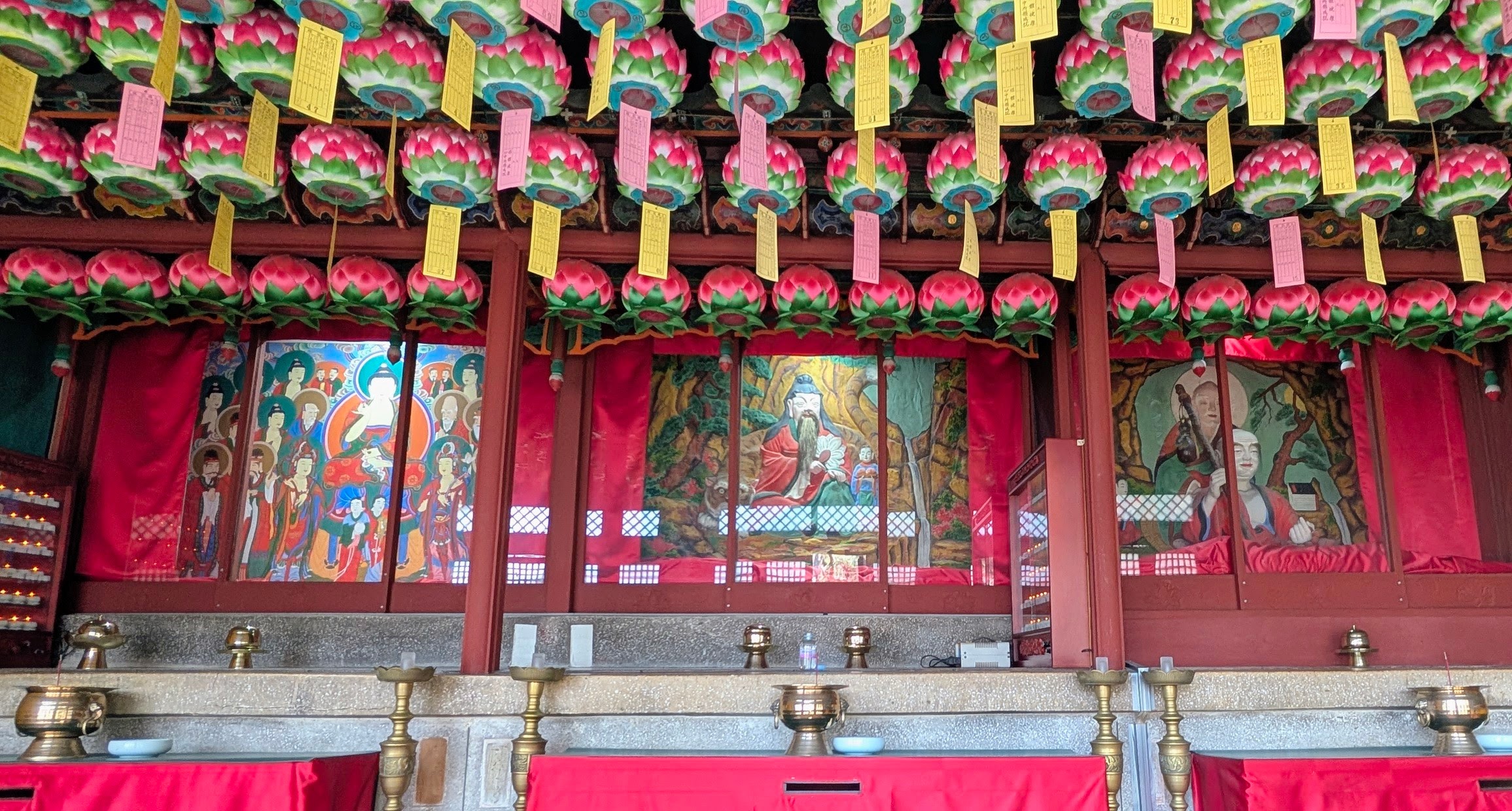
After reaching the upper level, I opened the door of a temple, took off my shoes, went inside and sat there for a few minutes saying “thanks” for the great day that I had thus far.
Not sure which specific deity this temple honored, but I figured that any of the three – wealth, longevity or fortune – would certainly be helpful to me.
On the same day, I went to the Seoul Sky deck at Lotte World Tower. Unlike Namsan which is immersed in nature, Lotte has a truly urban setting, looming proudly over other buildings. Reaching it is very easy, because Jamsil subway station is located right under the tower.
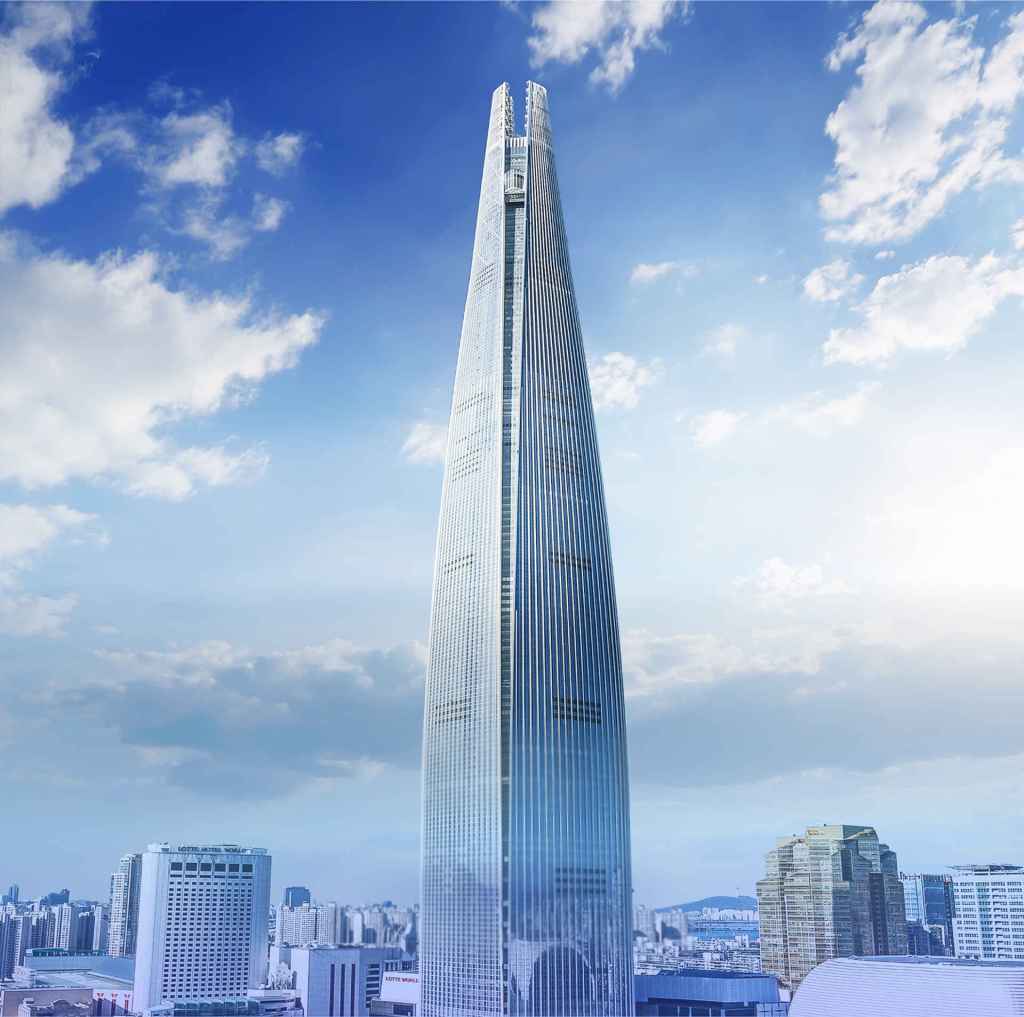
Also, unlike Namsan, the Seoul Sky deck has timed entries. If you want to skip the lines, book your ticket (KRW 30,000 / $20 USD) online (HERE) for a particular time-slot and go straight to the elevator.
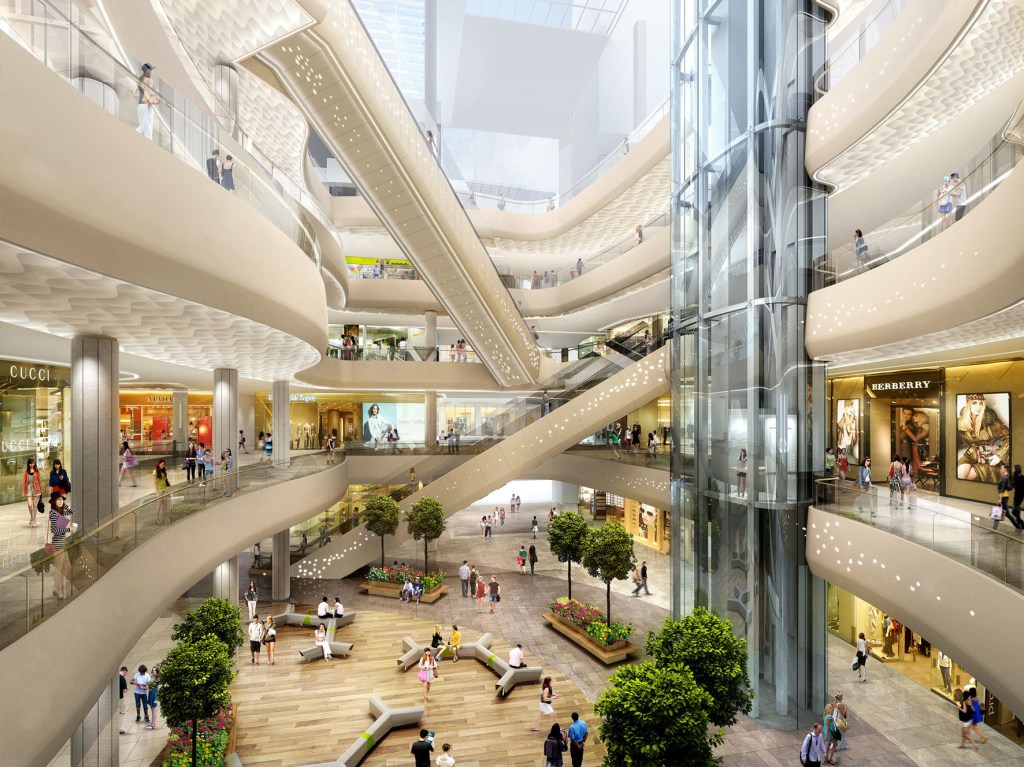
Another recommendation is to allow a cushion of time to find the reception area and elevators for Seoul Sky, because Lotte Tower is a huge complex that includes a shopping mall, adventure theme park, aquarium, concert hall, etc. While about 3 million people enjoy Seoul Sky every year, the total annual number of visitors to Lotte Tower is more than 55 million.
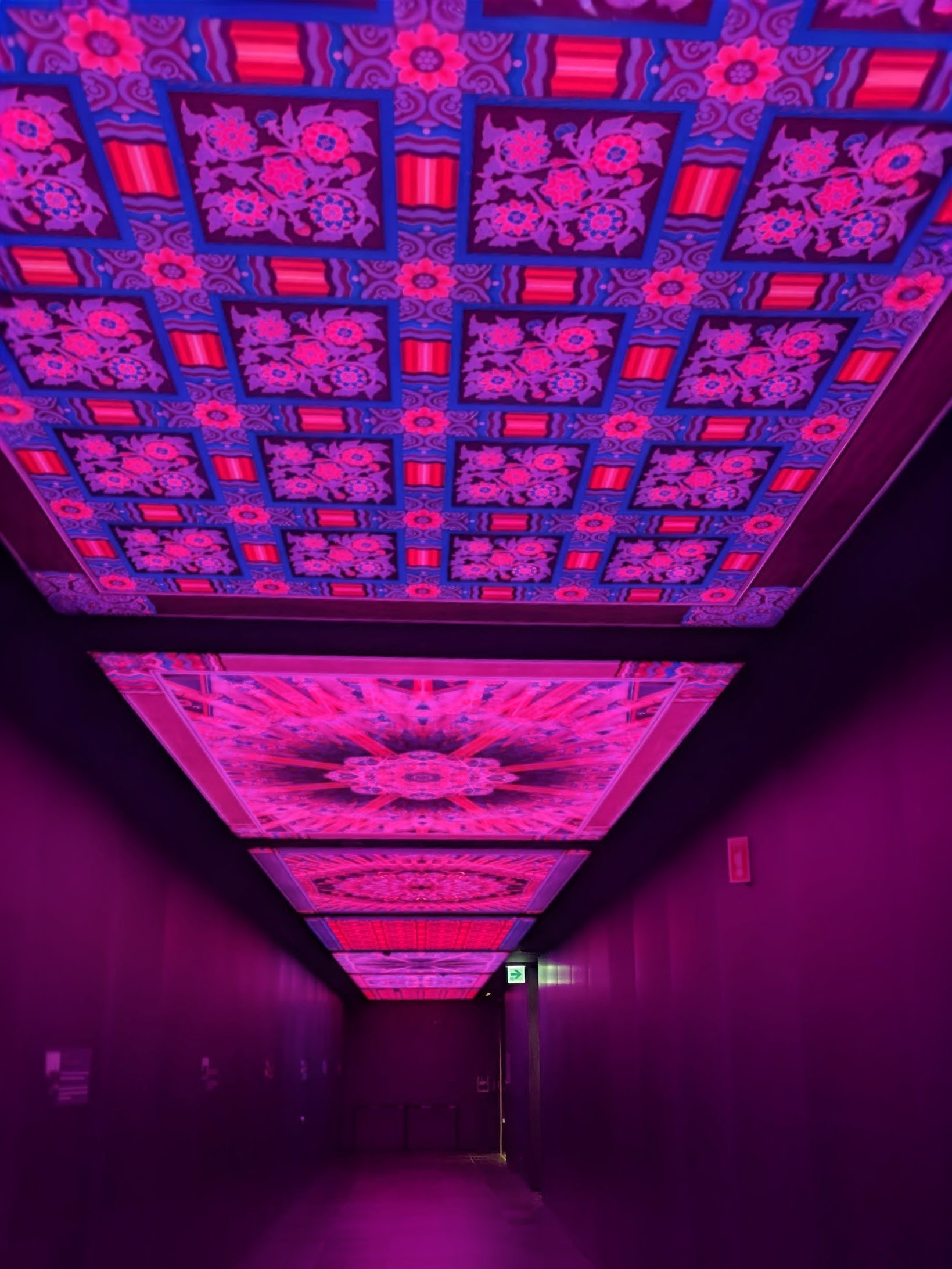
While the Namsan feels integrated with the surrounding nature, everything at Seoul Sky is focused on a high-tech experience. This begins by walking to elevators through a corridor with dark walls and color-changing bright lights coming from the ceilings.
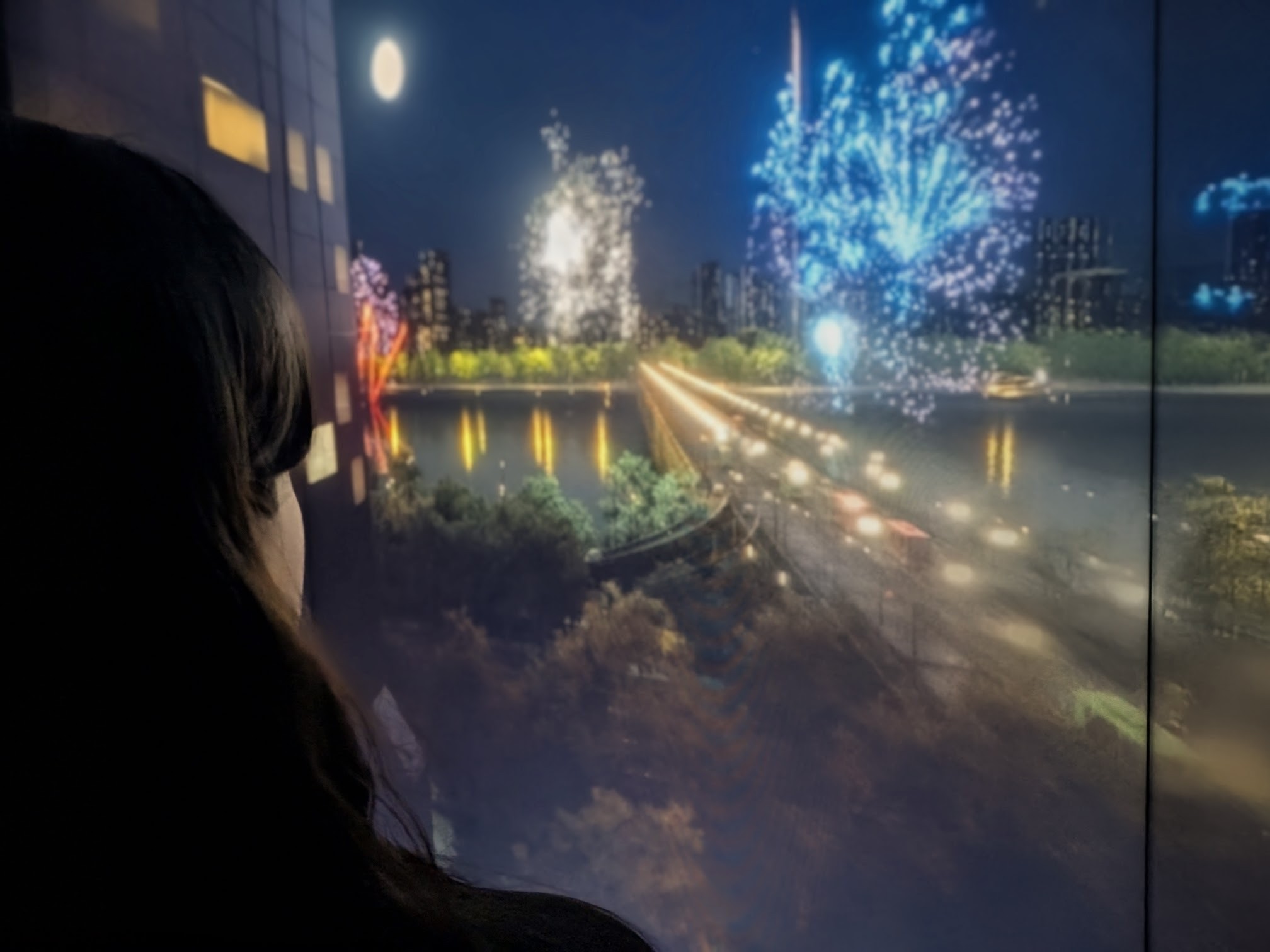
The elevator ride to the Seoul Sky deck is also an adventure on its own. Officially known as the Sky Shuttle, it travels 496 meters / 1,600 feet in just 60 seconds. However, for two reasons, you will never notice its lightning speed. First, the ride is truly smooth.
Second, during these 60 seconds, the elevator’s walls and ceilings turn into huge three-dimensional OLED screens showing breathtaking high-definition footage of Seoul.
After disembarking at the 117th floor and walking one more level up, you will witness the next “high tech” thrill: the 118th level features the world’s highest (478 meters / 1,570 feet) indoor glass flooring with a chilling view looking straight down to the ground. This is also the main observation level to walk around and absorb the panorama of Seoul.
However, if you prefer fresh air, you can take an escalator to the 120th level and the Sky Terrace. On this outdoor viewing platform, you can enjoy the view without any barrier between you and the city skyline.
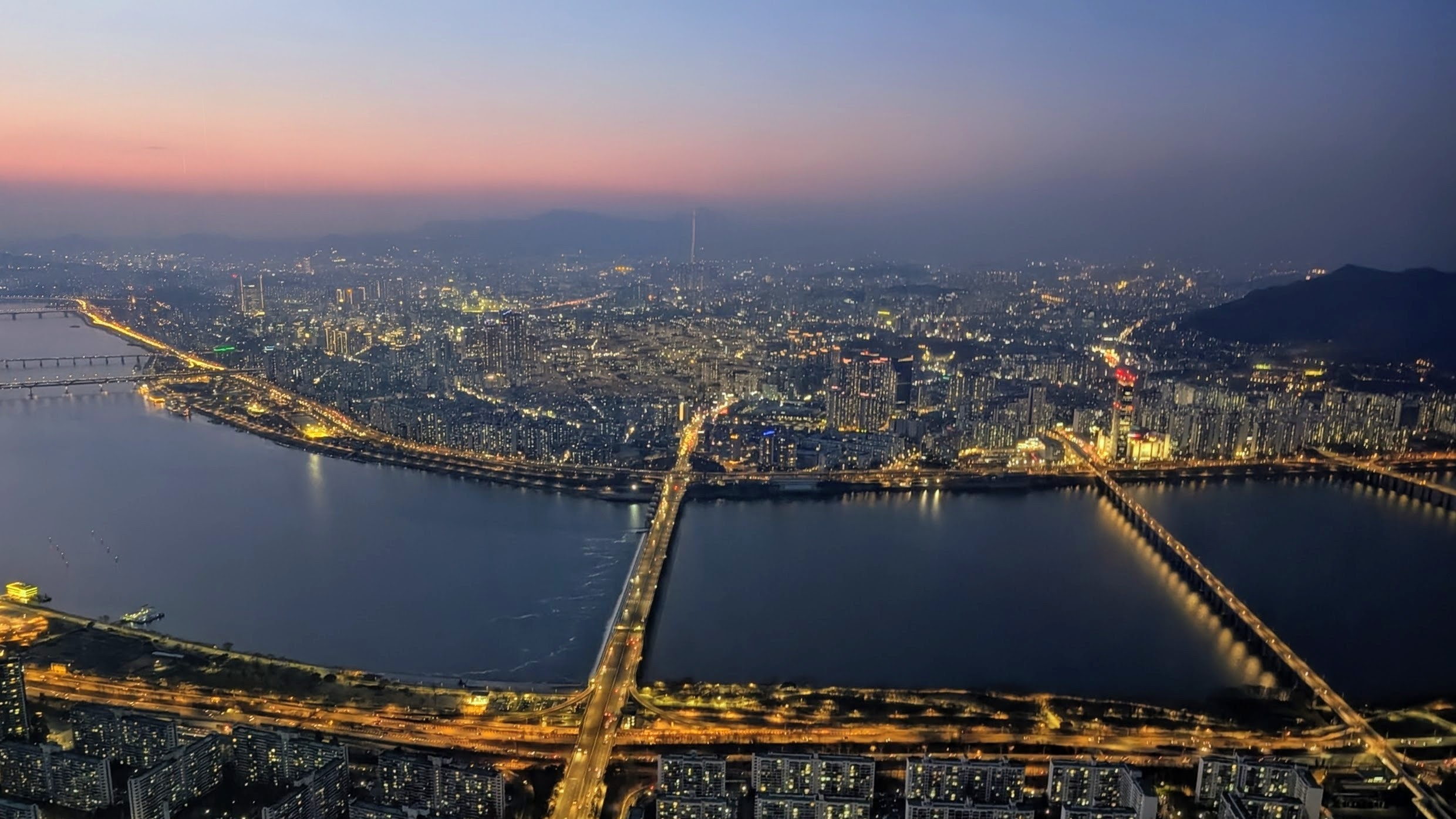
One way or the other, try to arrive in time for sunset to watch how the Korean capital transitions from daylight into night while transforming into a glistening maze of streets and buildings.
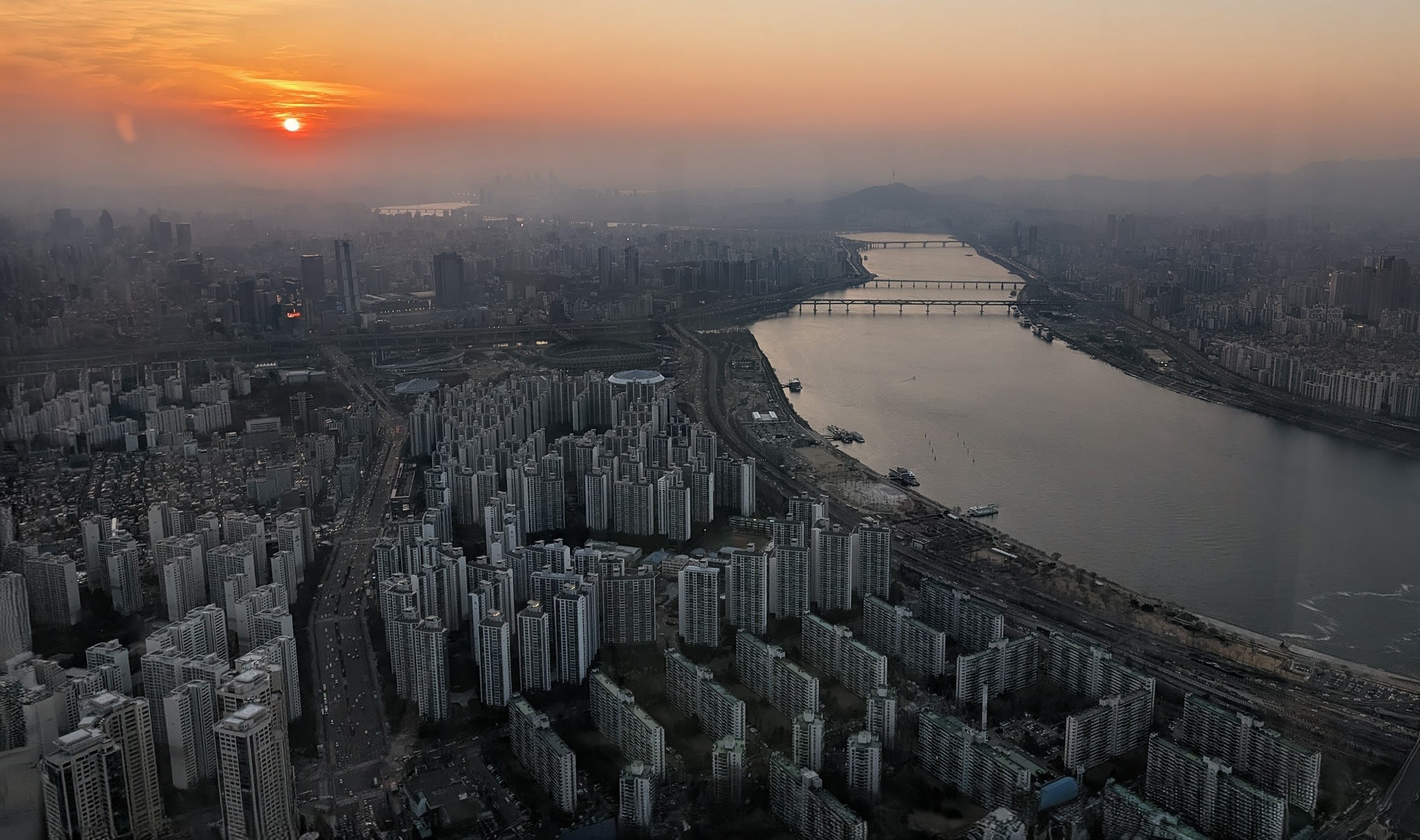
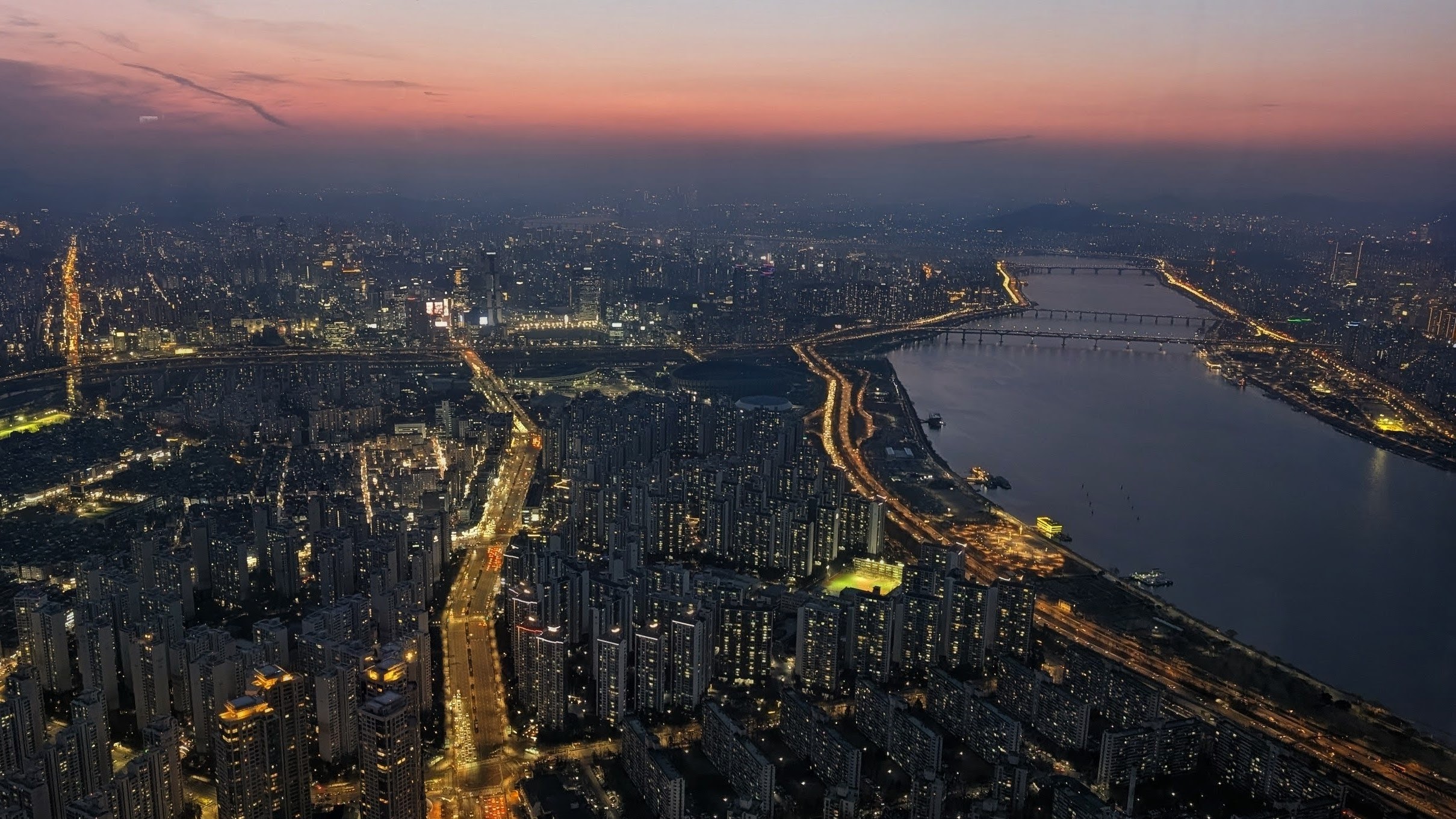
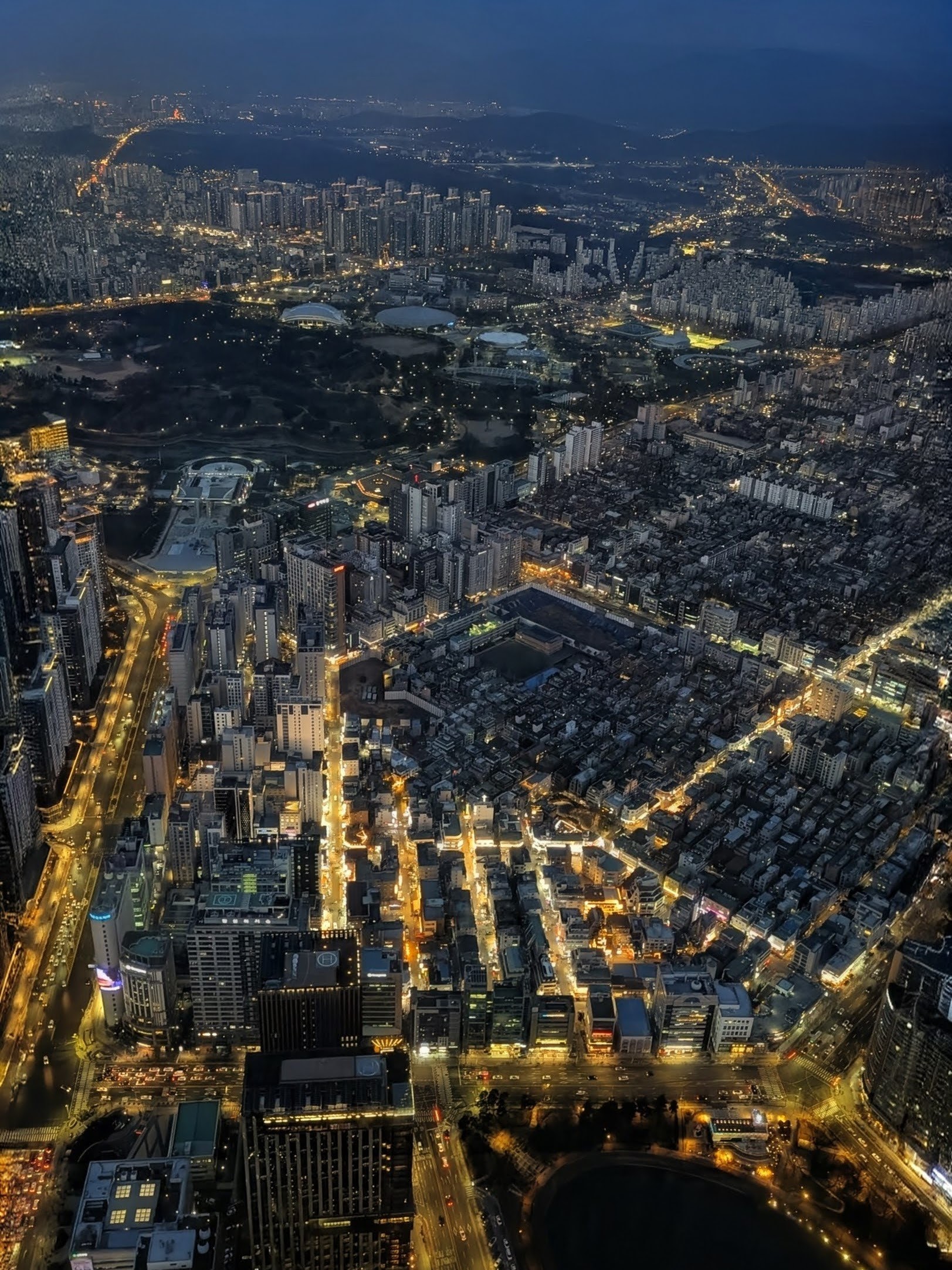
When visiting Seoul Sky, I learned about one more option. With an advanced reservation and for additional fee, thrill-seekers can walk an 11-meter-long outdoor bridge at the top of Lotte World Tower. Besides payment, the “protocol” includes signing a consent form, wearing special safety gear, and climbing stairs equivalent to a 20-story building.
Was I disappointed by missing this extra “show?” Not at all. Watching the glowing skies above Seoul, I felt perfectly happy and grateful for so many highlights of this day.
A Farewell to Seoul: Steam and Stream
My last evening in Seoul was reserved for two quintessentially local rituals: a visit to a traditional bathhouse and a walk along the Cheonggyecheon stream.
What are traditional bathhouses in Korea? They fall into two categories. One is Mogyoktang, a truly “neighborhood” establishment. They are smaller, gender-segregated and focused purely on visiting a steam room, bathing and possible scrubbing by an attendant.
The second kind is Jjimjilbang, which are spa-like facilities. These are massive complexes that include gender-segregated wet areas, co-ed “dry” areas with themed saunas (salt, clay, ice), restaurants and even sleeping rooms. Typically, Jjimjilbang are open 24 hours, so you can even stay overnight. In fact, some smart visitors to Seoul use Jjimjilbangs as their accommodations instead of a much more expensive hotel. Here is a good video on Seoul’s bathhouse culture:
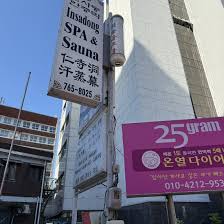
I opted for a middle-ground option, a place called “Insadong Spa & Sauna.” It offered several saunas and treatments (scrubbing, aroma therapy, massages), but still looked like a relatively small “boutique” facility. Most importantly, it was close to my hotel, and had hundreds of praising online reviews.
In case you decide to visit , here is an embedded map with its precise location. A somewhat confusing part about finding Insadong Sauna is that it sits in the basement of a multistory building. But this – location in a basement – is fairly typical for many bathhouses in Seoul.
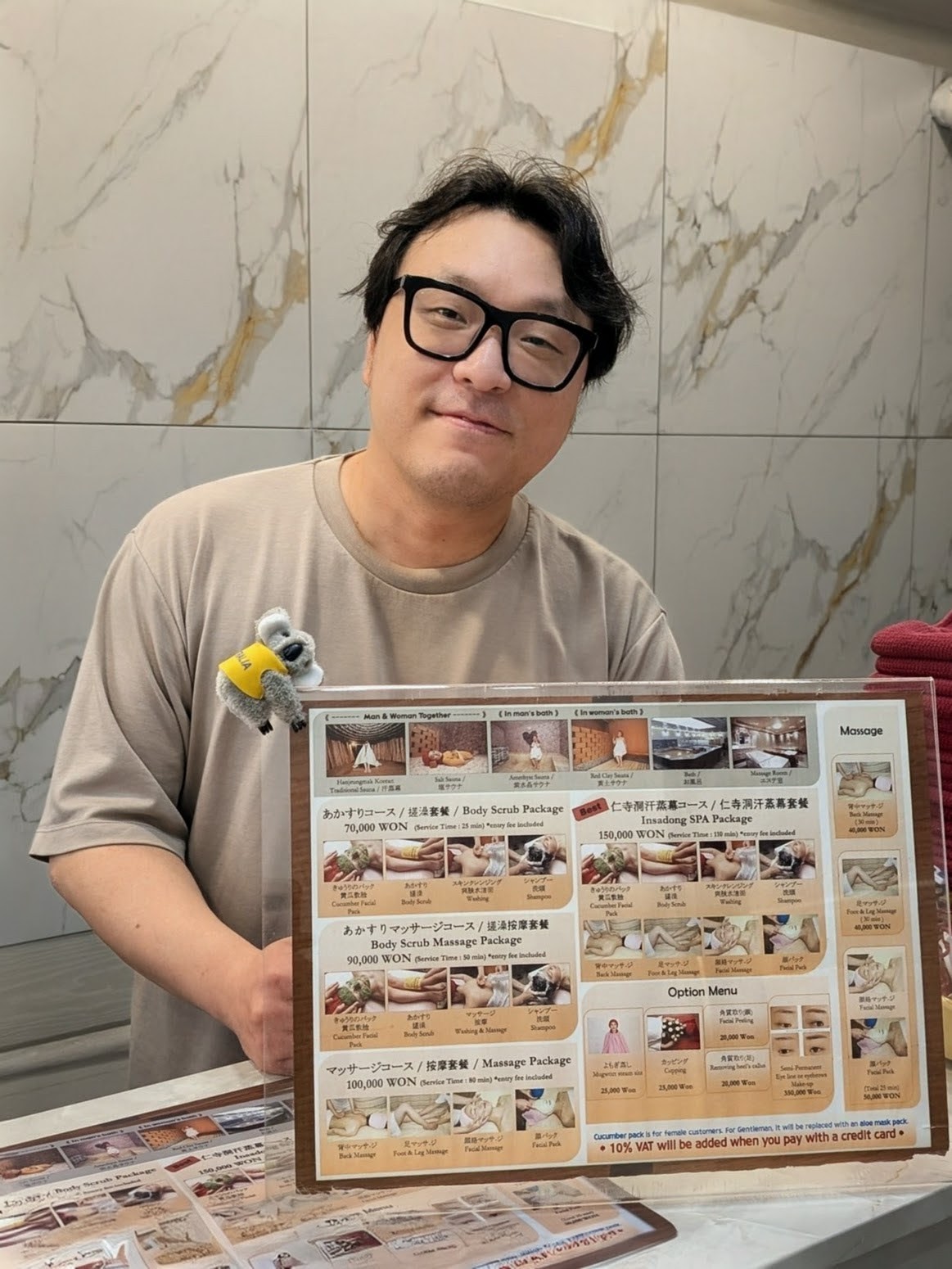
In the reception area, I was greeted by a cheeful gentleman. Sang (his name) was the manager and the son of the owner. In perfect English and with an elegant British accent, Sang explained to me all available bathing and service options.
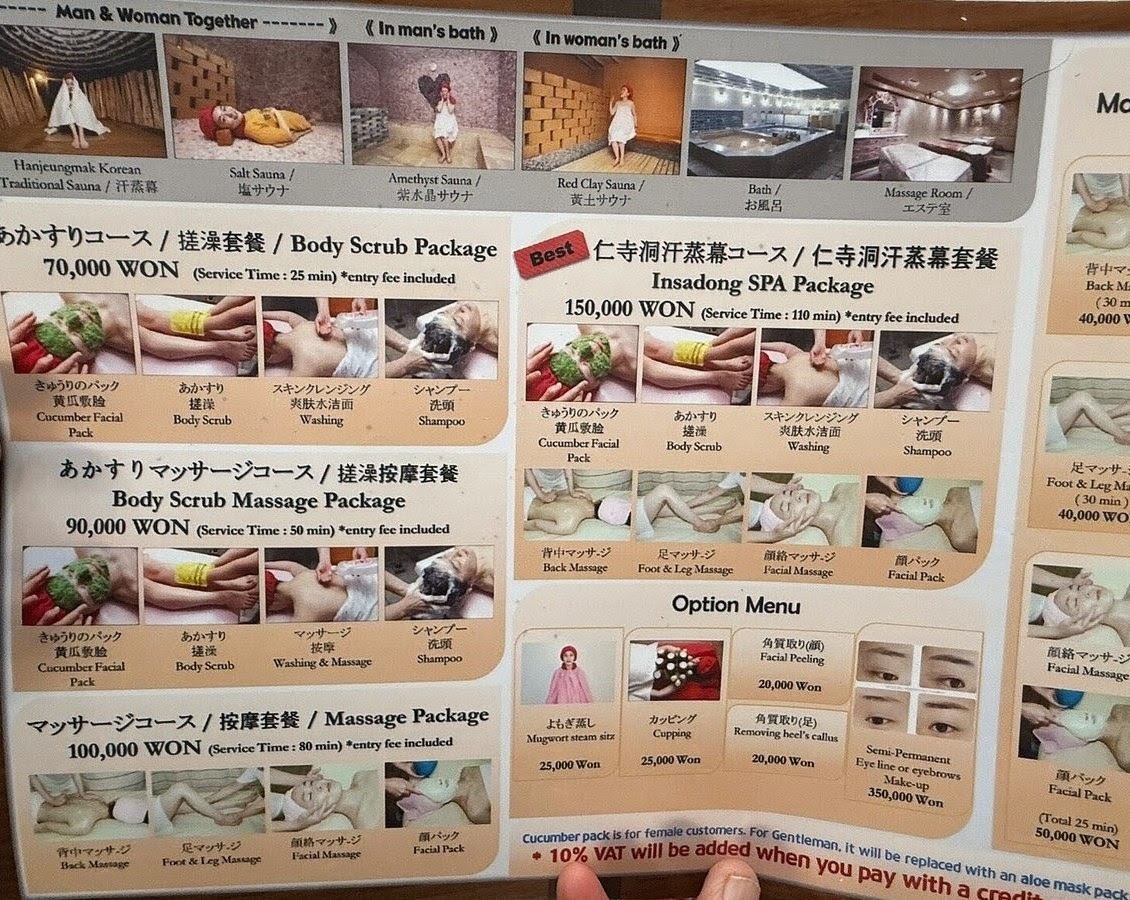
I chose a package for KRW 90,000 / $60 USD which – besides the entrance fee – included washing and scrubbing by an attendant, shampooing, a facial treatment with aloe cream, and a full-body massage. If you simply want to visit Insadong without any additional services, the entrance fee is KRW 15,000 / $10 USD.
I asked Sang to first give me some time to explore the spa on my own, and then proceed with the washing ritual. As expected, Insadong wasn’t very big. The main room was occupied by two saunas plus chairs and loungers for relaxation. This was an area shared by men and women wearing bathrobes that were provided by the sauna.
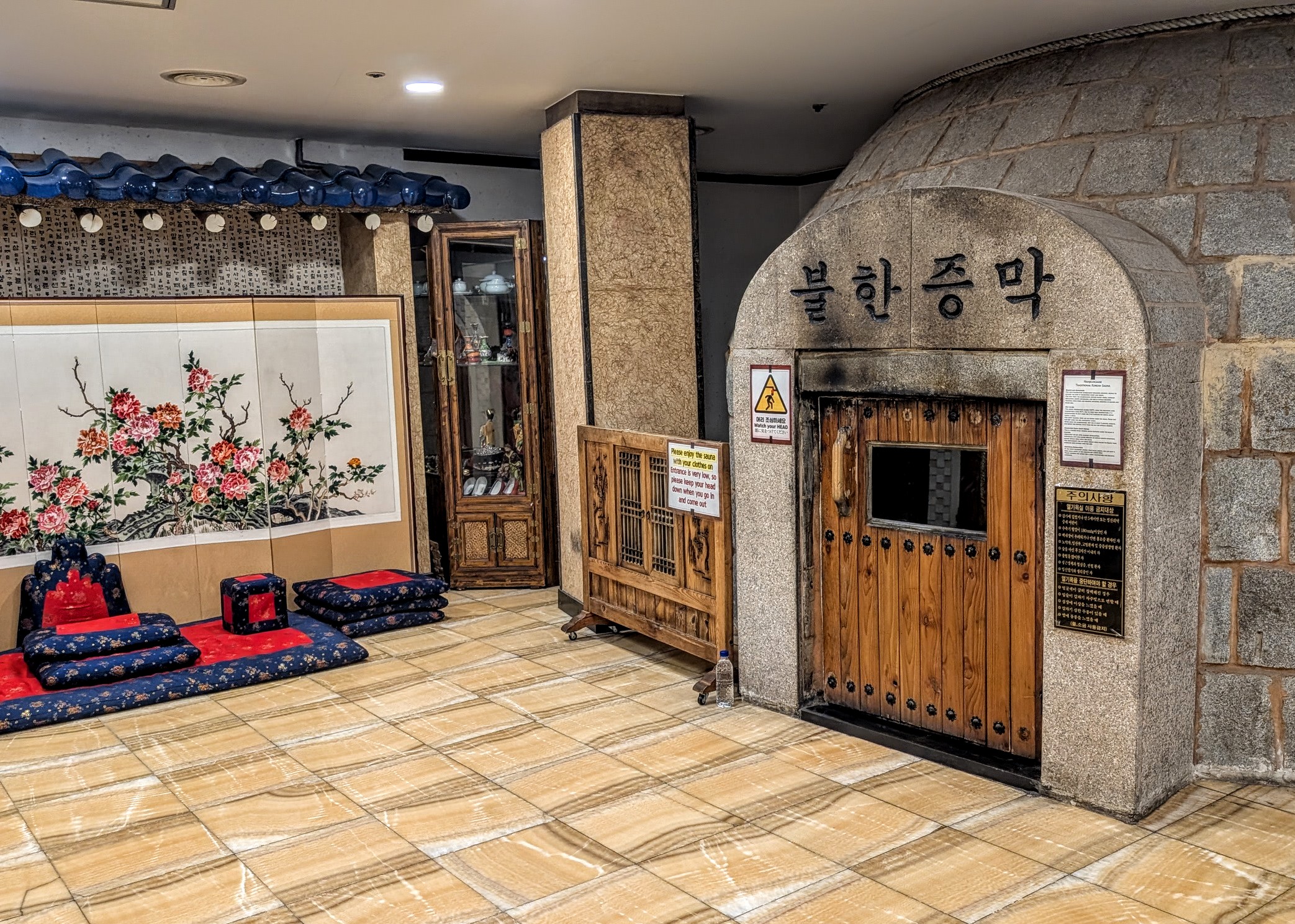
Two saunas served different purposes. One – decorated inside with various stones – was mostly for relaxation: it was nicely warm, but not really hot.
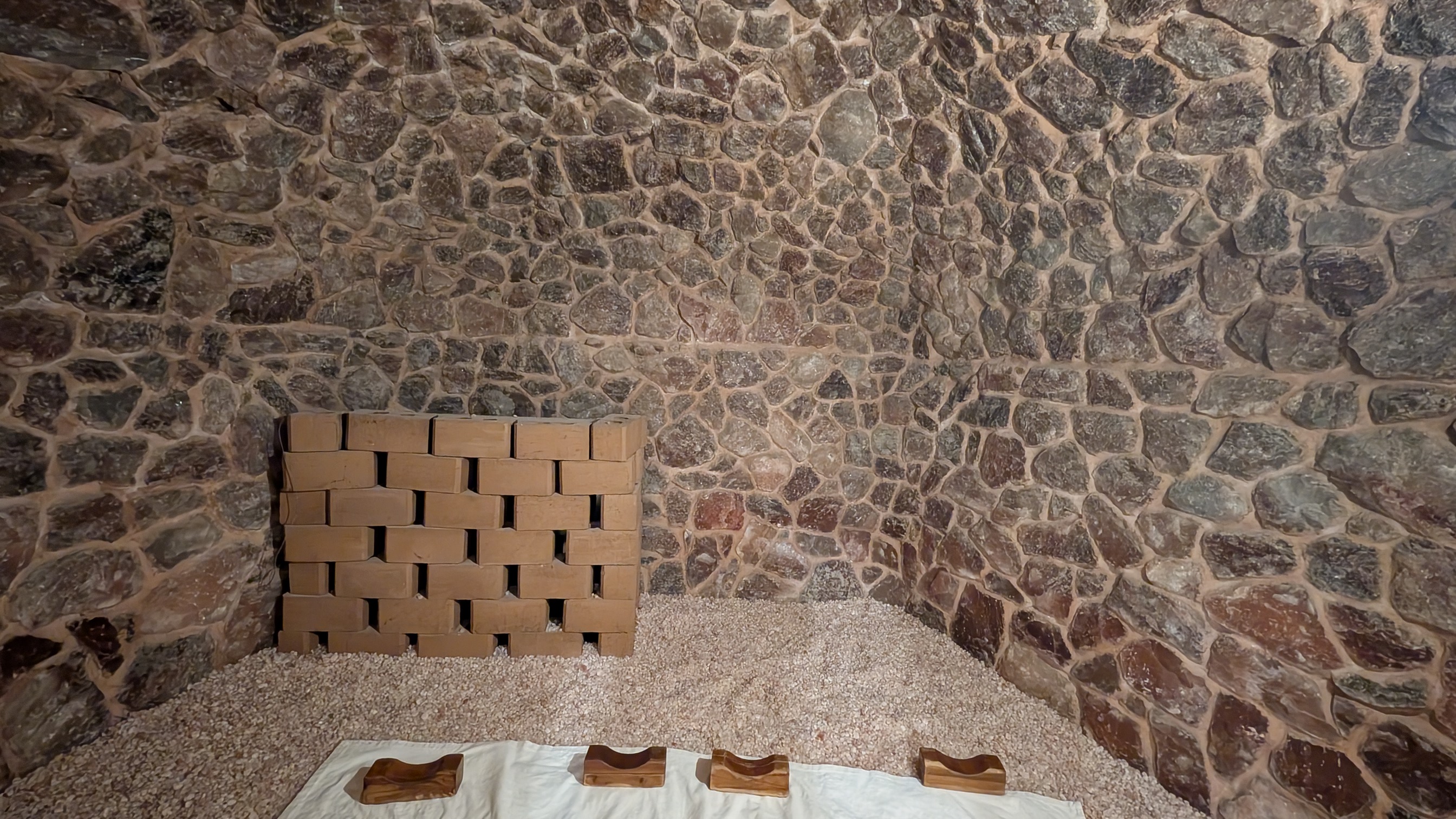
On the contrary, the second sauna was truly hot.
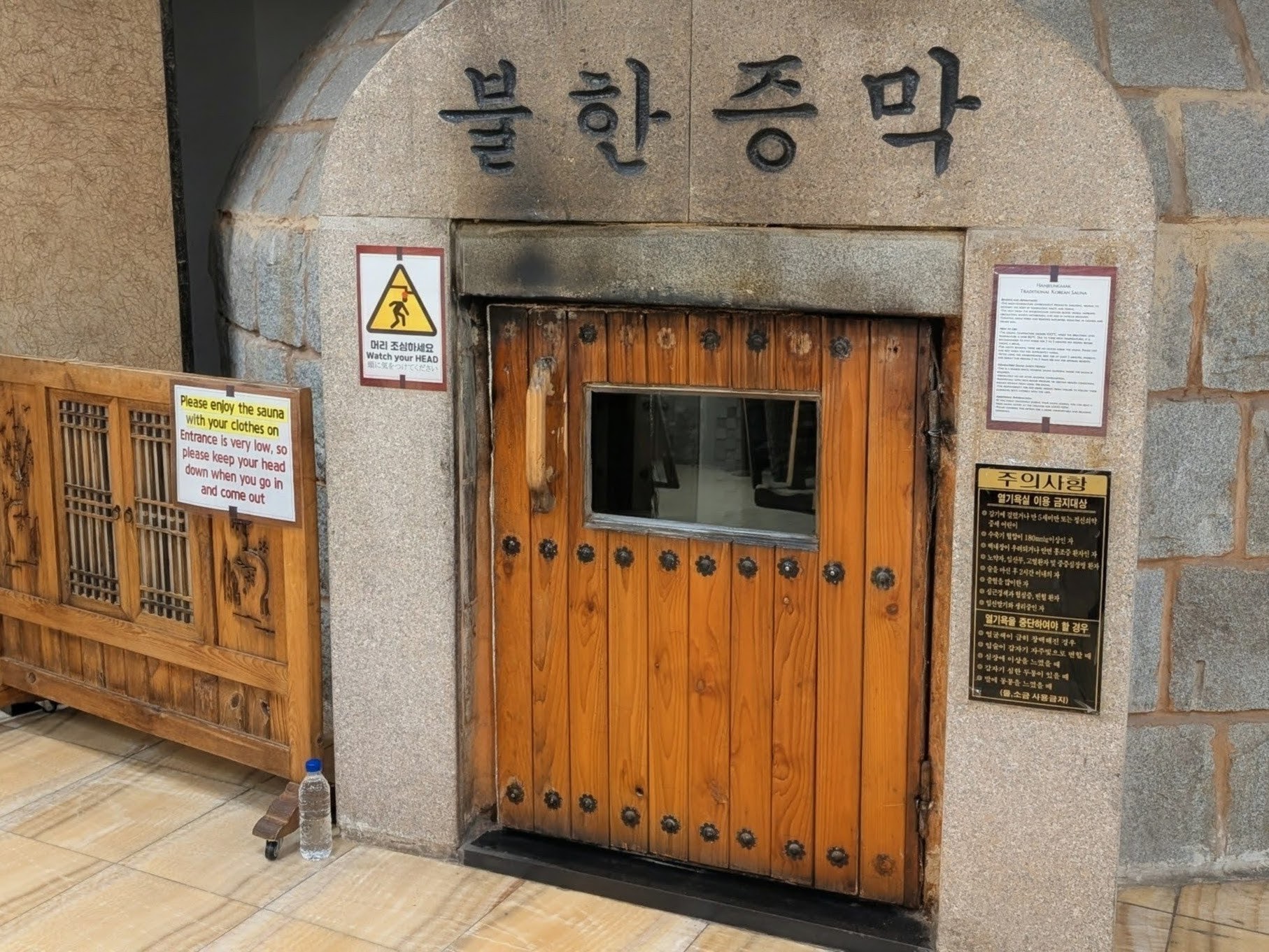
Inside the hot sauna, the round-shaped room with a cupola ceiling was surrounded by massive wooden “trunks” placed along the walls. In both the “relaxation” and “hot” saunas, patrons were expected to lie on the floor and use wooden headrests to make themselves more comfortable.
In about one hour, Sang suggested that I move to the wet-area to properly prepare for my treatment package. Unlike the dry-sauna area, wet-areas are separated for men and women with people being naked. Several pools filled with warm (from mildly to nearly hot) water were intended to relax the body, make the skin soft and open all pores for proper washing and scrubbing. The wet-steam room served the same purpose.
Sang told me to use these pools for about 20 minutes, and then he sent an “ajusshi,” a professional who performs both washing/scrubbing and massages.
I am not going to describe all the details of the washing/scrubbing/facial treatment/massage “ritual,” but I will firmly state: it was 100% worth the money I paid.
Insadong closed at 9 pm (unlike giant Jjimjilbangs, it does not stay open overnight), but I stayed a bit longer and chatted with Sang about his work at Insadong and about other “must visit” bathhouses in Seoul – each with a distinct character.
In case you will are tempted to visit Insadong Spa & Sauna, here is the full “menu” of treatments and services. .
Back on the streets, I suddenly felt “light and tingly” with a cool night breeze invigorating my freshly scrubbed skin. This was actually very helpful for the final part of my visit to Seoul – a leisurely walk along Cheonggyecheon.
Cheonggyecheon is an 11-kilometers / 6.8-miles stream and walkway that sits about 4.6 meters / 15 feet below street level while bisecting downtown Seoul. Once a polluted open sewer, in 2003-2005 it was transformed into a quiet “sunken” oasis offering an escape from the busy traffic above.
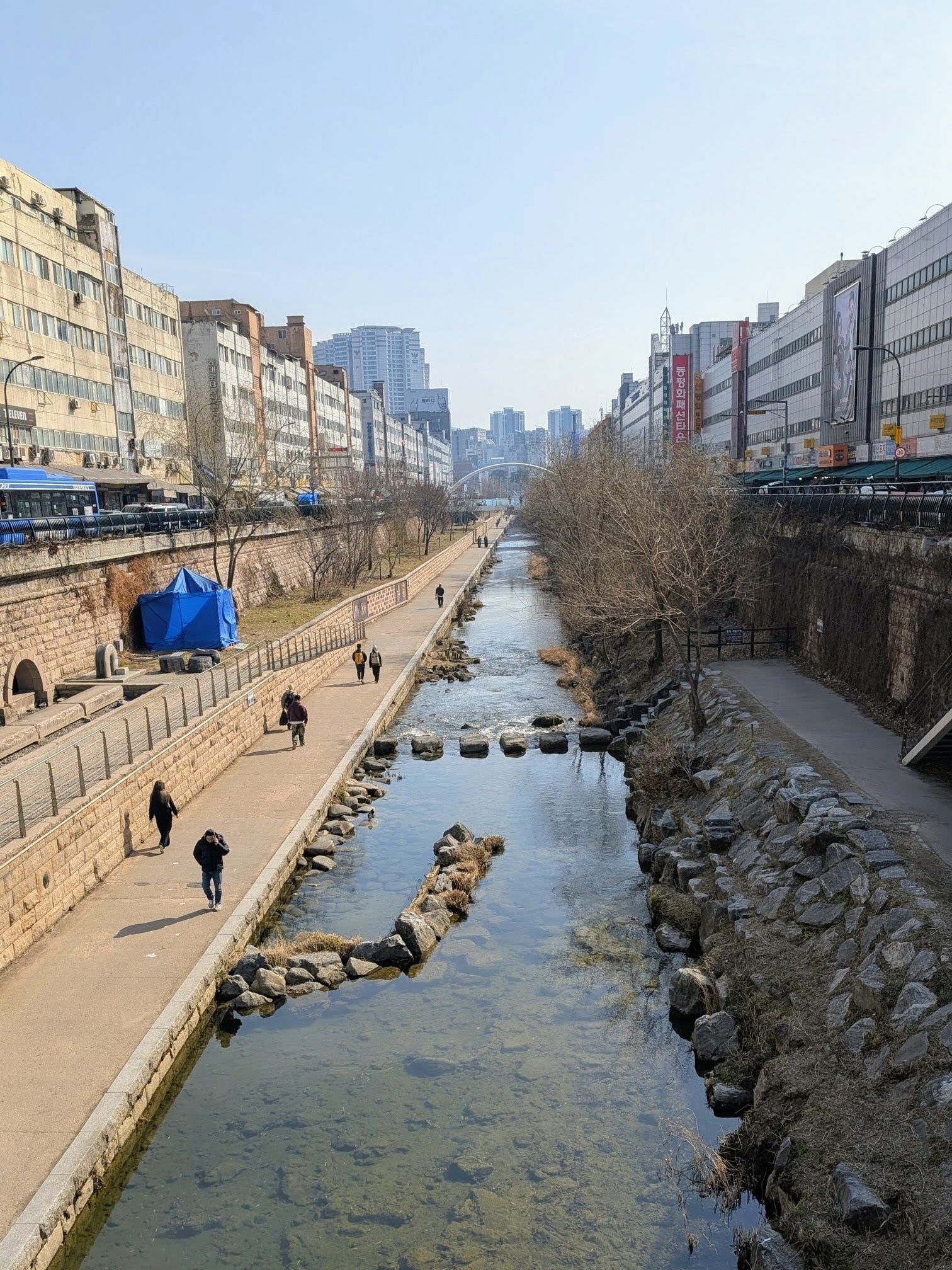
Cheonggyecheon isn’t just a nice pedestrian area. It is also a public area that hosts various cultural events. If you come here in winter, you will enjoy the Seoul Lantern Festival, when the water is filled with glowing sculptures.
The starting point for a walk along the stream is at Cheonggye Plaza, which is near city’s historic heart, Gwanghwamun Square. It is marked by the colorful “Spring” sculpture.
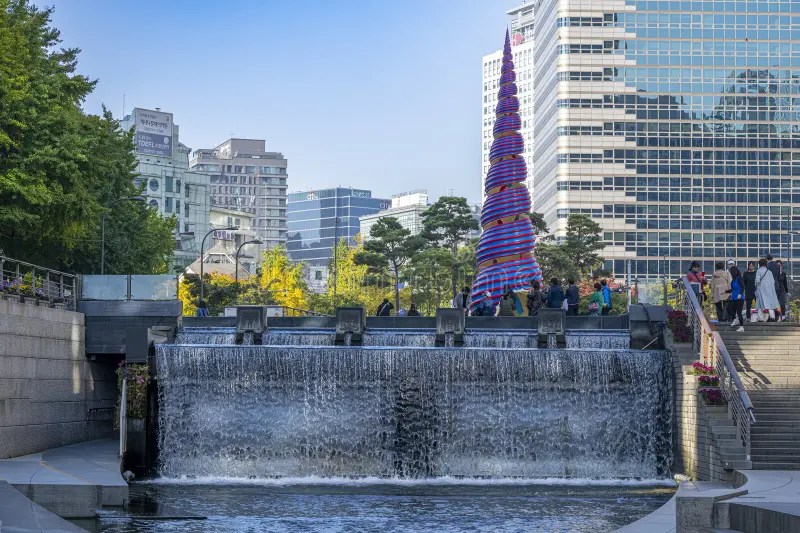
While also attractive during the day, Cheonggyecheon is truly charming and “magical” after dusk when it is brightly illuminated with colored lights. And this was the reason I saved this walk as my very last adventure in Seoul.
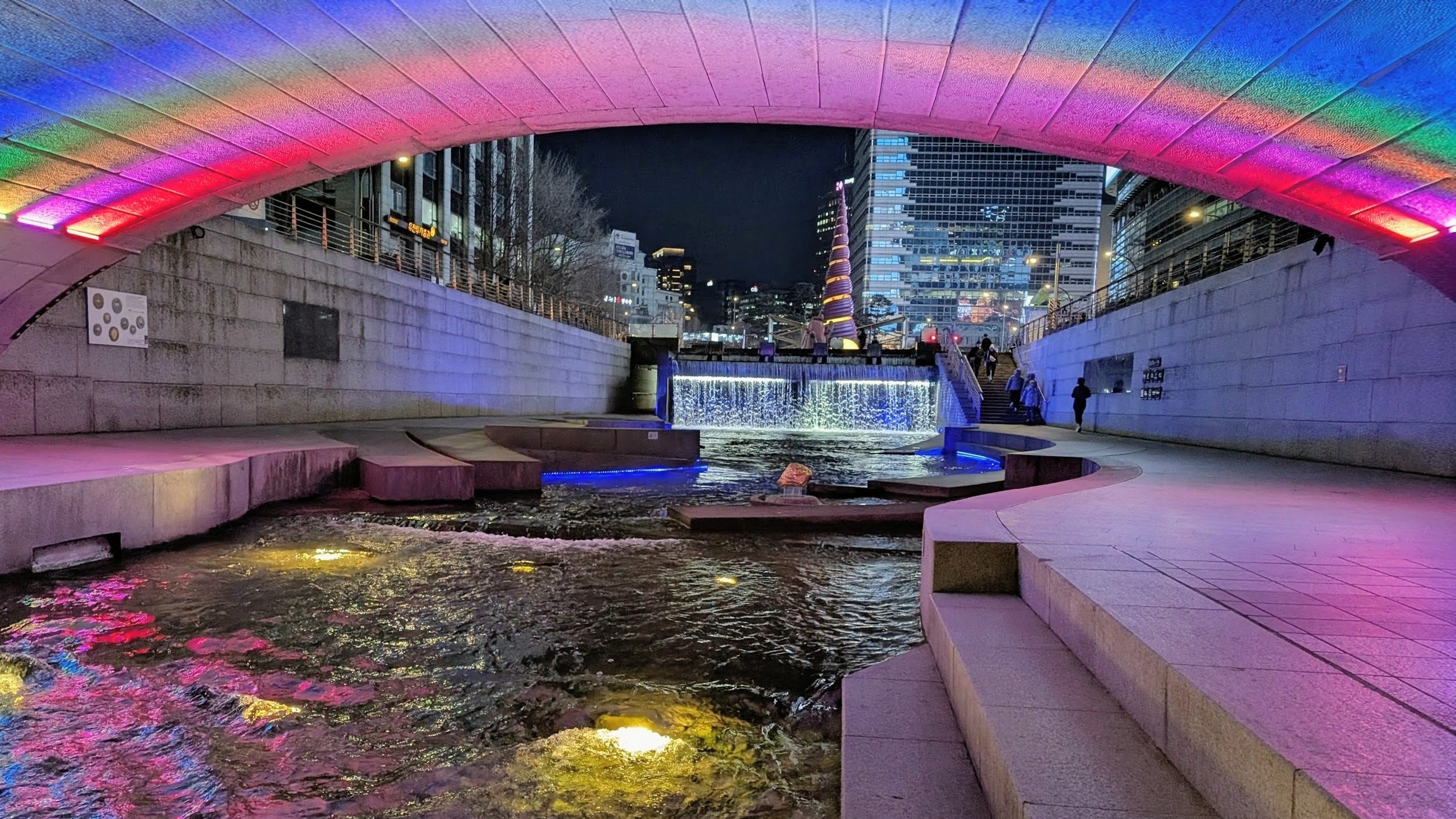
I didn’t walk the entire length of Cheonggyecheon; it was nearly midnight and I had an early flight the next morning. However, even a short stroll along the shimmering waters – with kaleidoscopic reflections and lights from the looming buildings above – created the perfect setting to ponder my two days in Seoul.
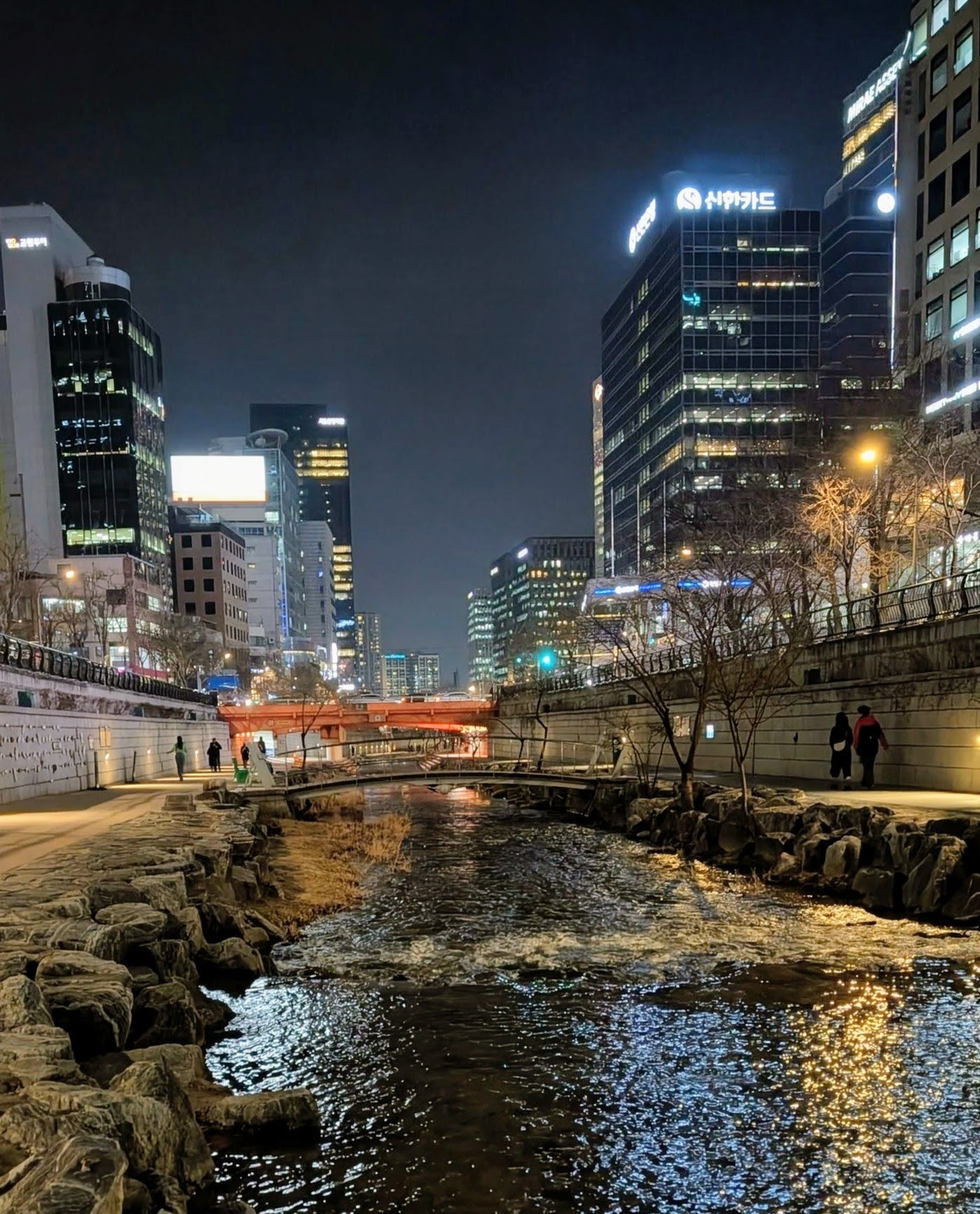
Did I really explore Seoul? Hardly. My visit here was a mere glimpse into the dazzling pot of Seoul’s culture, which blends respect for tradition, obsession with appearance, and a reverence for high-tech innovation.
Will I come back? Absolutely. More than the various “landmarks and experiences,” I loved the intense, yet friendly and invigorating energy of this city. Thanks for welcoming me, Seoul!

 Alexei on the Road
Fascinating account, fascinating city – thanks so much for sharing Alex
LikeLike
Alexi,Once aga
LikeLike
You’re amazing! Sounds like you had a wonderful time. Thanks for sharing and God bless you always! Have a blessed rest of the great fast and a glorious Pascha! Love, Fr. Joe
Sent from AOL on Android
LikeLike