I heard from many friends and fellow travelers that Morocco is amazing and a true “must-visit” destination. But what struck me was that while they were all talking about the same country, they were excited about completely different things.
Some were captivated by medieval cities with bustling Oriental bazaars, as if coming straight from “The Arabian Nights.” Some talked about mesmerizing beauty of the Sahara desert. Some praised intricate flavors of Moroccan cuisine. Some bragged about their adventures in remote Berber villages in the Atlas Mountains. Yet, some spent most of their time enjoying local art scene and nightlife. It felt like all these people visited quite different countries.
Marrakesh, the medieval heart of Morocco
Atlas Mountains
Sahara Desert
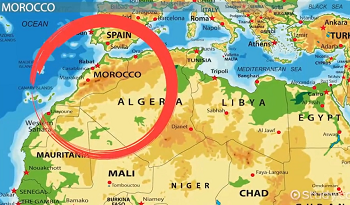
Morocco occupies the northwest corner of Africa. Bordered by Algeria and Mauritania, the country also has an expansive coastline. Furthermore, Morocco controls the Strait of Gibraltar, the place where Mediterranean Sea and Atlantic Ocean meet.
The culture of Morocco is a blend of African and Arabic influences. Scholars even devised the term “Maghreb” (“West,” the place of sunset) to describe this fusion. To the ancient Arabs centered in the Middle East (the “Mashriq” or “Place of Sunrise”), North Africa (“Maghreb”) was the land where the sun set.
Of the 38 million population, about 98% are descendants of either Berbers (also known as Amazigh), the indigenous people of North Africa, or Arabs, who arrived here during the 7th century’s conquests. Over the centuries, most Amazigh people adopted Islam and the language brought by the Arabs. As a result, while a large percentage of Moroccans have Amazigh ancestry, they often identify as Arabs and speak Darija, the Moroccan Arabic dialect (although Amazigh is also recognized as an official language of Morocco).
The relations and interplay between Berber and Arabic cultures in today’s Morocco is a fairly complex matter. If interested, watch this short YouTube video: it will give you a good idea about this subject.
When planning my trip to Morocco in October 2025, I decided to skip most famous and popular destinations (like Marrakesh or Fes). Instead, my focus was on places which remain somewhat less visited by tourists.
One more note. In order to have a truly rewarding journey in Morocco, you will need: a) to know a few travel practicalities and b) to be aware of some sensitive aspects in Moroccan politics and culture. If you think of visiting Morocco, I highly recommend reading the first section from the table of content below. Otherwise, you can skip HERE straight to the story about my trip.
A Few Important Things to Know Before You Go To Morocco
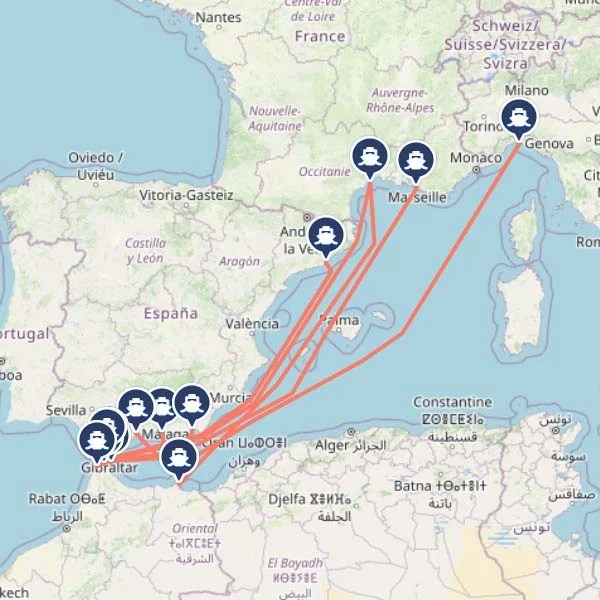
HOW TO GET TO MOROCCO. All major Moroccan cities (Rabat, Casablanca, Tangier, Marrakech) have international airports, so there is a good choice where to begin your trip. However, if you travel to Morocco from Europe, there is another and more interesting option – a number of ferry boats operate between Spain, France, Italy, and several cities on Moroccan coast.
The most popular and fastest (1-2 hours travel time) line connects Spanish cities of Tarifa (for foot passengers) or Algeciras (traveling with vehicle) with Tangier, Morocco’s main seaport. But for genuine lovers of boat travel, there are also much longer routes from Eastern Spain (Barcelona), France (Marseille) and Italy (Genova). Look for schedules and tickets on Direct Ferries.
Morocco is connected by ferries with several European countries
TRANSPORTATION IN MOROCCO. Traveling in Morocco by public transport is easy. First, many cities have airports, and domestic flights are inexpensive. Second, Morocco has a fairly expansive railroad system. Look for schedules and tickets on the website of ONCF, the national rail company. A small warning: to buy tickets from this website you need to set your VPN to Morocco.
The rail map of Morocco
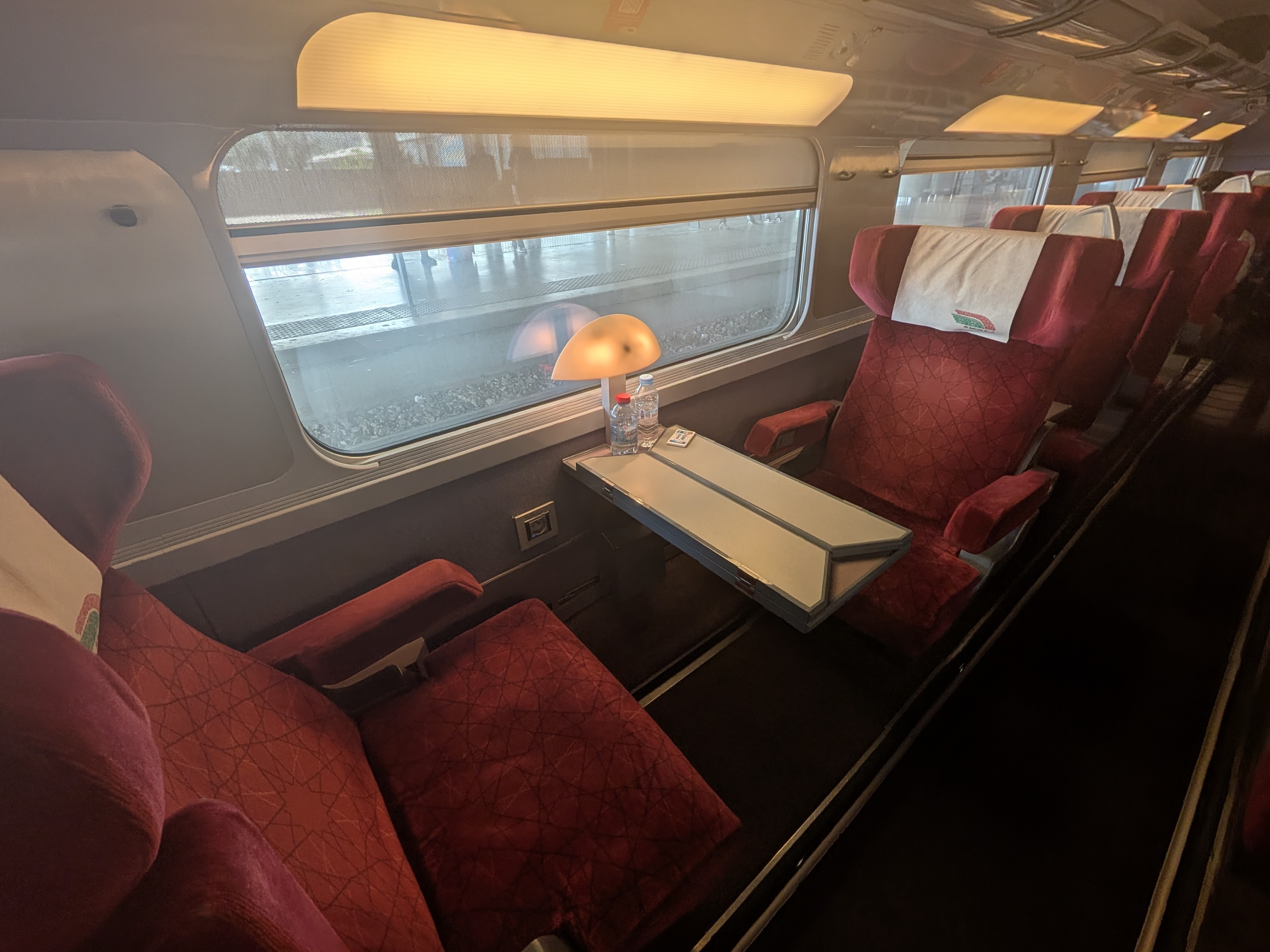
In 2018, the first high-speed line was launched. Connecting Tangier and Casablanca (323 km / 201 mi), it reduced travel time from 4h45m to just 2h10m. The nice thing about Moroccan trains is that they are cheap, so I splurged and traveled only first class. For example, a trip from Tangier to Marrakesh (with a change in Casablanca) costs only US$ 60. Look at these posh first-class seats: they are very comfortable.
First-class seat on high speed Al Boraq train
Third, Morocco has an extensive network of intercity buses. They are operated by various companies, but most of them sell their tickets on 12Go Asia website.
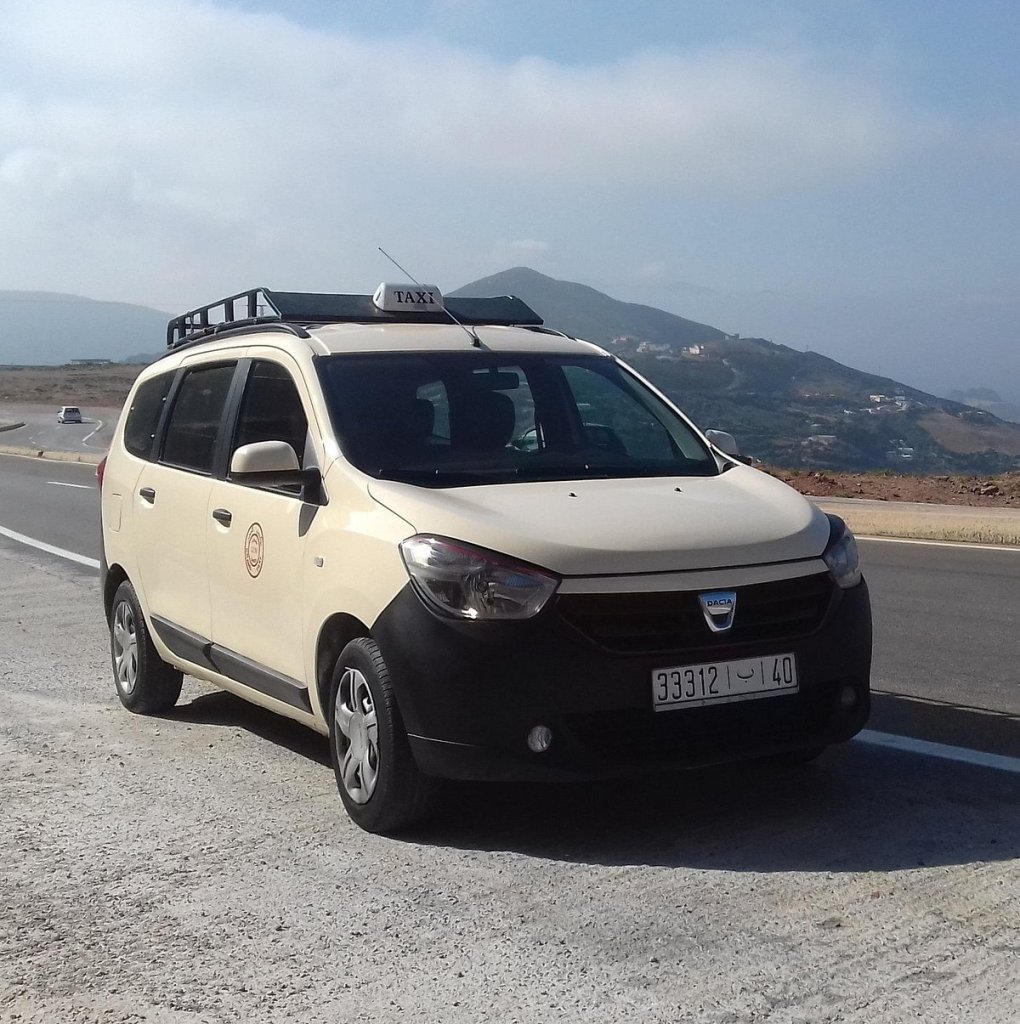
Fourth, for a truly Moroccan experience, consider using “grand taxis.” These are shared, long-distance minivans. Typically with six seats, they travel on fixed routes between cities and towns, but they do NOT have exact scheduled departure times. Instead, grand taxis wait at designated stands until all seats are filled before departing.
Passengers pay a set price for a seat, making it an affordable, though often cramped, way to travel across the country. As an option, if you are in a hurry, you can pay for all six seats (or remaining empty seats) and depart to your destination immediately.
Grand Taxi is a common way to travel in Morocco
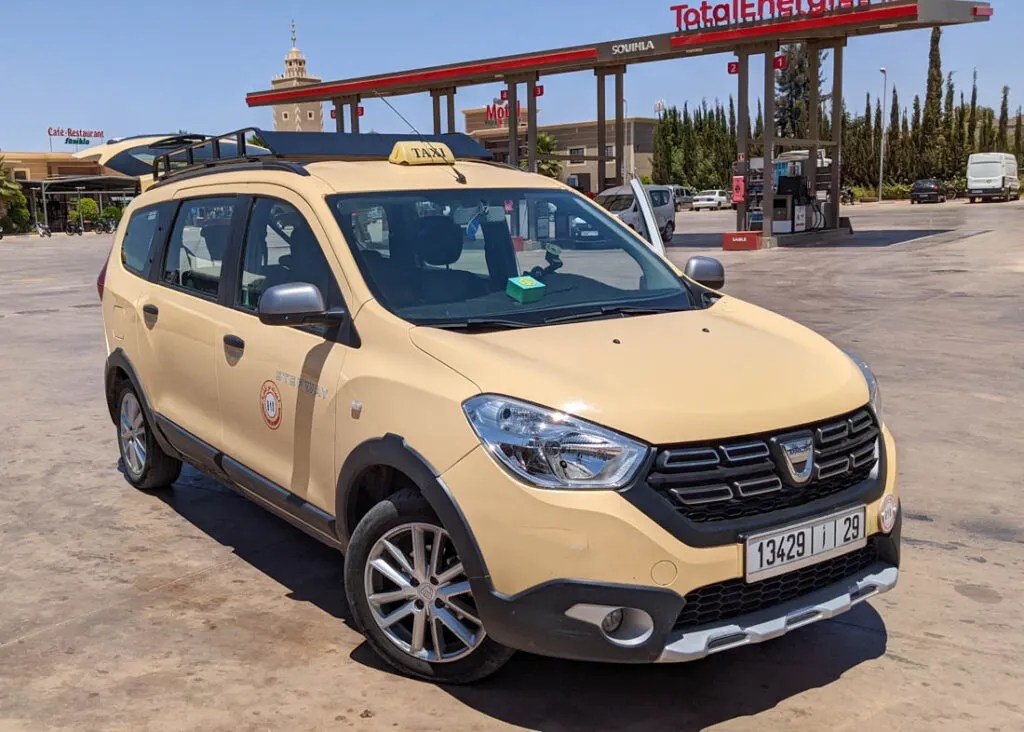
Unlike long-distance “grand taxis,” “petite taxis” operate within the city limits. In each city, they have distinct colors: beige in Marrakech, blue in Tangier, etc. Overall they are similar to US or European taxis, but there are also two things to keep in mind.
First, very often, instead of using a meter, the driver will offer you a certain price for the ride which you can negotiate. Second, if a taxi goes to certain destination, it is customary to pick other people along the route who want to travel in the same direction. The price is then split between all passengers.
Petite taxi in Tangier
There is no Uber or Lyft in Morocco, but instead another ride-sharing app is very popular – inDrive.
InDrive is a popular ride-sharing app in Morocco
Being similar to Uber/Lyft, inDrive yet has a few differences. First, after requesting a ride, the app will show a suggested price, but you can also increase the chances to be picked-up quickly by offering a higher price for potential driver. Second, all payments are in cash. Third, along with cars, inDrive also allows riding with motorbikes and scooters.
While the latter option is always cheaper and often faster, you should also weigh in the safety question. I took a ride with motorbike from Tangier to Cape Spartel (a place where Atlantic “meets” Mediterranean sea), and we covered 15 km / 10 mi really fast. Problem was that my driver had a helmet for himself, but not for passengers. So…there are things to consider.
Using inDrive ride sharing app, you can also ride with motorbike or scooter
FOOD IN MOROCCO. You will definitely not die from hunger here. The cuisine of this country is diverse, complex, and flavorful, and I even met some tourists who traveled here with the main goal to “eat their way” through Morocco. Two most iconic dishes are tagine and couscous.
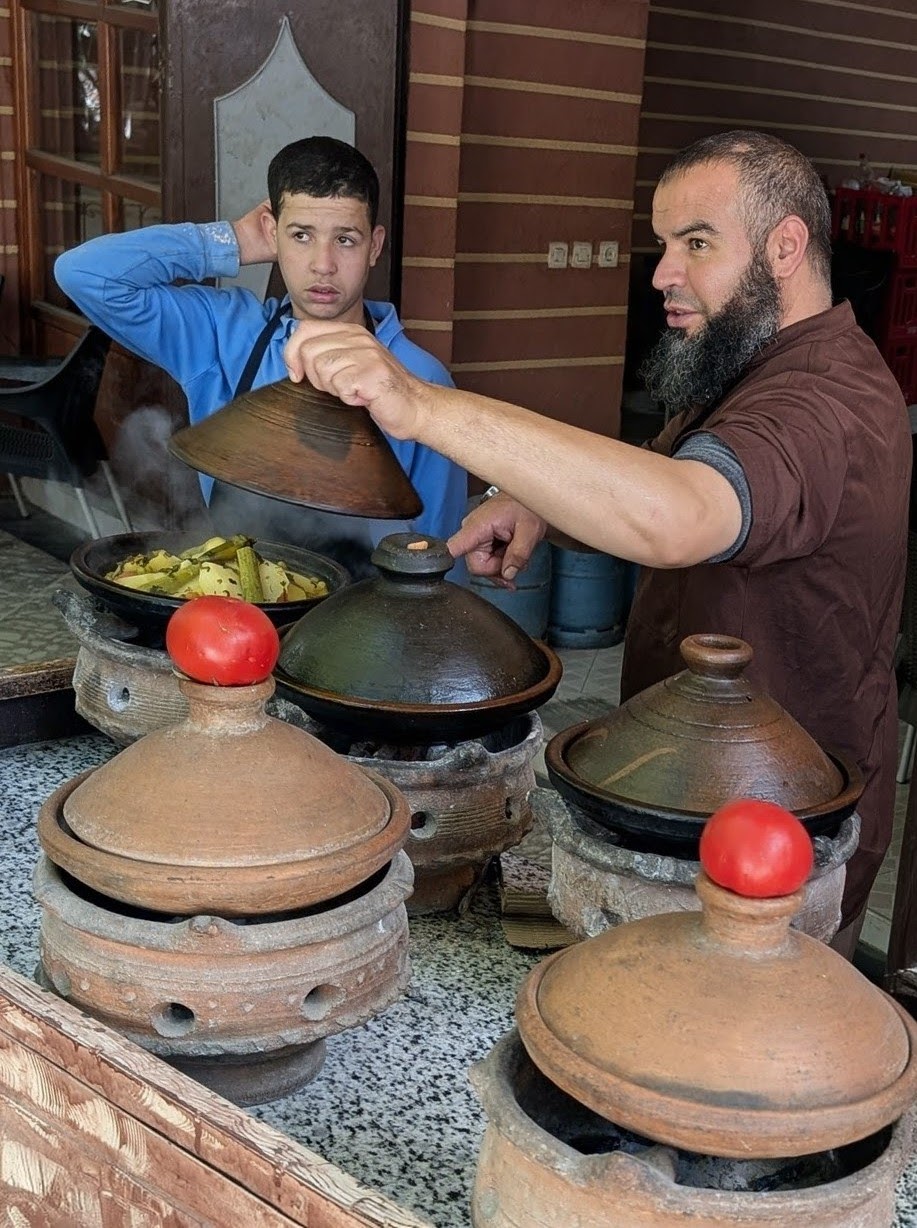
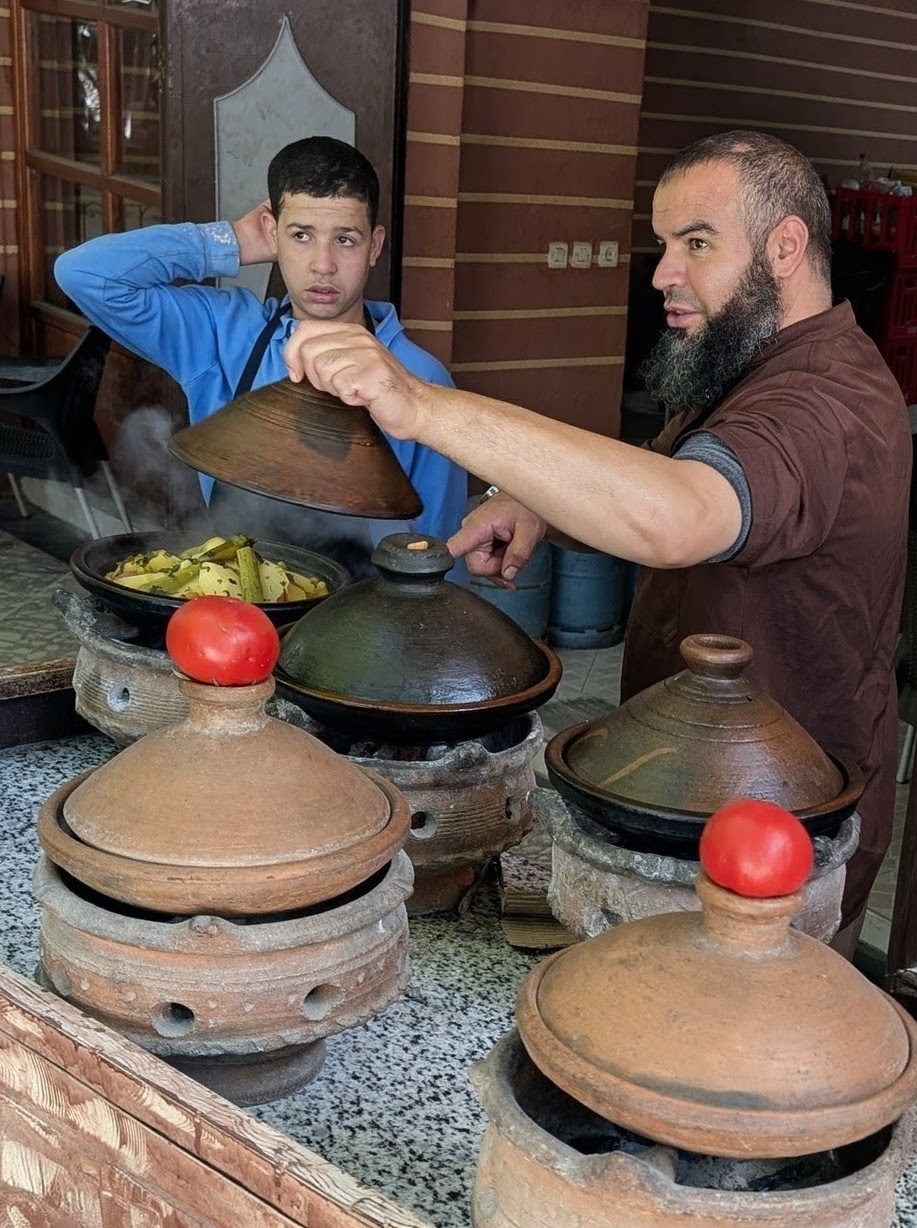
Tagine is a stew named after the cone-shaped earthenware pot in which it is slowly prepared. In the process of cooking, the uniquely designed lid traps steam, which then drips back down over the ingredients, resulting in incredibly tender meat and flavorful, aromatic vegetables.
Common variations include chicken with preserved lemons and olives, lamb with apricots and almonds, or beef with prunes – all infused with spices like turmeric, cumin, and saffron.
Preparing tagine, the most iconic Moroccan dish
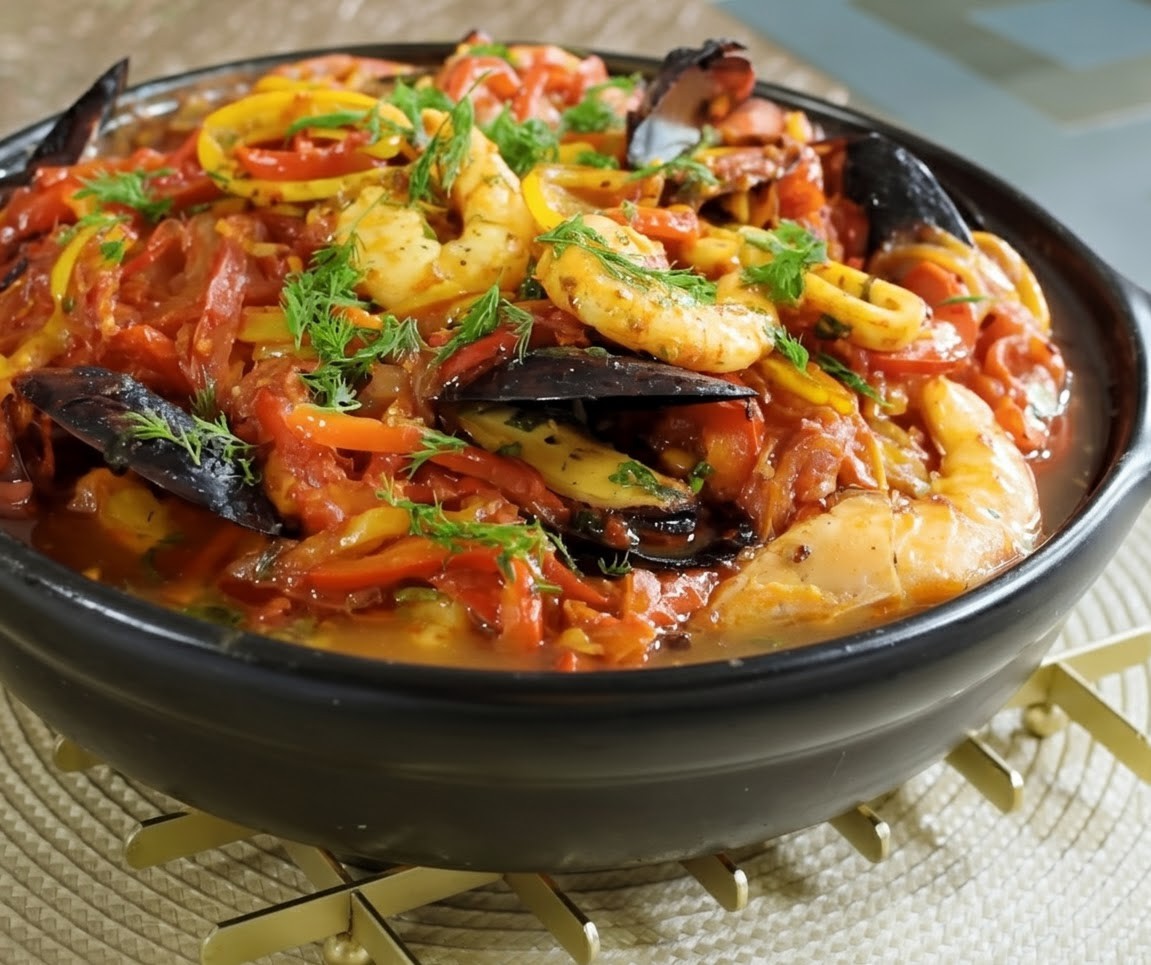
Traditionally tagine has been cooked with some kind of meat, but today vegetarian or seafood versions are also becoming increasingly popular.
Seafood tagine
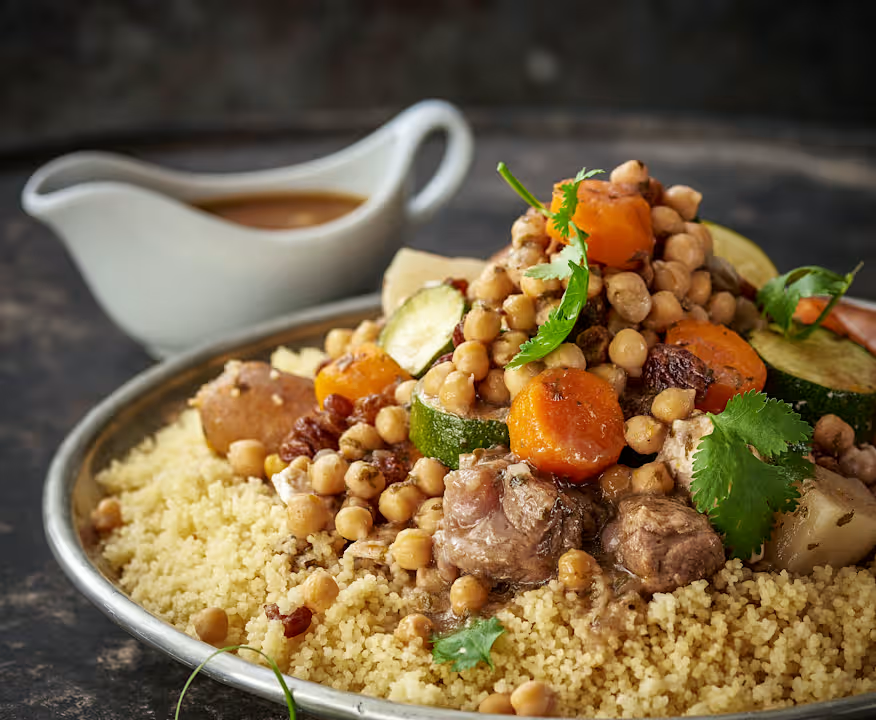
Couscous, the other Moroccan specialty, is like a two-layer dish. The first consists of tiny, light granules of steamed durum (wheat semolina), and it forms a fluffy bed for the dish. Then, it is piled high with a rich stew of meat (lamb or chicken) and various vegetables, such as chickpeas, carrots, turnips, and zucchini.
Just before eating, couscous is moistened with a fragrant broth from the stew. Similar to tagine, it is increasingly easy to also find a “no meat” version of couscous.
Couscous, another “must try” dish of Morocco
Historically served as a communal meal, couscous has a special place in Morocco’s religious and social culture. It was traditionally prepared and eaten on Fridays, the most sacred day of the week in Islam, when observant Muslims are required to attend a special congregational prayer (Jumu’ah) at the mosque around noon.
After the midday prayer, people would return home to gather for the most important meal of the week. This was a time for extended family to come together and connect, while eating couscous from a single, large platter.
Couscous is a centerpiece of Moroccan family meal
Clearly, besides tagine and couscous, Morocco offers many other “gastronomic treasures.” Depending on particular area of the country there will be either more meat, or seafood, or vegetables on the menus in local restaurants. Personally for me, one dish stood out and became my instant favorite – the pastilla (also spelt “bastilla.”)
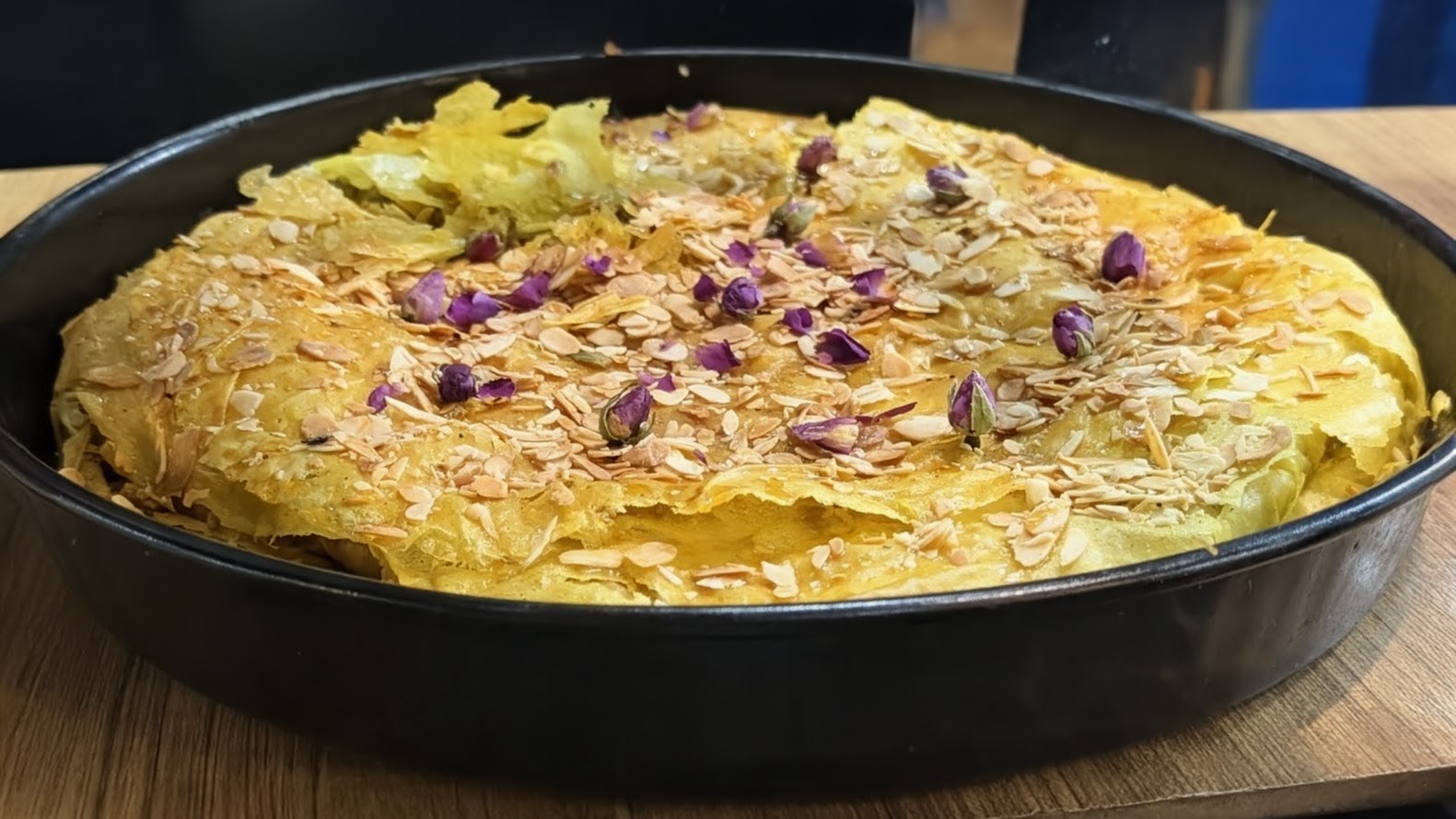
Pastilla is a pie with a crust made from layers of thin, flaky warqa or phyllo pastry. The classic filling is a captivating sweet-and-savory mix of slow-cooked, spiced chicken or pigeon, an egg-thickened sauce, and crunchy toasted almonds. The pie is finished with a dusting of powdered sugar and cinnamon. With dramatic contrasts of flavors and textures, the final result is simply fantastic. You can get small pastillas in the bakeries or order a full-size pie in a restaurant.
Pastilla, a unique sweet & savory Moroccan chicken pie
Speaking of “bakeries,” Morocco has great culture of various breads. On the one hand, the French heritage (Morocco was French colony during 1912-1956) resulted in abundant offering of crunchy baguettes, croissants, and other European-style pastries.
Morocco has excellent French-style bakeries
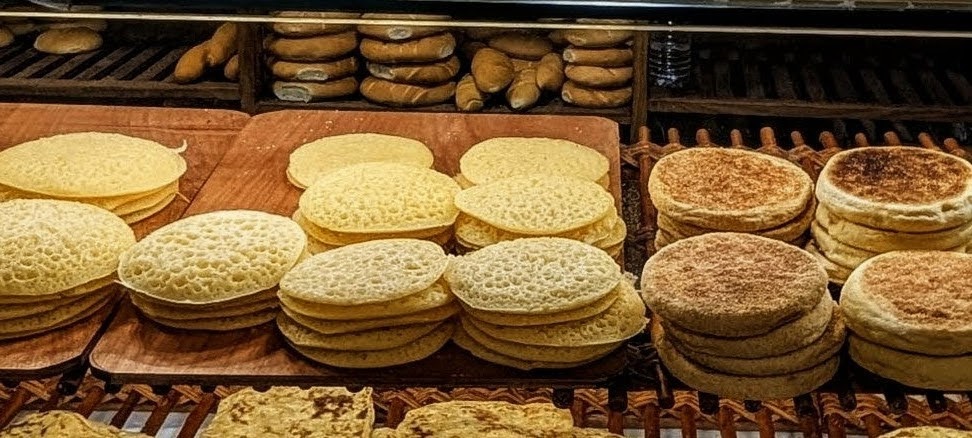
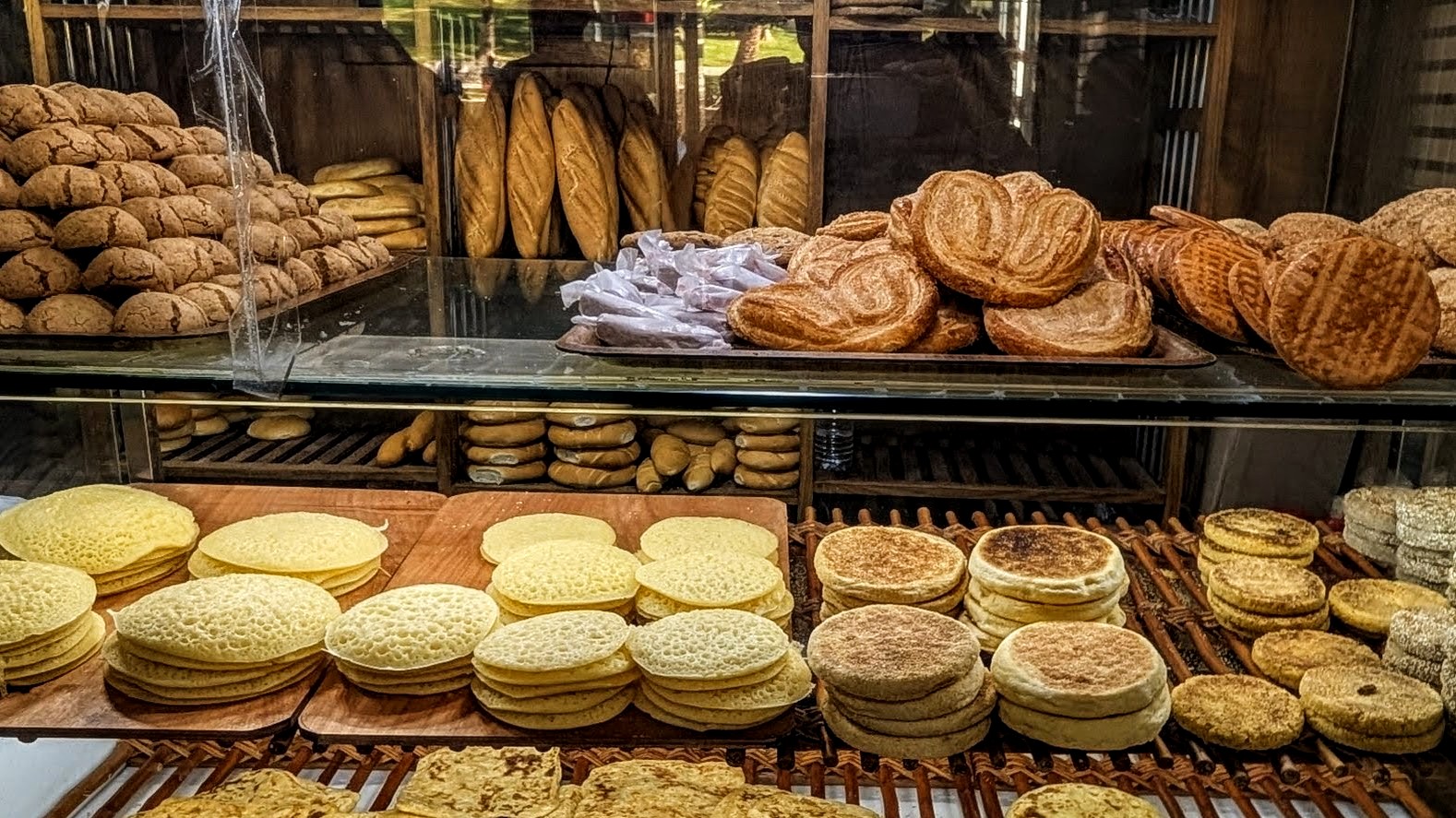
Yet other kinds of breads are truly unique to Morocco, with most of them being made from either semolina or barley flours. Semolina breads have slightly sweet flavor, somewhat gritty texture, and delicious crunchy crusts. In turn, barley-based baked goods are more rustic, darker, and have distinct nutty notes.
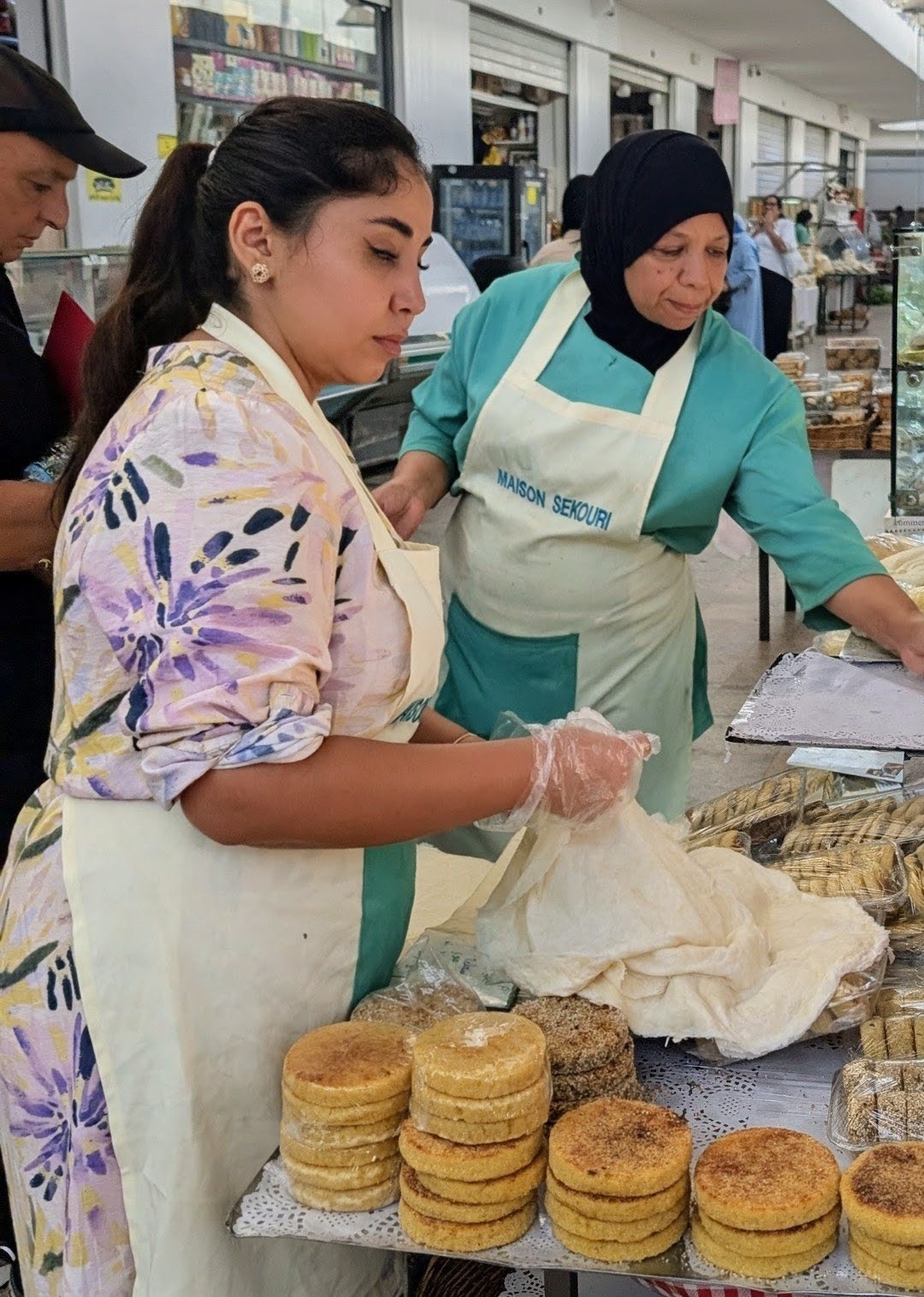
My favorites were “thousand-hole” spongy pancake called “baghrir,” and pan-fried flat cake “harcha” (it can be made from both semolina or barley). Being freshly baked, both are delicious on their own, but if you add some topping (honey, jam, cheese), they are simply heavenly tasty.
Baghrir (left) and harcha (right) became my favorite traditional Moroccan breads
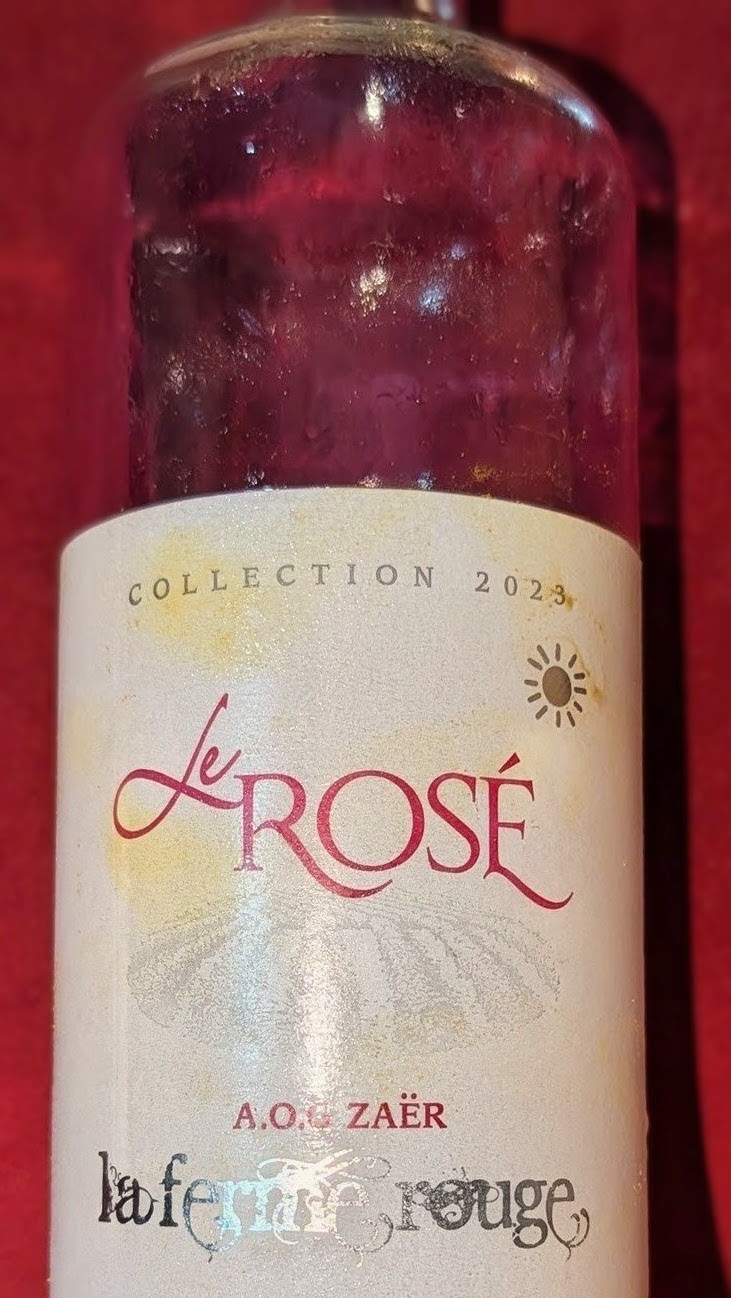
ALCOHOL IN MOROCCO. This is an interesting subject. Legally, consumption of alcohol is NOT prohibited and, in fact, Morocco even produces some decent wines: especially, dry Rose.
Morocco makes some good wines
At the same time, however, Morocco is an Islamic country. While many Moroccans drink alcohol, it is done sort of “quietly” and not in public places. For example, only a small number of restaurants serve alcohol, and they can be recognized by the fact that their windows are closed so that people walking the streets would not see the “sin” happening inside.
Similar story is with purchasing wine or beer. In big cities, your best bet are large European supermarket chains (like Carrefour), but still absolutely NO alcohol is sold on Fridays (the holiest day of the week in Islam). And it is even more difficult to find booze in smaller towns. That is , they do have stores selling alcohol, but you need to know “where exactly,” because typically there is no any sign outside. Here is an example: a door to the alcohol shop in the town of Chefchaouen.
The stores selling alcohol do not “advertise” themselves
THE ISSUE OF WESTERN SAHARA. This is a sensitive topic for Moroccans. De-facto, Western Sahara is part of Morocco. De jure, however, from the perspective of the United Nations, Western Sahara is a disputed territory presently occupied by Morocco.
Until 1975, Western Sahara was Spanish colony. After Spain’s withdrawal, the region was claimed by two powers: Morocco and the Polisario Front, an independence movement backed by Algeria that seeks self-determination for the indigenous Sahrawi people. A 1991 ceasefire left conflict “frozen” with Morocco fully controlling about 80% of Western Sahara’s territory. Here is an interesting video explaining complex situation surrounding Western Sahara.
Why is Western Sahara such a big deal for Morocco? Besides the fact that it occupies more than one-third of the entire Morocco’s territory, the Atlantic coastline of Western Sahara holds over 60% of Morocco’s total national fishing resources. Western Sahara is also a key-source of valuable phosphates, an important part of Moroccan export. Dakhla, a coastal city in Western Sahara, has become a major tourist destination for windsurfing, kitesurfing, and other water sports. The bottom line: I would not recommend to argue with Moroccans about the disputed status of Western Sahara.
THE KING OF MOROCCO. Morocco is a monarchy, and the king is both the head of the state and the supreme religious leader. Moroccan constitution defines the king as Amir al-Mu’minin – the Commander of the Faithful. This title not only implies king’s ultimate religious authority for Moroccan Muslims, but also positions him “above” any political or governmental disagreements.
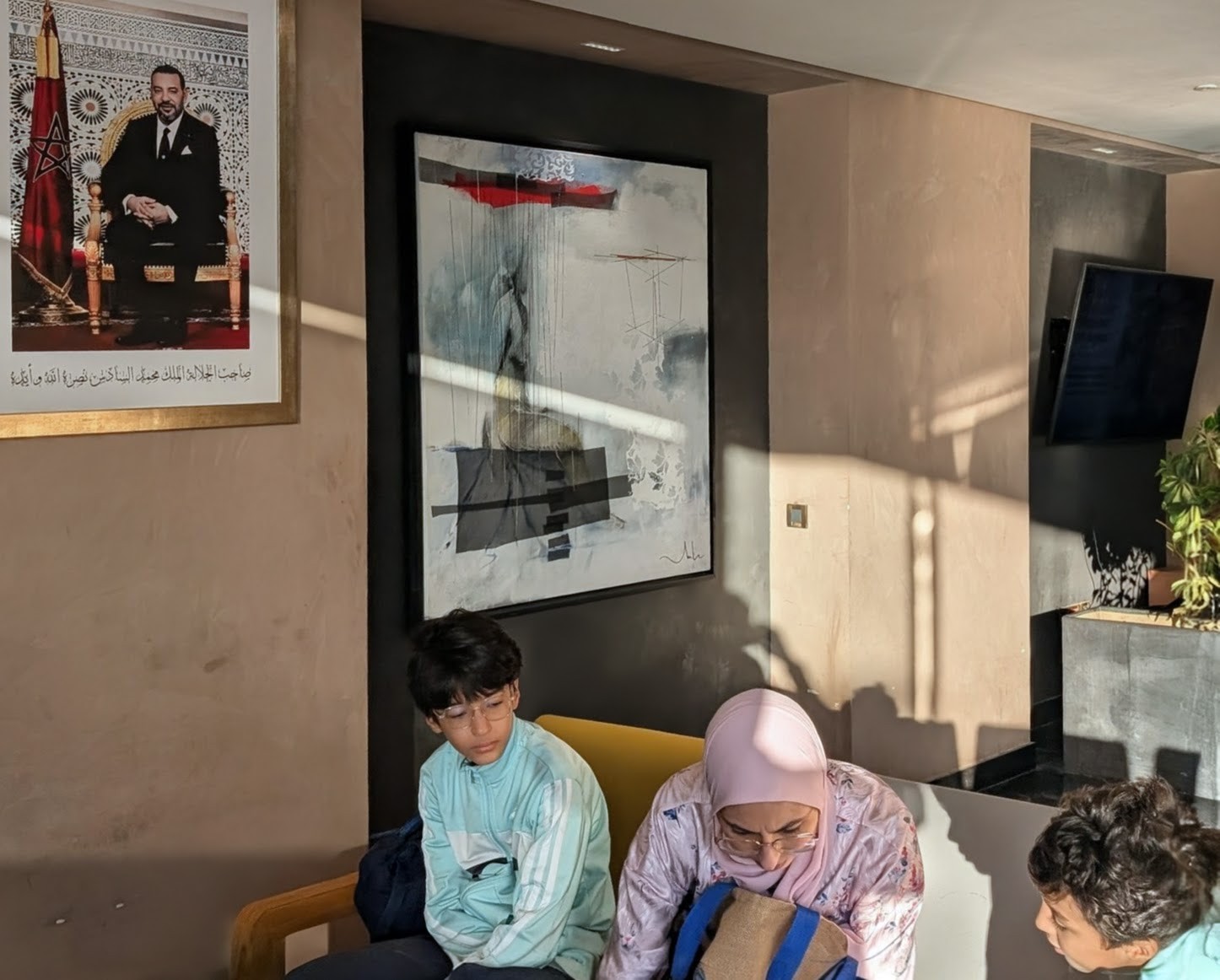
The outcome of such situation is interesting. While Moroccans largely disapprove of and criticize their government, the king remains popular and respected. Traveling in Morocco, you will see everywhere the portraits of the current monarch, Mohammed VI, who rules the country since 1999.
Portrait of Mohammed VI at the rail station
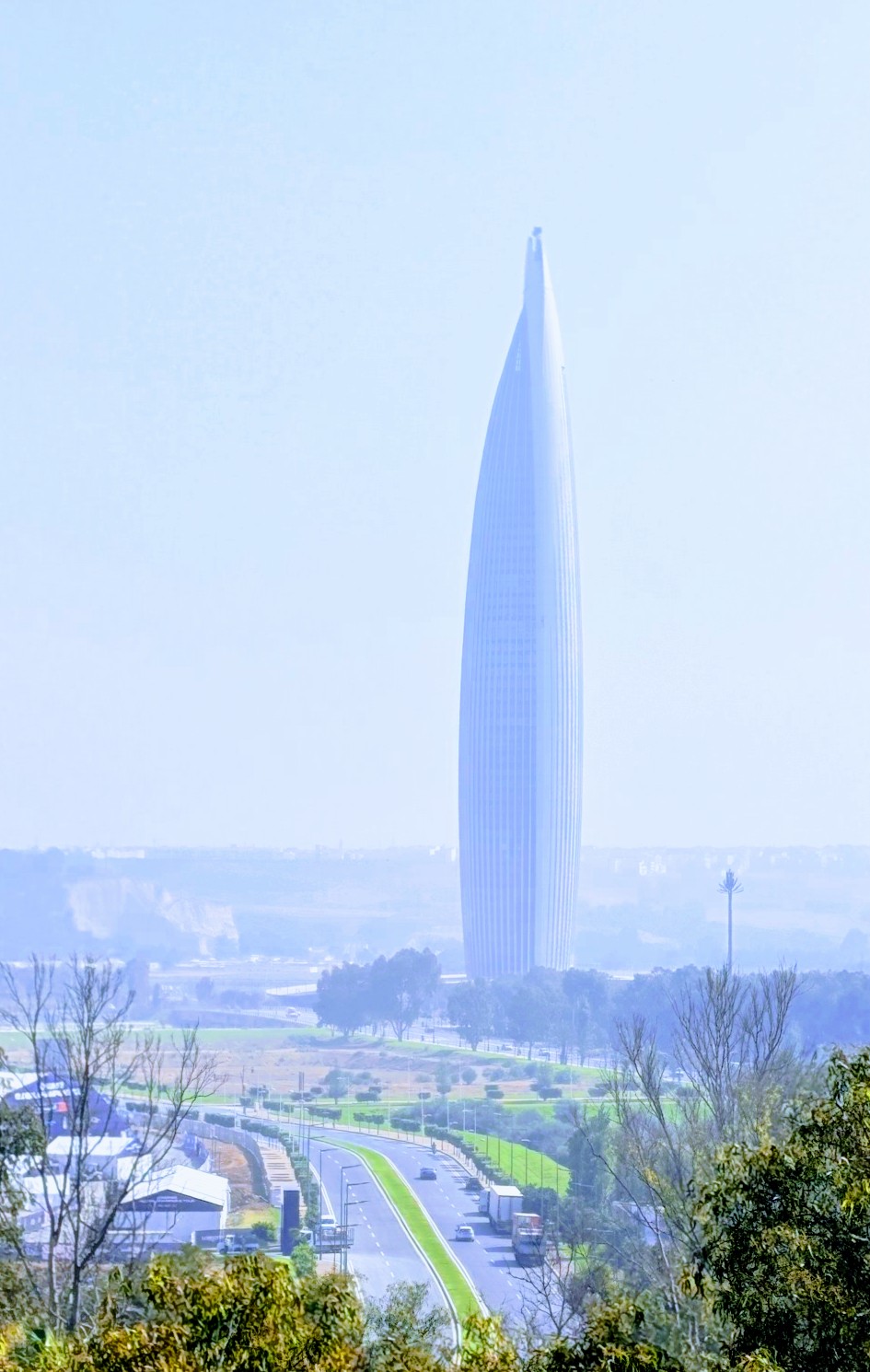
Besides his special status, there are other reasons for the popularity of Mohammed VI. One is that he is the driving force behind Morocco’s ambitious economic and infrastructure projects, which became a source of national pride. He has personally championed building modern Tangier-Med port (one of Africa’s largest), launching Africa’s first high-speed train (Al Boraq), and a vast expansion of highways.
A new office building in capital Rabat, the “personal project” of Mohammed VI
Also, early in his reign, Mohammed VI was seen as a reformer and modernizer, even earning him the nickname “King of the Poor.” His most celebrated reform was the 2004 Mudawana, a change in family law that granted women significantly more rights in marriage, divorce, and child custody.
When “Arab Spring” erupted (2011), instead of suppressing democracy movement (as this happened in Egypt, Tunisia, Syria, or Libya), Mohammed VI proposed a new constitution which granted more power to the elected parliament.
Capital Rabat: a Blend of Tradition and Modernity
When you ask people about best known Moroccan cities, most common answers are: Casablanca (because of famous Casablanca movie) and Marrakech, a city epitomizing Morocco’s Oriental culture. At the same time, Rabat, Morocco’s national capital, remains somewhat “under the radar” and underappreciated by tourists.
Meanwhile, it offers a unique blend of history and modernity, along with some UNESCO-listed monuments. Rabat also provides a more relaxed, and authentic Moroccan experience, free from the overwhelming crowds and high-pressure “souks” (bazaars) of other major tourist cities. And so, my trip to Morocco began here. Rabat’s airport is only about 10 km / 7 mi from the “medina” (old town) and the standard taxi fare is 200 dirhams (22$ USD).
Thanks to the international hospitality network SERVAS, I was able to stay my first two nights in Morocco with a local family. This was a great “bonus” and possibility to get first-hand insights in Morocco’s culture and traditions.
SERVAS, an international hospitality network
I was also very lucky to be hosted by a person who had deep knowledge of Moroccan society and politics. Indeed, Radouan Himdi worked for many years as the chief of staff of the national parliament.
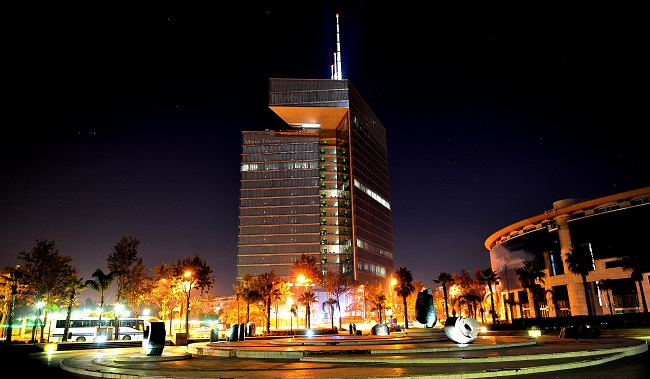
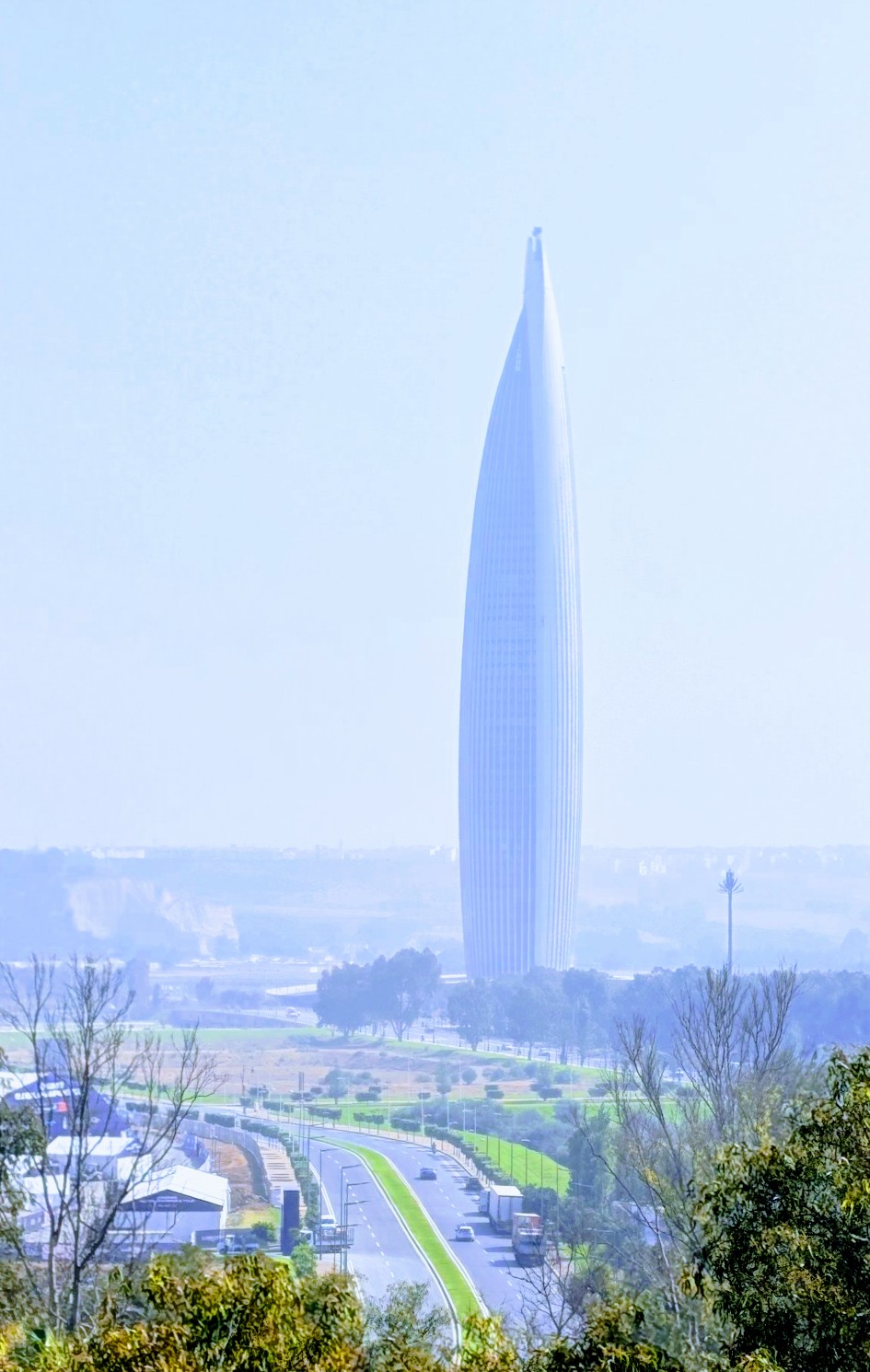
After arriving to his home at around 7 pm, we went on a long walk. Radouan lives in a newer part of the city, and, yet, I was still surprised how wide and clean the streets were and how modern overall look of the buildings was.
Morocco Telecom Tower
Radouan Himdi, my host and former chief of the staff of Moroccan parliament
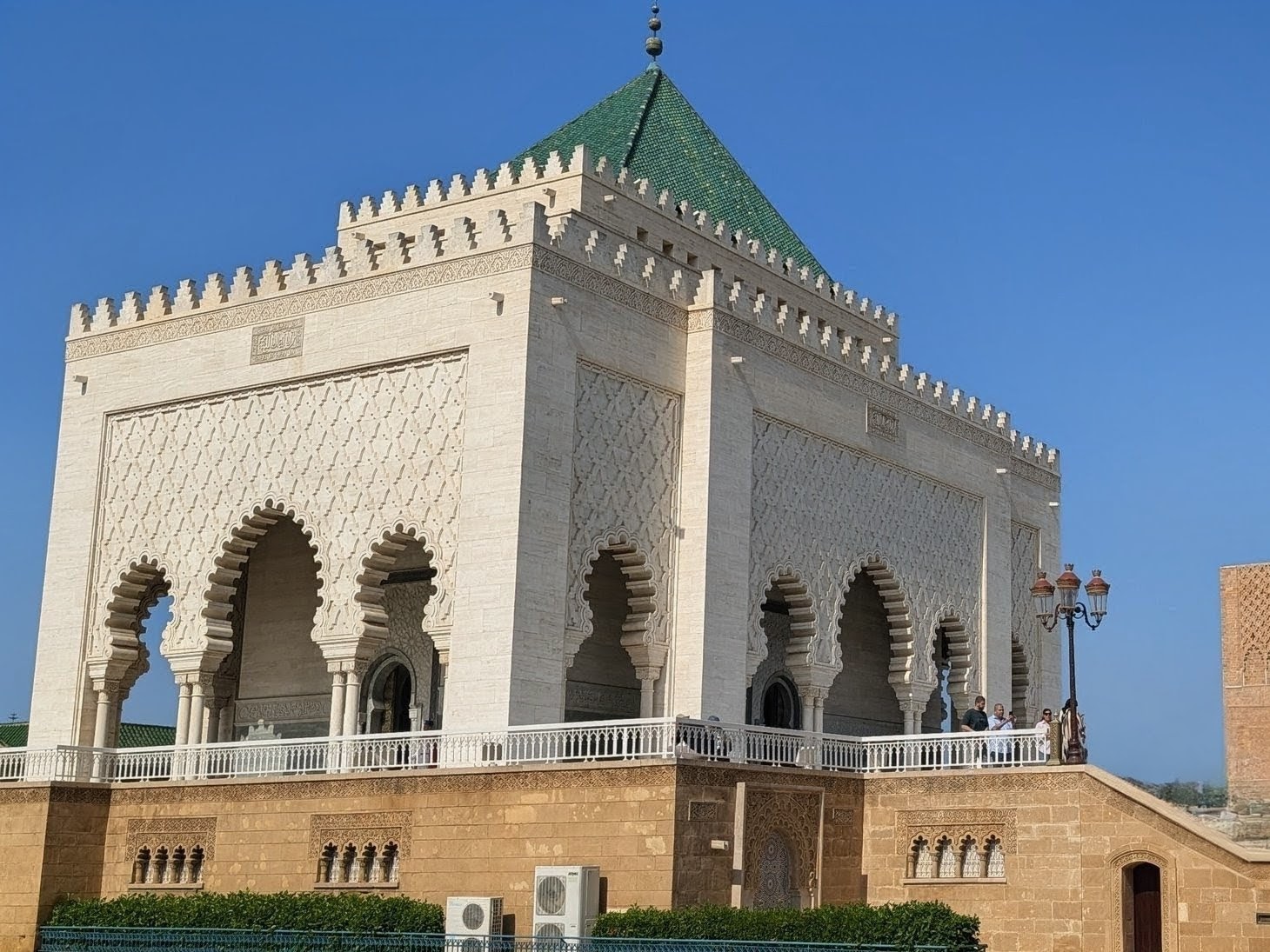
I had only one full day in Rabat, and simply asked Radouan to take me to the places which – he thinks – I should see and explore. The first destination was the Mausoleum of the King Mohammed V.
Mausoleum of Mohammed V
Mohammed V is, perhaps, most revered King in Moroccan history. His rule (1927-1961) encompassed a difficult period: French colonial administration (Morocco was French protectorate in 1912-1956), WWII, spark of nationalist movement, and first years of Morocco’s restored independence .
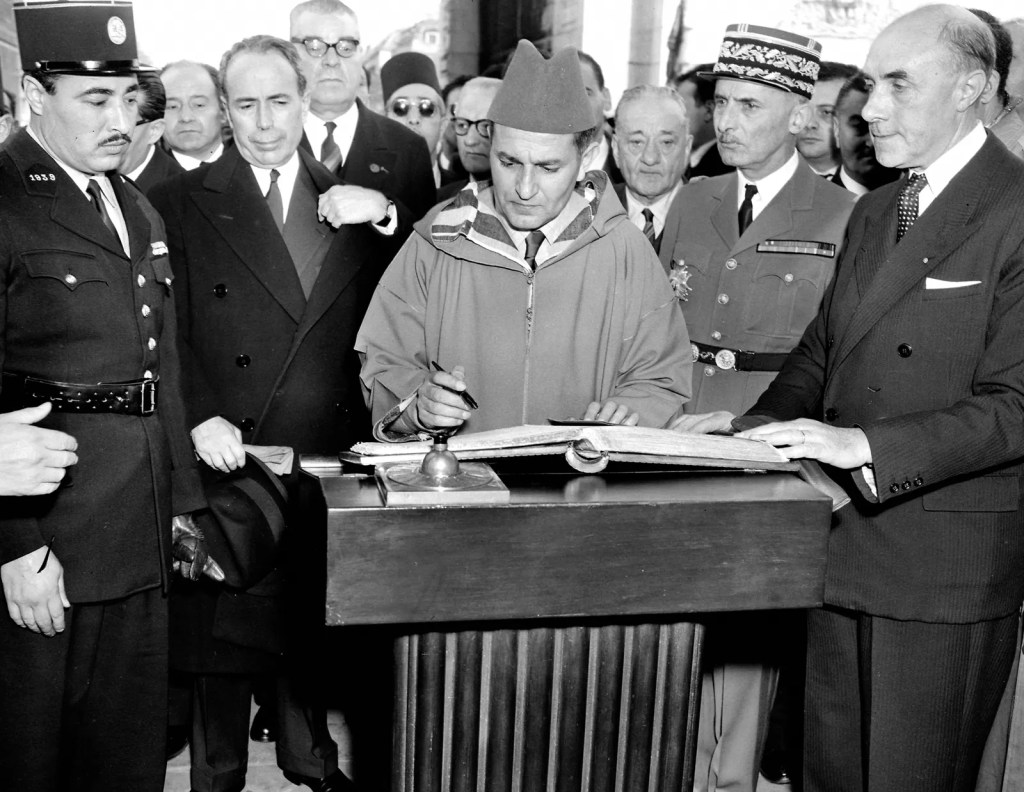
His forced exile by the French in 1953 turned him into a martyr and national hero, uniting all Moroccans in the “Revolution of the King and the People” to demand his return and their freedom. Today, Mohammed V is officially revered as the “Father of the Nation.” This title honors his pivotal role for uniting the monarchy and the nationalist movement into a single, powerful force which lead the country to independence from France (1956).
The “Father of Nation,” Mohammed V, signing documents restoring full independence of Morocco
Mohammed V was also famous for his refusal during World War II to apply the anti-Semitic laws of the French Vichy regime and offering protection to his Jewish subjects.
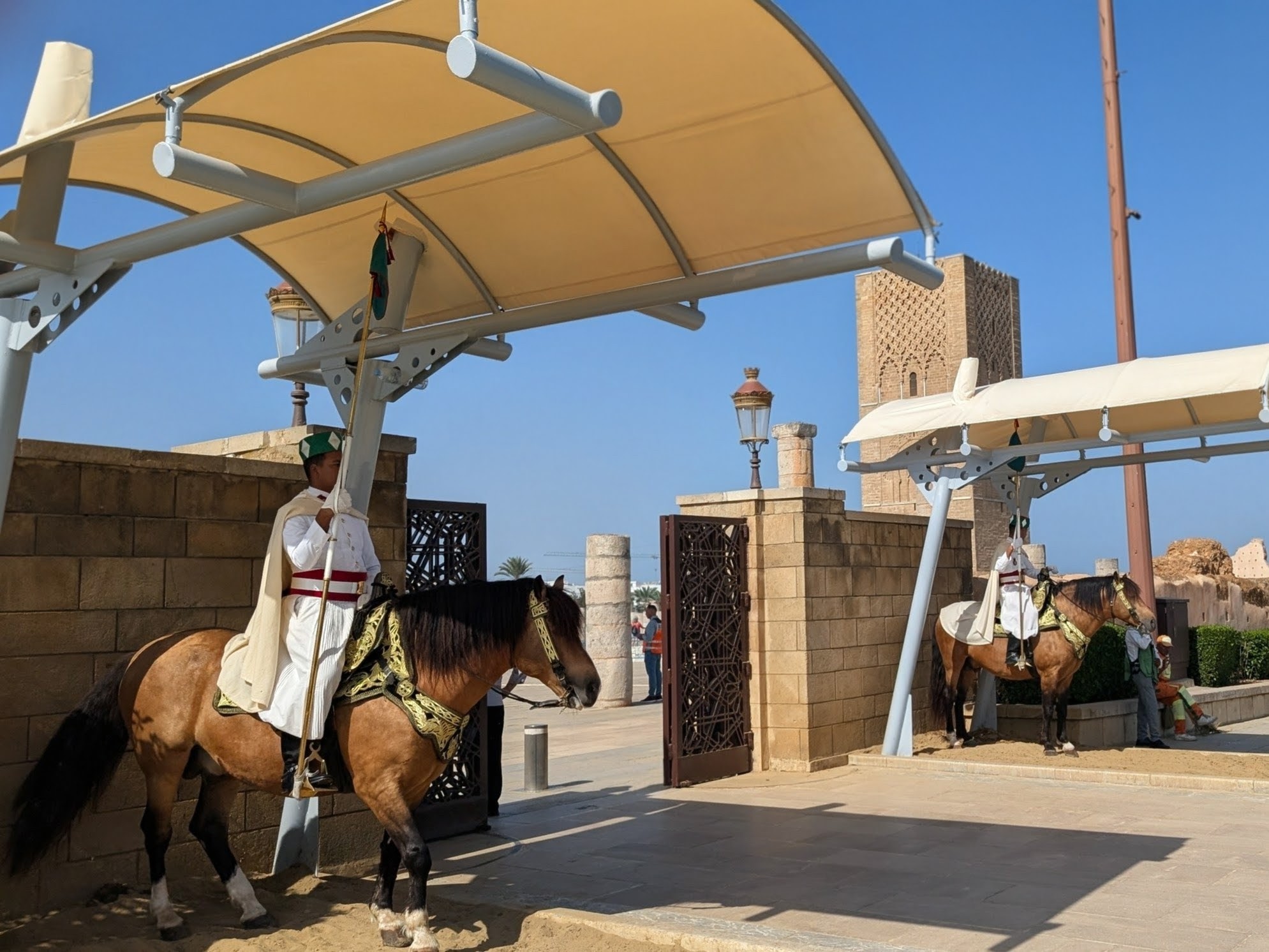
The gates to Mausoleum’s grounds are guarded by two impressive cavalrymen who absolutely don’t mind people making selfies together with them.
Entrance to Mohammed V Mausoleum
The doors of the Mausoleum itself have the “second layer” of guards. Dressed in traditional uniform, these soldiers are no less picturesque than the ones at the gates, and this is another great opportunity for making a good selfi.
Entrance to Mohammed V Mausoleum
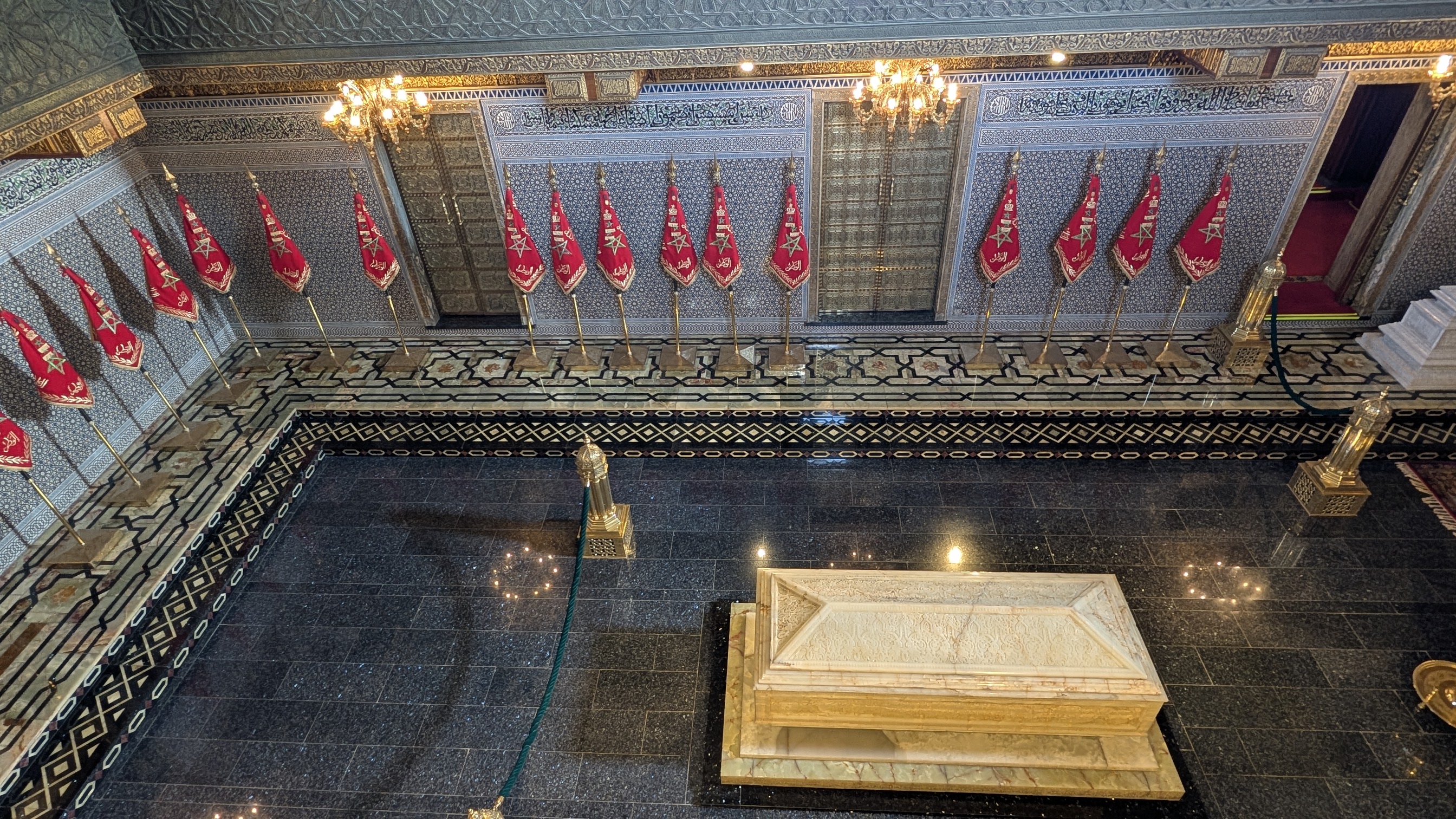
Presently, there are three tombs inside the Mausoleum: Mohammed V, Prince Moulay Abdallah, and King Hasan II (the son of Mohammed V and father of the current monarch).
Inside Mohammed V Mausoleum
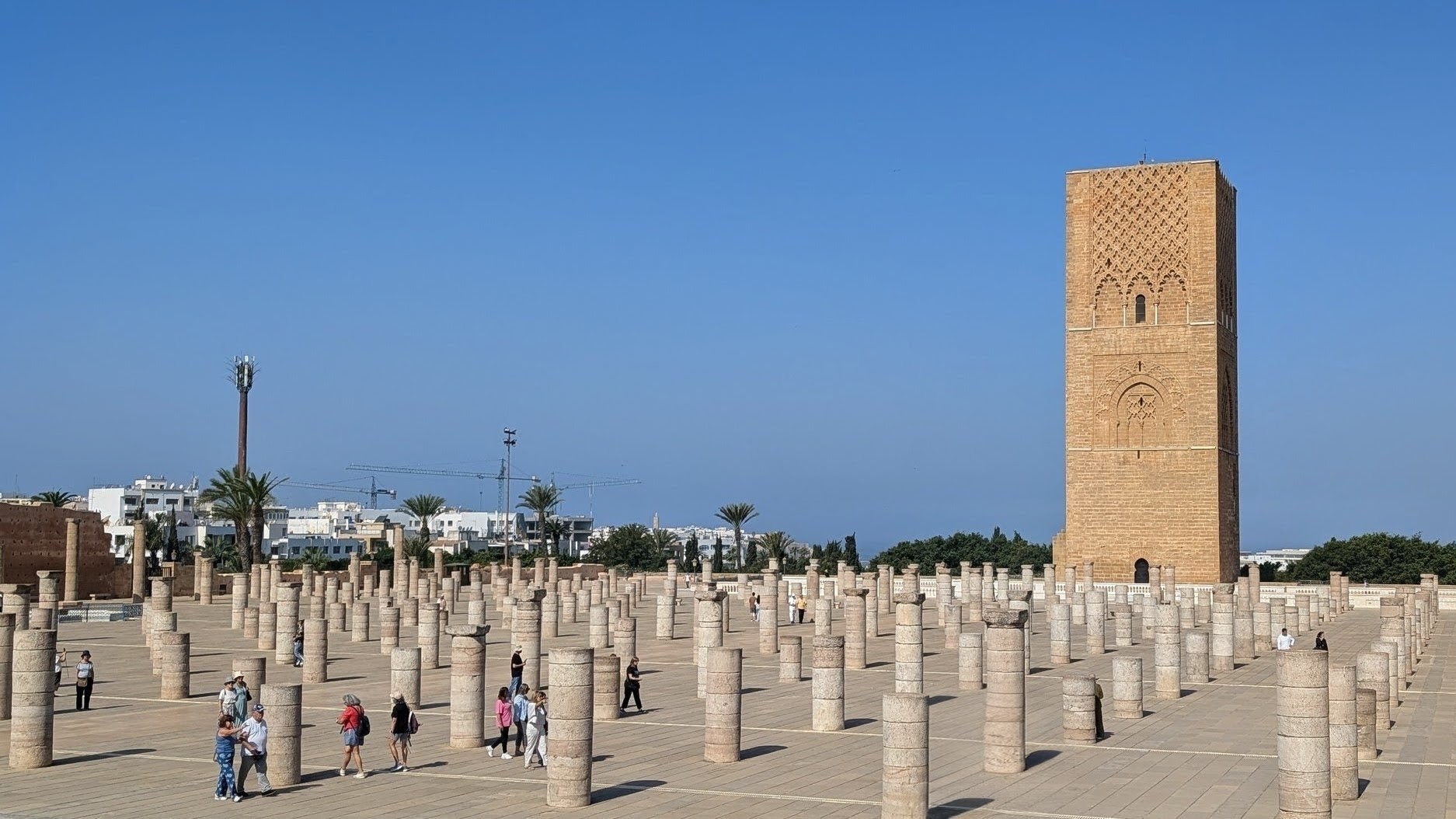
The Mausoleum is built on the site of what used to be the Hasan Mosque. Commissioned in the late 12th century by Almohad Caliph Yaqub al-Mansur, it was intended to be the largest mosque in the western Muslim world.
However, the construction was abandoned upon his death in 1199. Today, the 44-meter / 150 feet red sandstone minaret stands amid a “forest” of over 300 ruined columns and wall fragments that outline the vast scale of the original project.
The grounds of what used to be “Hasan Mosque.”
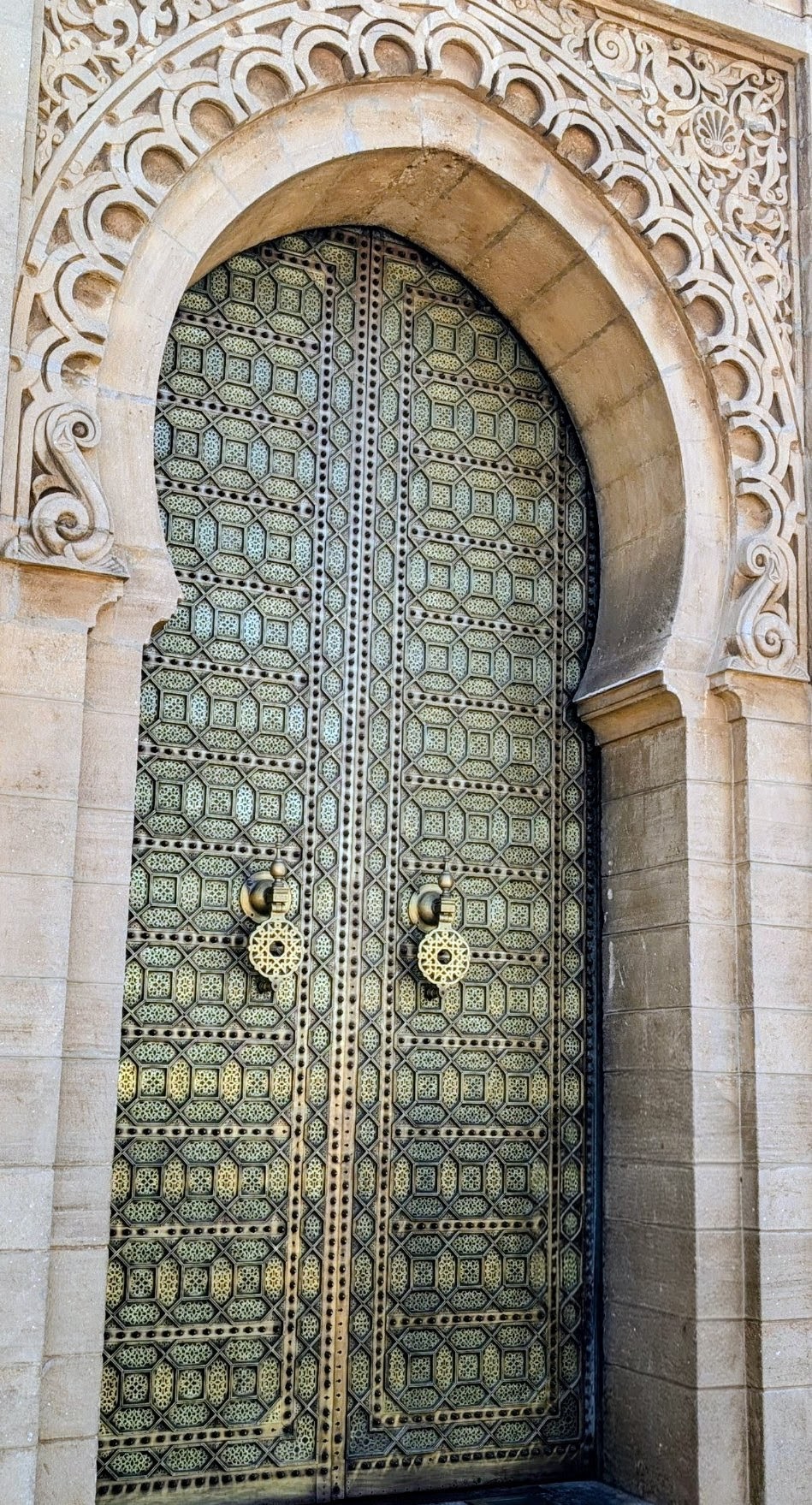
There is another, new mosque standing right next to Mohammed V Mausoleum. I was blown away by the intricate and colorful ornaments of its walls and doors.
A new mosque near Mohammed V Mausoleum
After visiting the Mausoleum, we walked along Boulevard Mohamed Lyazidi. Eventually we came to a spot which offered an amazing view over Rabat. Here is a Google map, where you can find this exact location.
From here, we could perfectly see two masterpieces of modern Morocco architecture. One was the Royal Theatre.
The Royal Theatre in Rabat
Another futuristic building was a newly constructed Moroccan government office.
New government office in Rabat
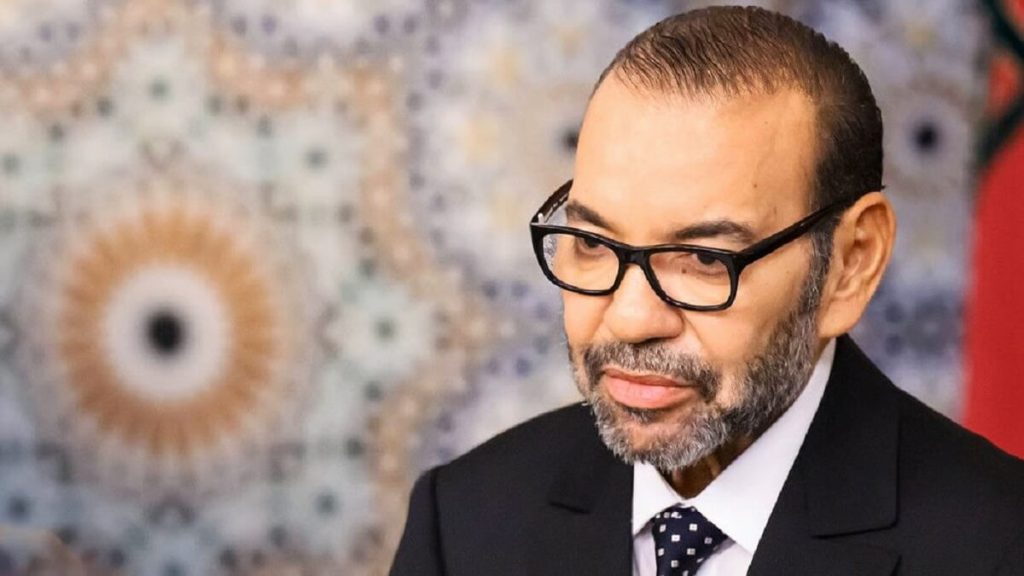
My host, Radouan, explained that both Royal Theatre and new government office were personal projects of the current King Mohammed VI, the grandson of the “Father of Nation” Mohammed V. In INTRODUCTORY SECTION of this story, I wrote about popularity of Mohammed VI. Looking at these new buildings, I thought that he definitely strives to live up to his image of “modernizer and reformer.”
Mohammed VI, current king of Morocco
Our next destination was St. Peter Catholic Cathedral. Being an Islamic country (99% of population are Sunni Muslims), Morocco yet has liberal laws and attitudes towards few religious minorities: Christians, Jews, and Bahai. A curious fact: Moroccan constitution names the King not only as “Commander of Faithful” (meaning Muslims) but also the “guarantor of free exercise of worship.”
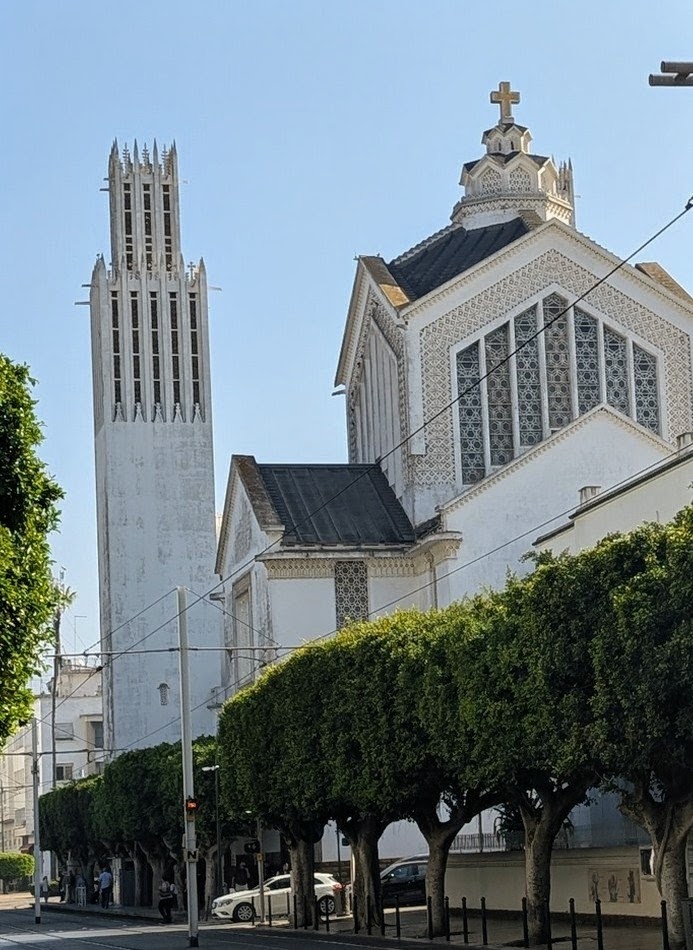
The St. Peter’s Cathedral was built in the 1930s, and it is a stunning example of Art Deco architecture that creates a striking contrast to the Rabat’s traditional Islamic landmarks. It also stands out as a symbol of the era of French protectorate in Moroccan history and the country’s long-standing religious tolerance.
St. Peter’s Catholic Cathedral in Rabat
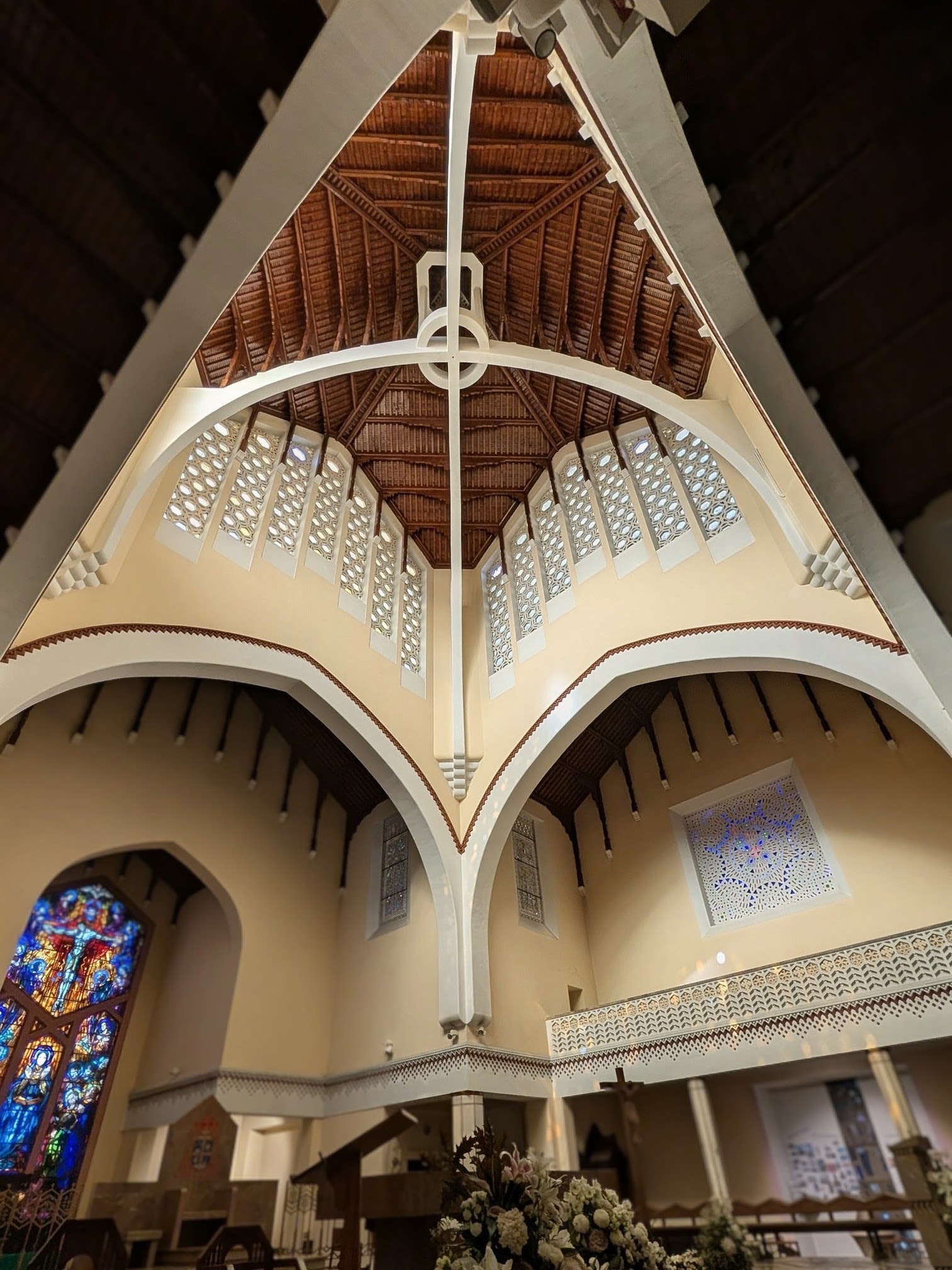
Inside, Cathedral’s serene and peaceful sanctuary is adorned with the colorful stained glass windows.
Inside St. Peter’s Cathedral
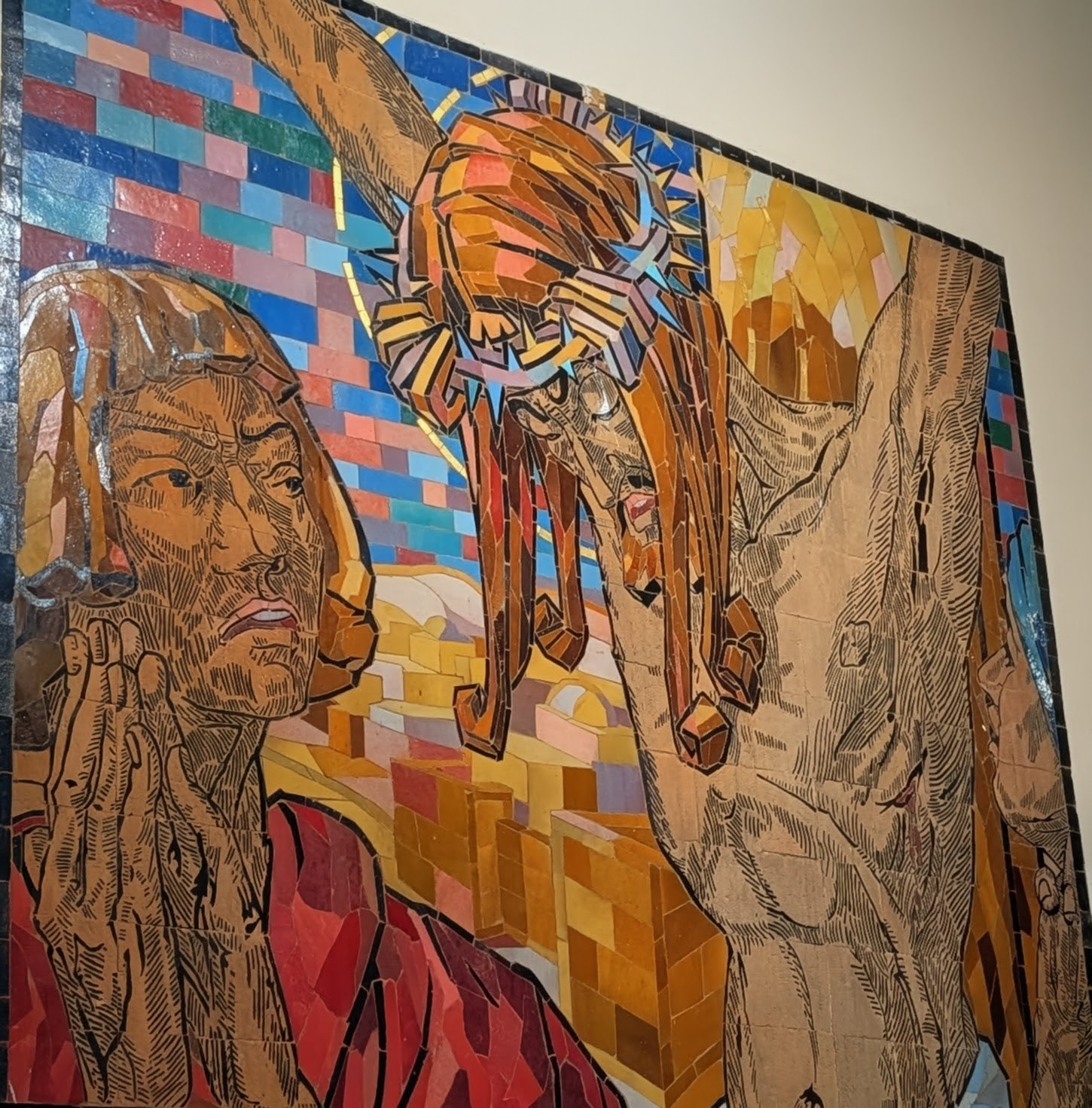
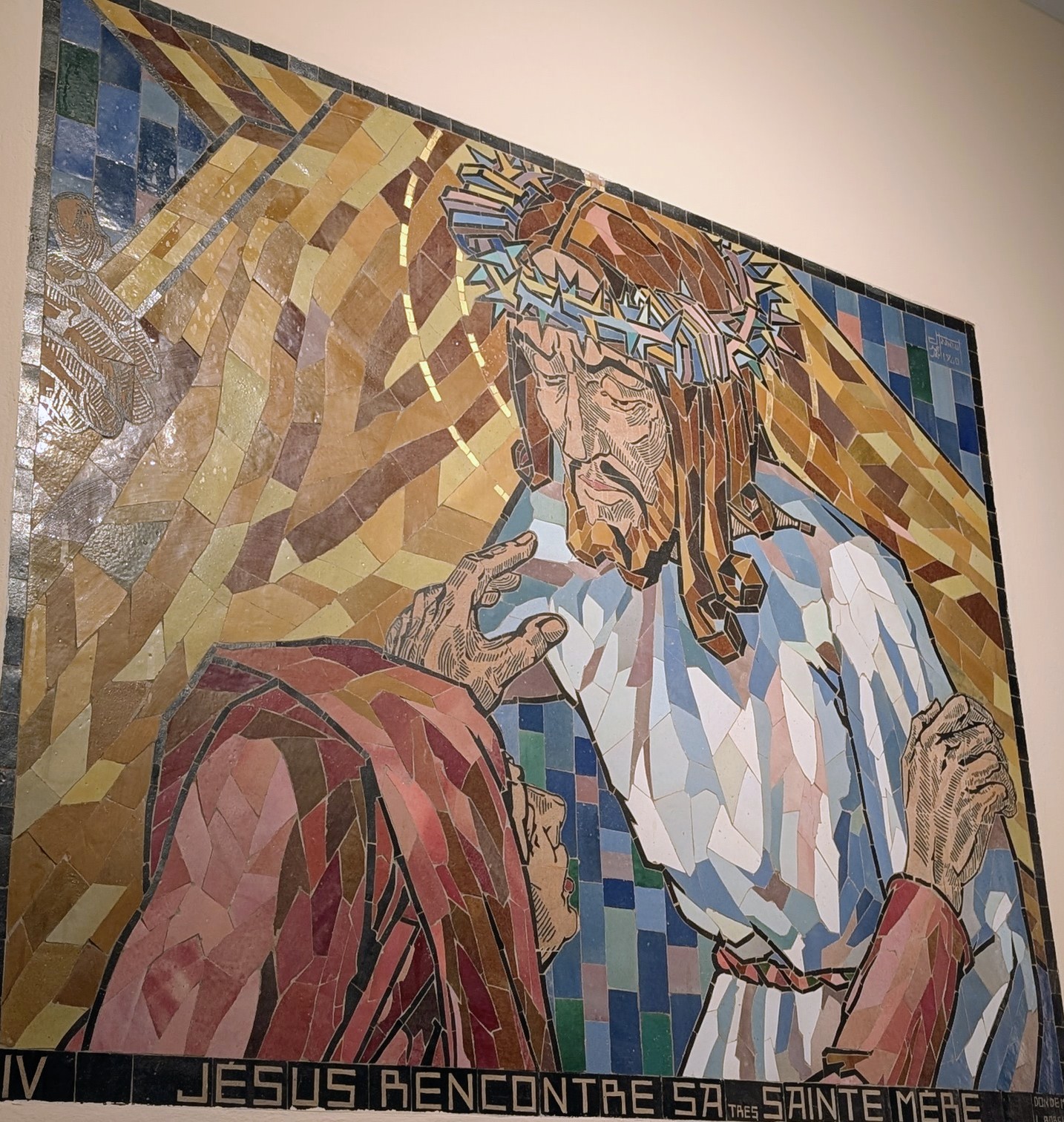
On the walls, giant murals depict various moments from the life of Jesus Christ.
Wall murals in St. Peter’s cathedral
Wall murals in St. Peter’s cathedral
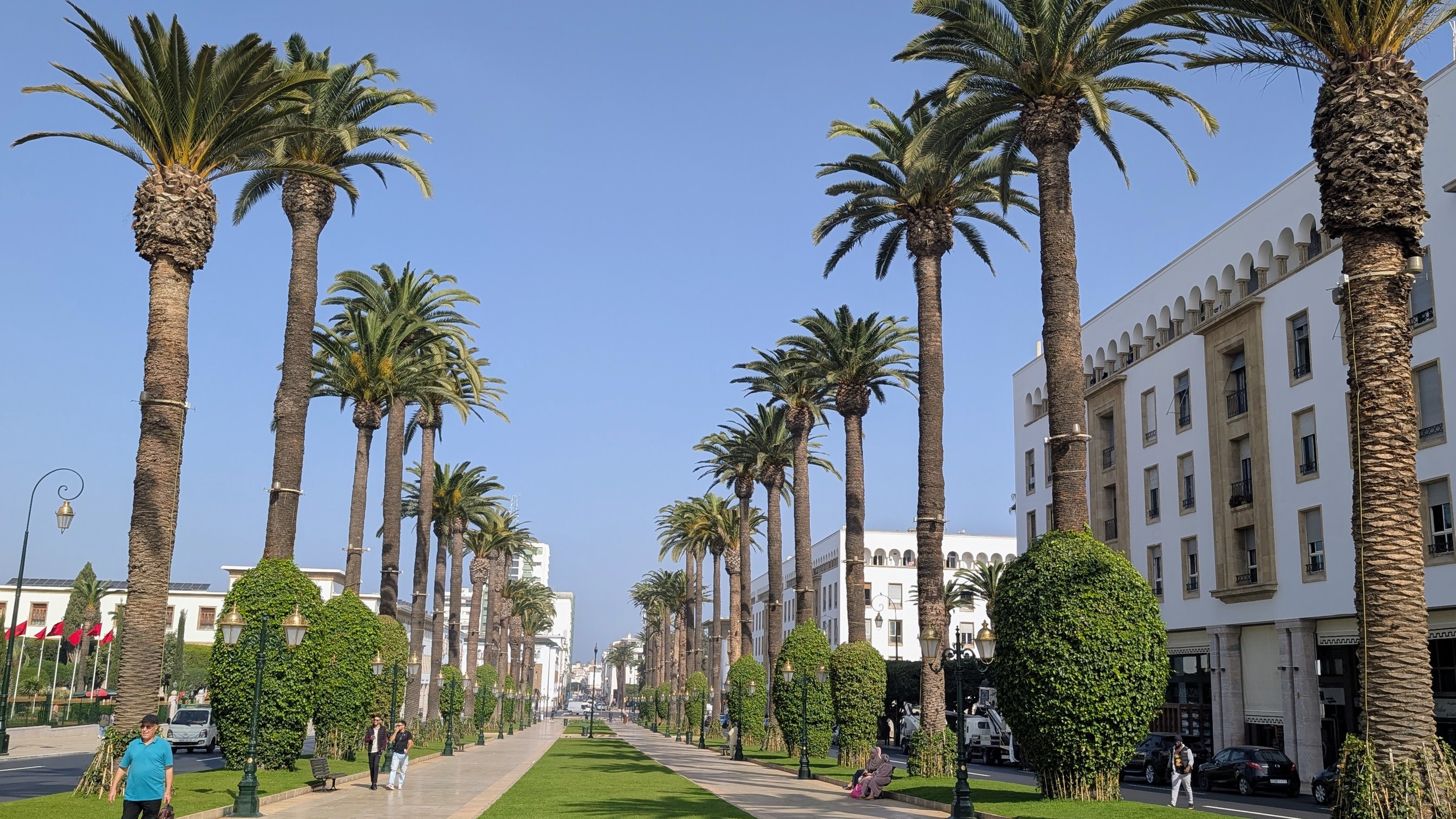
In the afternoon, we visited Rabat’s “medina,” the word normally used in Morocco to describe the old part of the town. Radouan suggested to go there via Avenue Mohammed V, and this was a great idea: I enjoyed walking this sprawling, palm-tree lined boulevard.
Walking along Mohammed V avenue
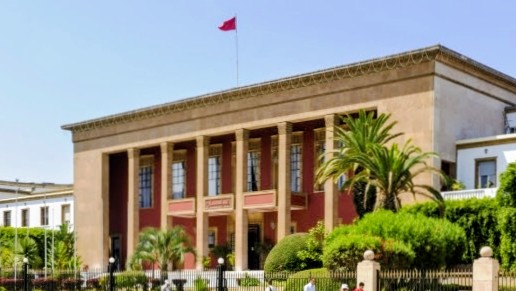
On our way to “medina,” we passed Morocco’s parliament, and I was somewhat surprised by how “humble” the building is. But then even after 2011 reforms proposed by Mohammed VI, the power of legislature vs. the monarchy remains fairly modest.
Morocco’s parliament
It was late afternoon when we finally arrived to “medina” which is completely surrounded by ancient walls creating a real “town” within the city of Rabat.
Rabat’s medina
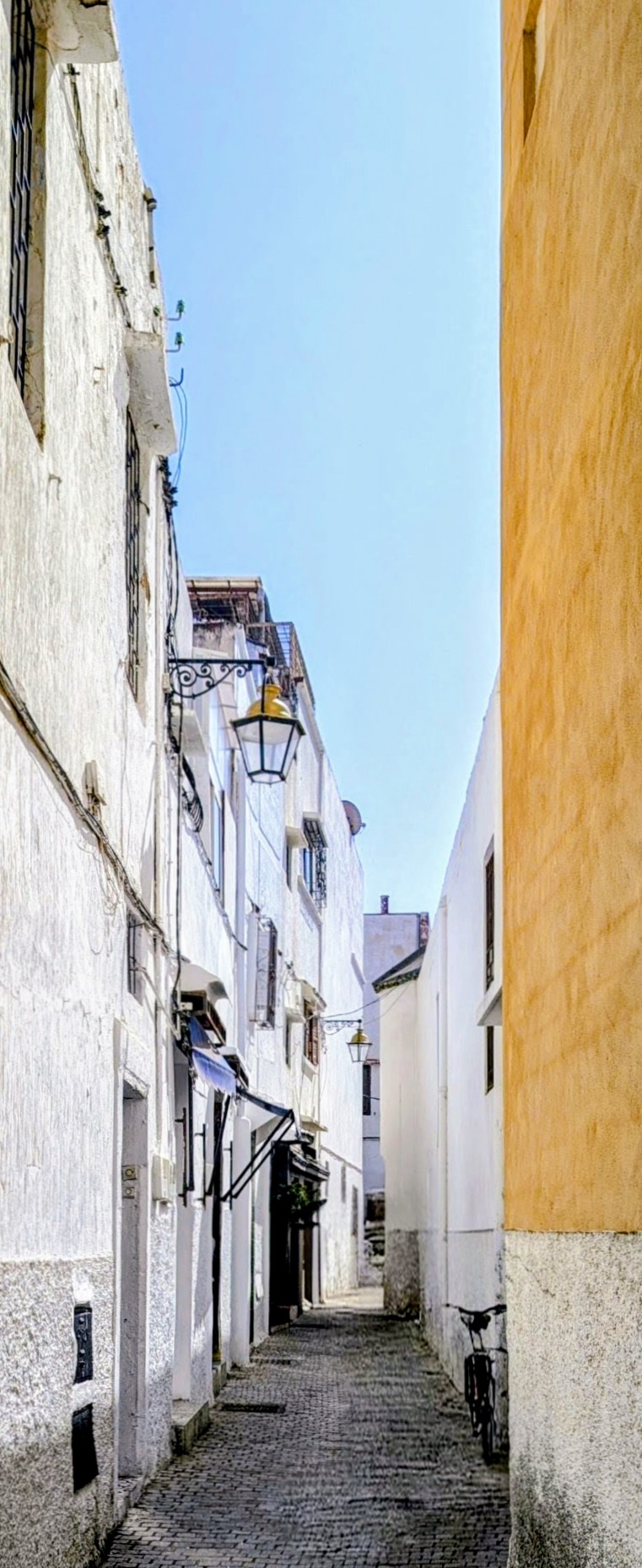
Each main city in Morocco has its own “medina,” and each is distinct in a certain way. What is special about Rabat’s version? First, the overall atmosphere is calmer, cleaner, and more relaxed than medinas in Marrakech, Casablanca, or Tangier. It feels more like a lived-in neighborhood.
Second, unlike the maze-like labyrinths of Marrakech or Fez, built in the 17th century, Rabat’s medina has an Andalusian grid-like layout. It is remarkably easy to navigate without getting instantly and hopelessly lost.
Rabat’s medina
Rabat’s medina
Rabat’s medina was the place where I first discovered Morocco’s wonderful semolina and barley-based breads: baghrir and harcha (I wrote about them in the INTRODUCTORY SECTION).
Make sure to try different Moroccan breads
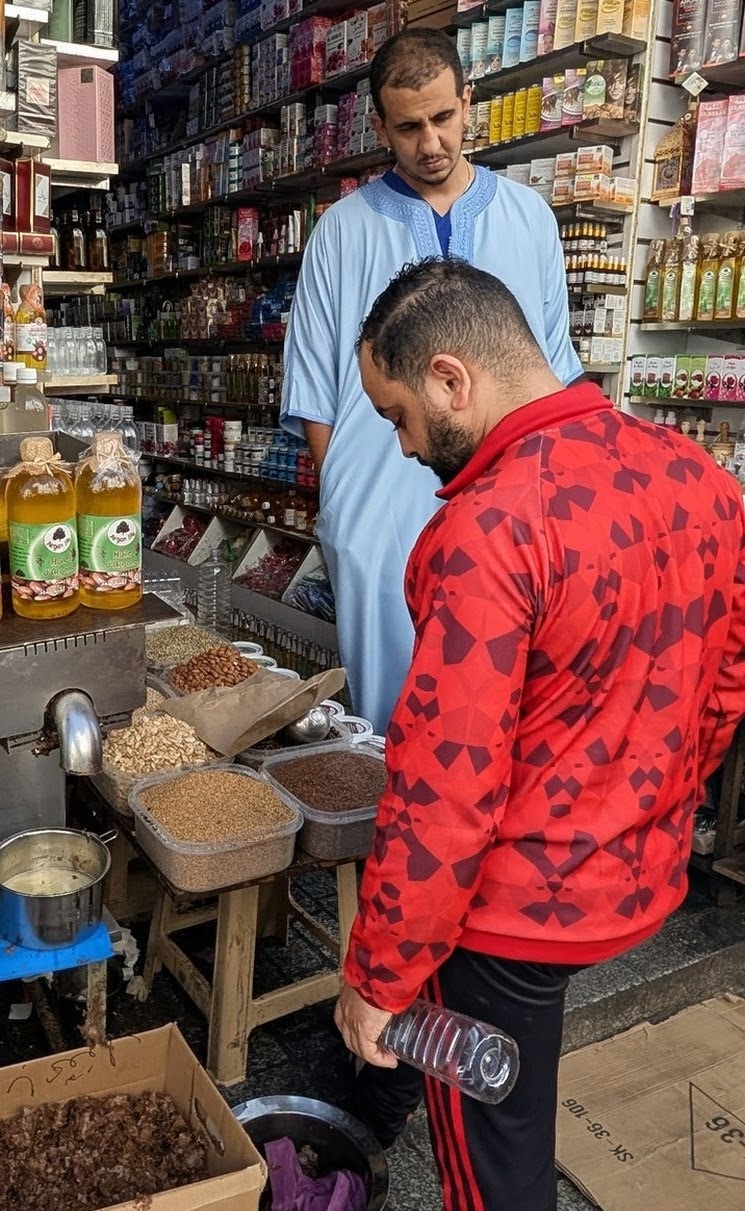
Here, I also saw the traditional oil-pressing process. By the way, Morocco is famous for various products made out of Argan oil. The culinary argan oil is produced from roasted argan kernels. The roasting process gives it a deep, nutty aroma and a rich flavor, often described as hazelnut or toasted sesame.
The cosmetic version of Argan oil is the one more known internationally. It is cold-pressed from unroasted raw kernels resulting in a much milder, almost neutral scent and flavor.
Traditional oil pressing
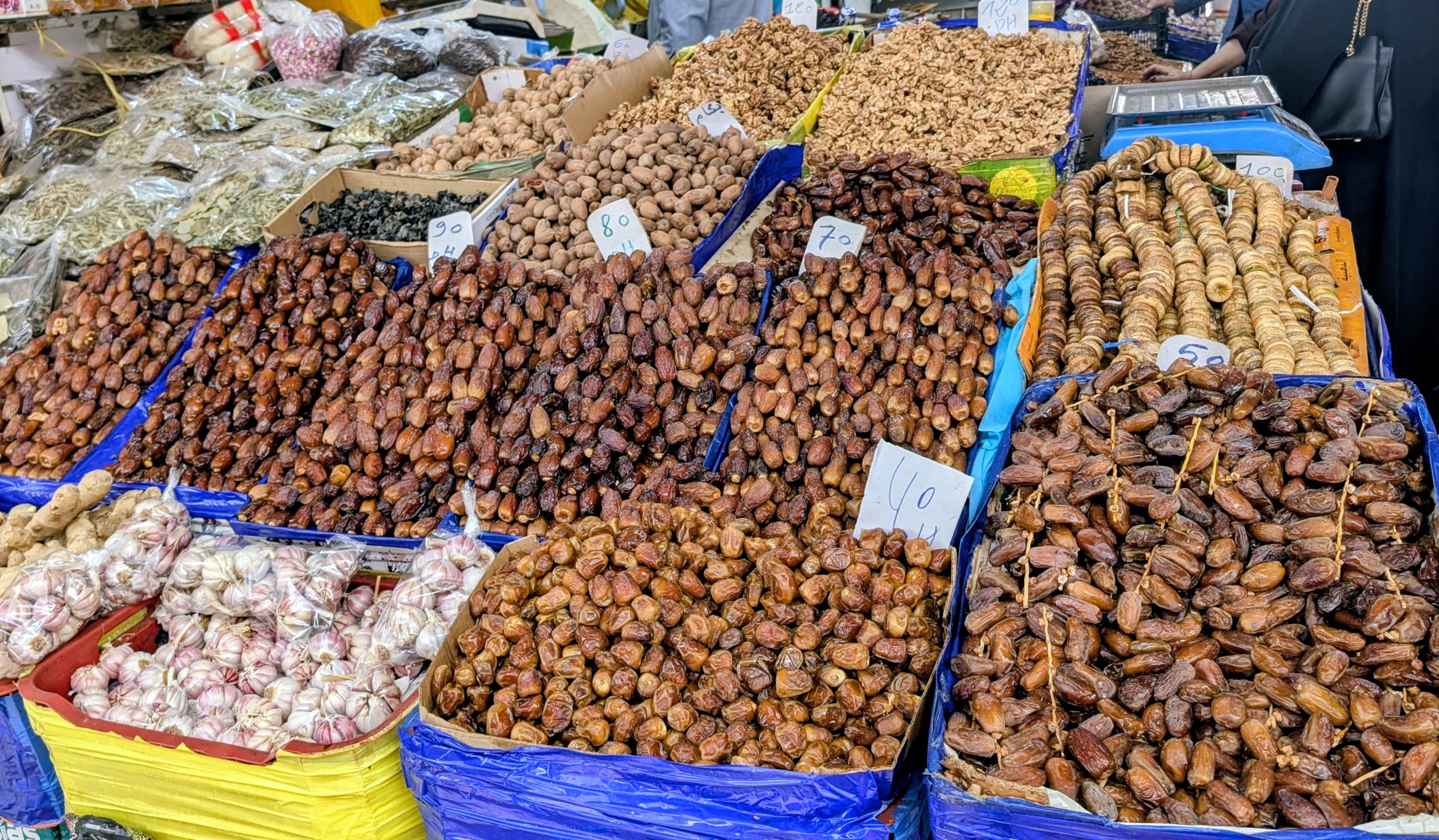
I was craving for some late-afternoon snack, and the stand with abundant choices of nuts and dried fruits came into my view perfectly on time.
Dried fruits and nuts: best snacks in Morocco
And as everywhere in Morocco, numerous carpets’ shops also lined the streets of Rabat’s medina.
Carpet shop in medina
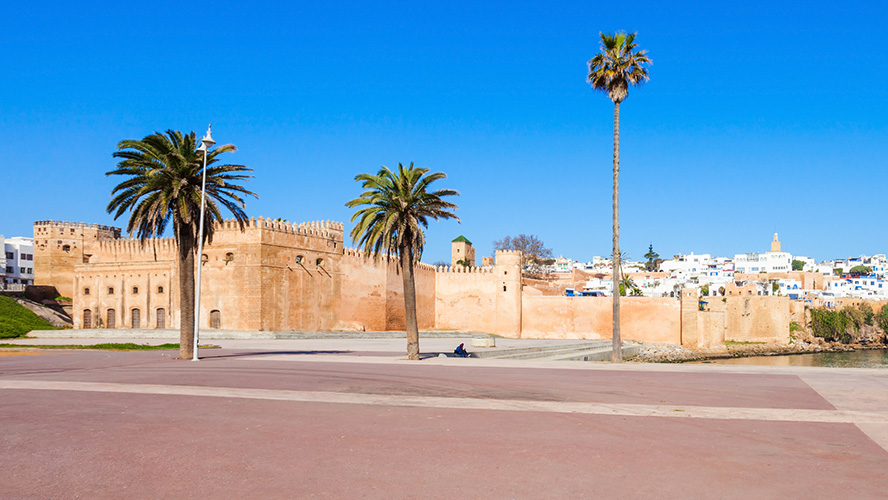
Right next to medina, you will find the stunning Kasbah of the Udayas, a 12th-century fortress with iconic blue-and-white streets. Situated at the mouth of the river flowing into the Atlantic ocean, both the Kasbah and medina were declared a UNESCO World Heritage site.
Kasbah of the Udayas
Kasbah of the Udayas
I ended the day of Rabat’s exploring by walking the “corniche,” a nice promenade which loops around Kasbah and medina following the river and then the coast of the ocean.
An evening stroll along the “corniche” is a “must” experience in Rabat
And so, this was my only day in Rabat. Clearly, you can easily spend a few days in Moroccan capital, but my time was limited and other destinations were waiting.
Asilah: an Open-Air Gallery by the Sea
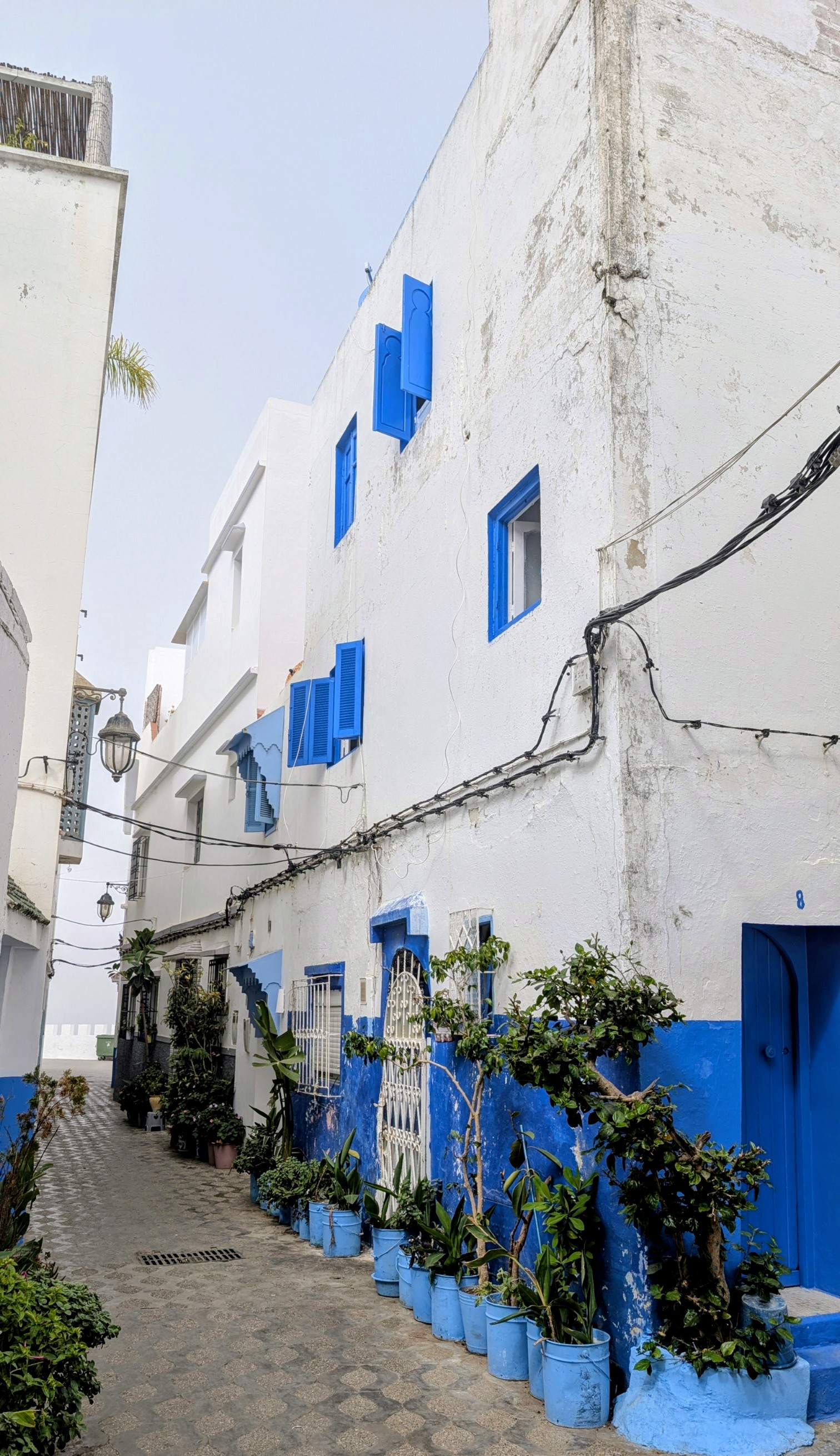
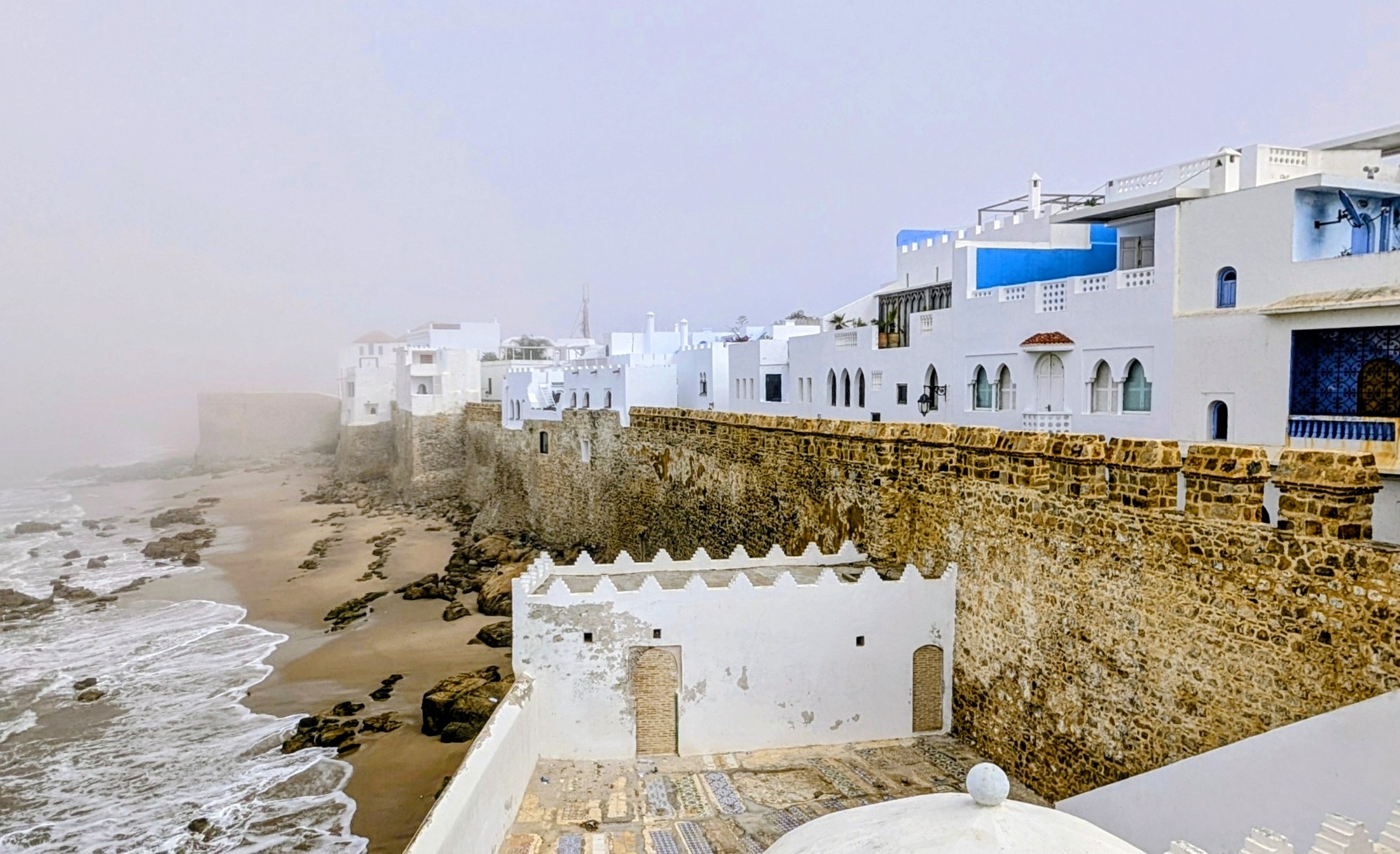
Asilah is a town on the northwest Atlantic coast of Morocco, approximately 31 km / 19 mi south of Tangier. It is known for its well-preserved medina, with whitewashed houses enclosed into the 15th-century Portuguese ramparts.
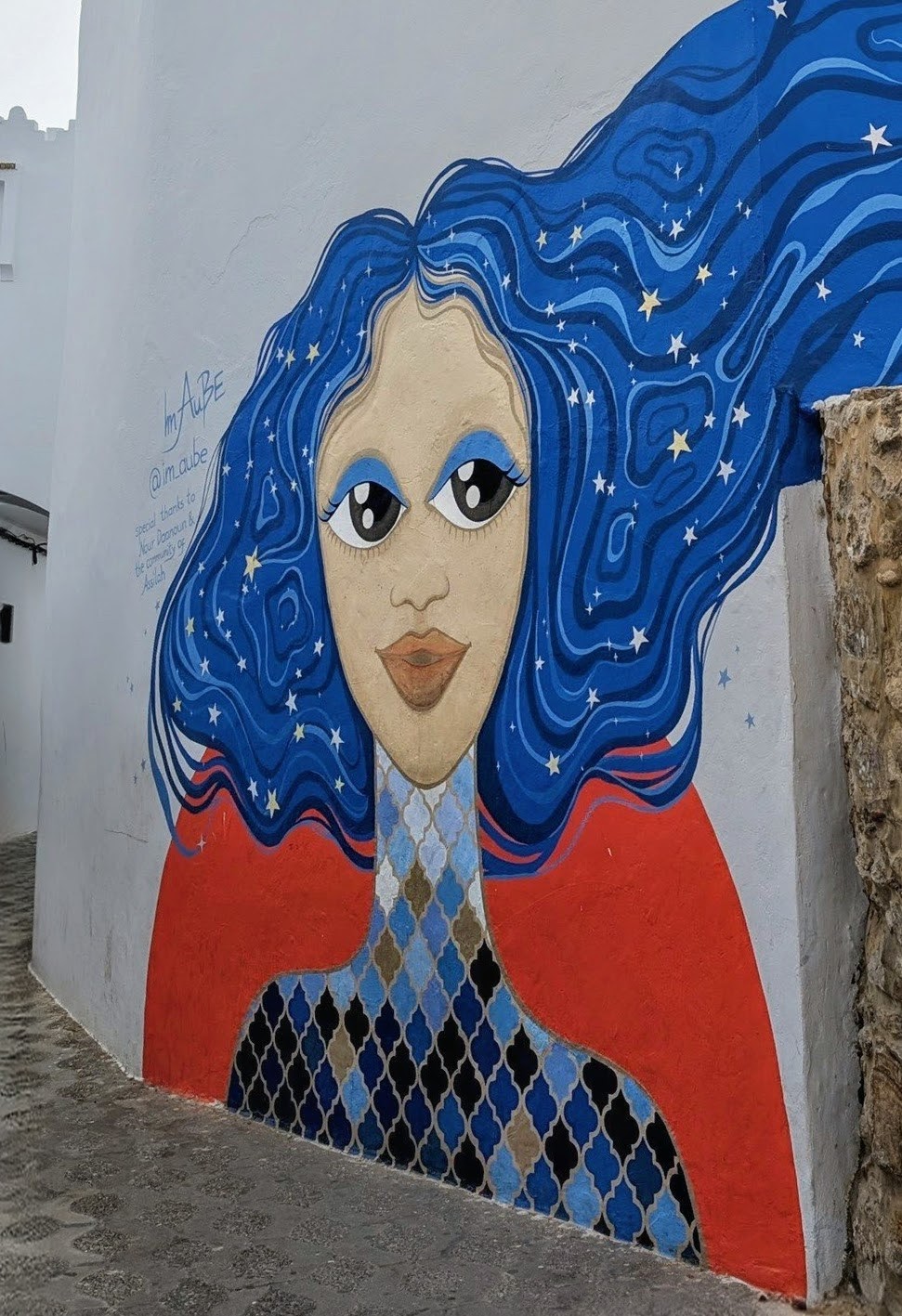
But besides history, Asilah also has a reputation of a street arts hub. The walls of the houses serve as an open-air gallery with graffiti and colorful murals that are painted anew each year during June-July international festival.
Traveling from Rabat, I first took a high-speed Al Boraq train to Tangier.
A high speed Al Boraq train
Morocco is very affordable country, and I splurged for the first-class ticket. The distance of 250 km / 155 mi was covered in 1h20m, and my luxury ride costed only US$ 12.
Traveling first-class in Al Boraq high speed train
In Tangier, I planned to take a local train and “back-track” 31 km / 19 mi to Asilah. The layover was nearly one hour, and I decided to try to negotiate a much faster taxi ride. It turned out surprisingly easy: for US$ 25, in 40 min I arrived to Asilah.
My accommodations were in an apartment called “Puerto Marina Asilah.” I found it on Booking.com and it turned out a great choice. The apartment was brand new, clean, spacious and with balcony offering a nice ocean view.
Puerto Marina apartment, an excellent place to stay in Asilah
Puerto Marina apartment, an excellent place to stay in Asilah
As a “cherry on top of the cake,” the building also had a roof terrace with panoramic view of the ocean and Asilah’s medina.
The view from the roof terrace of Puerto Marina apartment
If you decide to visit Asilah and stay at Puerto Marina, you can find it on Booking.com or by getting in touch directly with the cheerful owner, Yassine, via Whatsap: +212-646-536-450
From apartment, I walked along palm-tree lined promenade towards medina. In about 10 min, I was in Asilah’s old town.
Walking to Asilah’s old town
People usually ask for recommendations about “What to see and to do.” In case of Asilah, best thing to do is simply walk the narrow streets and contemplate the blend of medieval architecture and modern wall murals. And remember: these wall paintings are changing every year. So, what you see on these pictures may or may not be the same when you will come to Asilah.
Wall murals in Asilah
Wall murals in Asilah
Wall murals in Asilah
Wall murals in Asilah
Somehow, these modern street arts were fitting nicely into Asilah’s old streets and houses.
A blend of modern and medieval in Asilah
Asilah’s old town
I was pleasantly surprised that the town was not crowded with tourists at all. Perhaps, there will be many more visitors during the summer art festival, but in mid-October Asilah felt calm and quiet.
Asilah’s old town
Nevertheless, Asilah’s medina had a good number of various shops for tourists. If you are looking for carpets, ceramics, scarves, or argan oil products, you will definitely find all what you need.
Asilah’s old town has many tourist shops.
An iconic spot for taking pictures in Asilah is “Krikia” (or Caraquia Viewpoint), a 15th century bastion in the southwest part of the medina. Extending out over the water, Krikia is popular place for watching the sunset with panoramic views of the Atlantic Ocean and the whitewashed medina walls.
Regrettably, when I arrived to Krikia, the weather changed suddenly: the fog and drizzling rain took away my chance for a good shot.
Krikia viewpoint, a popular spot for pictures in Asilah
Asilah also has a gorgeous beach. When I was there, the weather was not conducive for sunbathing, but I still enjoyed a walk along the ocean and refreshing salty breeze.
Asilah has an excellent beach
Besides simply wandering through the town, I also had two “projects.” One was to find a good barber shop and get a haircut. After examining Google maps and talking Gemini (my AI), I have chosen the “Bettiouui Barber Shop.” It was very close to medina, and the outcomes of my visit there were highly satisfactory.
A good place for haircut in Asilah
The second “project” was getting a good massage. Morocco is known for “hammams,” the traditional Oriental steam baths which also typically offer a variety of massages. While exploring medina, I stumbled upon “Ali Alba Hammam” and booked an appointment. Similarly to my haircut, the massage at Al Alba was “five stars” as well.
An excellent place for massage in Asilah
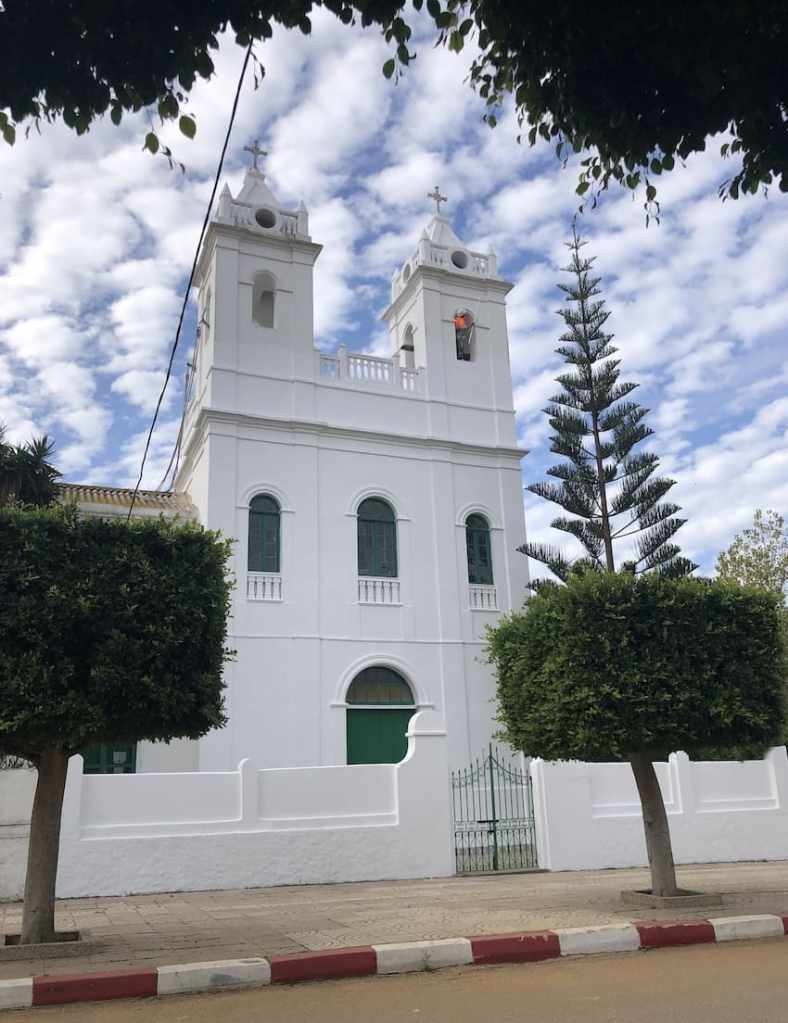
At dusk, walking back to Puerto Marina apartment, I spotted sparklingly white Catholic church, the Eglise Saint Barthelemy.
Eglise Saint Barthelemy.
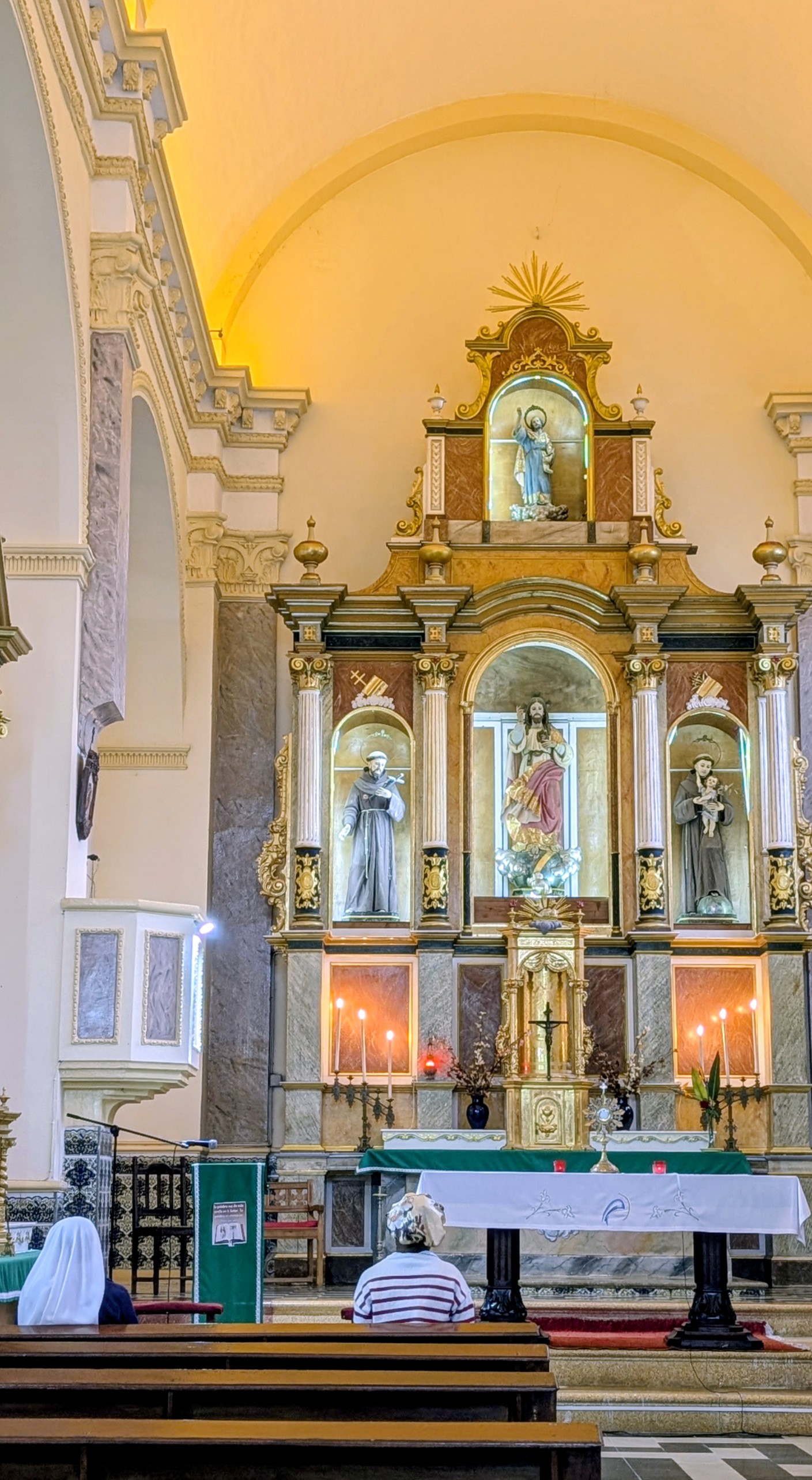
The gates were closed but unlocked, and I slipped inside. Three nuns were there reciting evening prayers and singing in soft, perfect harmony. The church’s serene and hallowed atmosphere was captivating, and I stayed until the end of the worship service.
Eglise Saint Barthelemy.
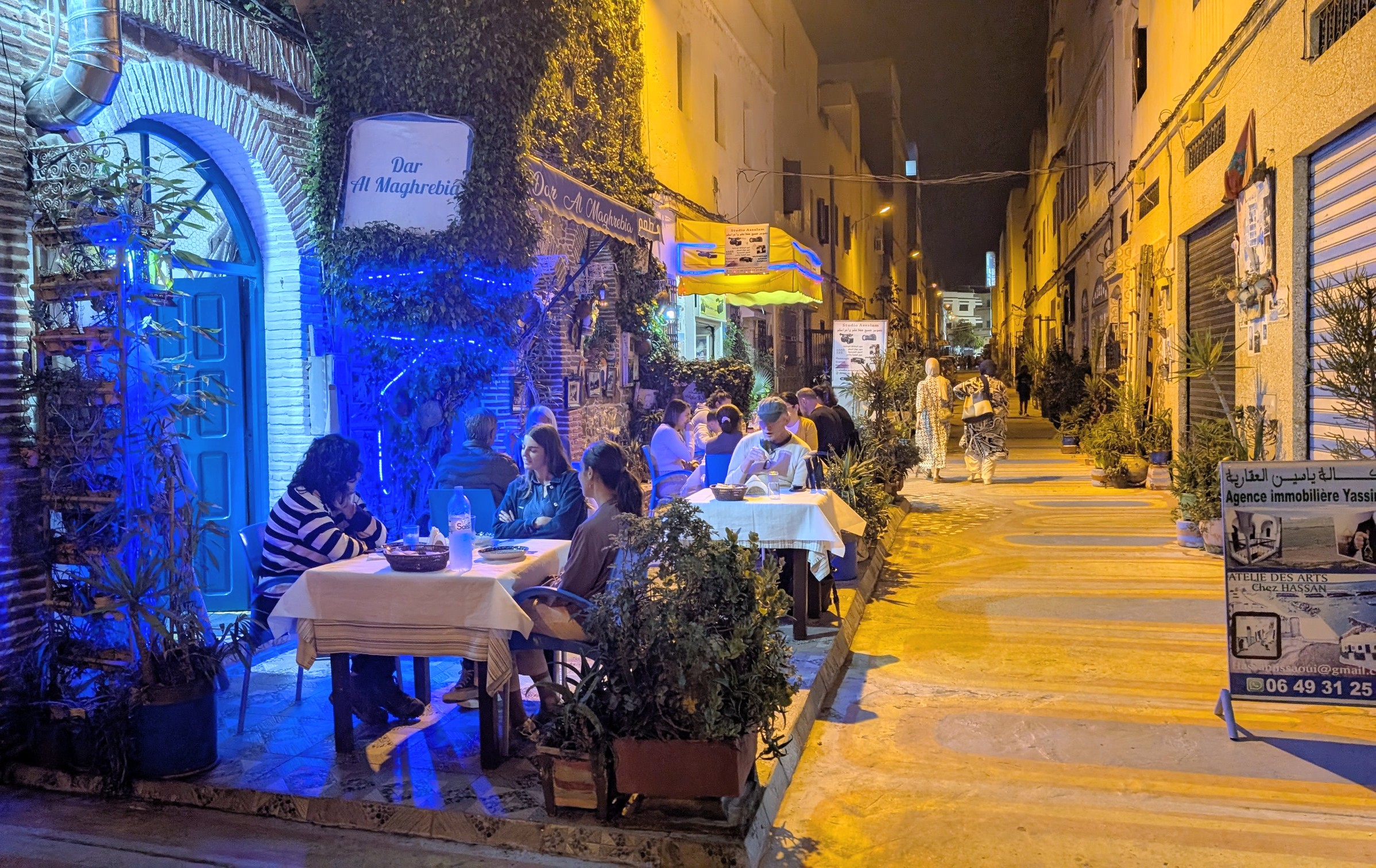
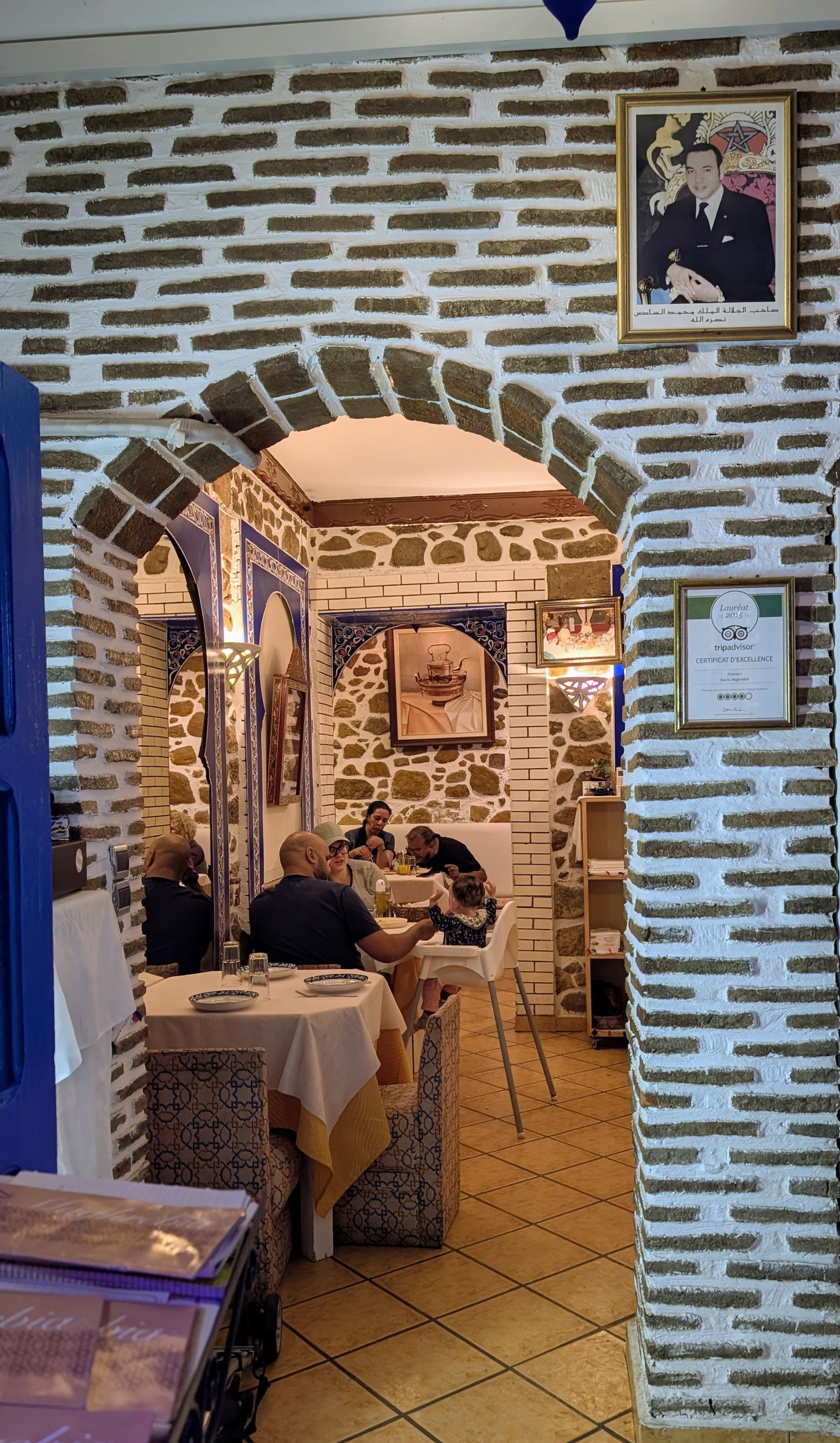
The last order of business for this day was finding a good place for dinner. My host Yassine recommended restaurant “Dar Al Maghrebia,” just outside Asilah’s medina.
Dar Al Maghrebia, a very good restaurant in Asilah
Dar Al Maghrebia, a very good restaurant in Asilah
The only problem was that the restaurant had just a few tables. I did not make advance reservation and they all were occupied. Rather than waiting, I opted for “take out” and ordered seafood pastilla.
I wrote about traditional chicken pastilla in INTRODUCTORY SECTION, but in this case the delicious pie was filled with juicy and flavorful blend of shrimps, mussels, and octopus.
Seafood pastilla from Dar Al Maghrebia restaurant
Back at my apartment, I opened a bottle of aromatic Moroccan rose wine and enjoyed a meal which was as satisfactory as my entire day in Asilah.
Morocco makes good dry rose wines
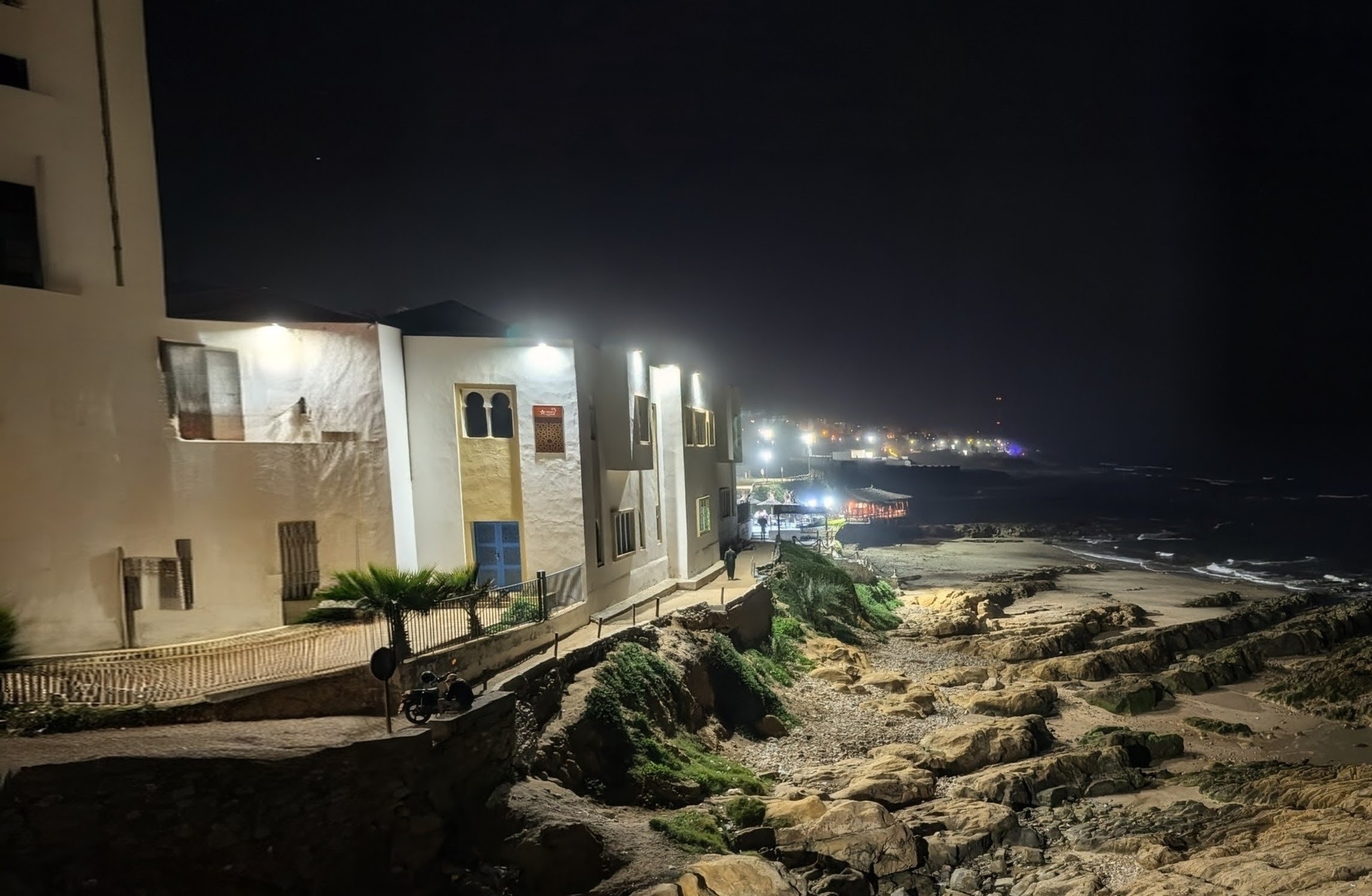
After dinner, I walked back to the medina to see it at night. When I came to the Krikia viewpoint, the skies cleared, and the brightly lit town looked as if being fully rejuvenated by the earlier rain. Good night, Asilah!
Good night Asilah
Imlil: the Heart of Berber Culture in the Atlas Mountains
My next destination was Imlil, a small town nestled at an altitude of 1,800 meters / 5,900 feet in the Atlas Mountains. Visitors are drawn here by the stunning mountain scenery, many hiking trails, and the opportunity to experience authentic Berber culture and hospitality. It is also the main starting point for trekking to Mount Toubkal, North Africa’s highest peak (4,160 meters / 13,670 feet).
Imlil is a starting point for trekking to Mount Toubkal
In the INTRODUCTORY SECTION, I wrote about the Berbers (Amazigh), the indigenous inhabitants of North Africa, with a history that predates the arrival of Arabs in the 7th century. If you skipped this section, you can watch this short video explaining the question of “Arabs vs. Berbers” in today’s Morocco
Referring to themselves as Imazighen (meaning ‘free people’), people of Berber ancestry form a large part of the Morocco population. However, over many centuries, their unique traditions and way of living were blended and intertwined with Arabic culture. The remote villages in the Atlas Mountains remain authentic ‘Berber islands,’ where one can still experience the traditional Berber way of life.
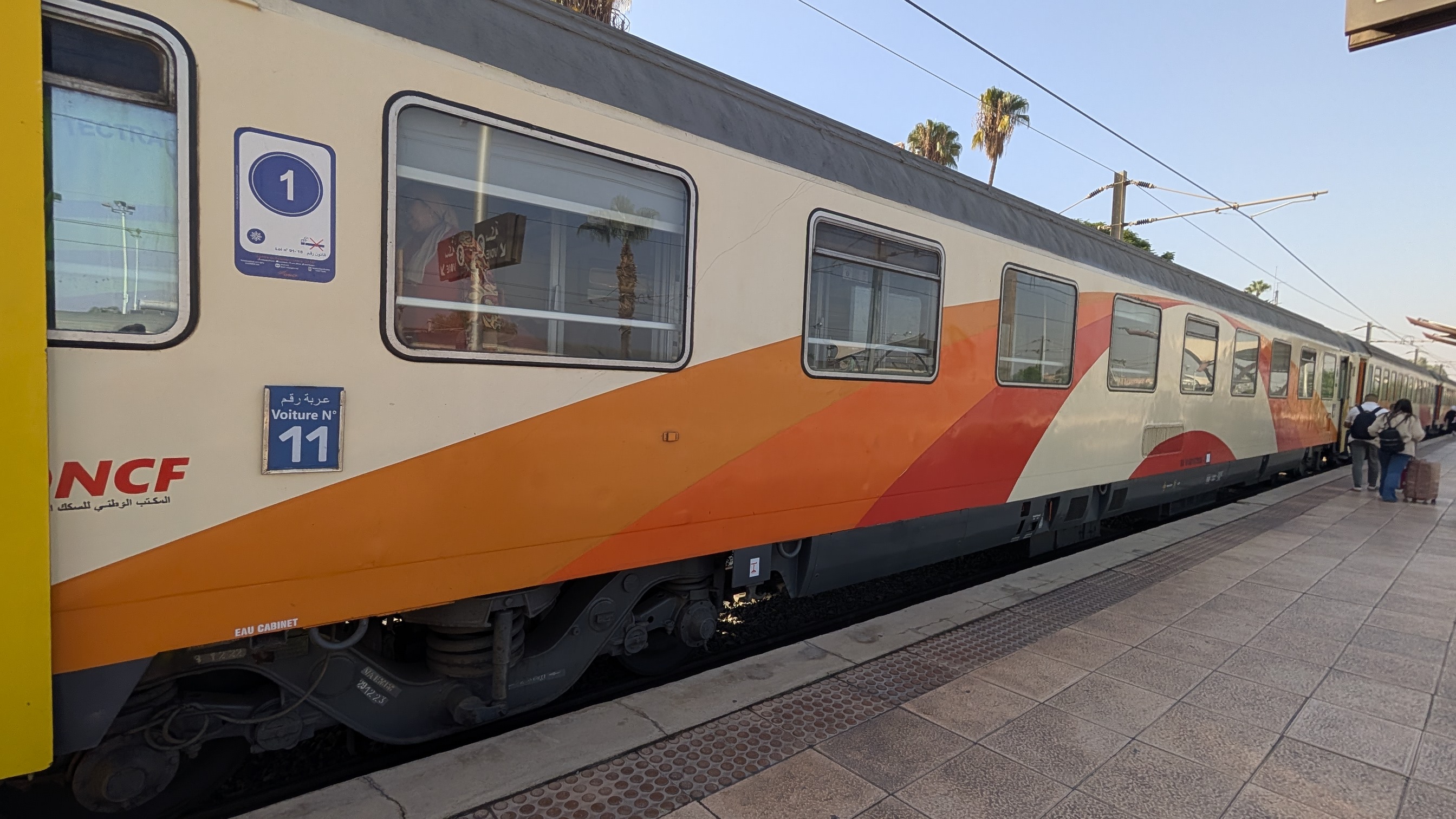
Traveling to Imlil from Asilah, I first took a taxi to Tangier, then high speed Al Boraq train to Casablanca, and then the normal train to Marrakesh.
Train Casablanca – Marrakech
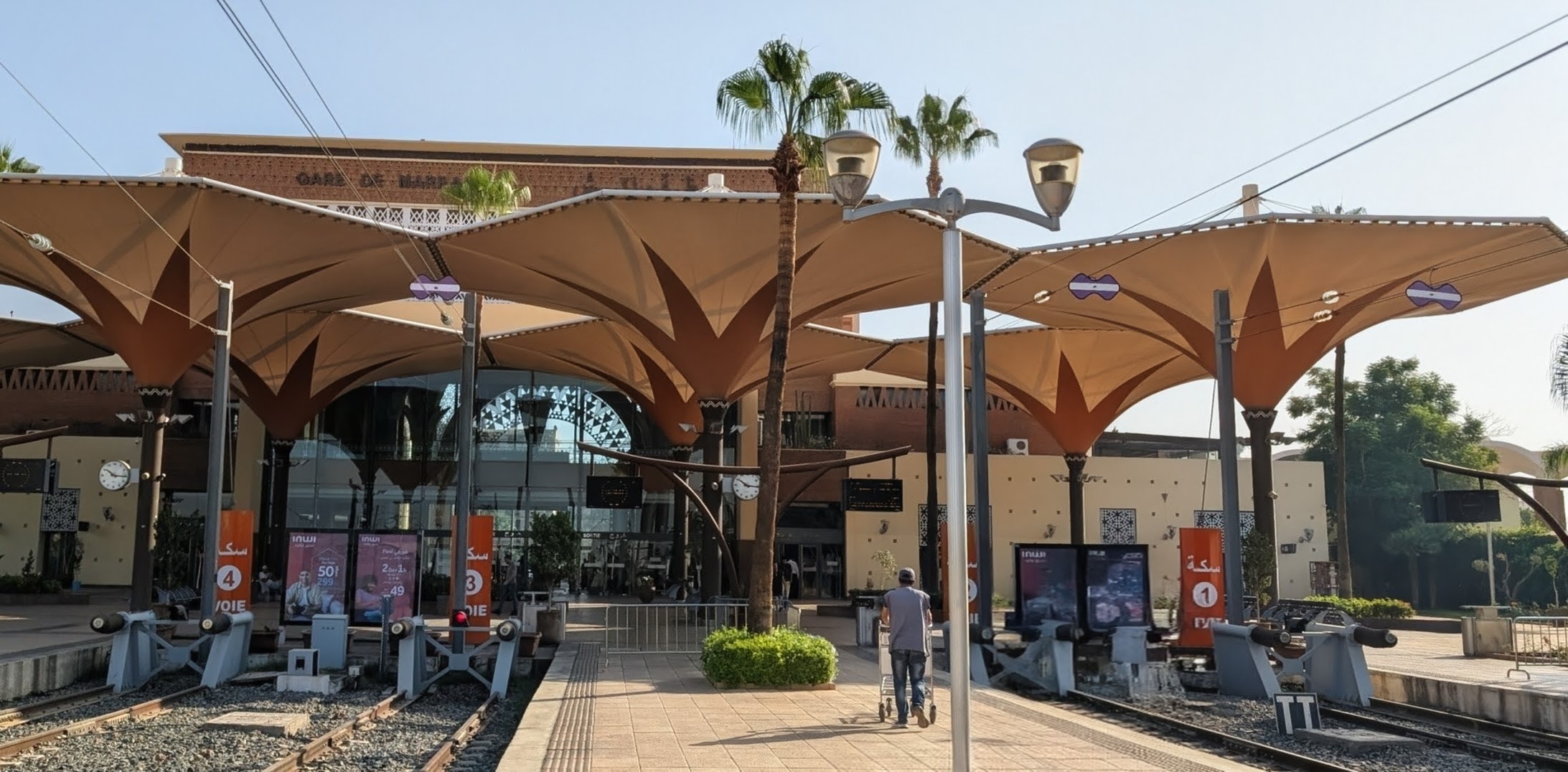
I liked the appearance of Marrakesh rail station: its interiors and exteriors blended nicely modern design and traditional Oriental elements.
Marrakesh rail station
From the station, I took a “petit taxi” and asked the driver to go to the “grand taxi” stand near Porte Bab Er Robb, one of the medieval gates to the Marrakesh medina. If you skipped the INTRODUCTORY SECTION, grand taxis are a common way for long-distance traveling in Morocco. Essentially, these are six-passengers minivans which wait to fill up, and then go to a certain destination for a fixed price.
Grand Taxi from Marrakesh to Imlil
The Grand taxi from Marrakesh to Imlil cost 60 dirhams ( US$ 6) and it took two hours to reach the town. Most of the route was very scenic, with constantly changing views of villages, mountains, forests, and streams.
The route from Marrakech to Imlil is very scenic
I arrived in Imlil in early evening and my host, Abdellatif, was waiting at the taxi station to take me “home,” his “Atlas Haven” guesthouse.
I found Atlas Haven on Booking.com, and my decision to stay there was instant. First, it location was great – right in the middle of Imlil but a bit away from the noise of the main street. Secondly and most importantly, people praised hospitality and variety of services offered by the guesthouse, such as home-cooked meals, guided hiking in the mountains, etc.
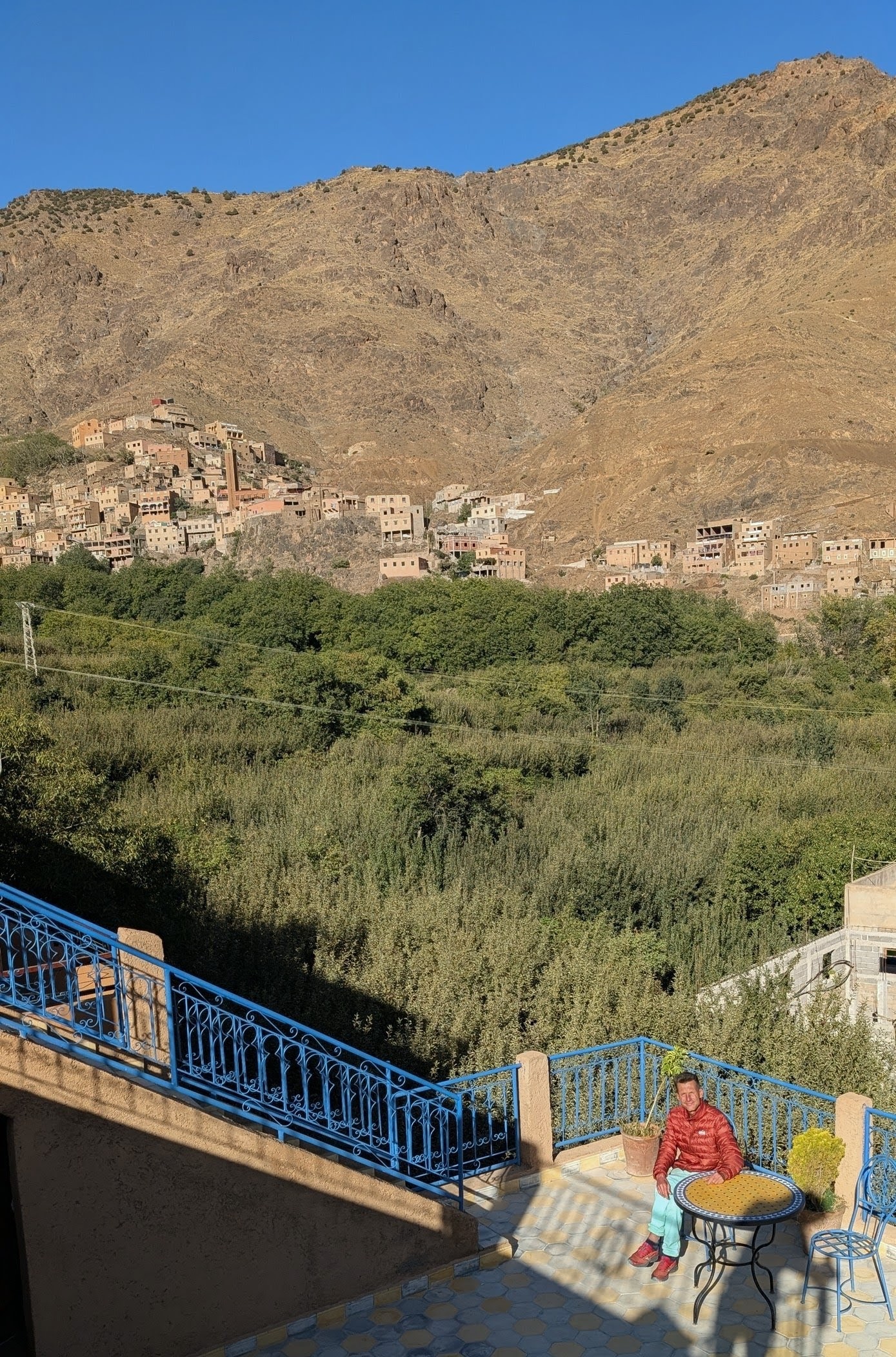
The view from the balcony of my room at Atlas Haven Guesthouse
Common sitting area on the upper floor of Atlas Haven guesthouse
Imlil sits at the bottom of the valley which is surrounded by high mountains. The dusk arrives early here, but I still had some day light and decided to explore the village. This was easy, because Imlil has only one main street lined with shops, restaurants, and other businesses.
The main street of Imlil
At the street’s intersection with a small creek I found a shady grove. A few tables with plastic chairs were sitting under the canopies of the trees. The sign indicated that this was a designated “family space.” And indeed, a few families have gathered there dining “al fresco” and socializing.
A designated “family spot” in Imlil
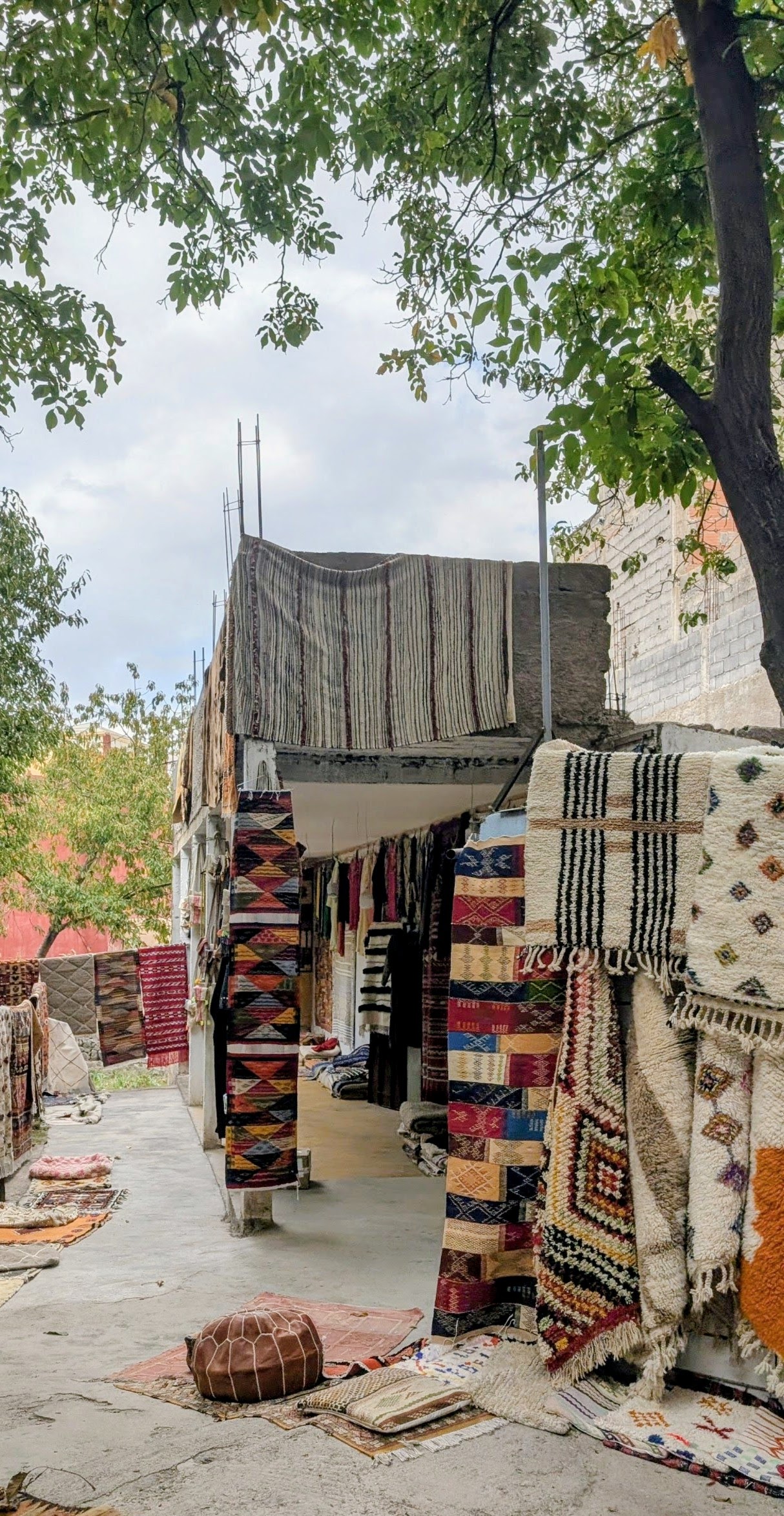
Morocco is known for its carpets and rugs, and Imlil is one of the centers of this industry. Not surprisingly, many small shops and road stands displayed huge variety of colorful tapestries.
The area of Imlil is known for carpets and rugs
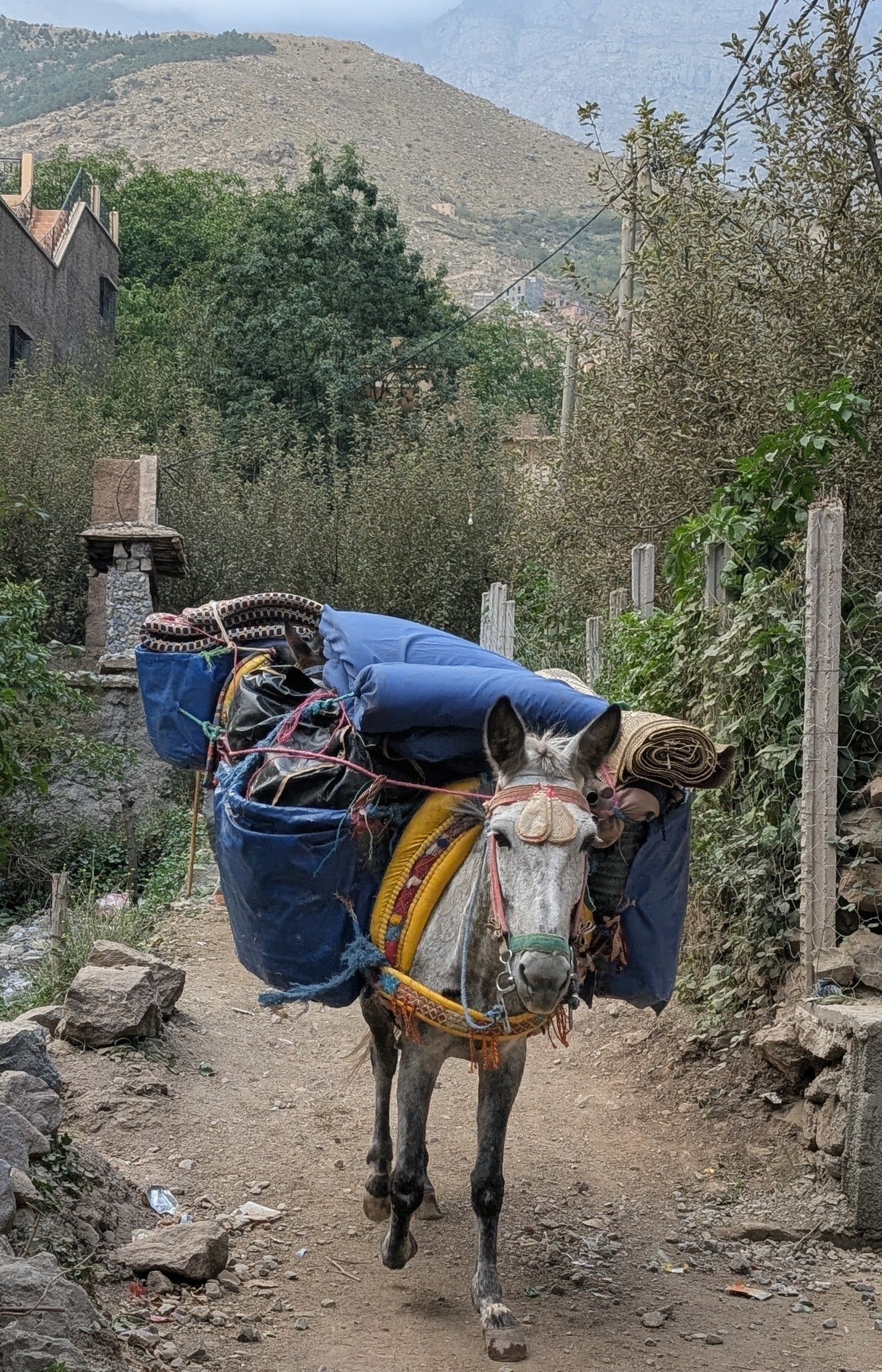
In about 20 minutes I walked through the entire village, eventually coming to the place where the main road crossed an unpaved trail leading into mountains. A loaded donkey was coming by this trail and heading into the village. He was unaccompanied by anyone, but was certainly and clearly aware what his destination was.
A “self-guided” donkey returning to Imlil
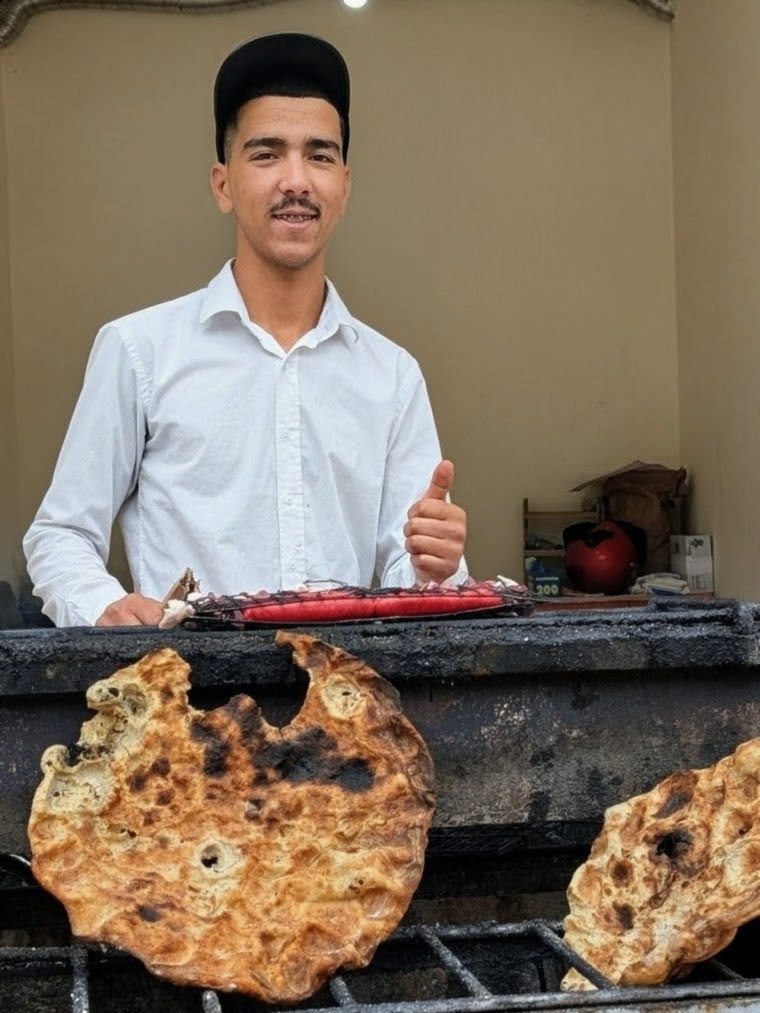
After long day of traveling, it was time to arrange a good meal. First, I searched for freshly baked bread. One road stand offered hot flat-breads. They looked very tempting.
No problem finding freshly baked breads in Imlil
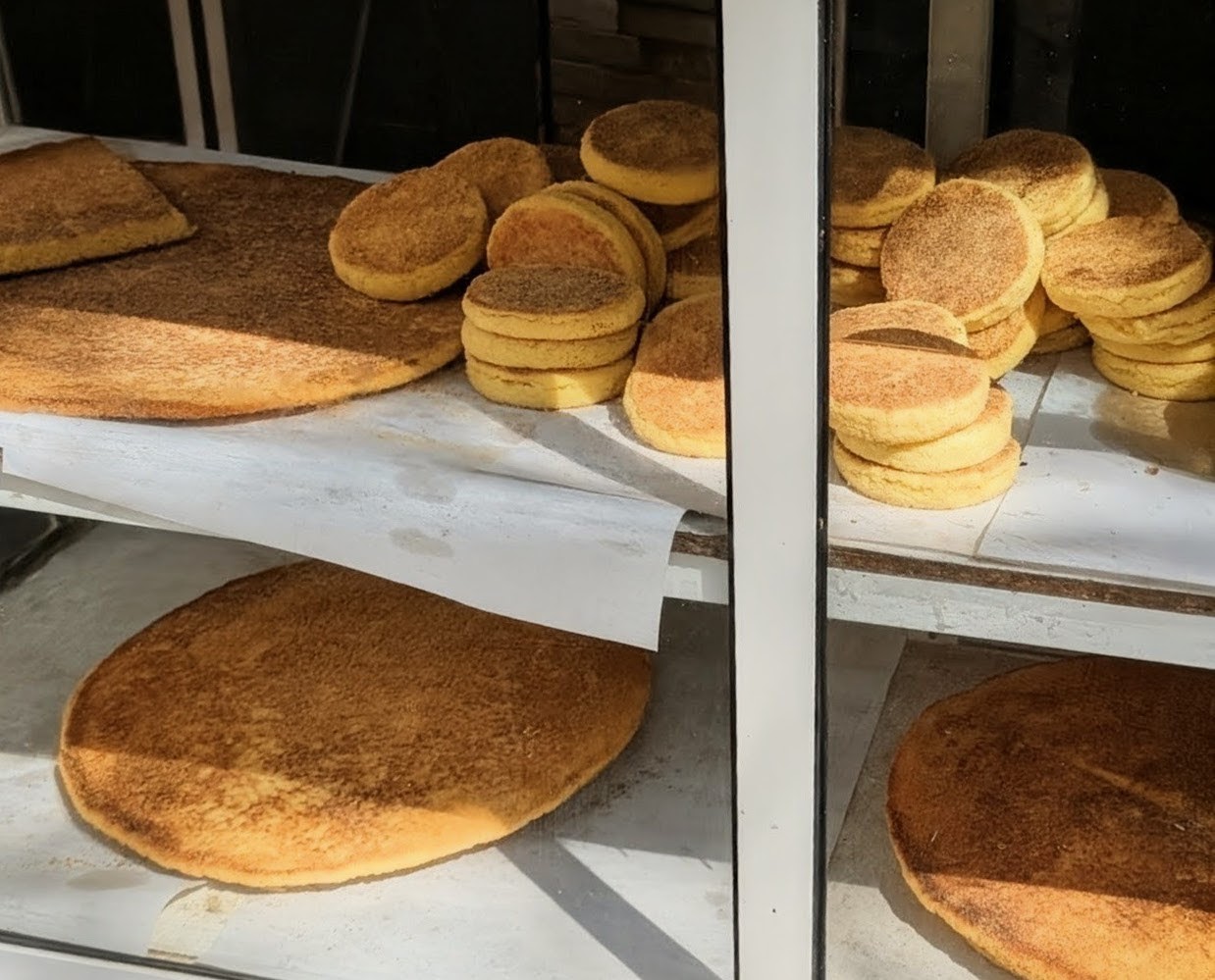
At this point, however, I tried already a variety of Moroccan breads (read about this in INTRODUCTORY SECTION) and defined my favorite – “harcha,” the pan-fried cake made either of semolina or barley flour. Further along the road, a small bakery had them.
Harcha, my favorite Moroccan bread
Nobody was in sight, and I went inside the shop to find the owner who was preparing the next batch of dough.
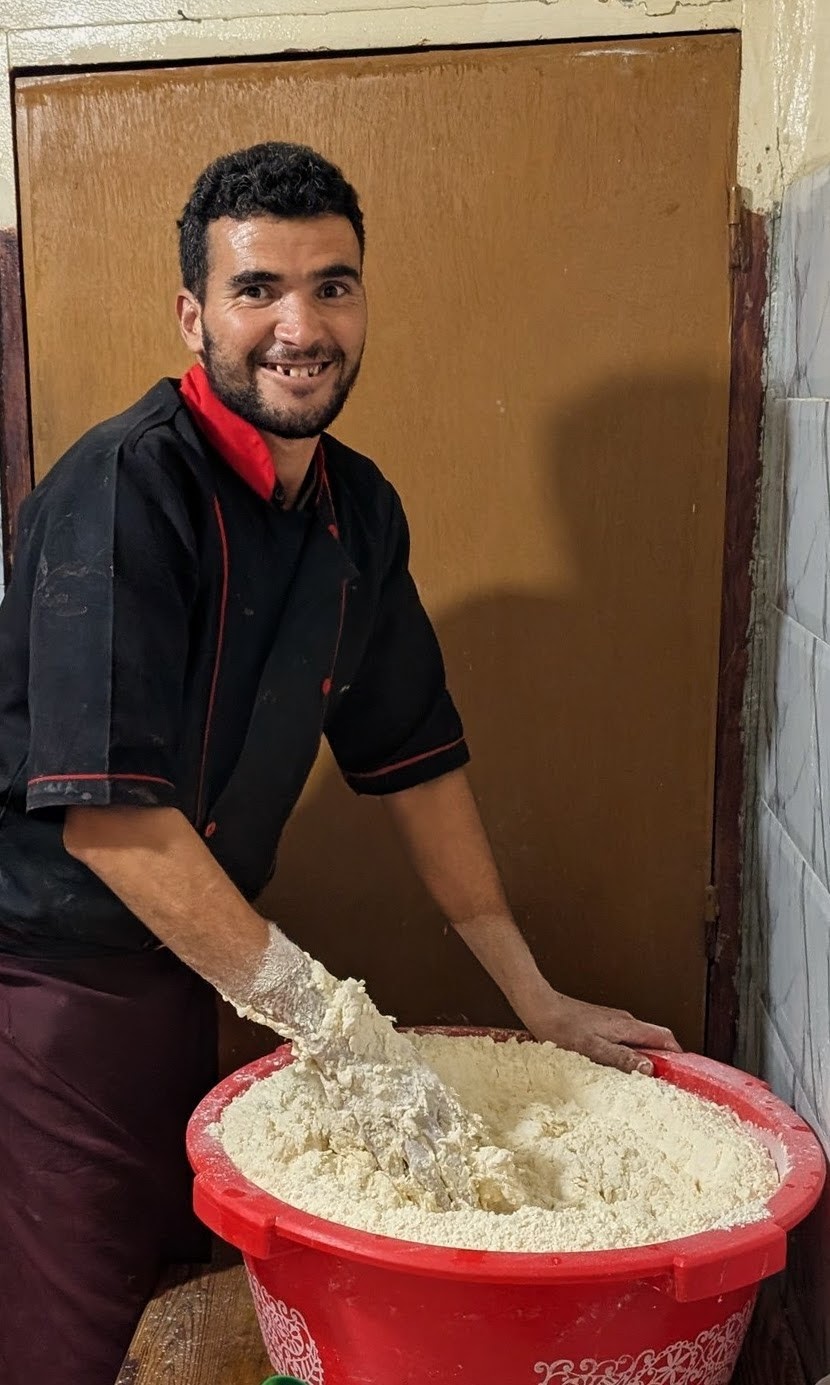
Preparing the next batch of breads
In the evening, several restaurants brought out on the street their “tagines” (read about this style of cooking in INTRODUCTORY SECTION), and the air was full of tantalizing aromas.
No problem finding a good tagine in Imlil
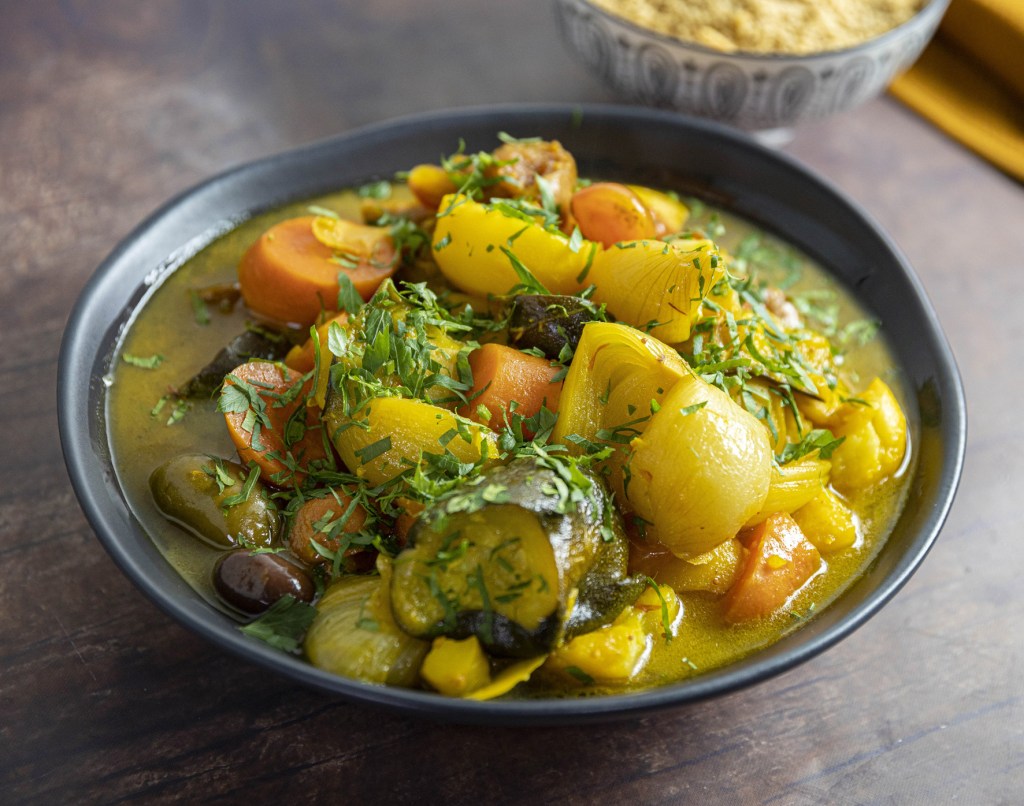
My choice was vegetarian version of tagine. Dipping freshly baked “harcha” into fragrant and rich vegetable stew, I felt that Imlil was definitely worth visiting: even just for this rustic culinary experience.
Vegetable tagin, my first dinner in Imlil
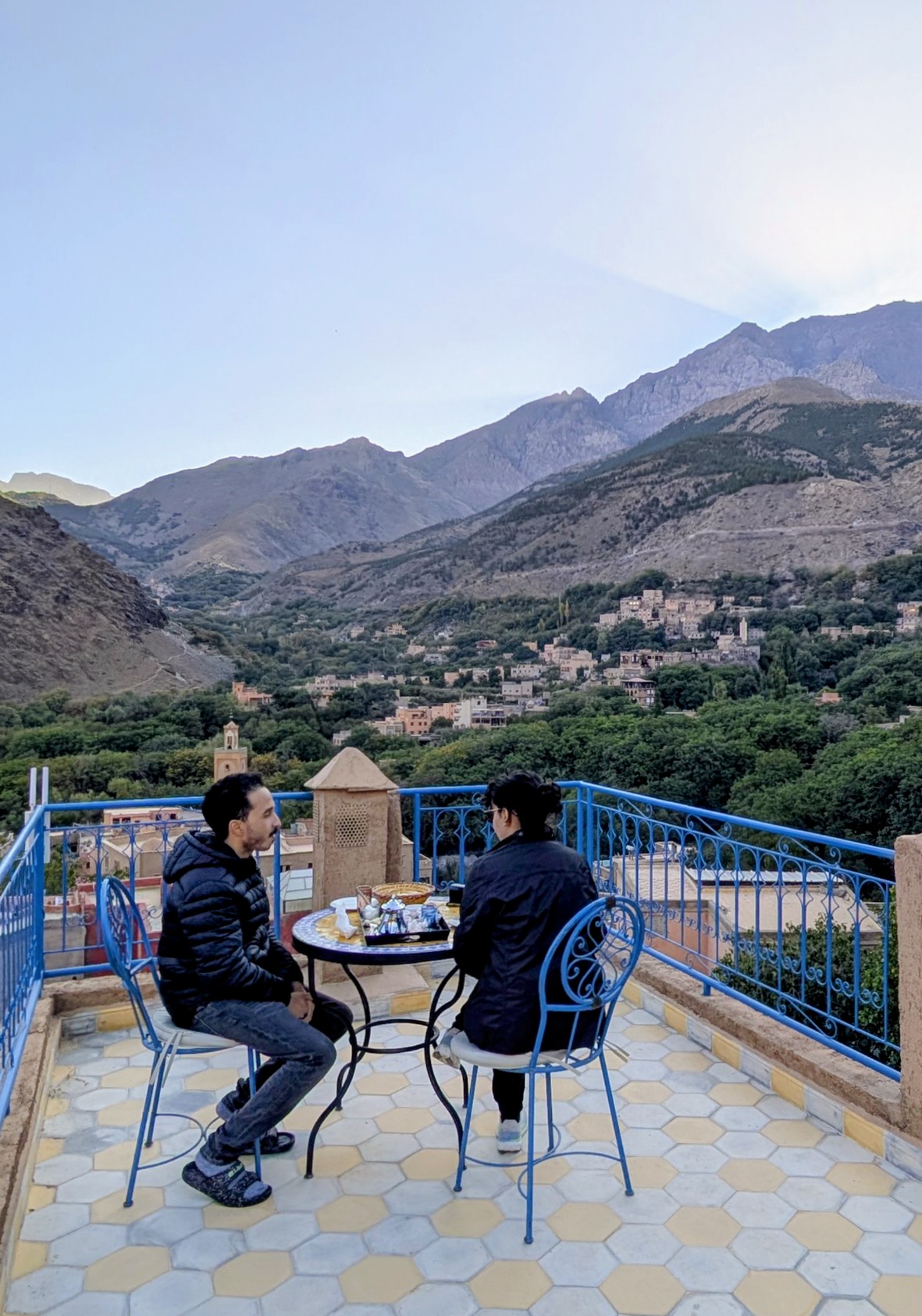
At Atlas Haven guesthouse, breakfast is included in the accommodations, and – weather permitting – it is served on the roof-top terrace. I went there at around 8 am, when the sun still did not show up from surrounding mountains.
Good morning Imlil!
Yet, I was not the first one to show up for breakfast. A young Moroccan couple also staying at Atlas Haven was enjoying their first meal of the day.
Fellow travelers staying at Atlas Haven
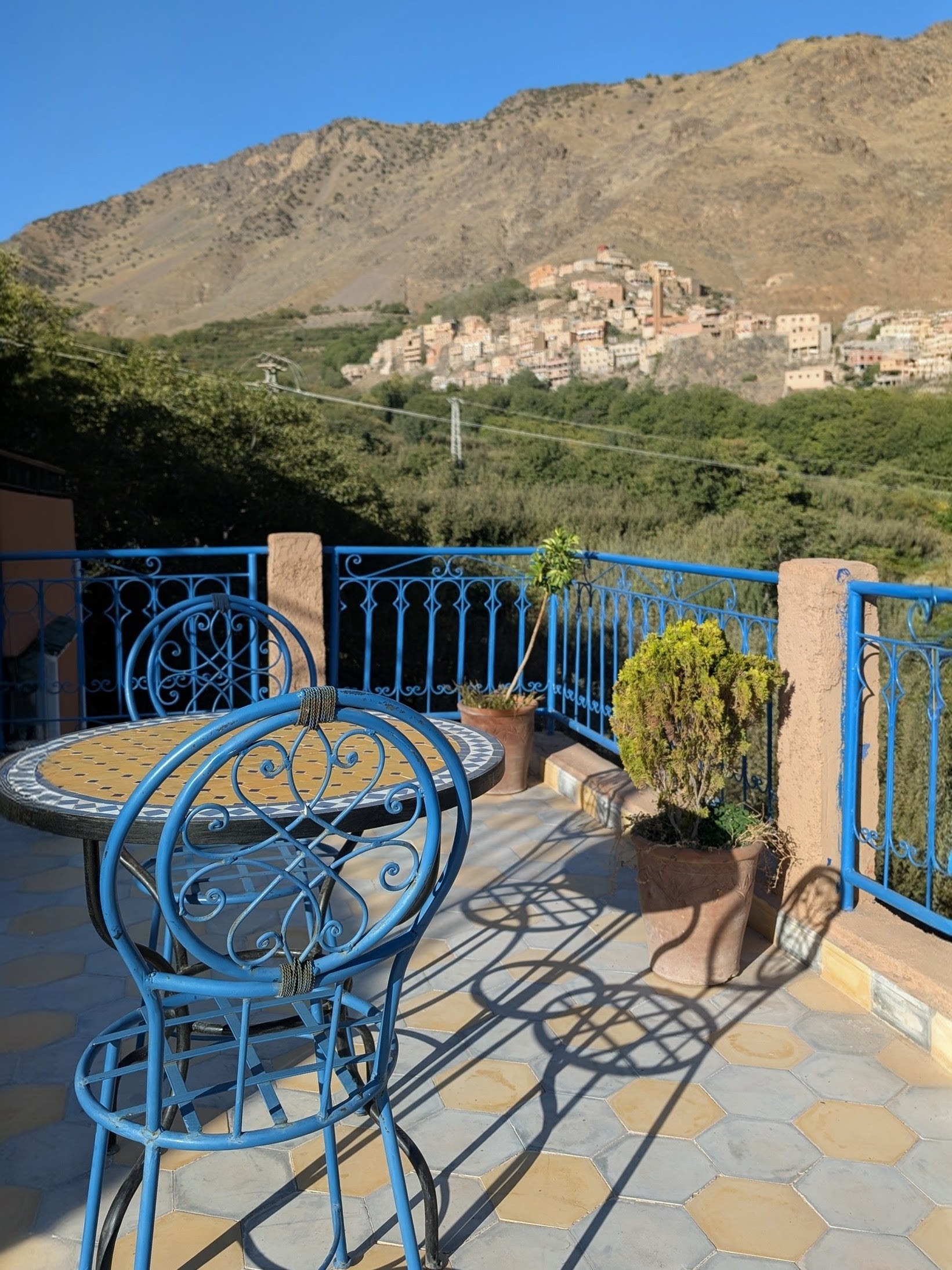
I chose a corner table with commanding views of the valley.
My favorite breakfast corner table
In about 10 minutes, a tray with an abundant breakfast was brought to me. It included freshly baked bread, fried eggs, butter, two kinds of olives, and home-made jams (apricot and strawberry). Upon my request, the guesthouse prepared black coffee, but more traditional breakfast drink in Imlil is peppermint tea. So, a shiny teapot was also proudly placed on the tray.
Breakfast at Atlas Haven guesthouse
As I was perusing emails and messages on my phone, the sun suddenly came from behind the mountains flooding the valleys with lights and colors.
Good morning Imlil
Those who come to Imlil for exploring the Atlas mountains typically stay here for several nights, as there are many destinations for hikes of all difficulty levels and offering different sceneries. The most prized target, Mount Toubkal (the tallest peak of North Africa) requires two-day trekking.
But I had only one day, and wanted to experience both the natural surroundings and the local culture. One of the easiest and shortest hikes (40 min) was to the Imlil waterfalls. The trail there begins from the southern end of the village and it is well signposted.
In about 20 minutes, the trail came to the first interesting sight, Kasbah de Toubkal.
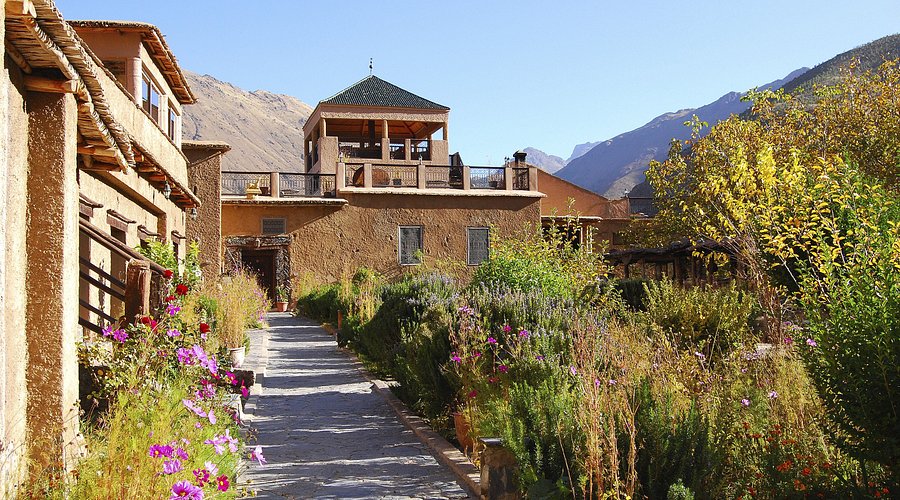
Kasbah de Toubkal, an interesting place to visit
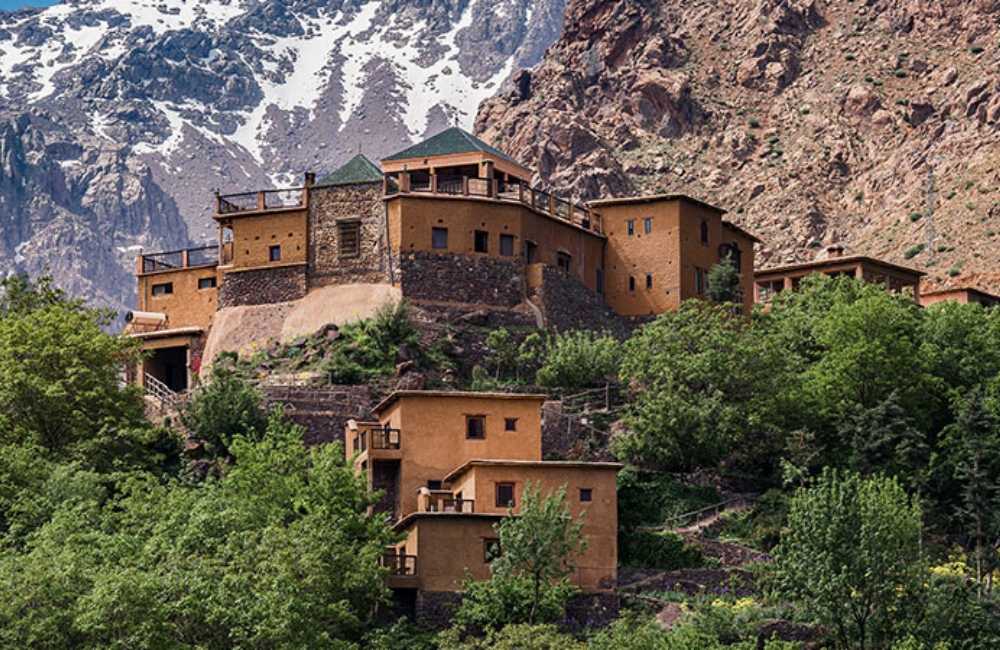
Kasbah du Toubkal is an eco-lodge and “Berber Hospitality Centre” located in a restored ancient fortress which is perched dramatically above Imlil. It is worth visiting for – at least – unparalleled, panoramic views of the Atlas Mountains. The Kasbah also offers various cultural experiences (handycrafts, traditional food, workshops) and it is run in partnership with the local Berber community.
Kasbah du Toubkal
Kasbah du Toubkal
After the Kasbah du Toubkal, the trail to waterfalls descended gradually and eventually came to an intersection with a small irrigation channel. Following the signs, I left the trail and walked along this irrigation channel.
Last portion of hike to Imlil waterfalls is along irrigation channel
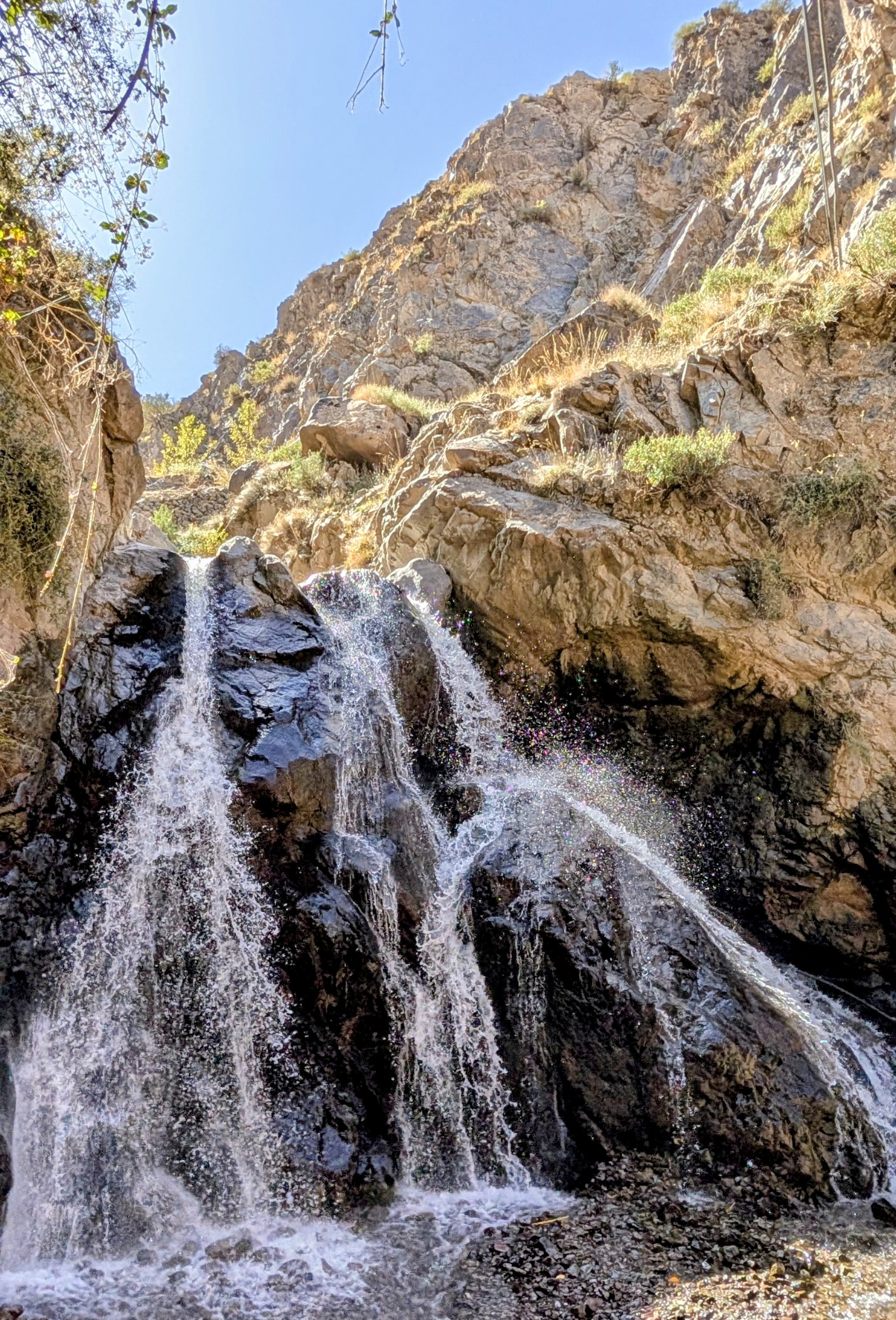
In about 15 minutes, I reached waterfall. It was October, the end of the dry season and not a good time for rivers and waterfalls. Yet, Imlil waterfall did not disappoint: the sparkling cascade offered a feast for the eyes and pleasant respite from the heat of the day.
Imlil waterfalls
After waterfalls, the next destination was the village Aroumd, about 4 km / 2.5 mi south of Imlil. While Imlil has accommodations, restaurants and other tourist services, Aroumd appeared to be completely free of any tourist infrastructure. And so, I figured that this would be my chance to see an authentic Berber village.
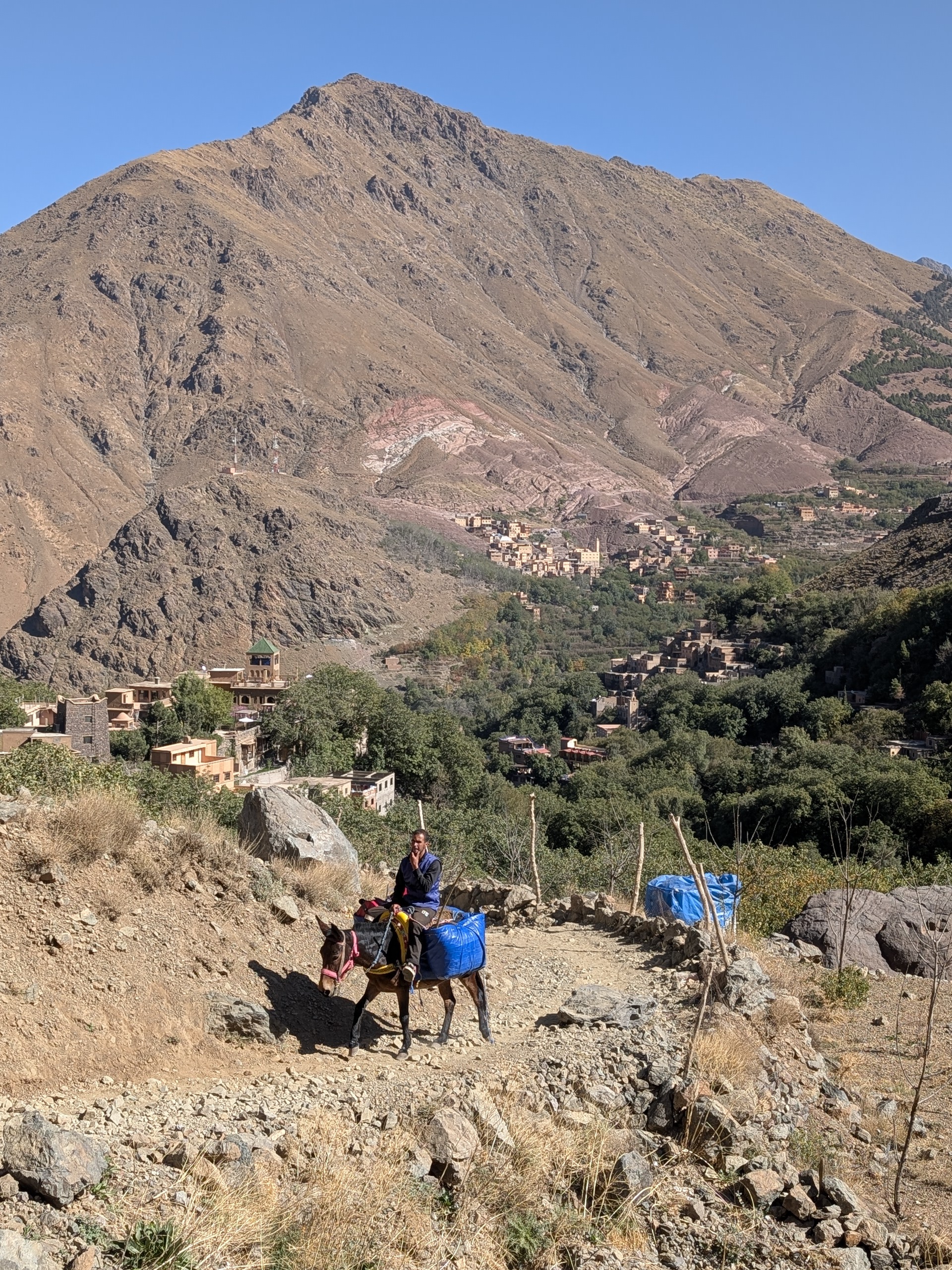
Being not exactly sure how to get to Aroumd from the waterfalls, I first simply followed the trail along the river at the bottom of the valley. In about 10 min, I met a man riding the donkey and asked him: “Aroumd?” He pointed to another trail climbing up the slopes and toward the main asphalt road.
My guide to Aroumd
I followed his directions and in about 15 minutes arrived to an asphalt road. An instant reward for steep climbing was a great view of Kasbah de Toubkal with Imlil in the distant background.
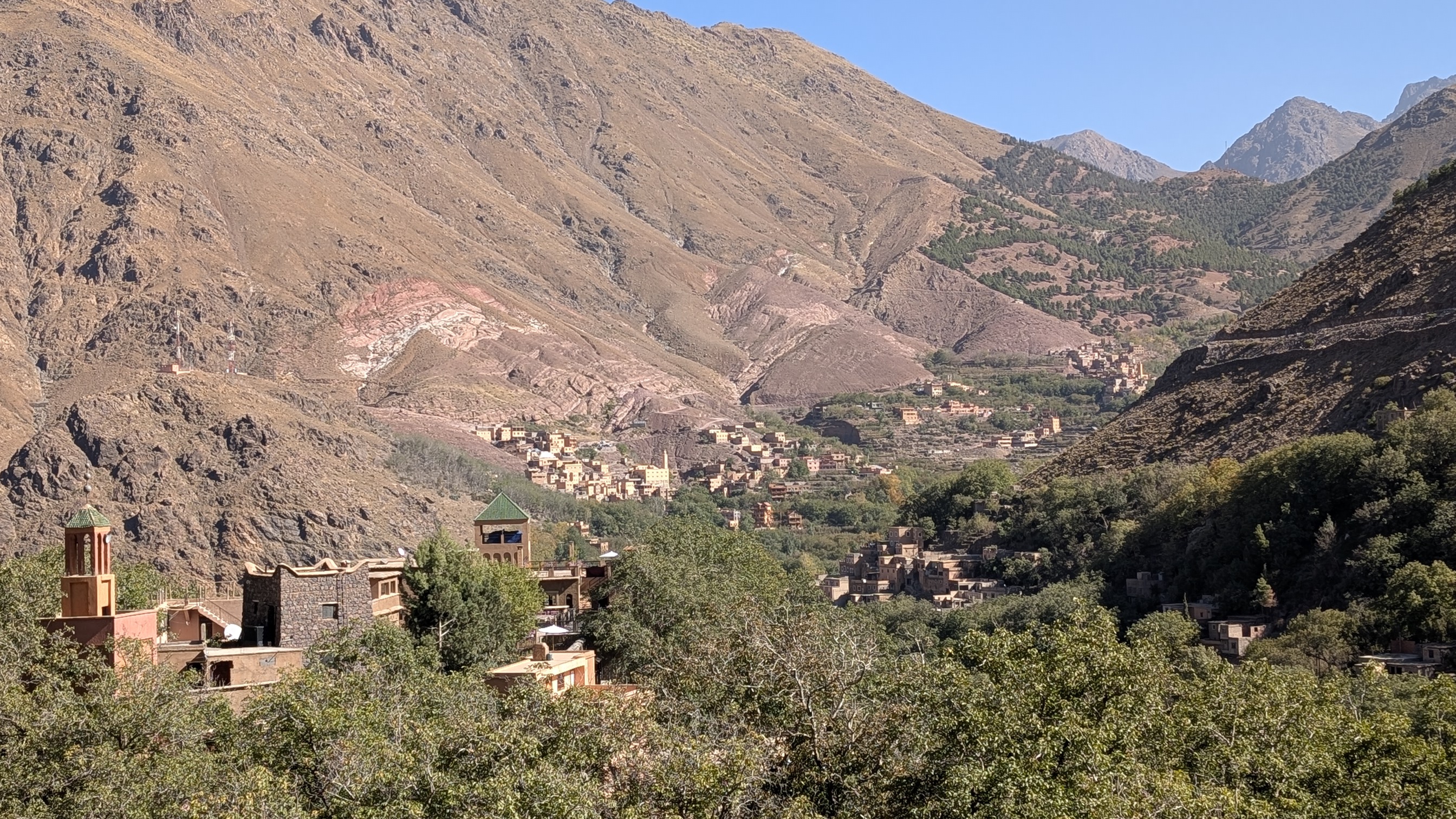
Kasbah de Toubkal (left front) and Imlil (background)
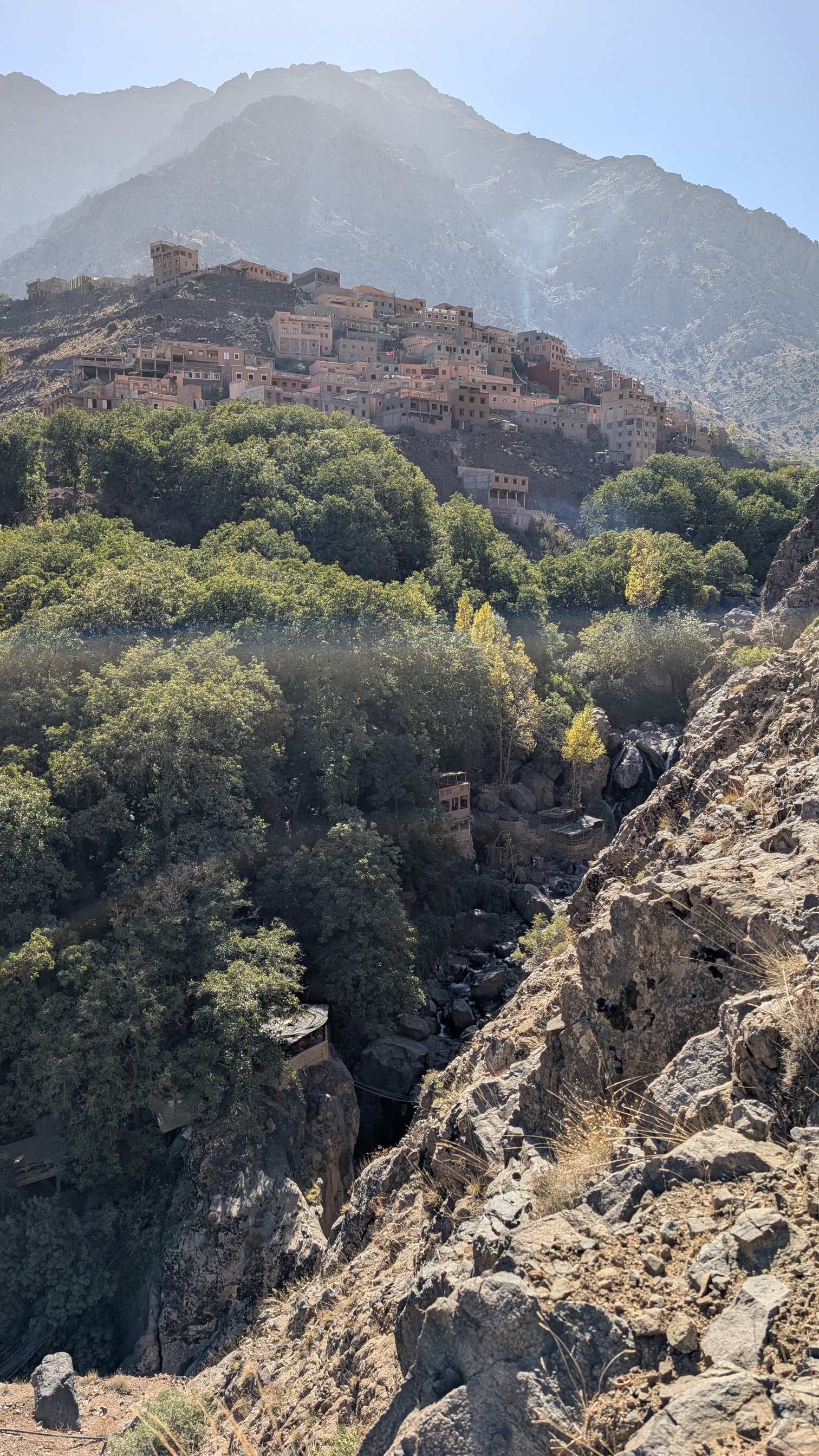
After walking about 20 minutes along the paved road, Aroumd came into the view. From the distance, the village looked entirely different than Imlil. Terrace-like rows of ochre-colored houses were clinging to the steep slopes. The view reminded me of the “hill towns” in Southern Italy.
Aroumd
But this initial resemblance to Italy disappeared instantly when I entered Aroumd. Essentially, there were no streets to speak of. The houses were haphazardly built next to each other. Some shared the same walls, while others were divided by narrow passages or stairs leading to the next level of the village. The overall feeling was that of a giant honeycomb.
In just a few minutes, I was hopelessly lost in the cobweb of tiny passages, stairs, and house walls. Worse of all, the village seemed to be fully deserted: not a soul in view. It was a respite when I stumbled upon some opening and saw a human being. A woman was working on an outdoor clay-oven.
Outdoors clay-ovens are common in local villages
Outdoors clay-ovens are common in local villages
As if waiting for my appearance, the woman opened the oven and extracted several piping hot round breads. Called “tafarnout,” it was a traditional Berber bread which is actually named after oven (“tannur”). The method of baking is simple. A wood fire is lit at the bottom until the clay walls are extremely hot. Then the flattened dough is slapped onto the interior walls of the oven. The dough sticks to the hot clay and bakes rapidly.
The outcome is a flat bread which is dimpled and covered with golden-brown blisters. Without saying a word, the woman handed me one bread. I took a bite and it was amazing. A crispy, slightly charred crust was combined with a soft, chewy interior. The wood fire imparted a distinct smoky flavor that would be impossible to replicate in modern gas ovens.
Tafarnout, a traditional Berber bread
I thanked the woman for delicious snack and tried to explain that I need to get out of this “village maze.” She asked a small boy to accompany me, and in just 10 minutes I was on the other, upper side of Armoud. From here, I could perfectly see the trail and the road which brought me here couple hours ago.
The trail and road which I walked to Armoud
Looking the other way, I saw lush valleys framed by the rugged, barren mountains. A quick check of Google Maps helped me put names to the villages spread out before me: Arghan, Imlil, and Talaoul.
The view of “three valleys” area
Instead of backtracking, I returned to Imlil by the other trail and along the other side of the valley.
Hiking back to Imlil along the other side of the valleys
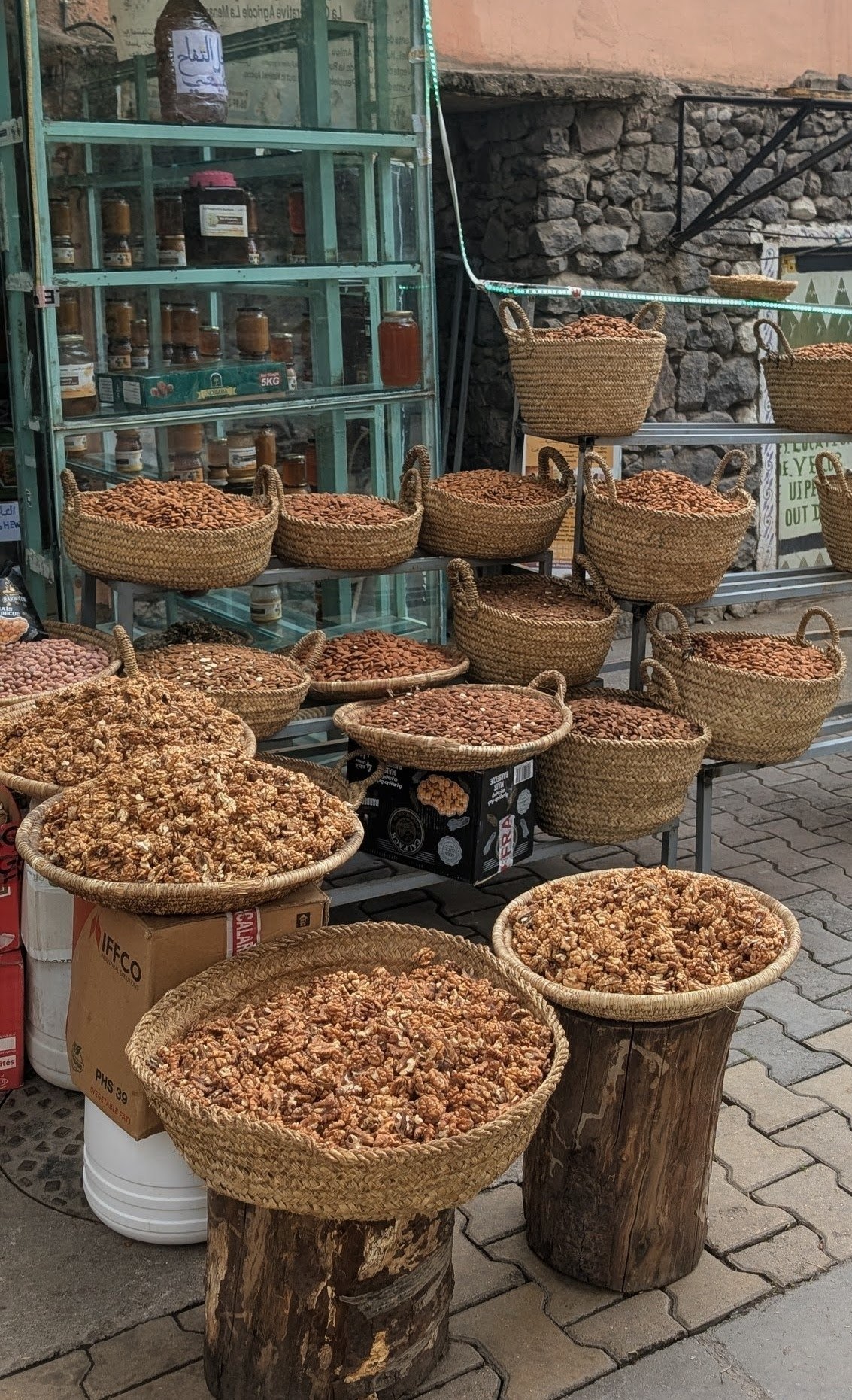
Back on the streets of Imlil I noticed something which I had completely missed night before. Many vendors were selling walnuts and apples. It turned out that both are the region’s main crops.
Imlil is known for walnuts and apples
Imlil is known for walnuts and apples
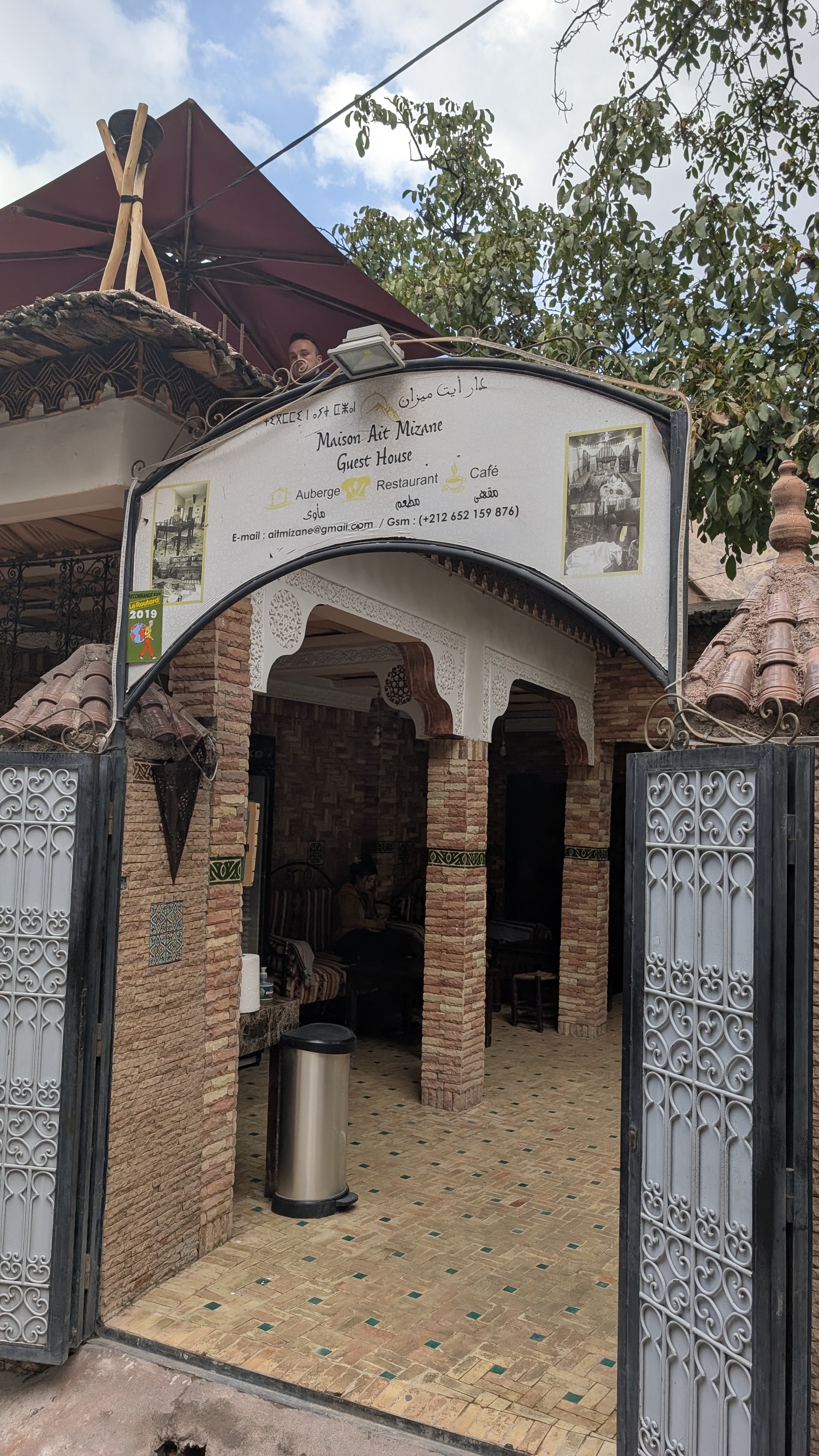
After day of hiking, I was very hungry and walked to the restaurant “Maison Ait Mizane” which was recommended by my host, Abdellatif. Using a mix of French and Amazigh (Berber), the name can be roughly translated as the “House of the People of the Mizane Valley.” Given that Imlil is the main village in Ait Mizane valley, the name sounded very appropriate.
Maison Ait Mizane, a good place to eat in Imlil
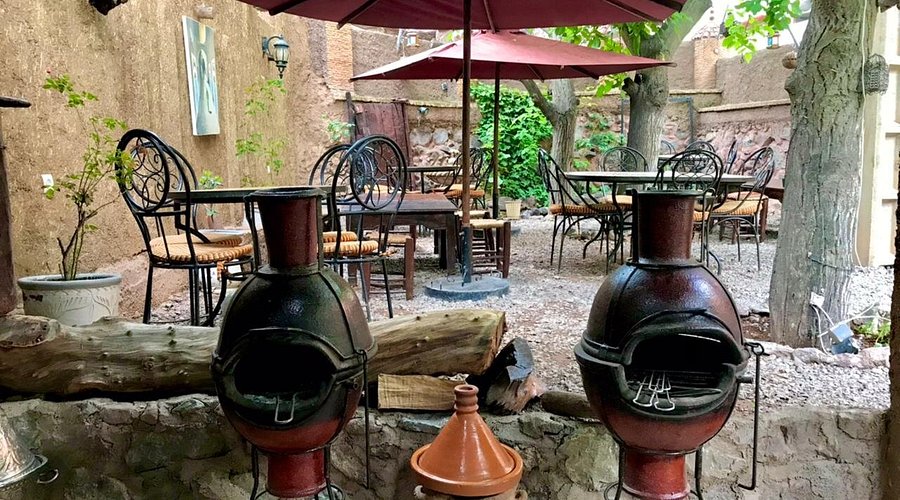
I instantly liked restaurant’s simple but cozy courtyard.
Maison Ait Mizane, a good place to eat in Imlil
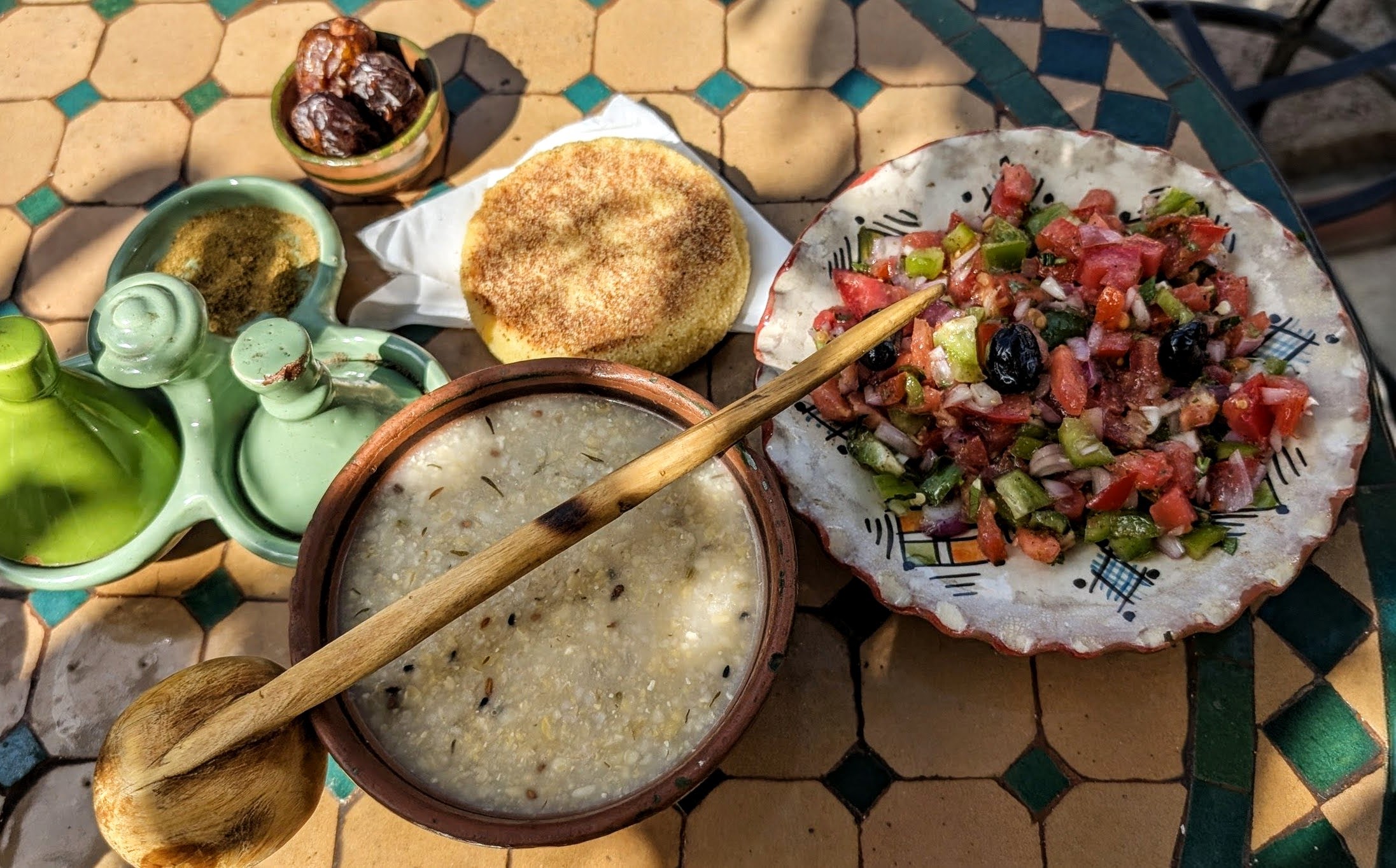
The menu was impressive with many both local and national Moroccan dishes. I ordered Moroccan salad, my favorite freshly backed “semolina harcha,” and “Berber soup.” Also known as “Hssoua Belboula,” it’s a creamy, porridge-like soup made from barley grits (belboula), which are cooked with milk, water, olive oil, and seasoned with cumin.
As a nice final touch, the soup was served with dried figs. The interplay of flavors – the sweet chewiness of figs and the creamy-grainy texture of the soup – was so comforting that I ended up ordering second portion.
Barley-based “Berber soup” served with dry figs is a local specialty
Back at Atlas Haven, Abdellatif was waiting for me. Sipping mint tea, we talked about life in Imlil and his guest house. Opened in 2007, “Atlas Haven” is more than a hotel. It actually evolved from the 400-year-old ancestral home where Abdellatif was raised alongside his six brothers.
I learned that Abdellatif was the first fully licensed local tour guide taking visitors on both simple day hikes and demanding multi-day treks. He explained that while few foreigners visit in winter, many Moroccans come to simply enjoy the snow, a “rarity” in Morocco.
Abdellatif also invited me to come back in May for the abundant wildflowers, or in June for the cherry season—another traditional crop of Imlil. Saying ‘good night’, I was immensely grateful to my host not just for the comfortable accommodations, but for making my short visit so interesting and meaningful.
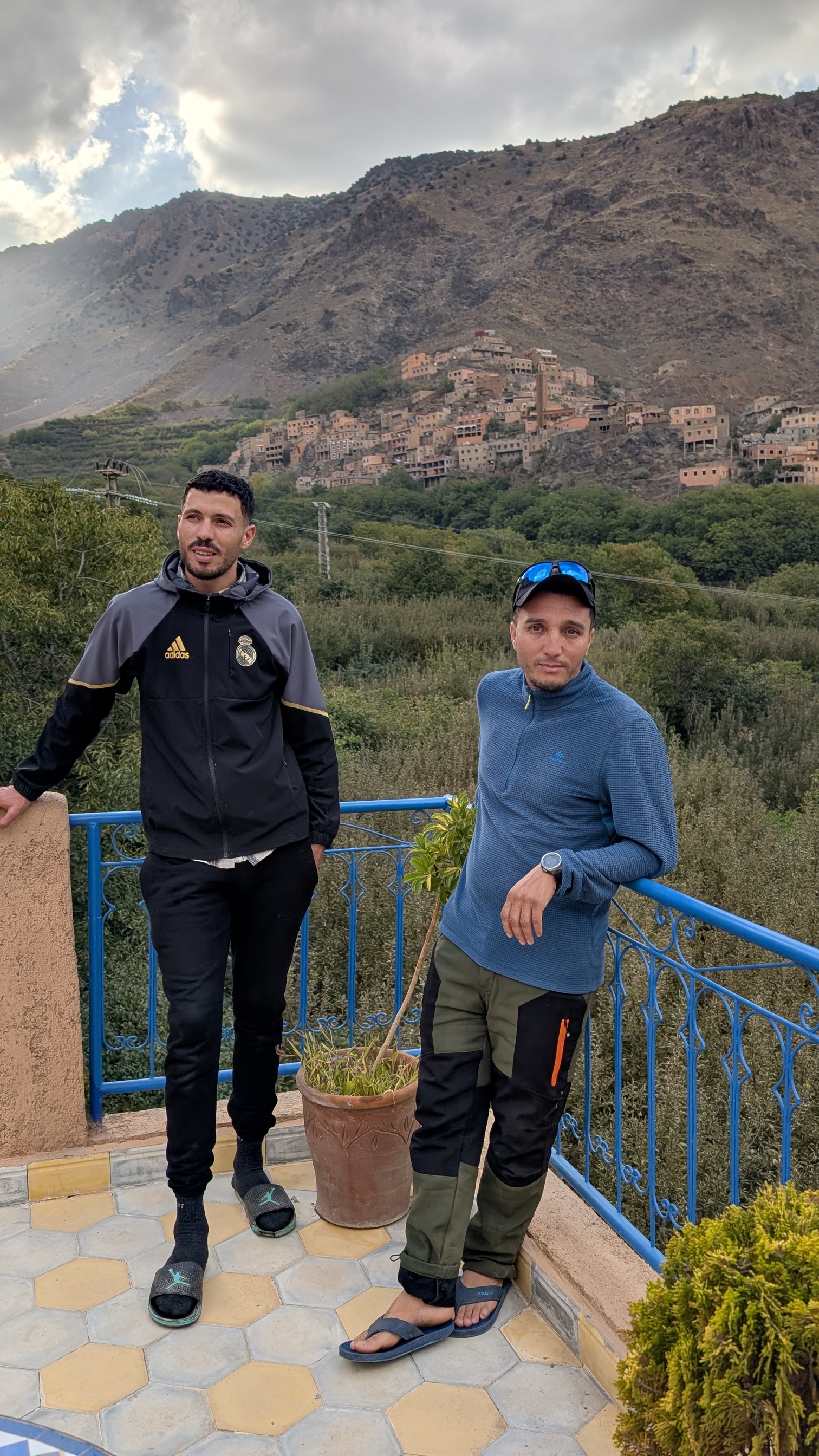
My host Abdellatif (right) and his co-worker Ismael
The next morning’s weather was perfect. Sunbathing on the upper deck and waiting for a taxi to go back to Marrakesh, I firmly resolved to come back in May: to witness the spring in the mountains, to enjoy wildflowers, and to go on a few treks with Abdellatif.
I am leaving Imlil, but will be back in May
Only Blue Colors Are Permitted: the Town of Chefchaouen
I wrote at the beginning about my intention to explore the less visited places of Morocco. Alas, my next destination, the town of Chefchaouen, definitely did not fit this definition, as it is a very popular tourist spot. Its main allure is the ethereal white-blue-washed medina nestled against the surrounding Rif Mountains. But besides desire to see this uniquely photogenic place, there was another reason to go there.
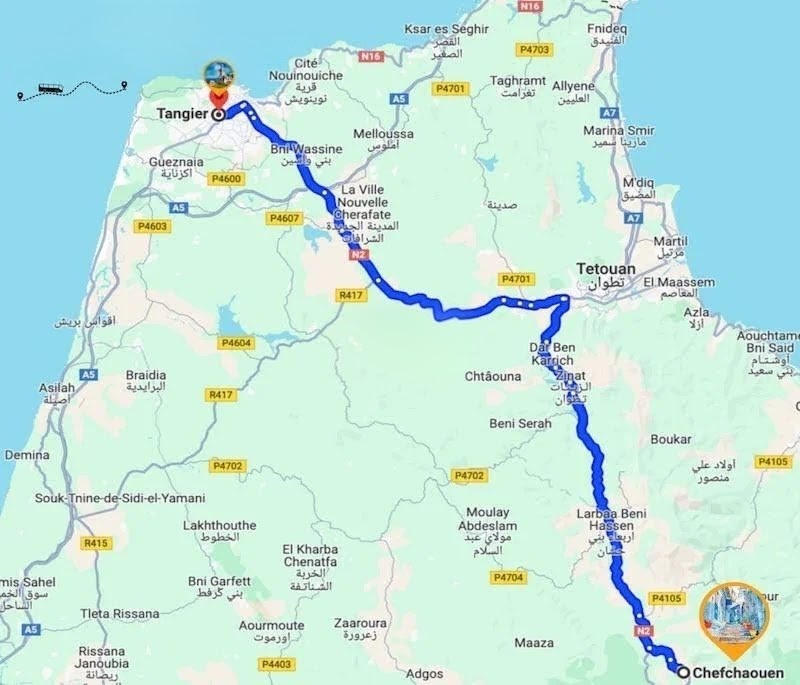
Chefchaouen (or Chaouen) is located about 110 km / 70 mi southeast of Tangier. Since the town does not have a train station, the best way to get there is by a shared “grand taxi” from Tangier. The trip takes about 3 hours and costs 70 dirhams ($7 USD).
It takes about 3 hours from Tangier to Chefchaouen
I traveled to Chefchaouen from Imlil (see previous chapter), and it was a long trip: first by taxi from Imlil to Marrakesh, then by train to Tangier, and finally by grand taxi to Chefchaouen. When I arrived, it was already dark. Hence, I decided to call it a day and simply relax in my guesthouse.
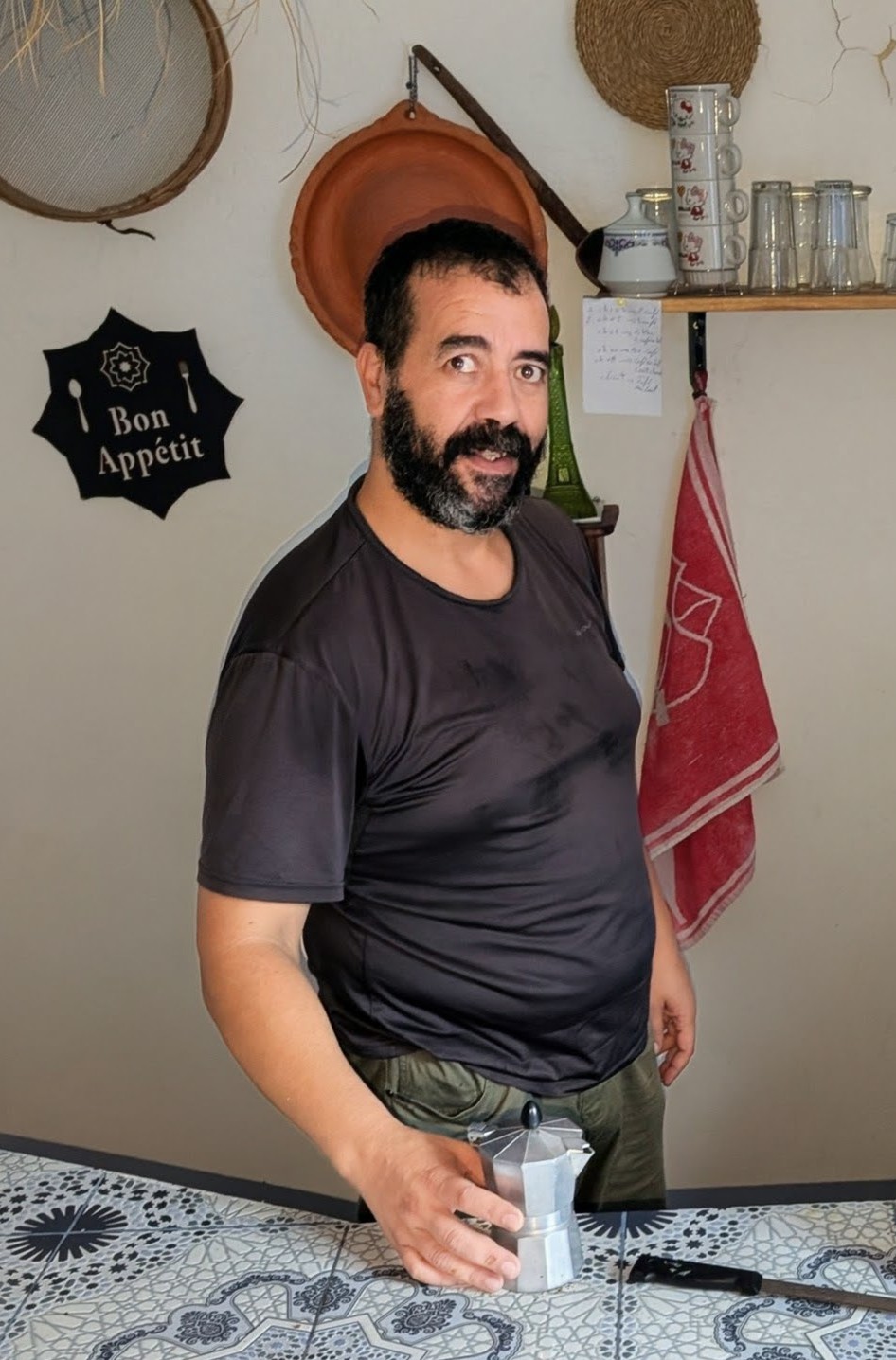
Called “Casa Troussi,” it was conveniently positioned right next to medina and yet away from the throngs of tourists roaming the streets of old town. Besides location, I picked “Casa Troussi,” because of other guests’ reviews praising genuine hospitality of the owner, Fahd. Indeed, he was waiting with a pot of freshly brewed aromatic coffee and definitely knew how to welcome worn out travelers.
Fahd, the owner of Casa Troussi
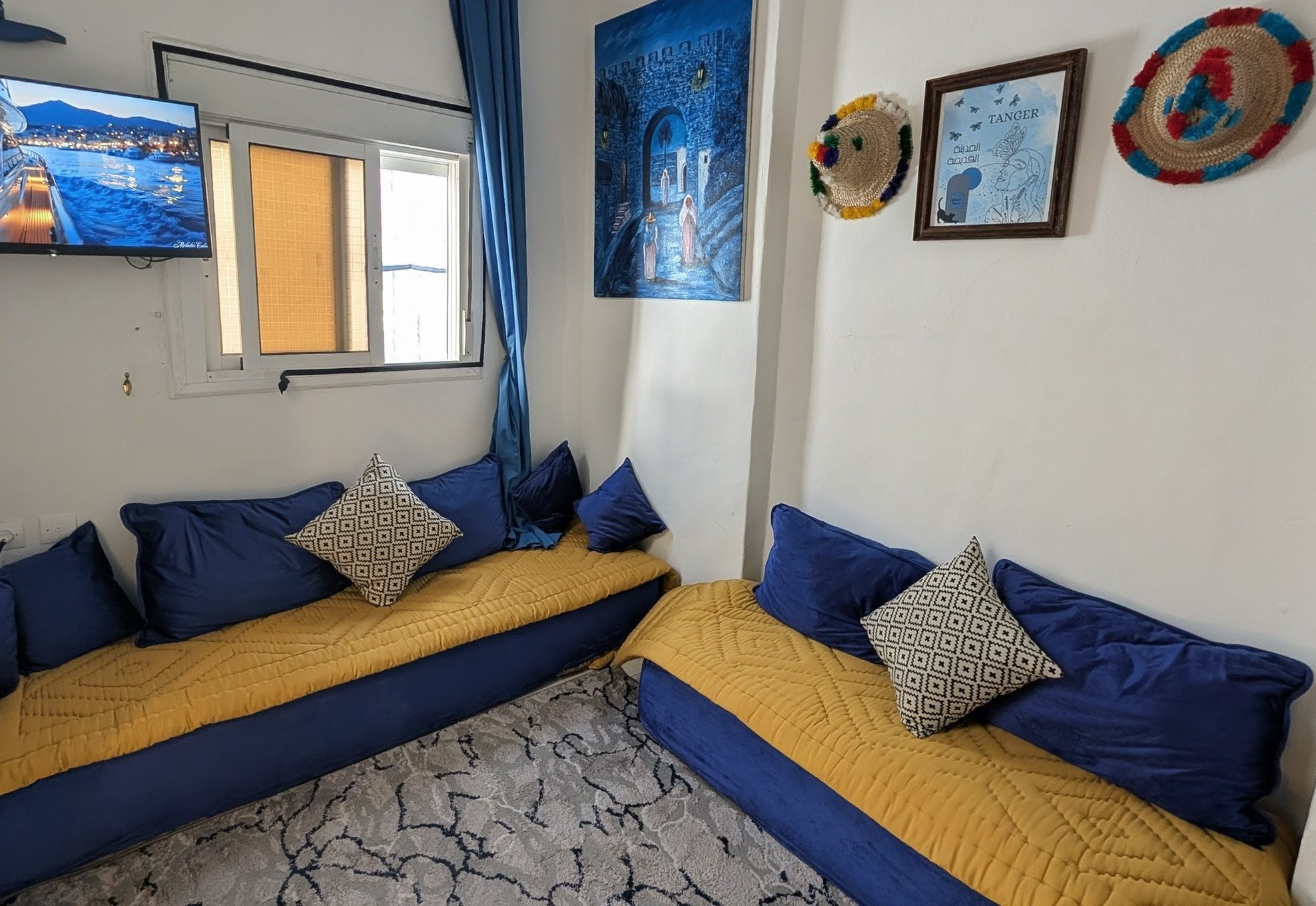
The guesthouse did not disappoint: the interiors felt very homey and with many small decorative “touches.”
Casa Troussi, a good place to stay in Chefchaouen
A very pleasant surprise was also a rooftop terrace with panoramic views of the Rif Mountains. In short, if you will visit Chefchaouen, don’t look any further: Casa Troussi is a place to stay. Find it on Booking.com or get in touch with Fahd directly (+212-670-98-69-07).
The view from the rooftop terrace at Casa Troussi
Next day began early. But instead of exploring Chefchaouen, I headed to the “grand taxi” stand and took a 40 min ride to the village of Akchour, the starting point of a hike to another major local sight, the “God’s Bridge Canyon.”
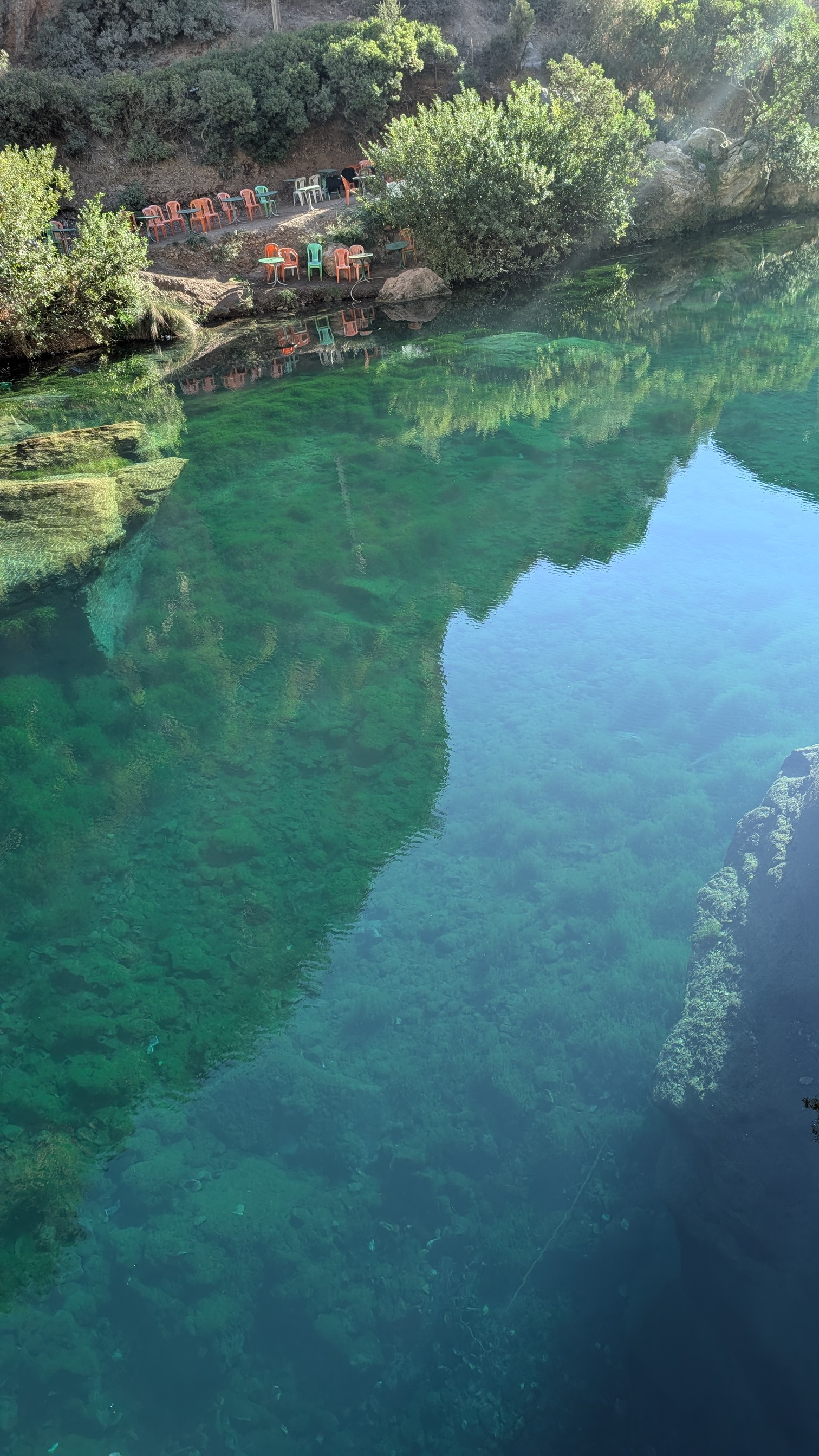
When I arrived there at around 9.00, all local shops and restaurants were still closed. I knew, however, that in couple hours this place would be full with visitors. Finding trail to God’s Bridge was not a problem, and I set off right away. The first part of one-hour trek was along the Farda River. The translucent water had amazingly shimmering emerald-green colors.
First part of the hike is along Farda River
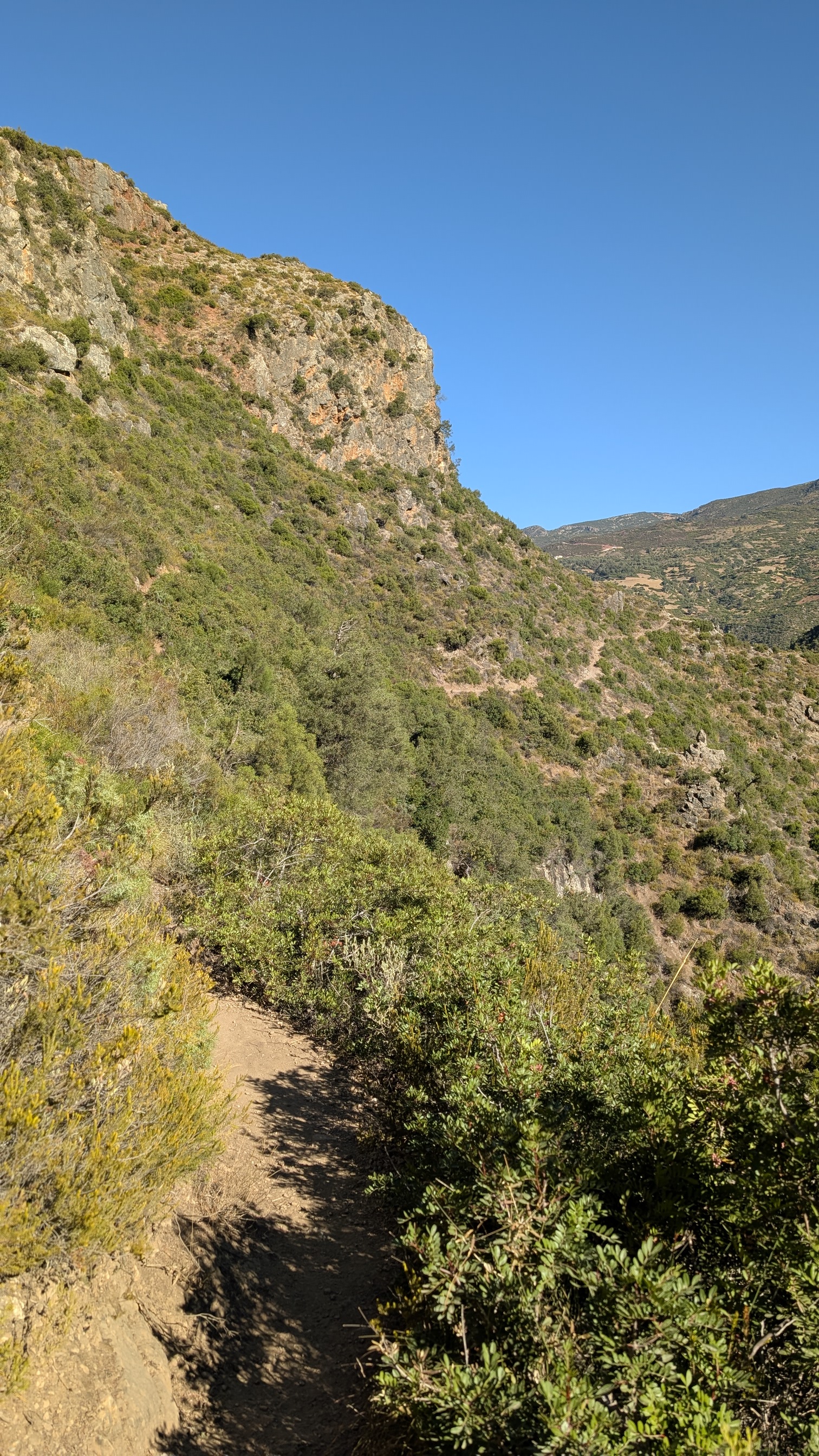
And then the path climbed up the side of the canyon. The trail was well trodden, and it was clear that God’s Bridge was a popular destination with many people visiting it each day. Hence, it was a good idea to set off early and have the entire place to myself.
The trail to God’s Bridge
With constantly changing views of the gorge the hike was easy and delightful.
Great views on a hike to God’s Bridge
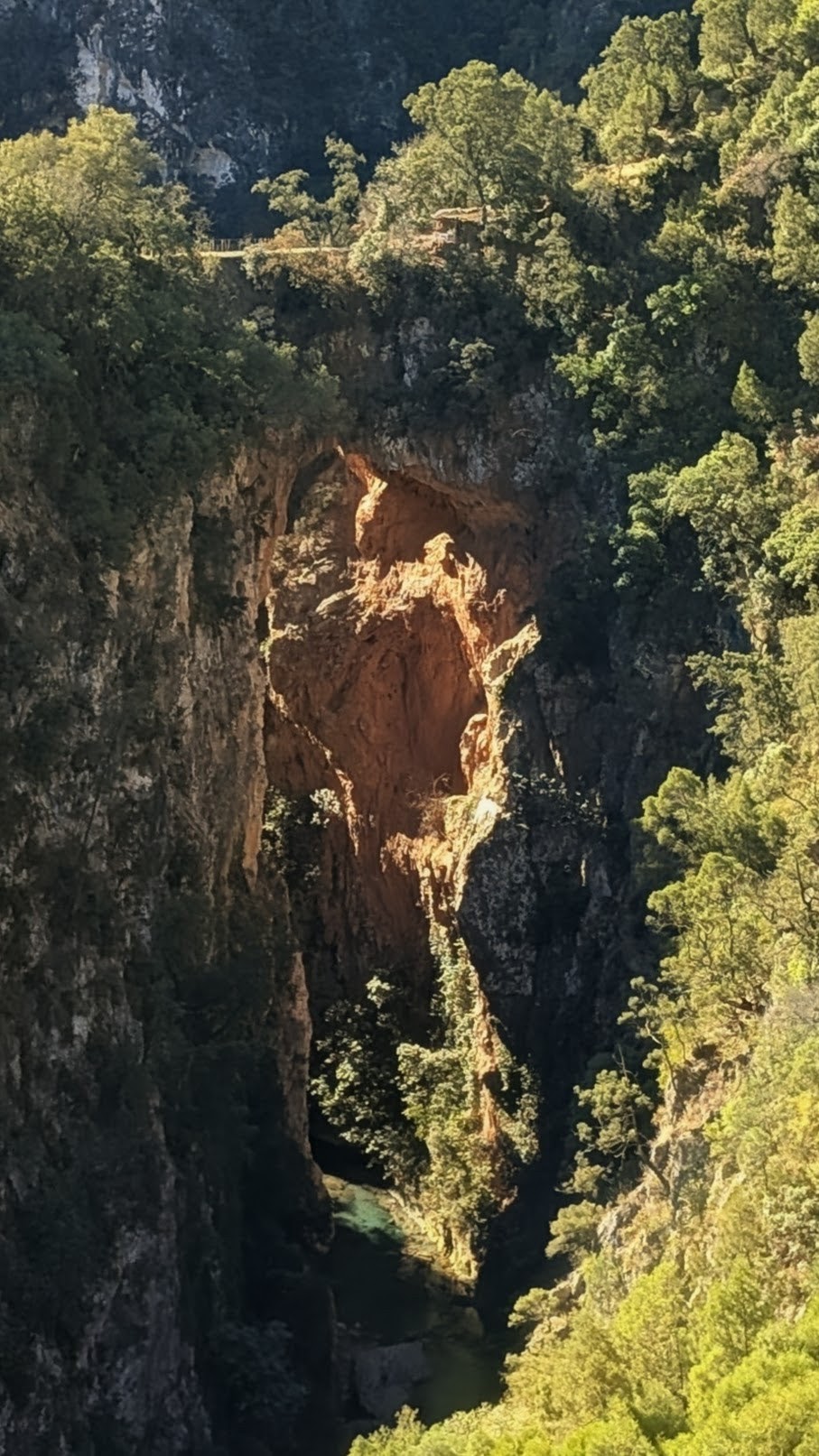
And finally in the distance I saw the God’s Bridge – a massive natural arch which was carved over millennia by the Farda River and erosion in the limestone canyon.
My destination, the God’s Bridge
Towering over 25 meters / 80 feet above the river, the God’s Bridge was like a giant “window” to the sky with the sunlight pouring through it into the deep gorge. The color contrasts were captivating. The reddish-orange arch stood out vividly against the lush green vegetation of the canyon walls and emerald pools of the river flowing below.
The hike was finalized by the “mandatory” walk on the top of the bridge and across the river. Then I returned to the original observation point. The weathered face of the bridge, showcasing millennia of erosion, gave it a rugged, prehistoric appearance. The whole setting felt untouched by modern life.
But then I heard approaching voices. The fellow tourists began to arrive, and it was time to go back to Chefchaouen.
The God’s Bridge
A small problem was that at this time of the day (late morning), many tourists were coming to Akchour, but no one (except me) was going back to Chefchaouen. So, instead of waiting for five more fellow passengers, I paid for all six seats on a grand taxi (150 dirhams / US$ 15).
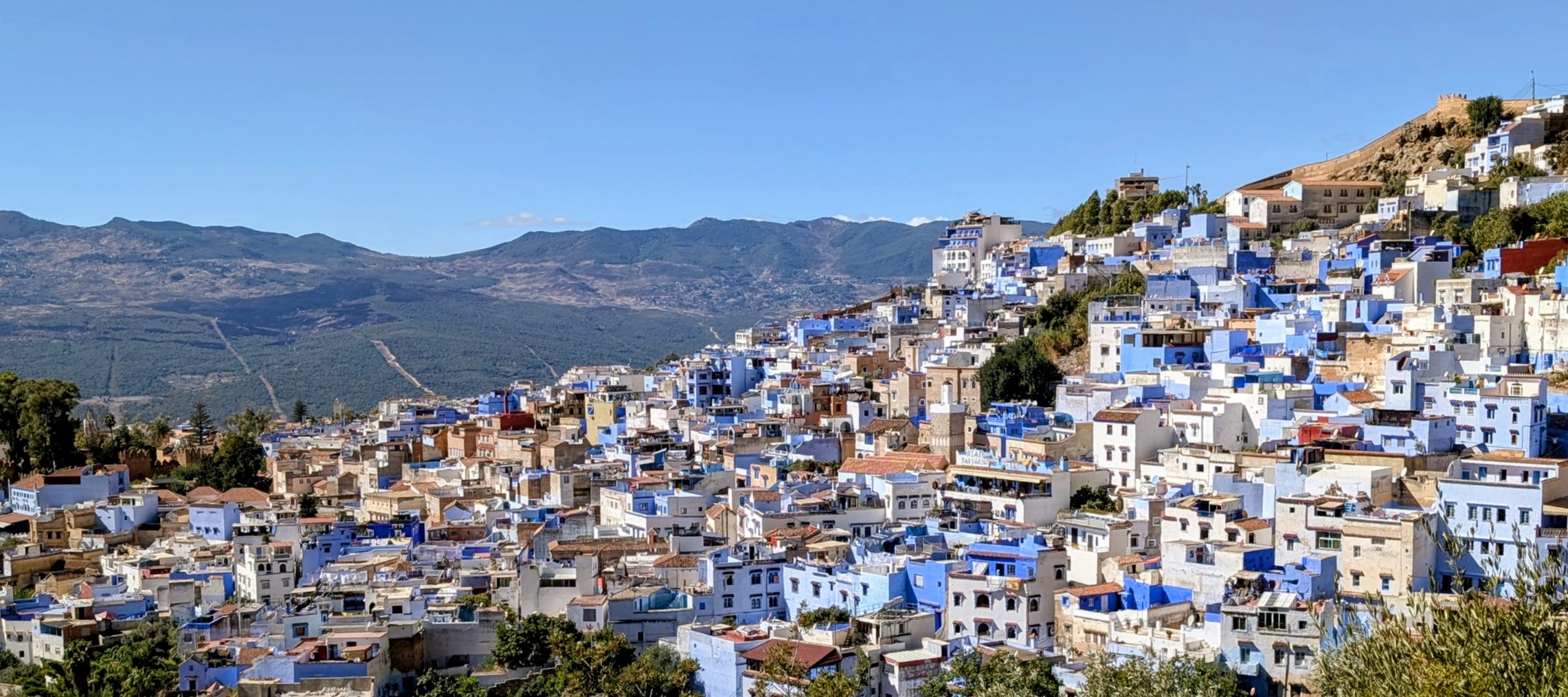
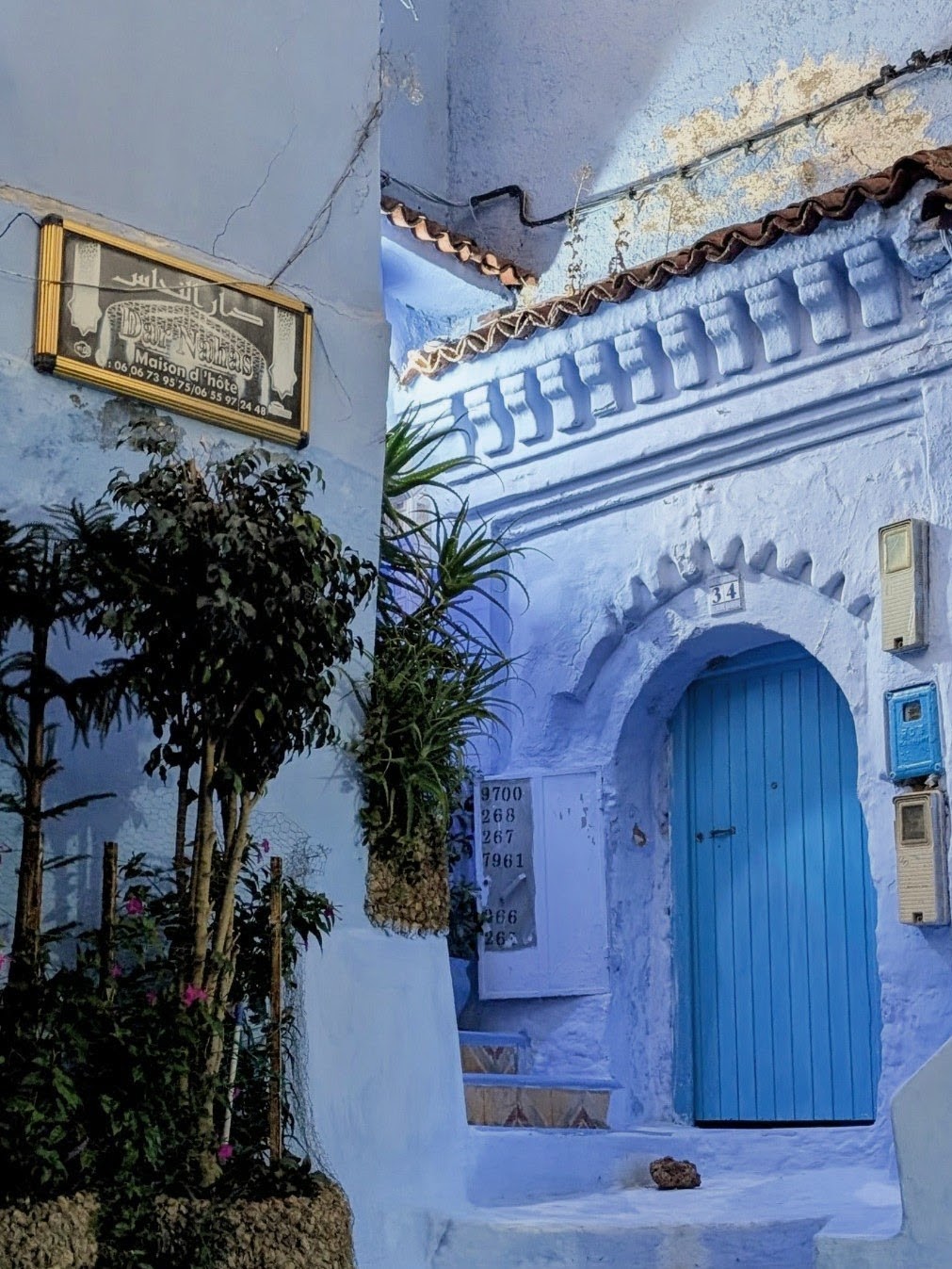
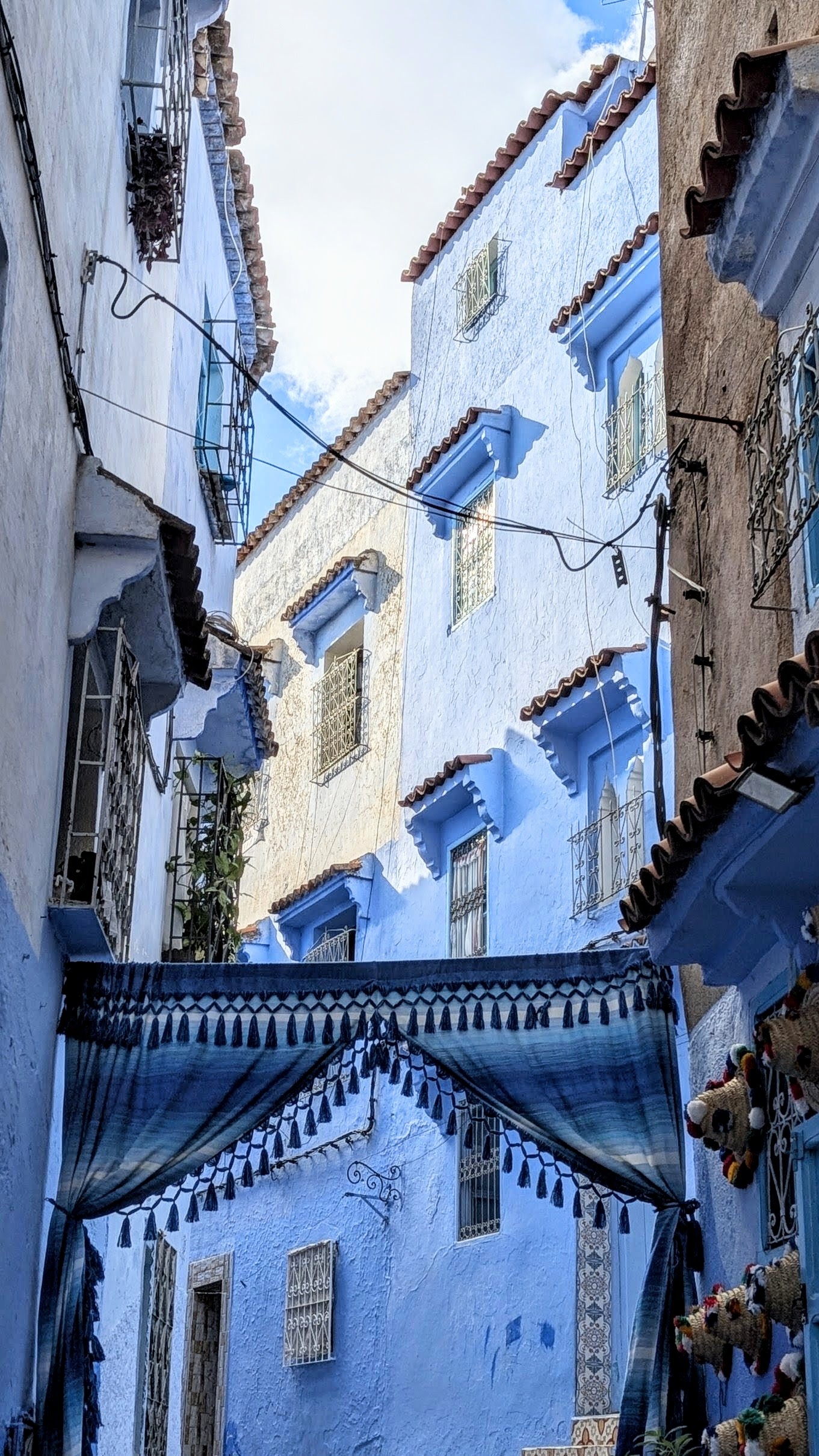
When I arrived previous night, it was dark. But today, approaching Chefchaouen, I realized that it is not just the medieval medina – the whole town is awash in bright white and blue.
The entire Chefchaouen is awash in bright white and blue
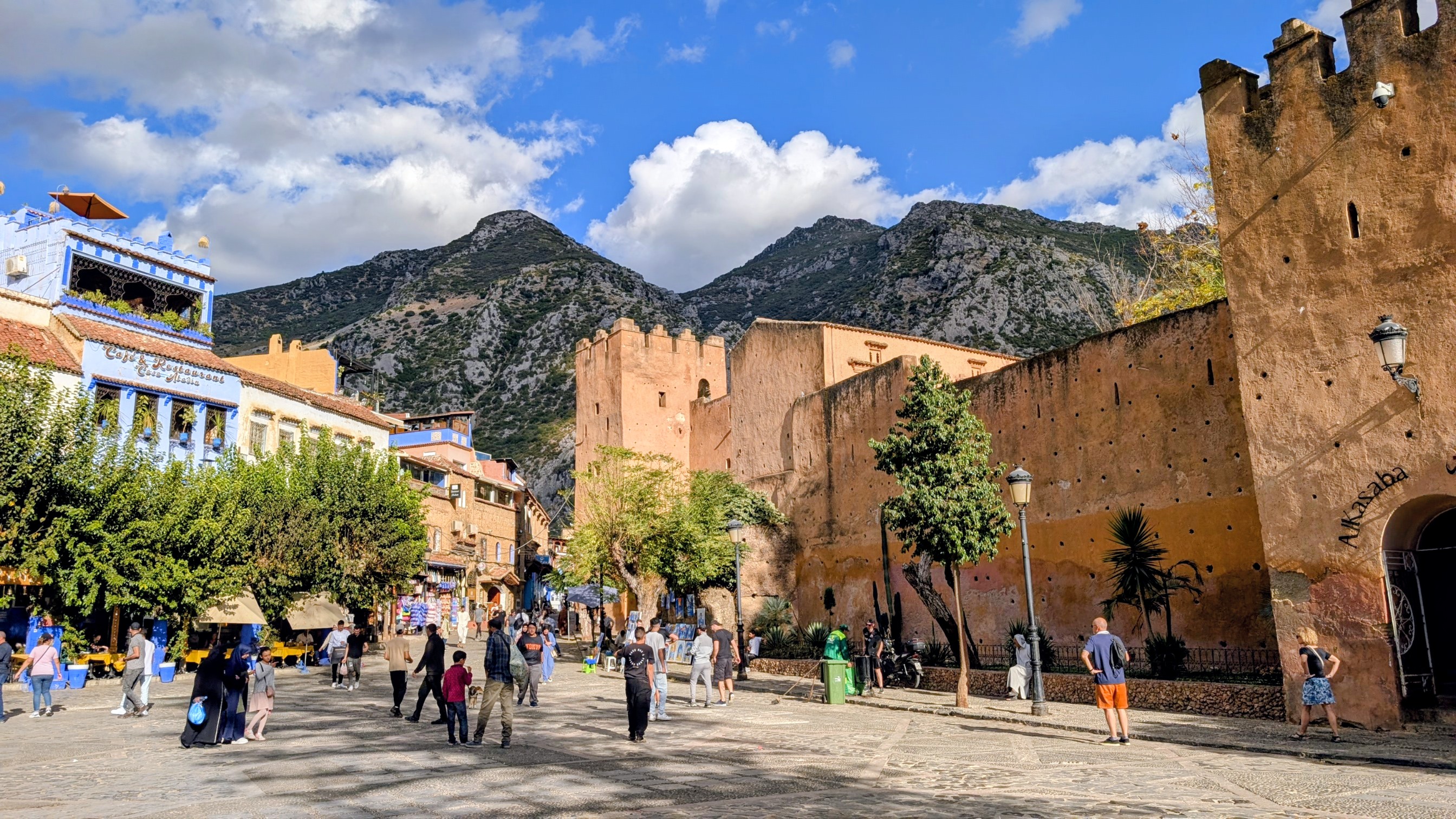
The best place to enter old town is through the Plaza Uta el Hamman, the “beating heart” of Chefchaouen’s medina. It is a gathering spot for both locals and tourists which is lined with cafes and shops of all kinds. It also hosts the city’s key landmarks: the Grand Mosque with its rare octagonal minaret and the 15th-century Kasbah (fortress).
The Kasbah’s bright reddish-brown walls and towers provided a striking contrast to the surrounding sea of blue-washed buildings.
Plaza Uta el Hamman and 15th-century Kasbah
But before sightseeing and mandatory picture-taking, I needed a good lunch to reward myself for all efforts of hiking to God’s Bridge.
From one of fellow travelers, I knew about a restaurant which was described as a “hidden gem.” So, I walked there through the white-and-blue maze of narrow passageways.
First steps through Chefchaouen’s medina
The suggested restaurant was called Tissemlal Casa Hasan. I was told that it uses a rare – for Morocco – farm-to-table approach, serving traditional dishes made with vegetables, olive oil, and meats coming directly from the owner’s private farmin the nearby Rif Mountains.
A restaurant with “farm-to-table” approach
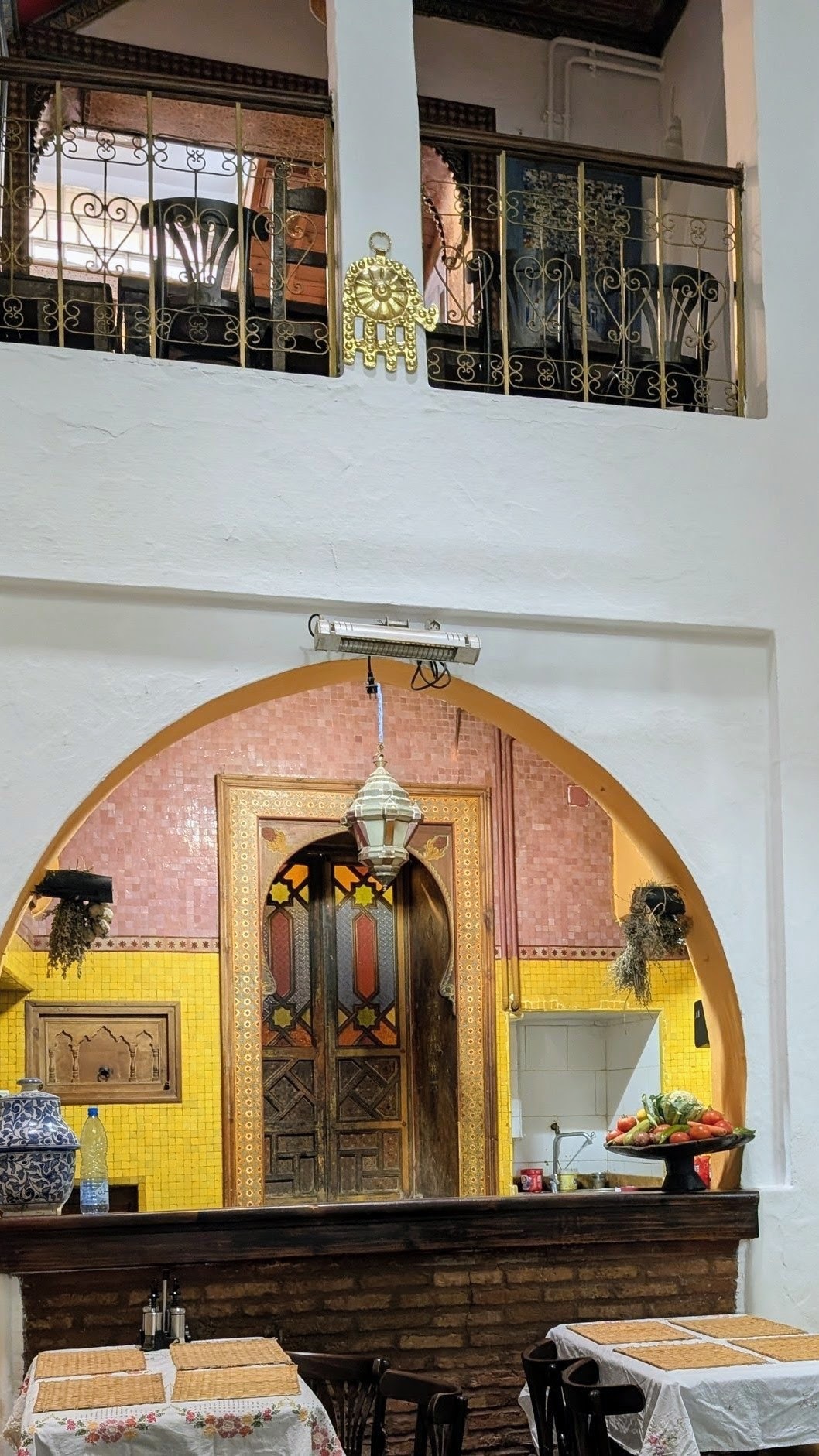
The interiors were elegant and cozy, being decorated with local arts and handicrafts. Overall, this romantic setting felt a little bit like a living museum.
Restaurant Tissemlal Casa Hassan feels like a living museum
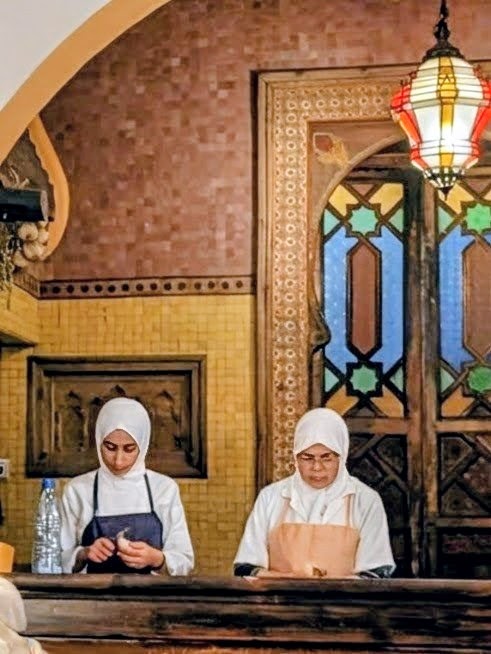
I also liked a lot the idea of having open kitchen where you can watch women preparing the meals.
You can watch how your meal is being prepared
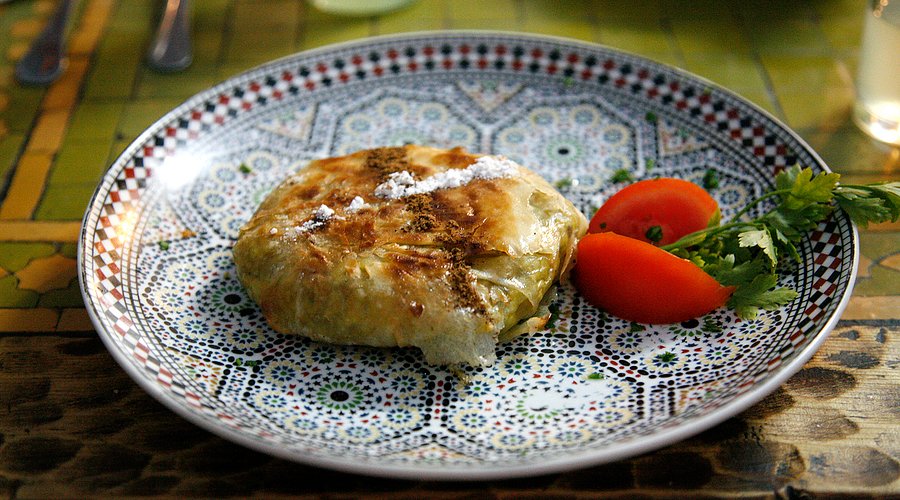
The menu was impressive with a variety of both local and national dishes. But I knew already that Tissemlal was especially regarded for its pastilla, a savory-sweet pie. Filled with juicy chicken meat mixed with crunchy almonds and dusted with cinnamon and sugar, the pastilla was literally to die-for.
To die-for chicken pastilla at Tissemlal restaurant
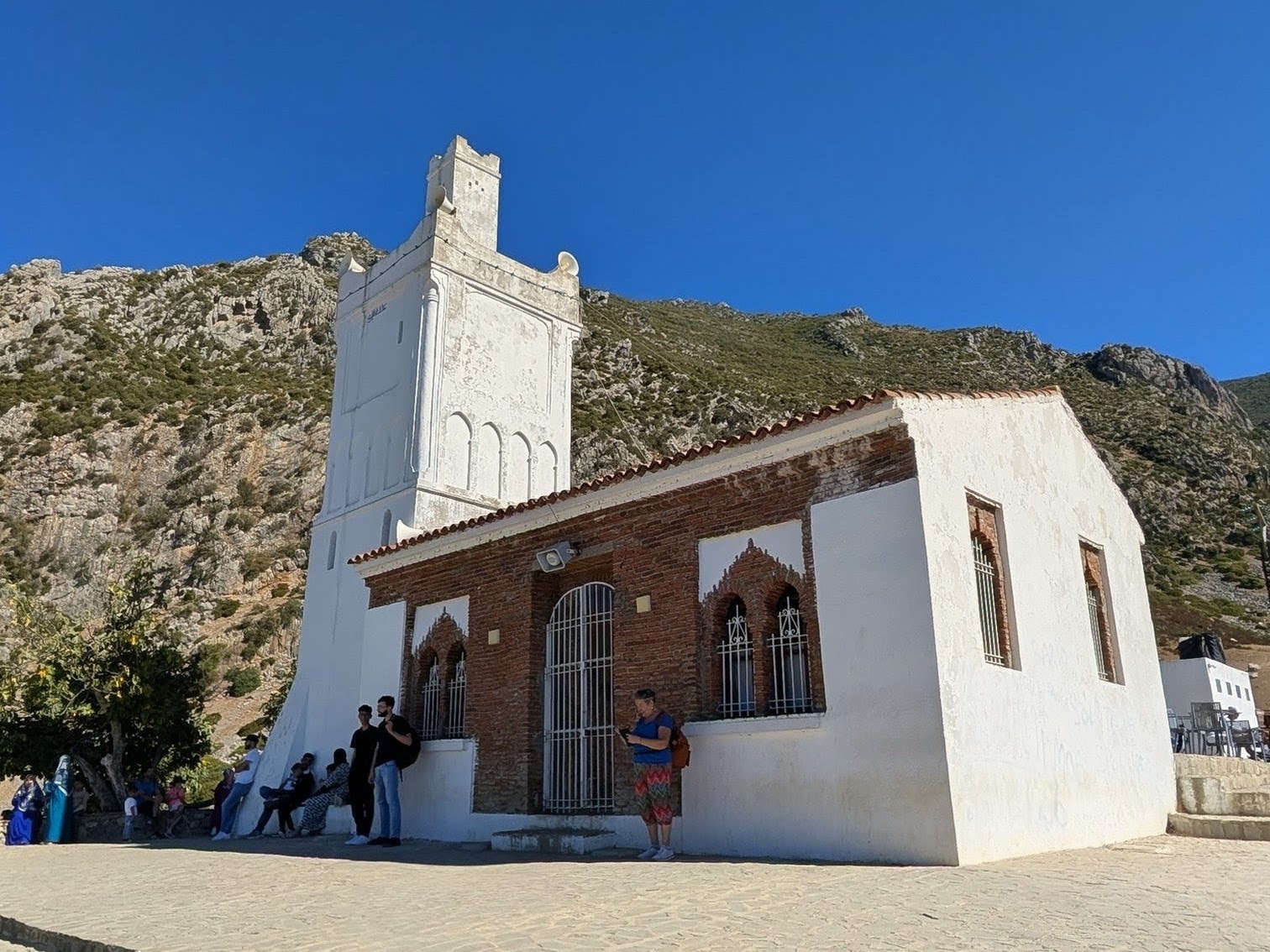
After lunch I headed to Spanish Mosque. Built by the Spanish in the 1920s to gain favor with the local population, the mosque was famously boycotted by residents and never used for daily prayers.
The Spanish Mosque was never used as a mosque
However, being perched high on a hill, it offers a spectacular view, allowing to see the entire Chefchaouen framed against the Rif Mountains. Main crowds arrive here right before dusk to watch sunset over the white-blue medina. Instead, I came in the early afternoon and shared the place with just a few people.
Spanish Mosque offers best observation point in Chefchaouen
The rest of the day I simply walked randomly through the narrow streets of medina. What was interesting, most tourists concentrated only in certain areas and streets – the ones lined with shops and cafes. Just a step aside, and I was able to find quiet corners and alleys and enjoy calming light-blue colors.
Chefchaouen’s medina
In some places, the locals decorated the walls of their homes with tapestries, baskets, straw hats, and other handicrafts.
Chefchaouen’s medina
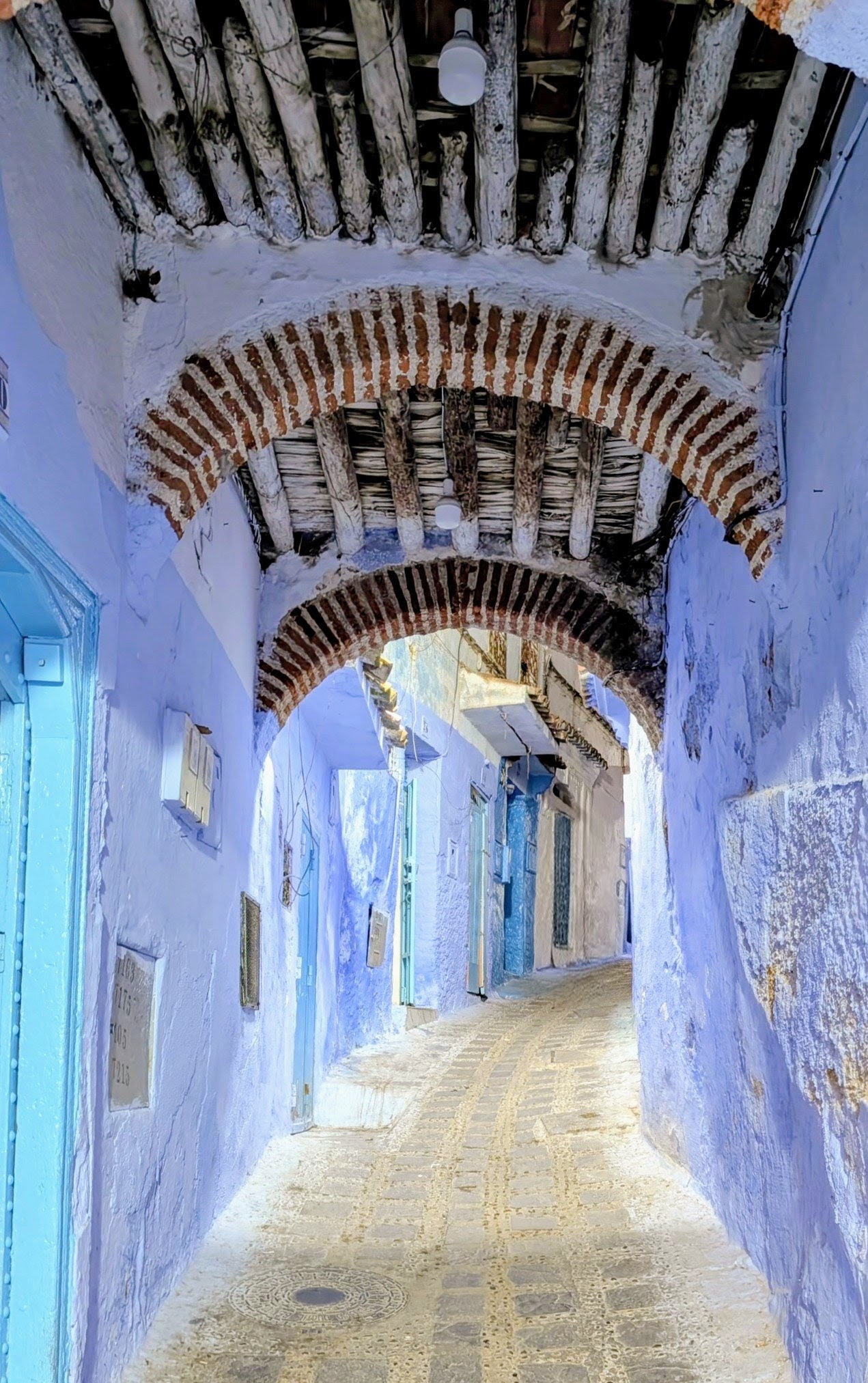
Some passageways were tunnel-like. Walking through them was a somewhat surreal experience: it felt like floating through flowing blue light.
Chefchaouen’s medina
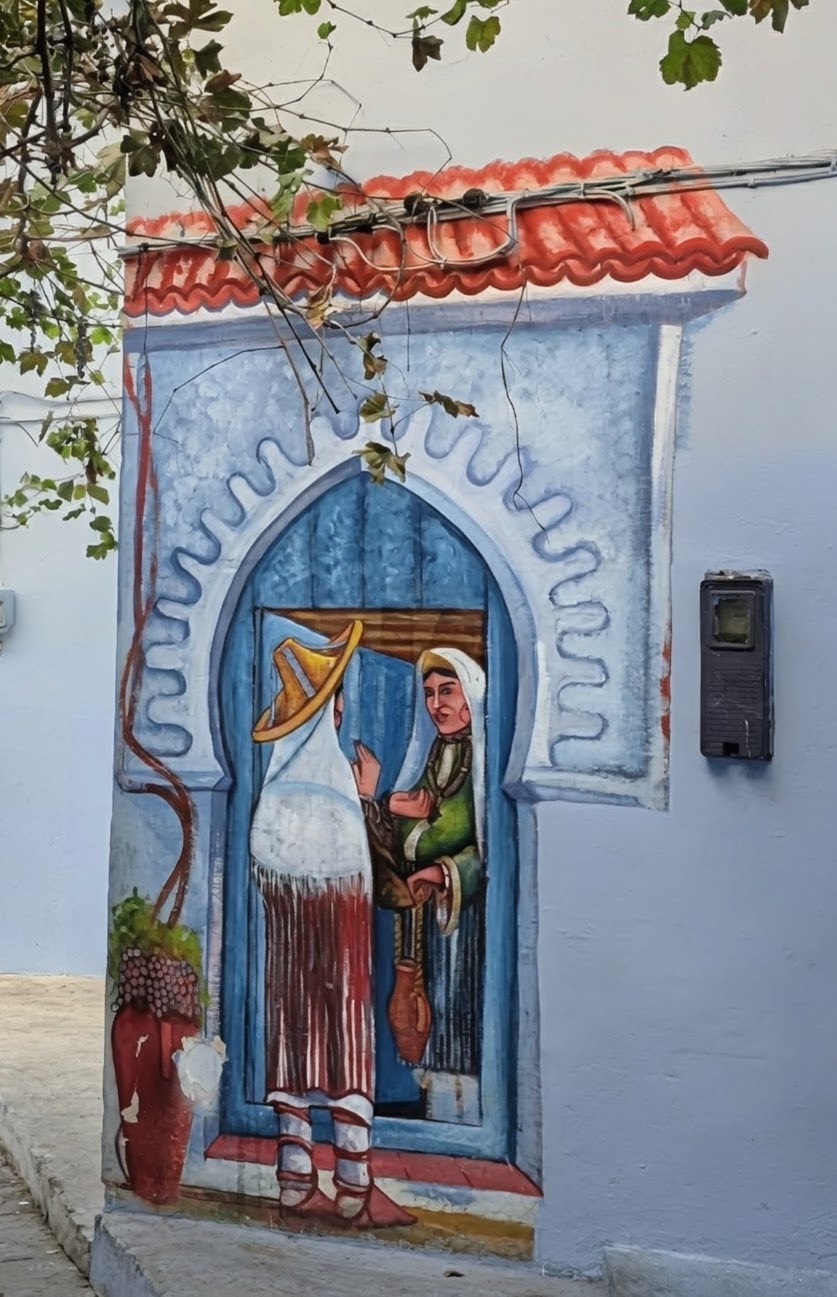
Some doors had nice folkloric paintings.
Chefchaouen’s medina
After constant immersion in mesmerizingly shining light-blue colors, I felt somewhat disoriented. It was as if the town began to absorb me. But then I stumbled upon a corner which offered a visual respite with more vivid colors.
Chefchaouen’s medina
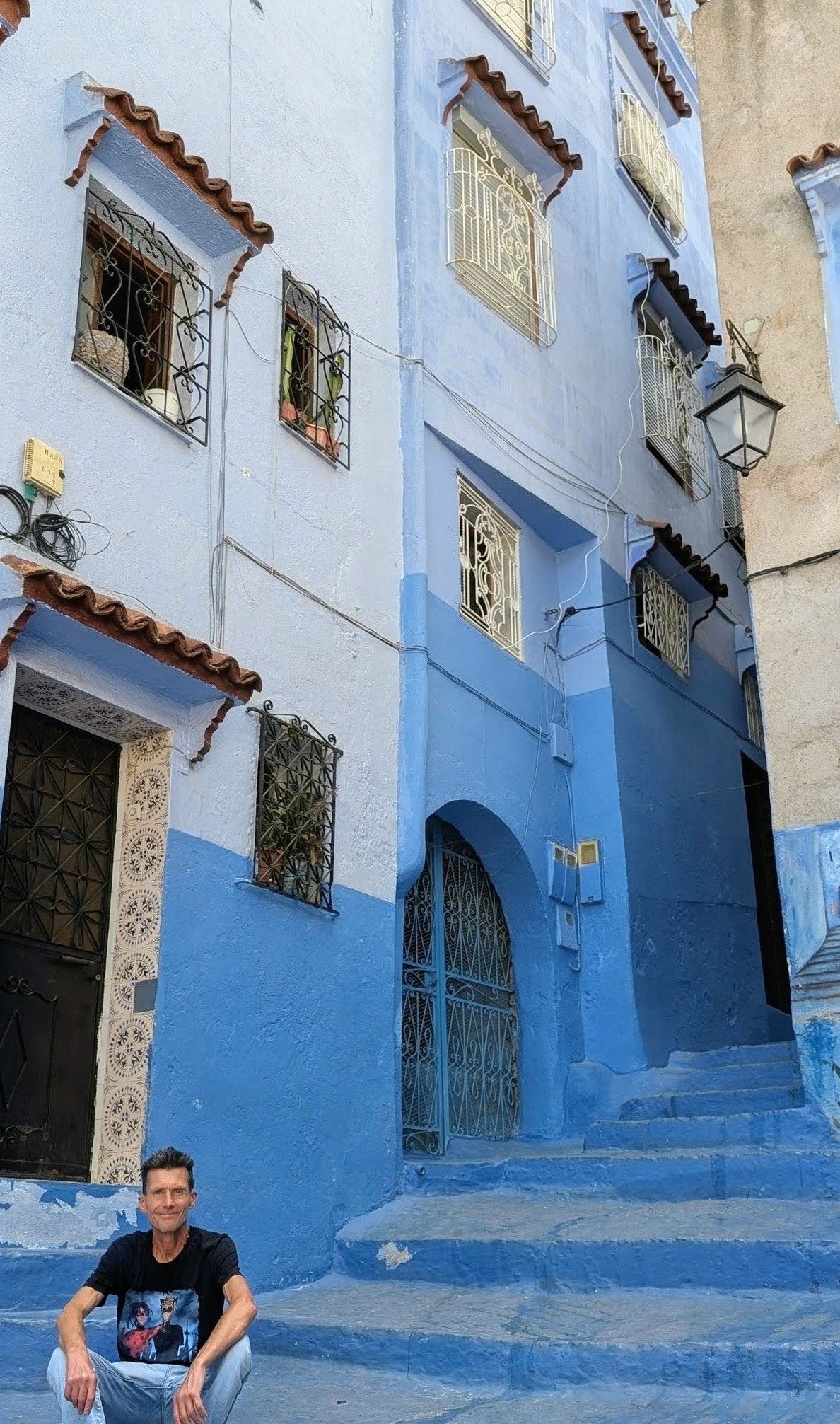
Twilight was falling and it was time to call it a day. But before heading home, I took a short break, sitting on the stairs, surrounded by high blue walls, and saying “good night” to the town.
Good night, Chefchaouen!
Eventually, I was joined by a dog and a cat. Both looked fully at peace with themselves and each other’s company.
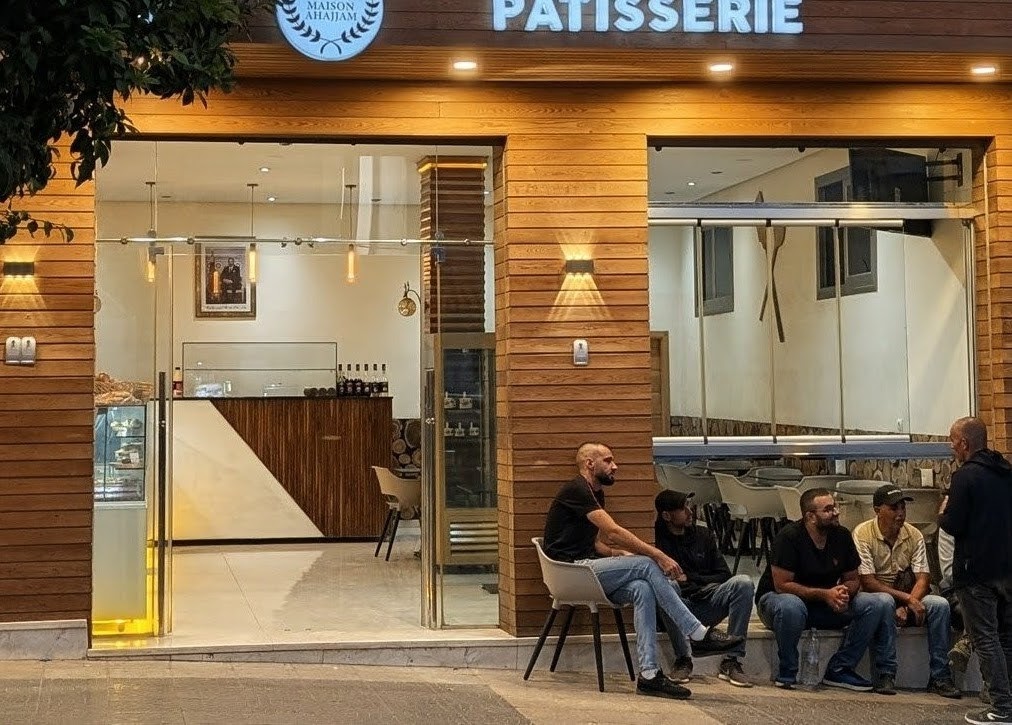
For light dinner, I stopped at French bakery, “Boulangerie Patisserie-Maison Ahajjam.” I highly recommend this place for good variety French-style baked goods.
Boulangerie Patisserie-Maison Ahajjam
I was leaving early the next morning, but Fahd, my host, insisted on preparing a breakfast before “official” breakfast time. Having strong coffee and omelet in the company of cheerful owner of Casa Troussi was a very good way to start another day.
If you will come to Chefchaouen, make Casa Troussi your “home away from home:” +212-670-986-987, Fahd’s Whatsap.
Thank you, Fahd, for my time at Casa Troussi
Threshold Between Two Worlds: Windswept Tangier
My last destination on this trip was Tangier, the second largest city of the country. If Rabat is Morocco’s political capital, Marrakesh the cultural heart, and Casablanca the economic engine, then Tangier is simply a world of its own. In fact, in many ways, it does not feel ‘Moroccan’ at all.
Facing Spain across the Strait of Gibraltar (a mere 40-minute ferry ride), Tangier sits at the confluence of the Atlantic Ocean and the Mediterranean Sea. Culturally, it offers an intriguing blend of European, Arabic, and African influences.
Tangier: facing Europe on the other side of Gibraltar strait
Controlling the entrance to the Straits of Gibraltar, Tangier was a geopolitical prize passed over centuries between the Romans, Arabs, Portuguese, Spanish, and British. At one point, it was even a wedding gift to King Charles II of England (1661) given to him as part of a massive dowry for his marriage to the Portuguese princess, Catherine of Braganza.
Tangier’s special status culminated in the early 20th century when it became an ‘International Zone,’ governed jointly by multiple foreign powers rather than the Moroccan Sultan. This era of sovereignty (1924-1956) created a cosmopolitan bubble that attracted spies, writers, and artists from around the world.
Think about 2015 James Bond “Spectre” movie. This film conveys perfectly the adventurous, romantic, and exotic atmosphere of Tangier.
2015 Spectre movie was set in Tangier
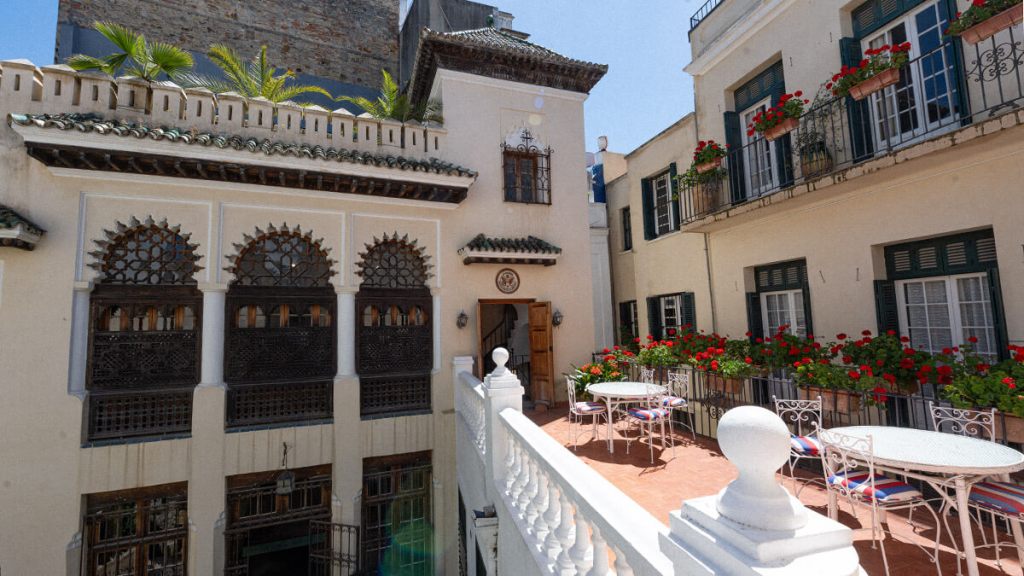
I arrived in Tangier in late morning and headed to my accommodations, the Ibn Batouta House. Found on Booking.com, it was, indeed an entire, three story tall but very narrow house situated inside Tangier’s medina.
Generally, in Morocco, I avoided staying in medinas, because it would require dragging the luggage through the narrow cobble streets, as the cars cannot go inside the medinas. But Ibn Batouta was only 3-4 minutes walk from the nearest entrance into the old town.
Ibn Batouta House, my home in Tangier
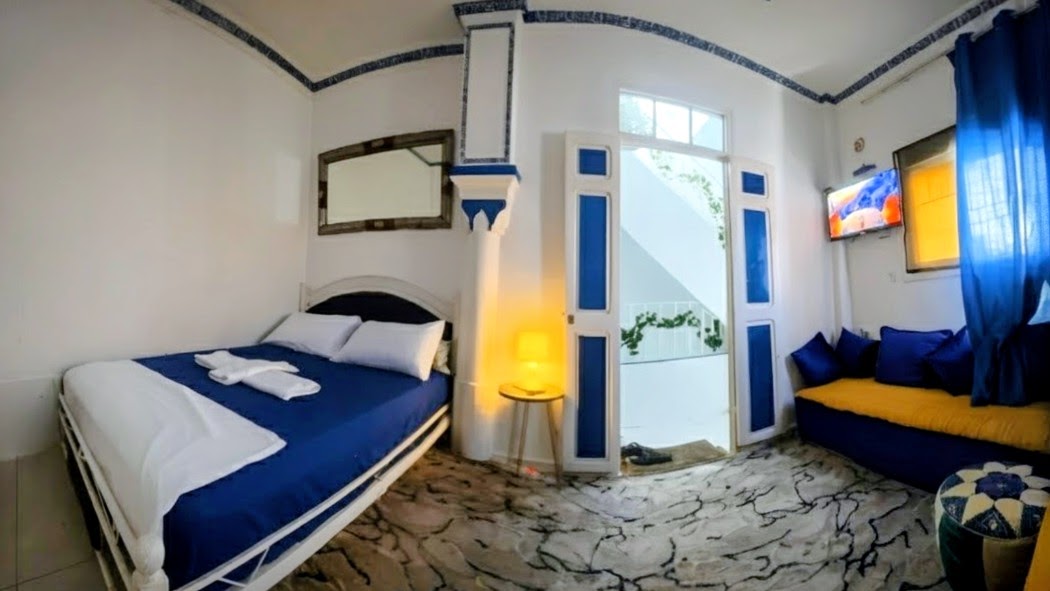
Choosing between several bedrooms, I settled in the one on upper floor: mostly, because of its calming color scheme.
Ibn Batouta House, a good place to stay in Tangier
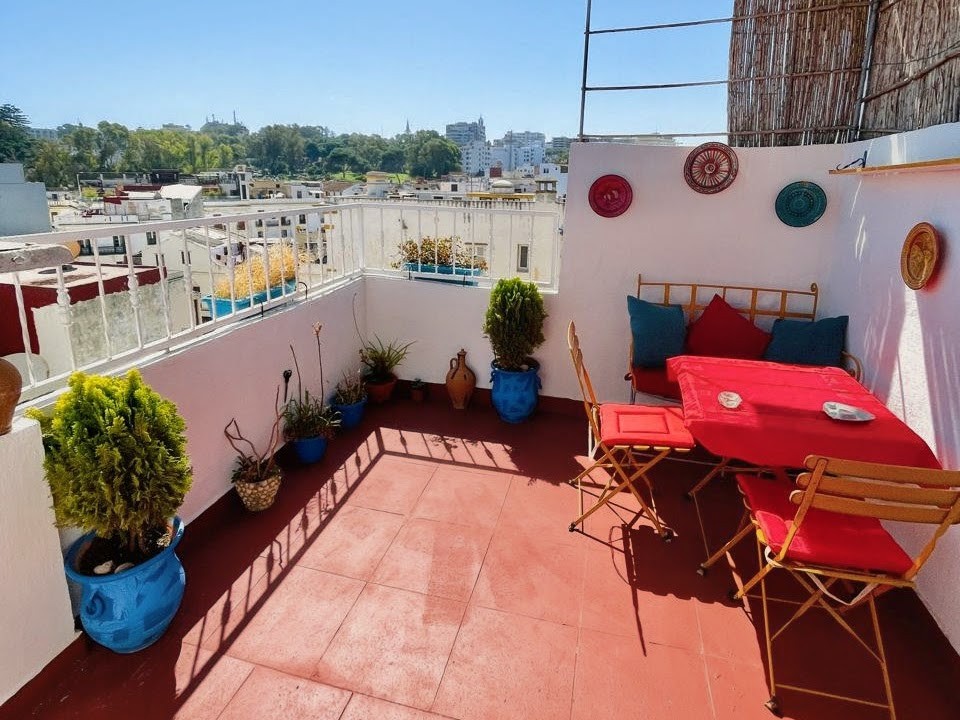
A “cherry on top of the cake” was a furnished roof-top terrace with a nice view of Tangier’s white houses with lush green park in the background.
Fast forward, I did not regret my choice. Ibn Batouta House turned out to be an excellent “home away from home:” both because of its comforts and hospitable owner, the young fellow named Yassine. If you decide to stay here, look on Booking.com or get in touch with Yassine directly: +212-632-772-850.
Ibn Batouta House, a good place to stay in Tangier
After arrival, the first item on the program was lunch. At this point I traveled for nearly two weeks and was a bit tired of eating only Moroccan dishes. My body was craving something more “European,” and I figured out one perfect combination.
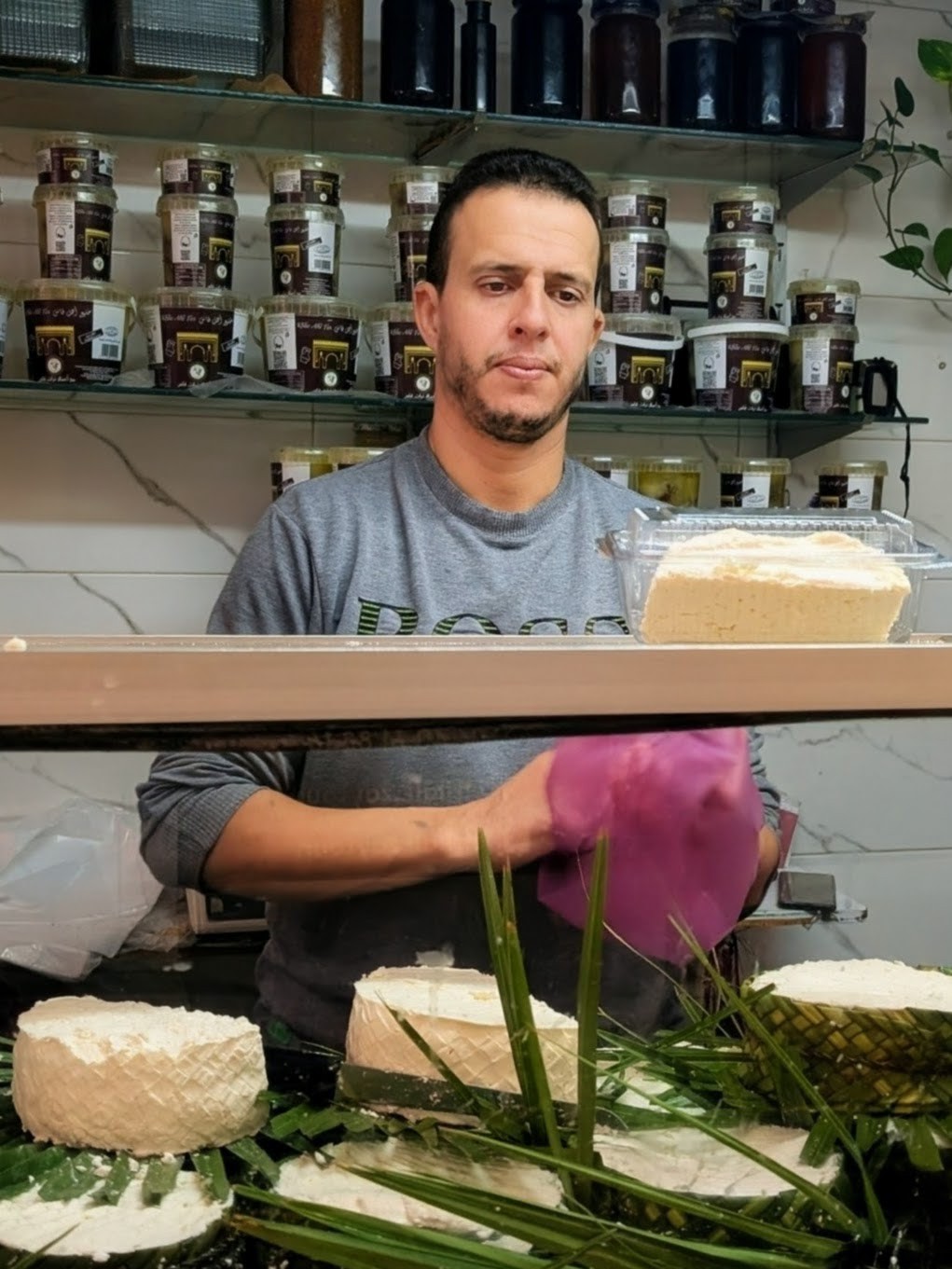
I walked to a big market hall at the nearby “Grand Socco” square. Several stalls there were selling locally made fresh and feta-style cheeses. All vendors offered generous free samples, and I found quickly the one I liked the most.
Morocco has good feta-style cheeses
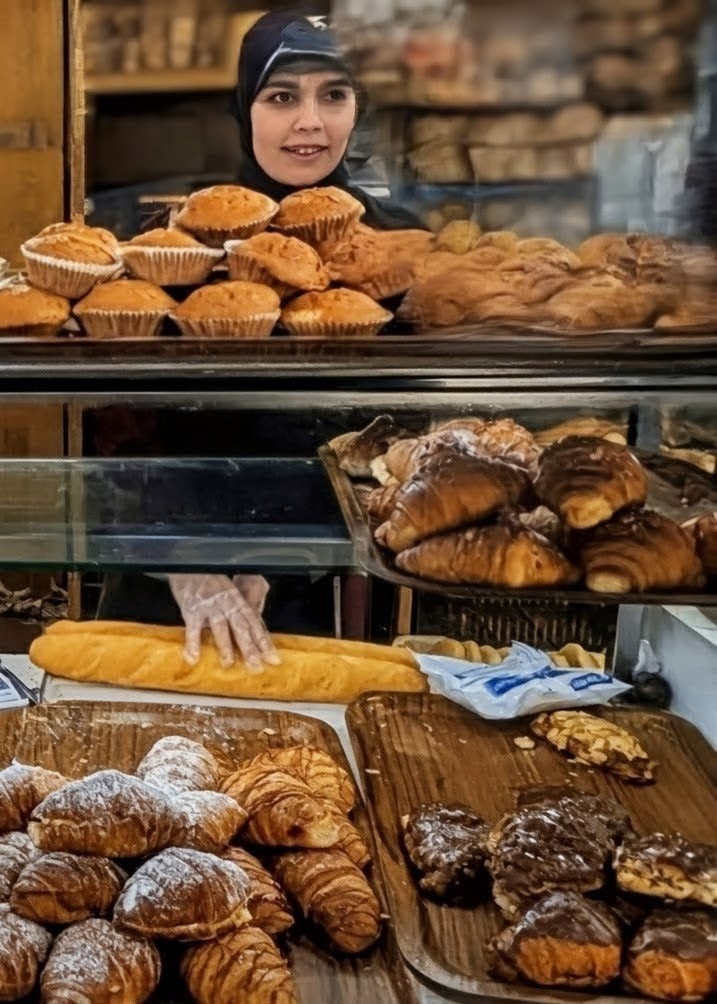
The next stop was at the nearby bakery recommended by Yassin. Called Bab Al Madina, it had a wide selection of both Moroccan and European breads and pastries. I picked up croissants and “chausson aux pommes” (French apple filled pastry).
Bab Al Madina, an excellent bakery in Tangier
Bab Al Madina, an excellent bakery in Tangier
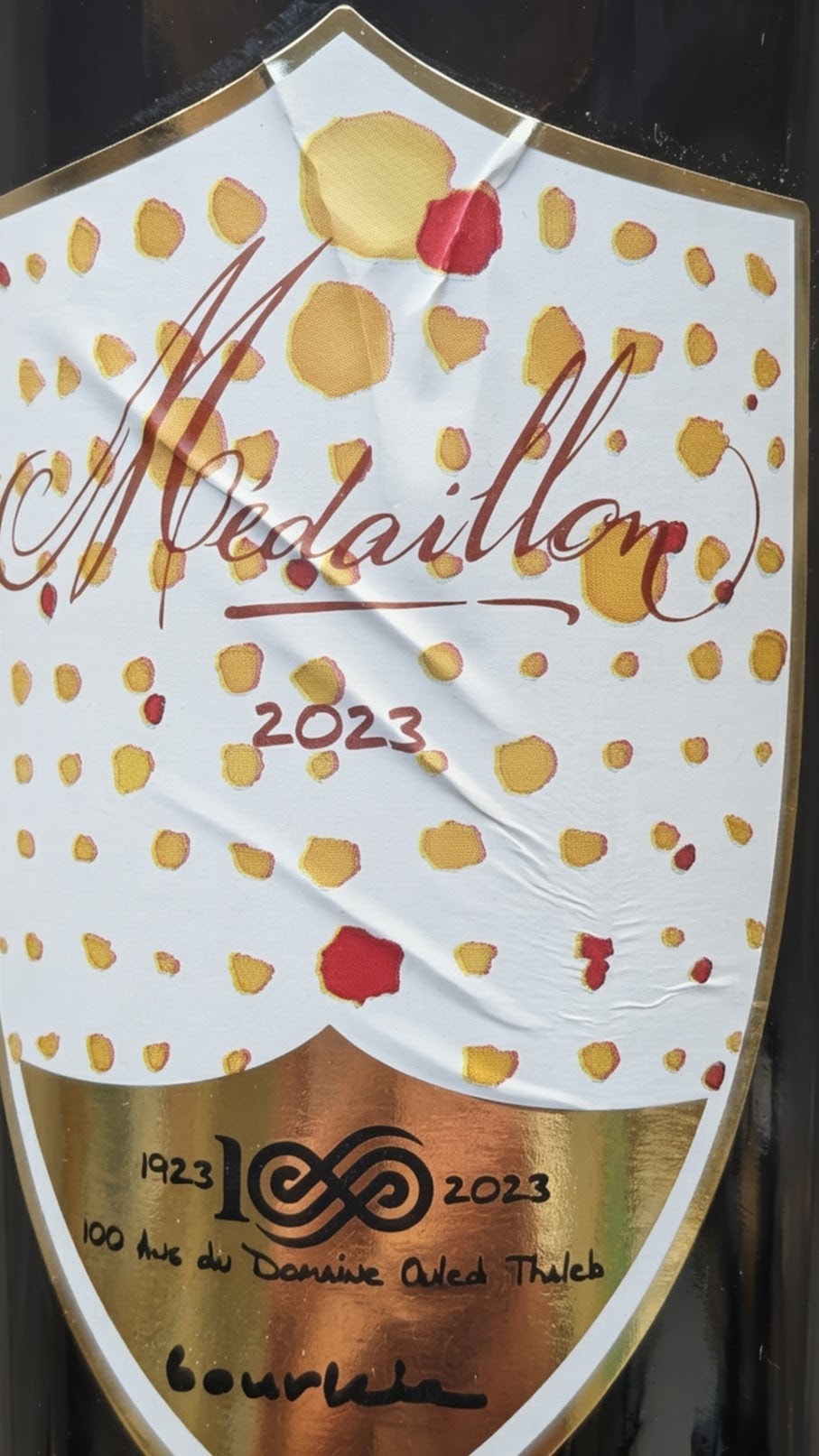
The last element in a carefully planned meal was a bottle of aromatic Moroccan red wine made by Domaine Ouled Thaleb, a winery about 65 km / 40 mi south of Rabat.
A good Moroccan wine
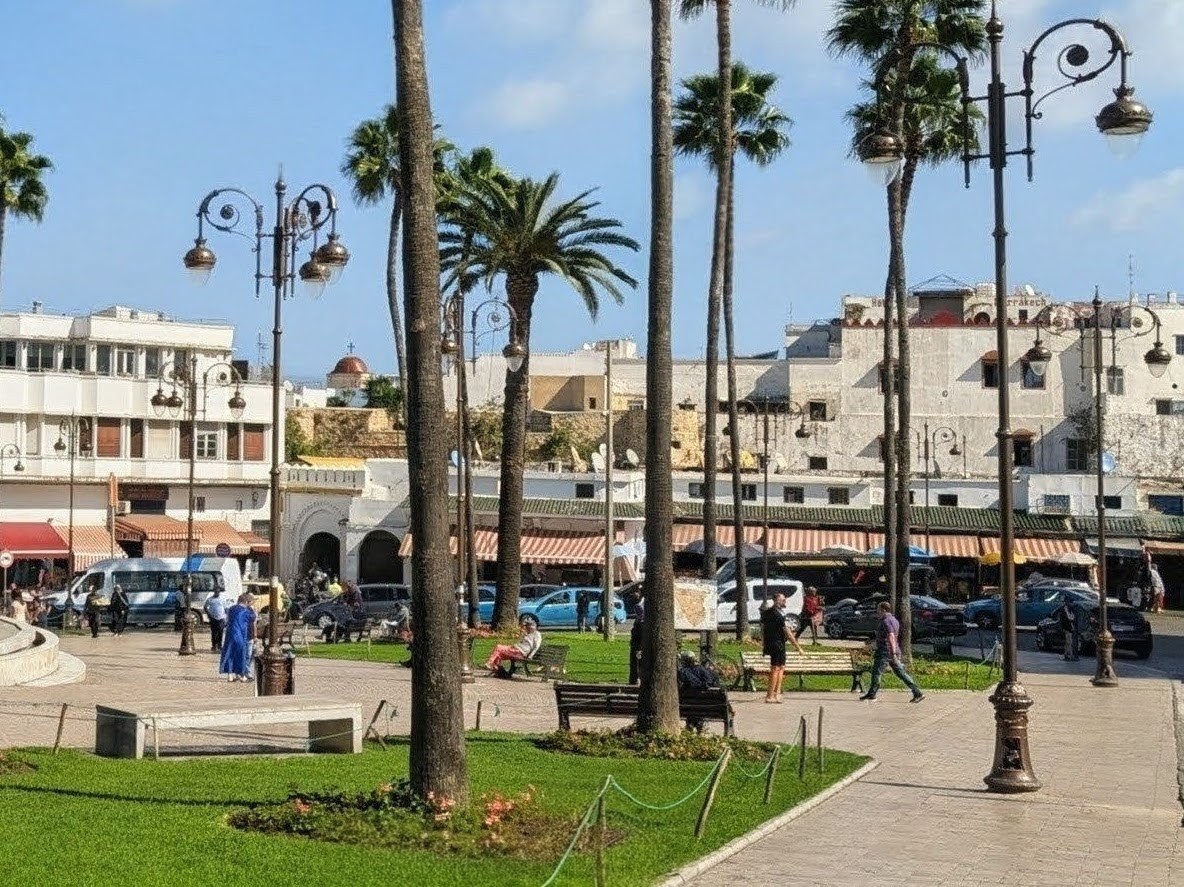
And then I found a bench at the Grand Socco square and enjoyed a picnic lunch simply watching the world go by.
Grand Socco square, good place to watch street life in Tangier
In the afternoon I explored two places which most tourists miss and which – in my view – are absolutely “must visit.” Both of them offer good insights into what make Tangier truly unique. The first was St. Andrew’s Anglican Church, less than 5 min walk from Grand Socco square.
What is special about St. Andrew? First, its history. It was built on a land given to Queen Victoria of England by Sultan Moulay Hassan in 1894. Despite being an Anglican church, this religious site was originally envisioned as a place where people of different religious backgrounds (both Christians and non-Christians) can pray together.
St. Andrew Anglican Church in Tangier
The second unique thing about St. Andrew is that its architecture and interiors blend Christian and Islamic influences. The bell tower is reminiscent of a minaret, complete with the square shaft typical of Moroccan mosques.
After donating land to British community, Sultan Hassan also sent his artisans from Fez to decorate the sanctuary, which features elements more typical for a mosque: colorful zellij tilework and intricate stucco carvings. Even Lord’s Prayer is inscribed in Arabic calligraphy above the altar.
Most surprisingly, the cleft behind the altar (“Quibla”) indicates the direction of Mecca. It is the only church in the world that directs Muslim prayer from the Christian altar. By including a Qibla, the architects explicitly acknowledged that Muslims might also use the space to pray.
Interior of St. Andrew Church has both Islamic and Christian elements and symbols
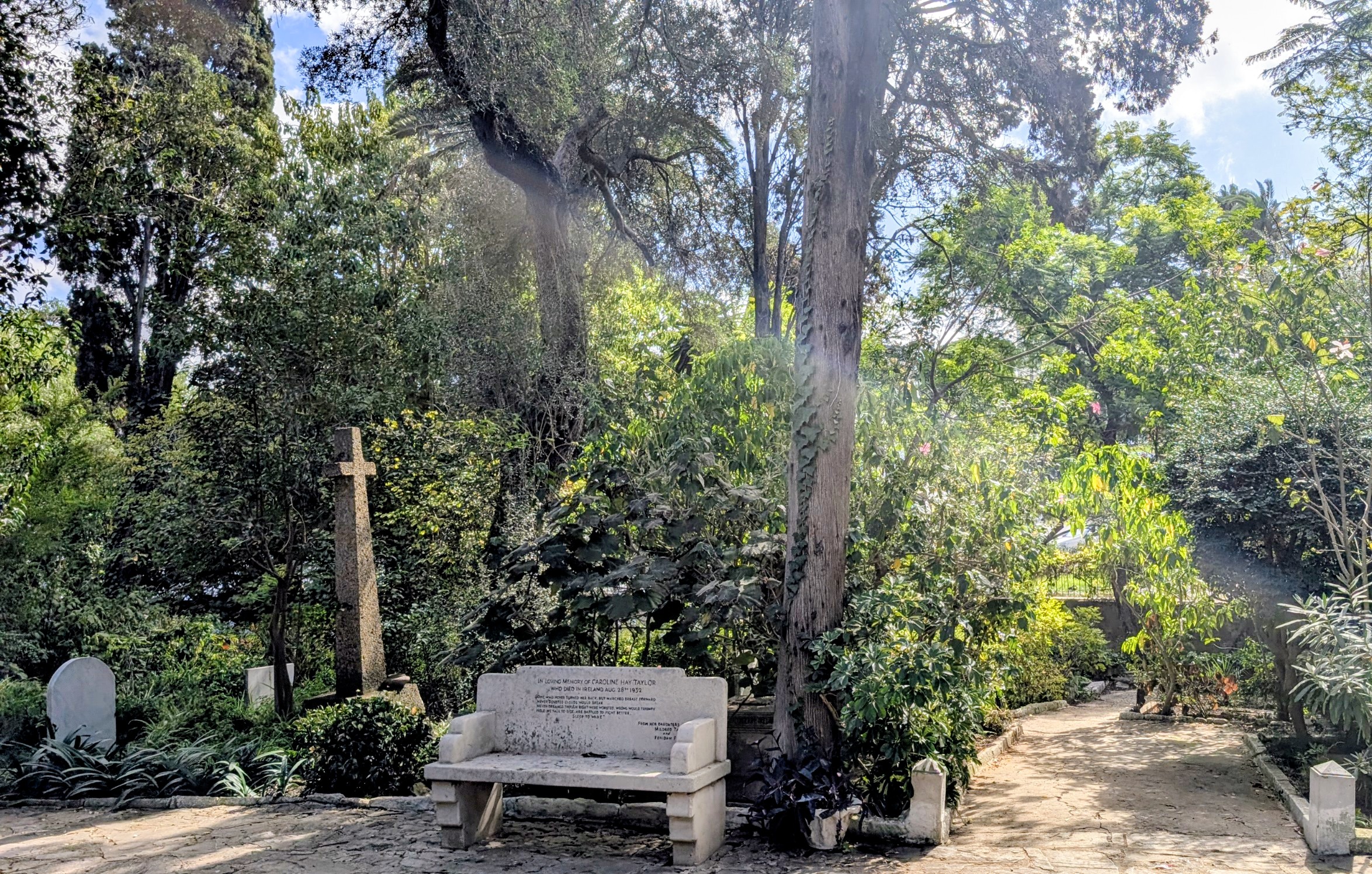
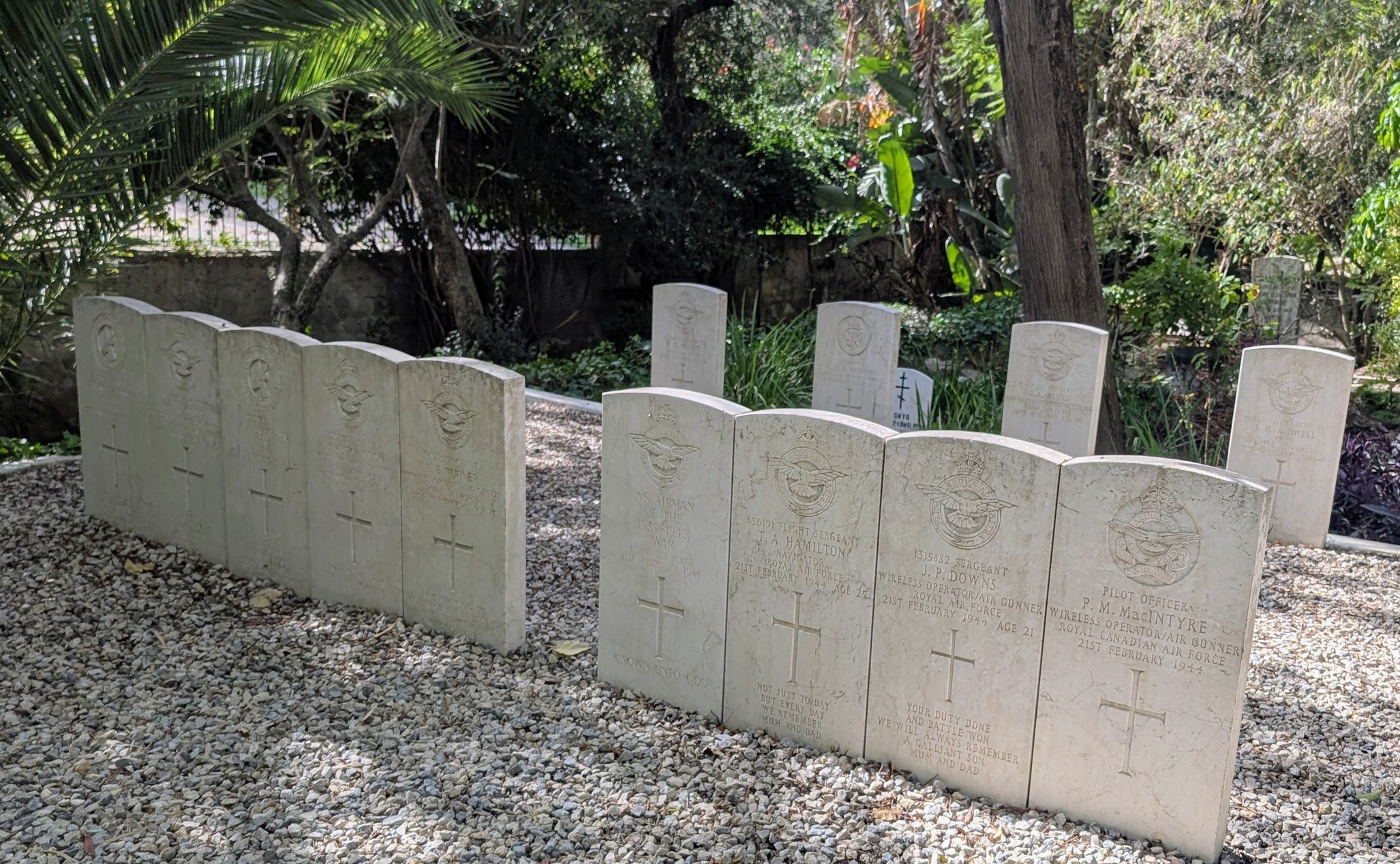
Finally, the lush quiet garden surrounding St. Andrew houses a cemetery that is the final resting place for several eccentric characters who made Tangier famous during its “International Zone” era.
Historical expats’ cemetery at St. Andrew Church
One of the graves contains the remains of Walter Harris. The Times journalist, adventurer, and a close friend of the Sultans, he is often cited as a real-life inspiration for Indiana Jones. Dean, the owner of the legendary “Dean’s Bar,” a hub for spies, writers, and smugglers in the mid-20th century Tangier also rests here.
A number of legendary personalities rest at St. Andrew cemetery
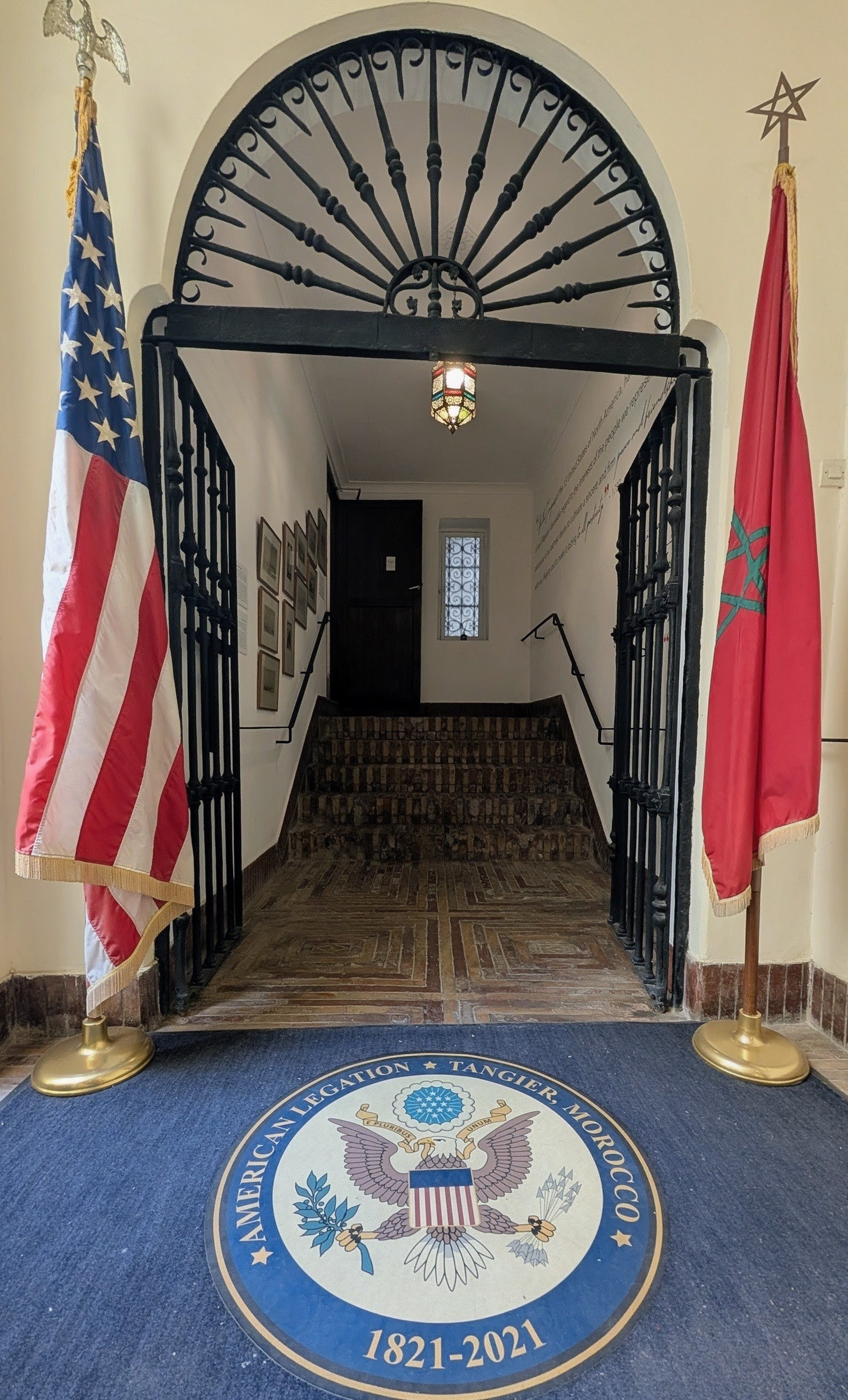
After exploring St. Andrew, I walked to American Legation (“Embassy”) Museum, another widely overlooked by tourists site in Tangier. Do you know that Morocco was the first country in the world to recognize the United States as an independent nation as early as 1777? Further, the 1786 Moroccan-American Treaty of Friendship is the longest unbroken diplomatic treaty in U.S. history.
As to Legation Museum, it was the first American public property acquired abroad. Being gifted by Sultan Moulay Suliman in 1821, its purpose was to house permanent US diplomatic representation. Today, it is the only building outside the United States that is designated as a U.S. National Historic Landmark.
American Legation Museum, formerly US diplomatic mission in Morocco
In 1956, Morocco gained independence and moved its capital to Rabat. The Legation (embassy equivalent) was downgraded to a Consulate General which later moved to the newer part of the city. The original building was then reborn as a museum showcasing fascinating episodes and various personalities from Tangier’s colorful history.
Entering American Legation (“Embassy”) Museum
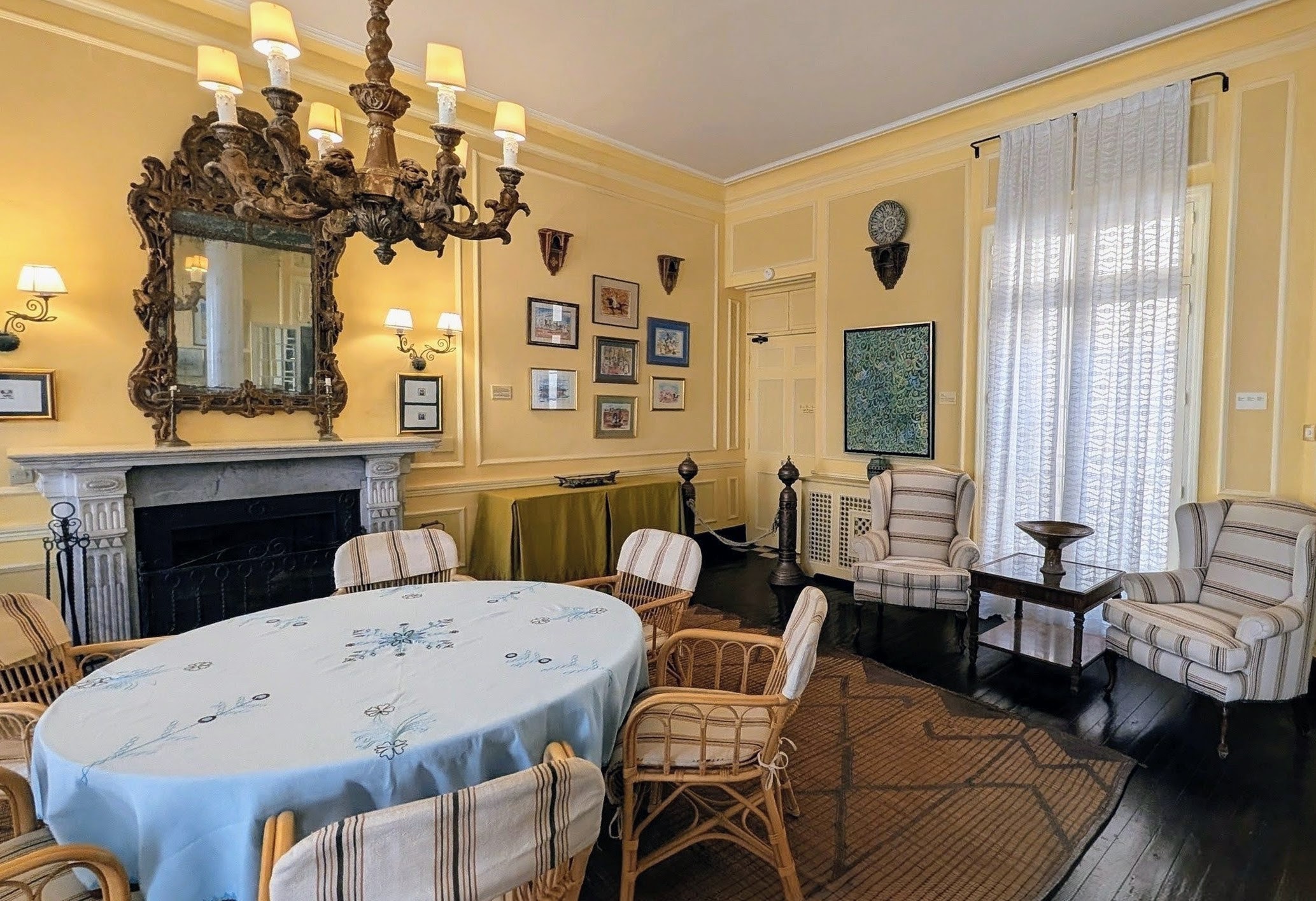
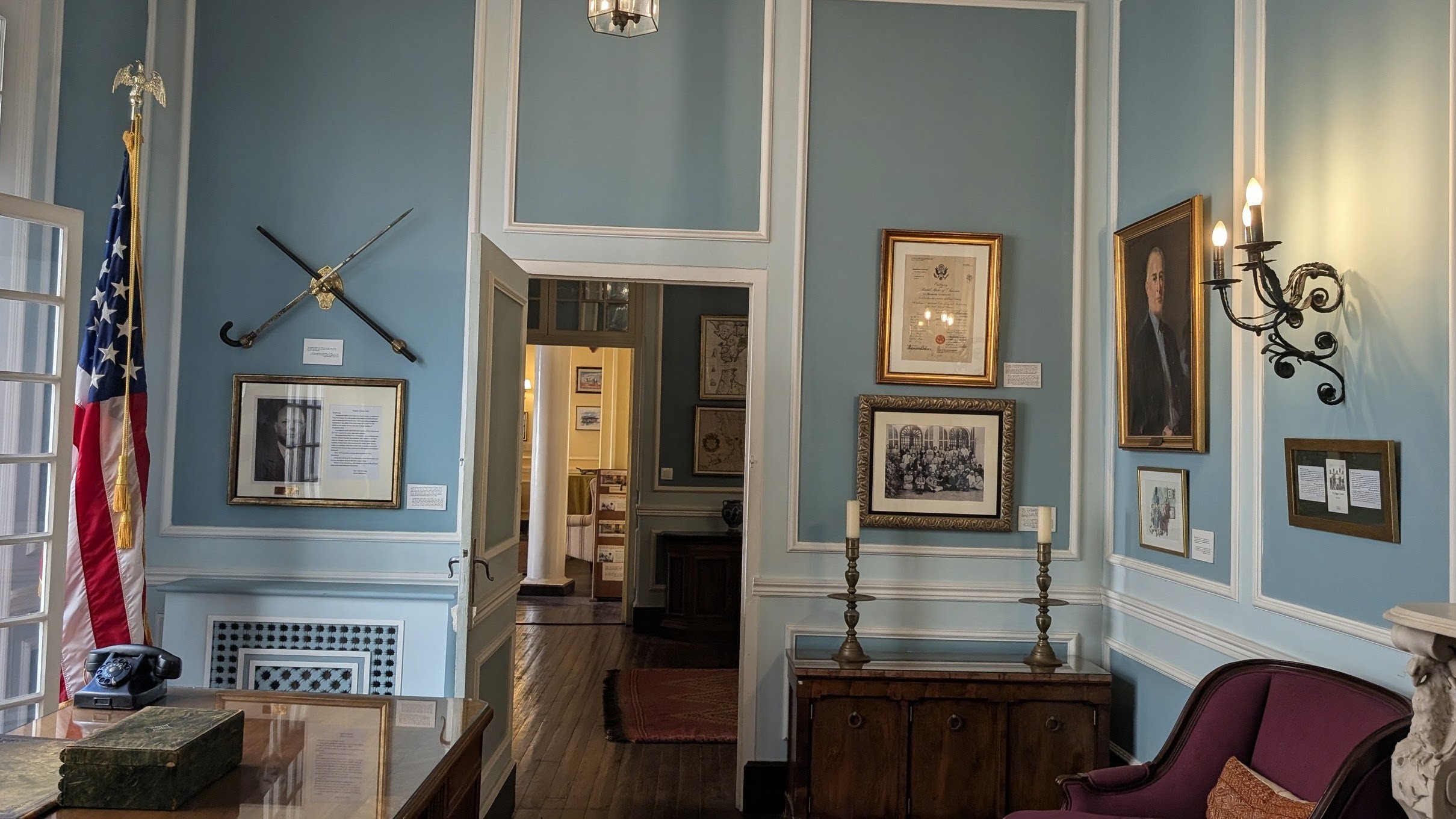
Originally, I thought about spending here an hour or so, but ended up staying until closing time. Despite small size, the museum was packed with interesting artifacts and offered a lot of intriguing stories. In addition, simply walking through the elegantly furnished rooms – each representing a different epoque – was like traveling through the layers of history.
Time-themed rooms in American Legation Museum
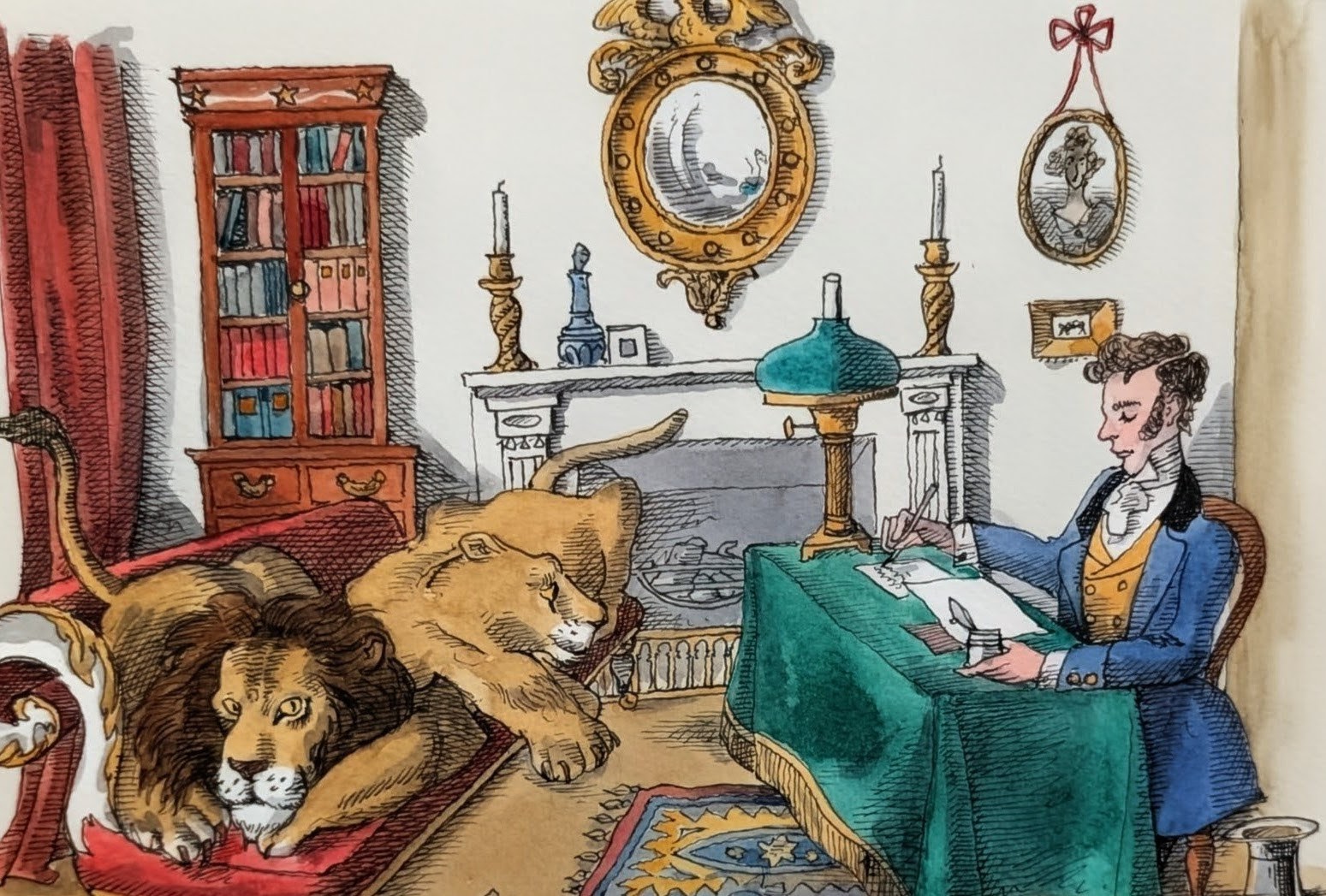
I laughed at one story from the early days of Legation. Apparently, in the 1800s, it was customary for Moroccan Sultans to gift lions as a sign of friendship. Knowing this, in 1839, the US Secretary of State instructed Consul Thomas Carr to prevent the such a present. In respond, Carr wrote that he planned “to write to the Sultan, but before a letter could be prepared, the sound of drums announced the arrival of enormous, magnificent lion and lioness.”
The Consul ended up living together with the lions for seven months until they were eventually shipped to the United States.
For 7 months, US Consul was forced to live with lions
I was fascinated with many spy-stories related to WWII. During the war, Tangier’s location and its status of an “international zone” turned the city into a playground for many secret services, including the Nazi, Spanish, French and British. Consequently, the US also began gathering its own intelligence and Legation became the central hub of a clandestine spy and radio network.
In 1941, the staff of Legation comprised just six people. A year and a half later, the numbers had grown to 65 thanks to the newly arrived military personnel. The information obtained here played a pivotal role in planning and execution of Operation TORCH, a massive 1942 invasion of North Africa by US and British forces to ensure control over French colonies which were aligned with Nazi Germany.
During WWII, Legation was the center of US intelligence for North Africa
The Legation Museum is not just about history and politics. It also showcases the Moroccan and foreign artists who lived and worked in Tangier. I was surprised to learn that in late 1950s – early 1970s Tangier was a real Mecca for prominent Jazz players. In 1959, trumpeter Idrees Sulieman (a contemporary of Coltrane and Monk) recorded here the famous The 4 American Jazzmen in Tangier.
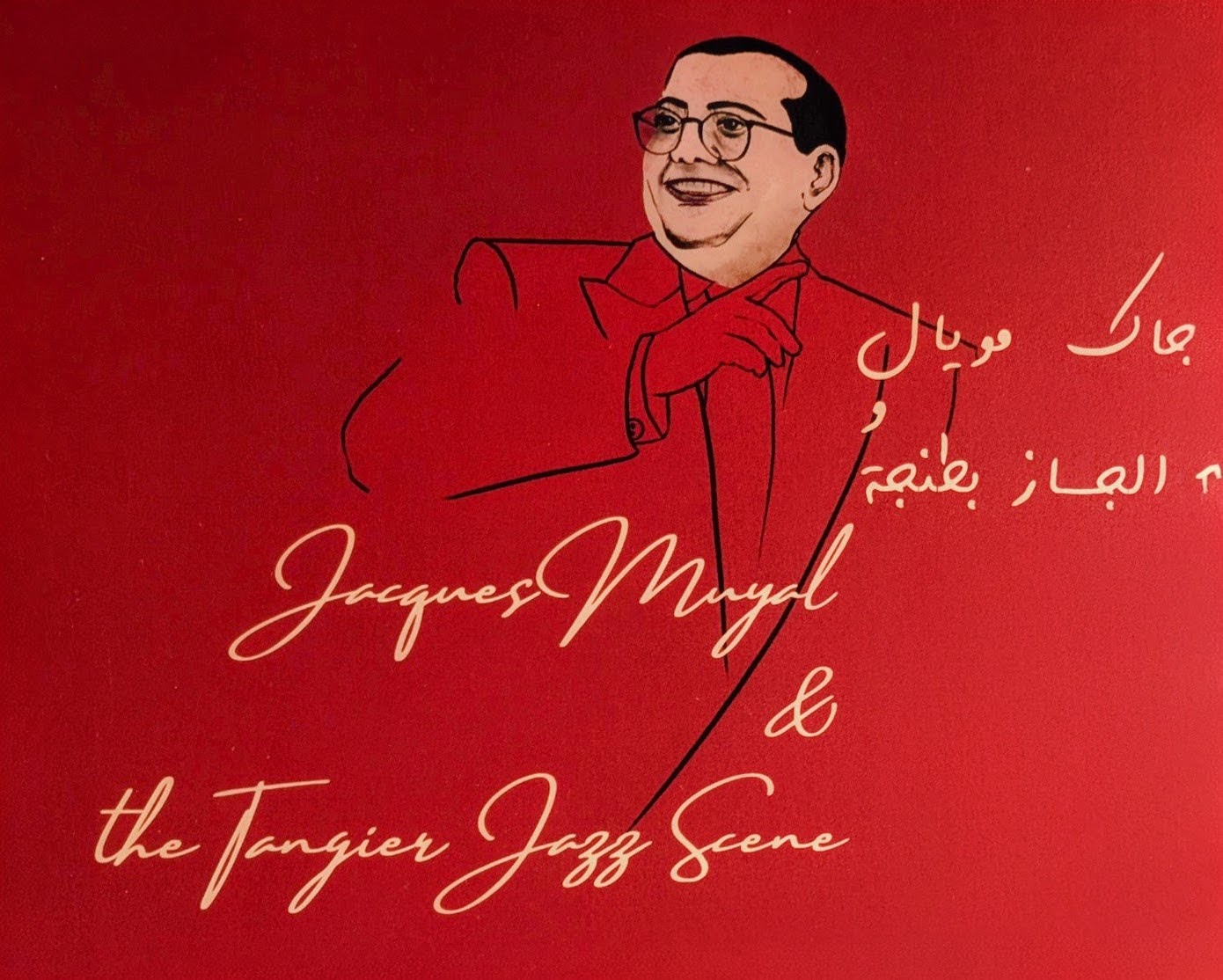
When the US State Department sent jazz pianist RandyWeston on a tour of Africa, he fell in love with Tangier, stayed and lived here for five years (1967-1972). Born in Tangier, Jacques Muyal was only 15 years old, when he hosted a hugely influential radio show on Voice of America that introduced worldwide audiences to the wealth of talented jazz musicians. The show was broadcasted from a studio here, at American Legation.
Jacques Muyal, a famous jazz producer and radio host
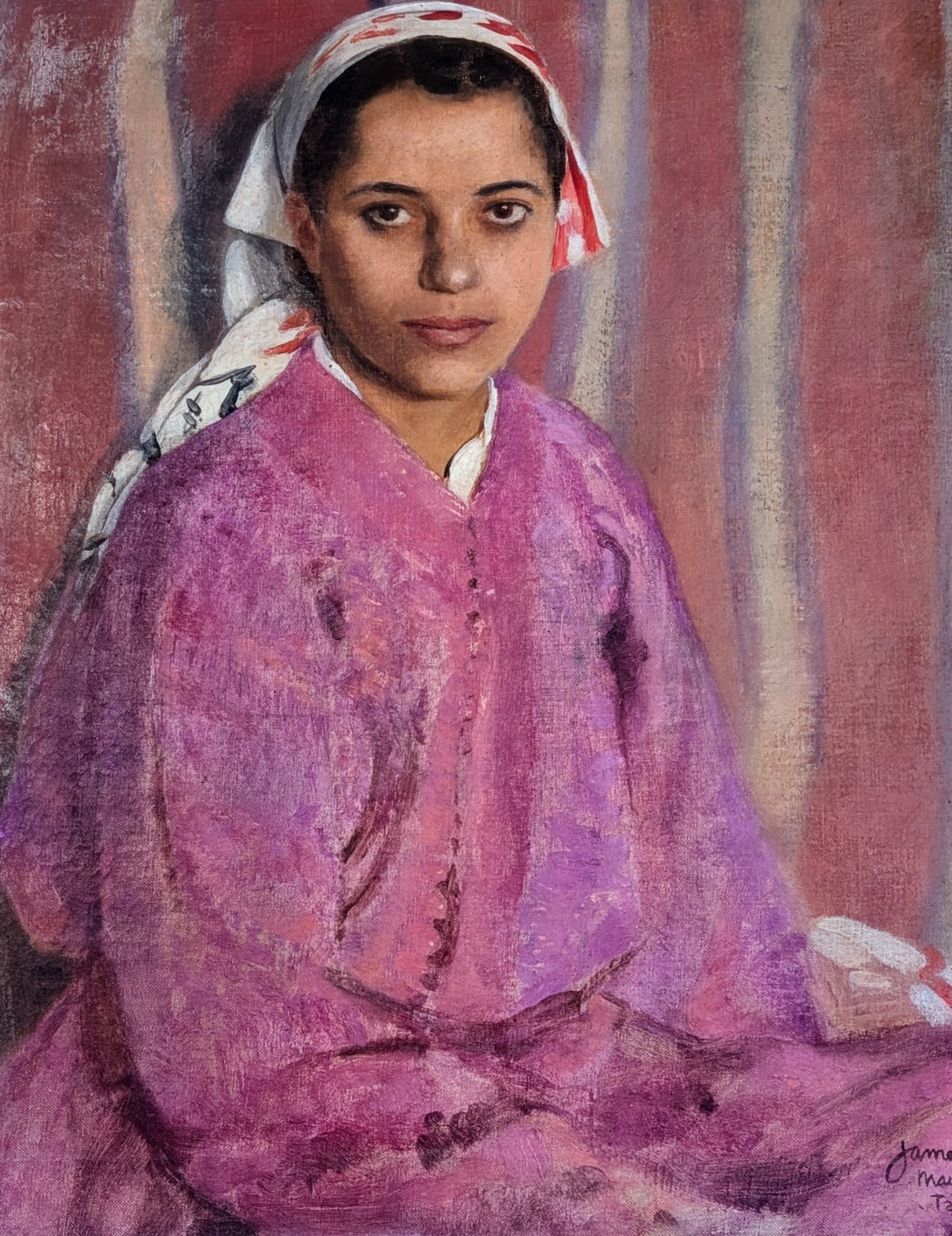
Walking through the museum, I was suddenly transfixed by one painting, the portrait of a young woman. I was mesmerized by her enigmatic gaze, which seems to follow me across the room. It was the work by Scottish artist James McBey who also lived in Tangier. Presenting Zohra, a young servant girl, this painting is often referred to as “Moroccan Mona Lisa.”
Zohra, the “Moroccan Mona Lisa.”
Eventually, the bell rang to signal that the museum was about to close. I walked into the courtyard and stayed there alone for a few minutes, simply trying to prolong the feeling of full immersion into Tangier’s colorful history.
The Museum’s courtyard
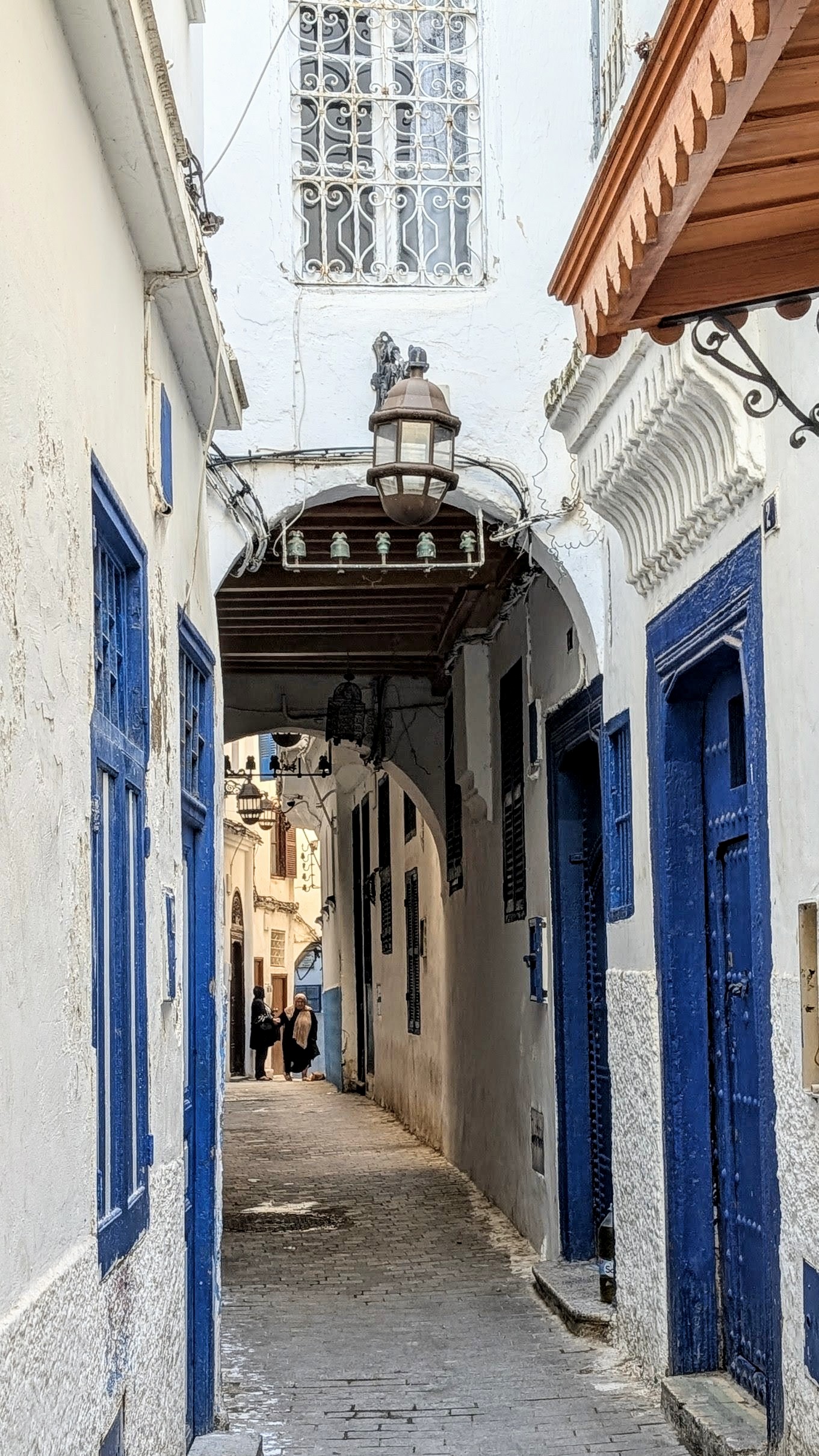
After the museum, I wandered through Tangier’s medina. It was different compared to what I experienced in Rabat and Chefchaouen. With its mix of Spanish/French architecture, Tangier’s old town emitted a more bohemian, Mediterranean and “faded glamour” vibe.
Tangier’s medina has a distinct Mediterranean vibe
Speaking of that Mediterrannean vibe, my aimless wandering through the medina came to an abrupt end, when one of the streets brought me to Ave Mohammed VI, the wide promenade that stretches along Tangier’s seafront.
Ave Mohammed VI stretches along Tangier’s seafront
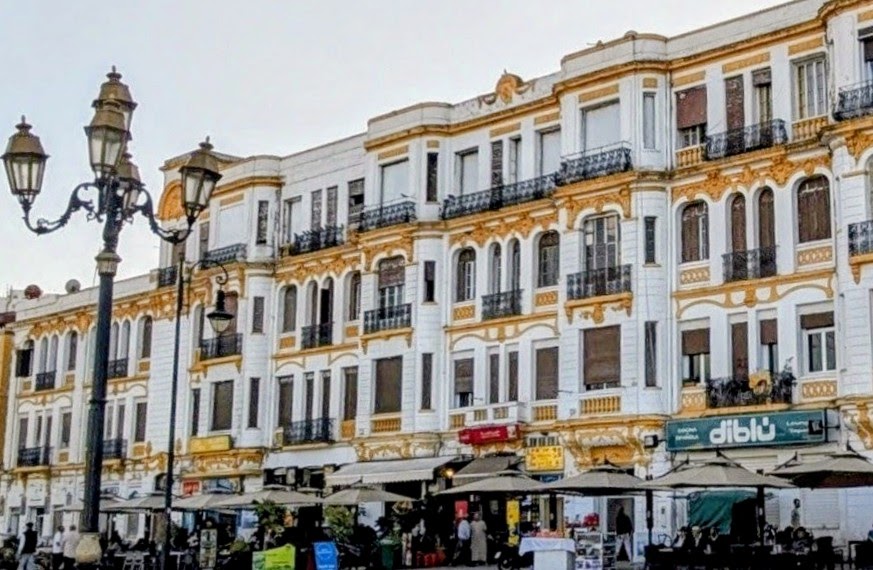
The weather was perfect and I walked along the promenade admiring fine examples of Tangier’s architecture. Indeed, Ave Mohammed VI was a genuine face of what this city always aspired to be: a cosmopolitan and affluent place.
Ave Mohammed VI has fine examples of Tangier’s architecture
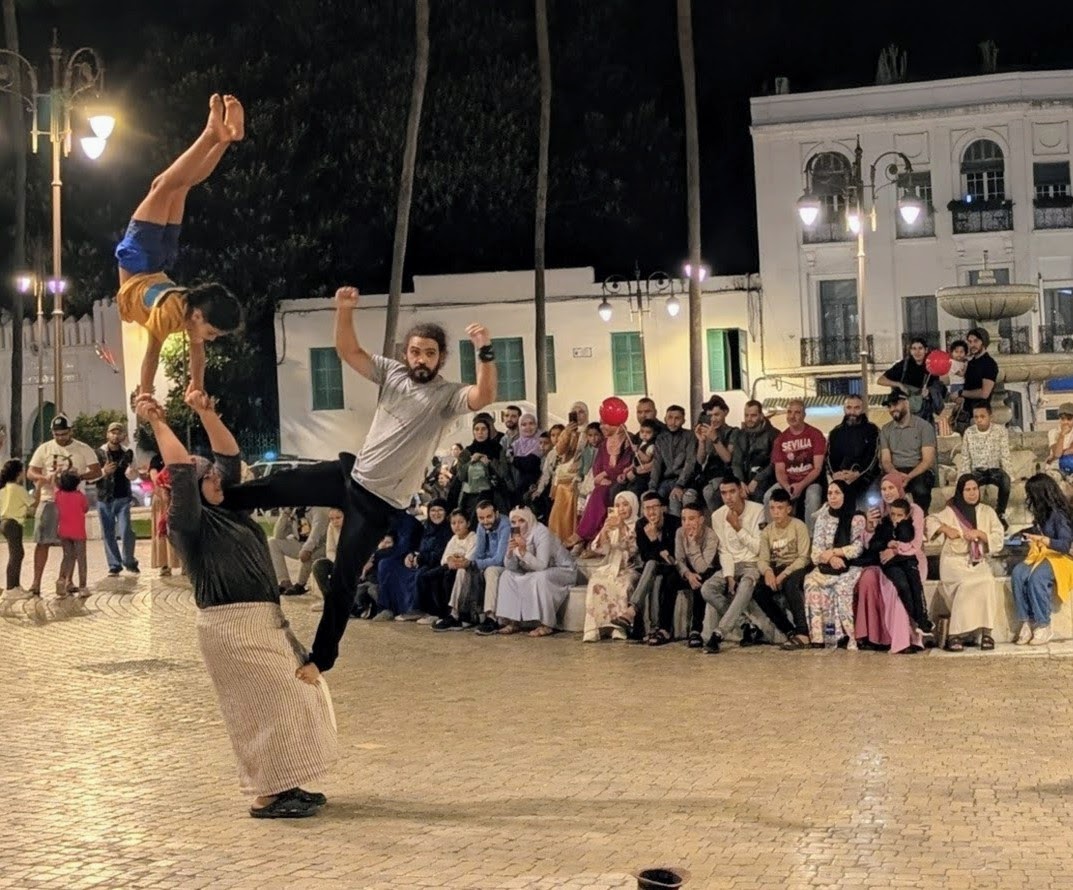
After dusk, I walked back home. Approaching Grand Socco, the place where my exploring of Tangier started, I noted some crowds surrounding the square. A group of street performers offered free open-air show. It was a perfect crown of an already very satisfying day.
Street performers at Grand Socco square
The next day was designated to visiting Cape Spartel, an iconic place, where Mediterranean Sea “officially meets” Atlantic ocean. It was about 15 km / 10 mi from Ibn Batouta House, and I decided – for the first time – to use Moroccan ride-share app called inDrive (I wrote about it in INTRODUCTORY SECTION).
Compared to Uber/Lyft, it has three differences. First, when requesting a ride, the app will show a suggested price, but you can also increase the chances to be picked-up quickly by offering a higher price for potential driver. Second, all payments are in cash. Third, along with cars, inDrive also offers riding with motorbikes and scooters.
InDrive is a very popular ride-sharing app in Morocco
The motorbike option is always cheaper (and often faster), and for this short trip I decided to check it out. Well, we covered 15 km / 10 mi with lightning speed, but there was one problem. My driver had a helmet for himself, but not for the passengers. After his crazy zigzagging between the cars and on the narrow roads, I sighed with relief when we arrived to the Cape.
Using inDrive app, one can get a shared ride with motorbike or scooter
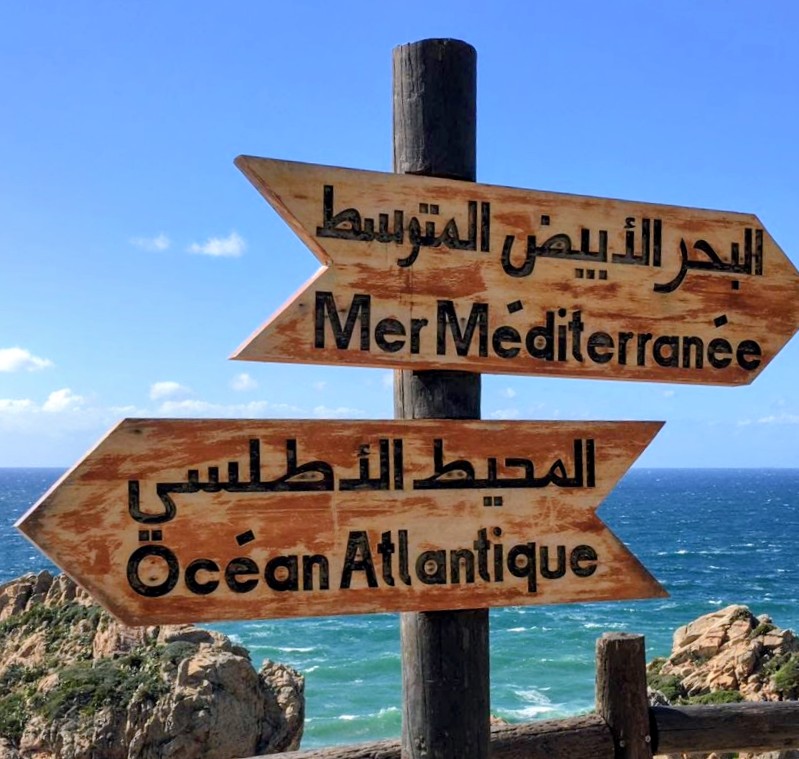
Predictably, Cape Spartel is a popular “picture taking” destination with many tourists visiting every day. But the spot is scenic and I did not regret coming here.
Cape Spartel, the place where Atlantic meets Mediterranean Sea
Most people just stop briefly at this road sign for a quick photo, but there is also a short and easy trail to the very tip of the Cape.
A short hike to the tip of Cape Spartel
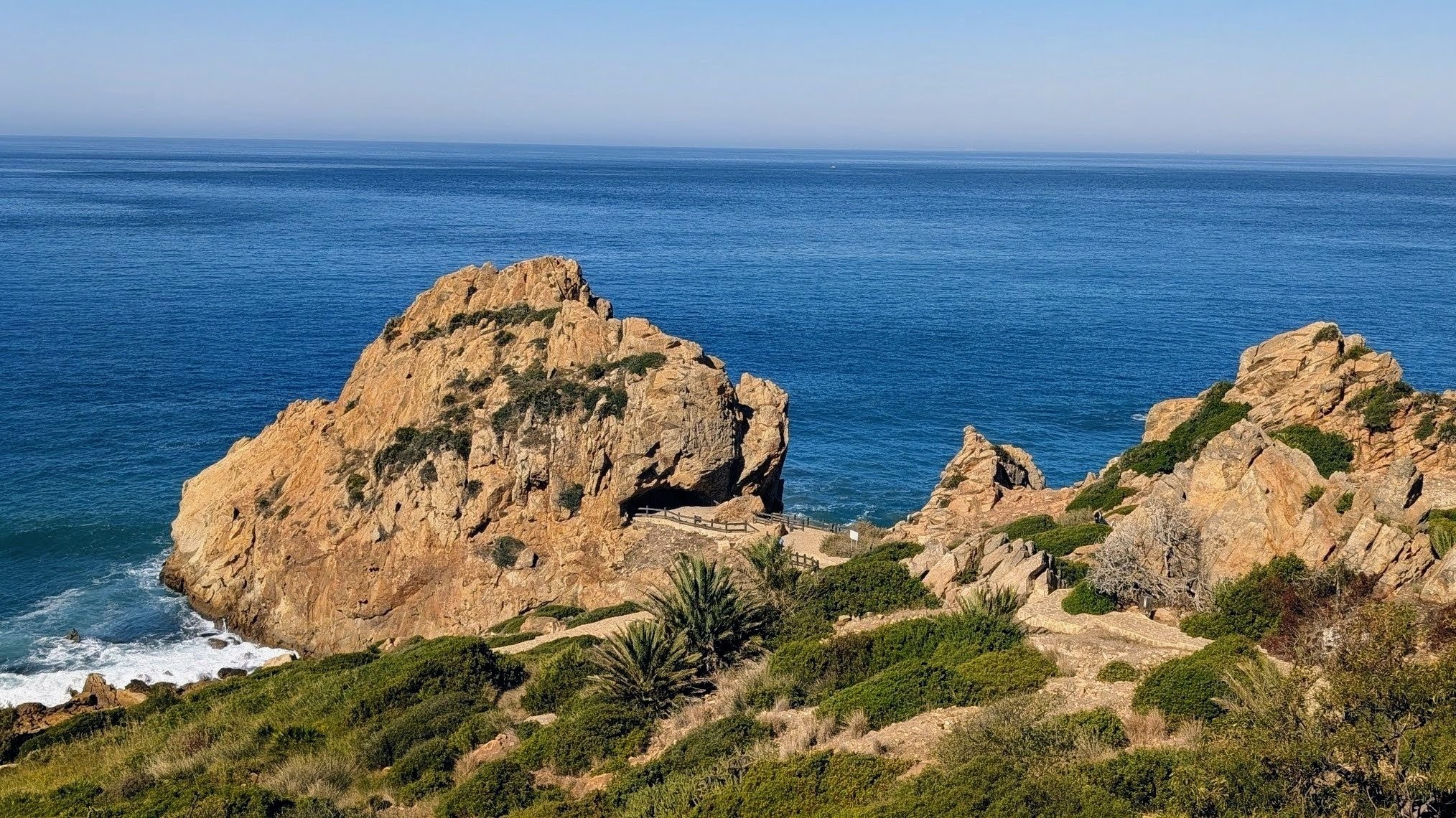
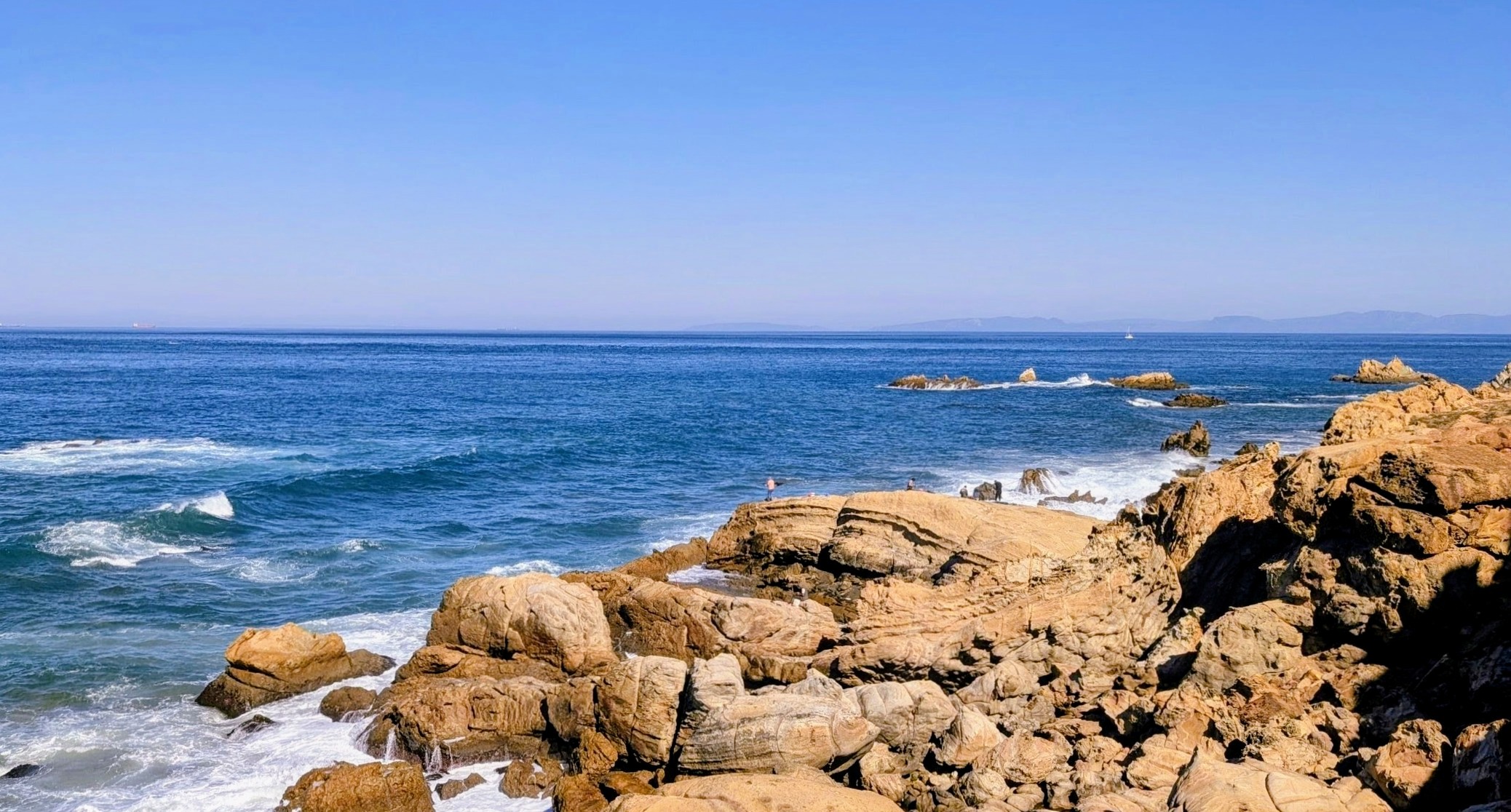
I walked this trail, and in less than 10 minutes was facing the collision of two powerful bodies of water. The entire place was to myself only: not a single person joined me despite crowds of visitors just quarter of a mile back at the parking spot.
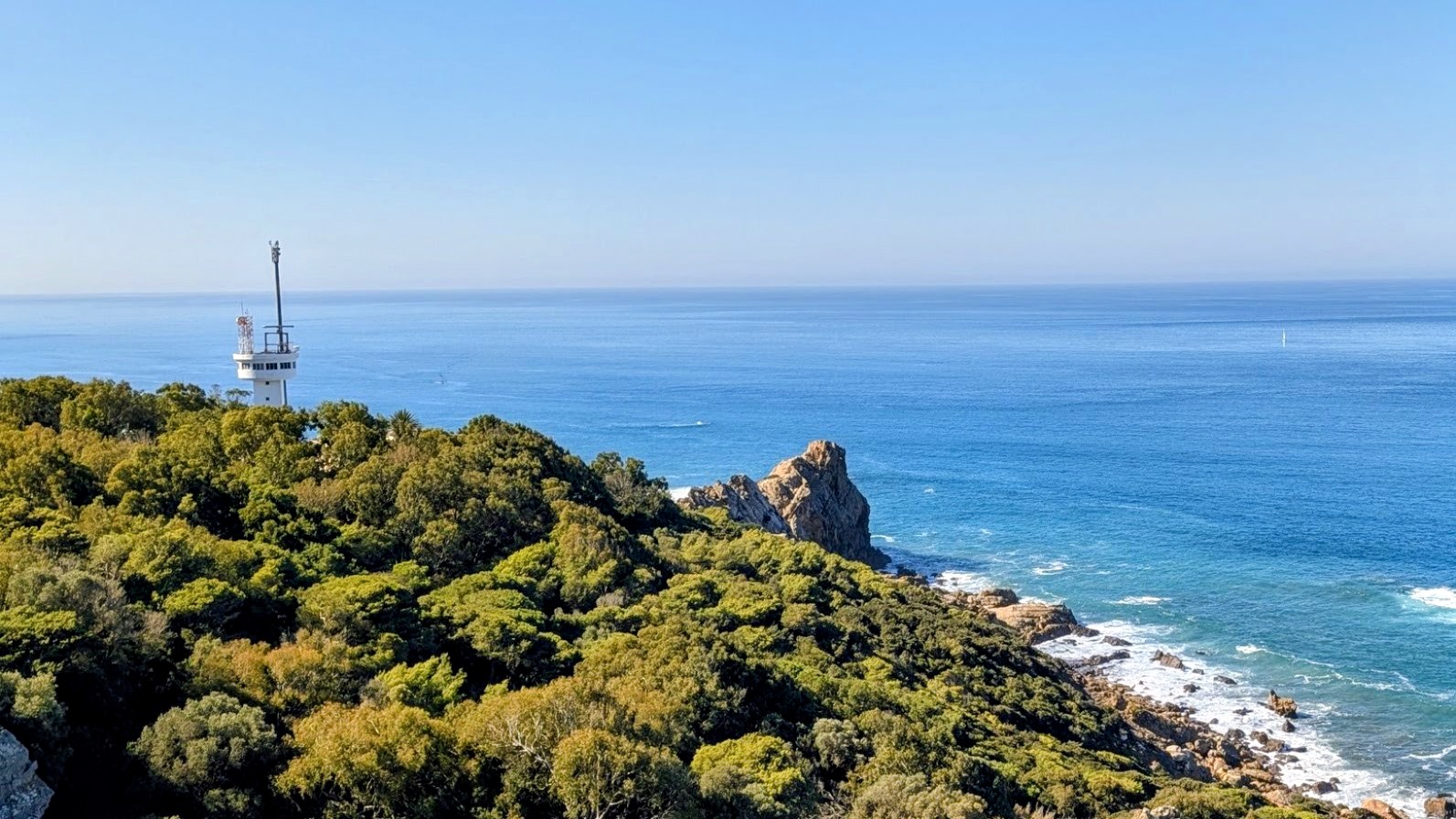
Very close (less than one kilometer) to Cape Spartel, there is another popular destination, the gorgeous historic lighthouse.
Built in the 1860s, it looks like a square tower featuring Moorish architecture and soft cream-and-ochre tones that contrast sharply against the blue sky and sea. Surrounded by dark-green pines, its lantern has served for over a century for vessels navigating the treacherous currents of the Strait of Gibraltar.
Lighthouse at Cape Spartel
The lighthouse has a good museum and here is one dramatic story related to its past. In 1911, the liner SS Delhi was sailing nearby through thick fog and heavy storms. On board were sister of British King George V, her husband the Duke of Fife, and their two young daughters. The ship ran aground on the rocks just south of Cape Spartel, and the violent waves smashed the lifeboats to pieces.
Several ships rushed to the scene, but the seas were too rough for rescue operations. French sailors eventually managed to offload royal family on a small boat, but as they neared the shore, the boat was swamped by a massive wave. Luckily, the Princess, the Duke, and their daughters were washed ashore, soaked to the bone and shivering in their nightclothes.
The royal family had to hike 6 km / 4 mi through the rain and mud to reach the Cape Spartel Lighthouse. The lighthouse keeper took them in, arranged hot tea, and lent them his own dry clothes. While the story sounds like an adventure, it had a dark ending.
The Duke contracted a lung infection from the freezing exposure. He never recovered and died just a few weeks later in Egypt. Three French sailors drowned trying to save the British royals. During the chaos of the boat capsizing, a case containing the Princess’ personal jewels was swept out of her hands into the Atlantic. Despite efforts to find them, they were never recovered.
For a small fee, I climbed to the top of lighthouse. The ocean looked deceptively peaceful today, while still hiding a fortune in royal diamonds somewhere at its rocky bottom.
The view from the lighthouse
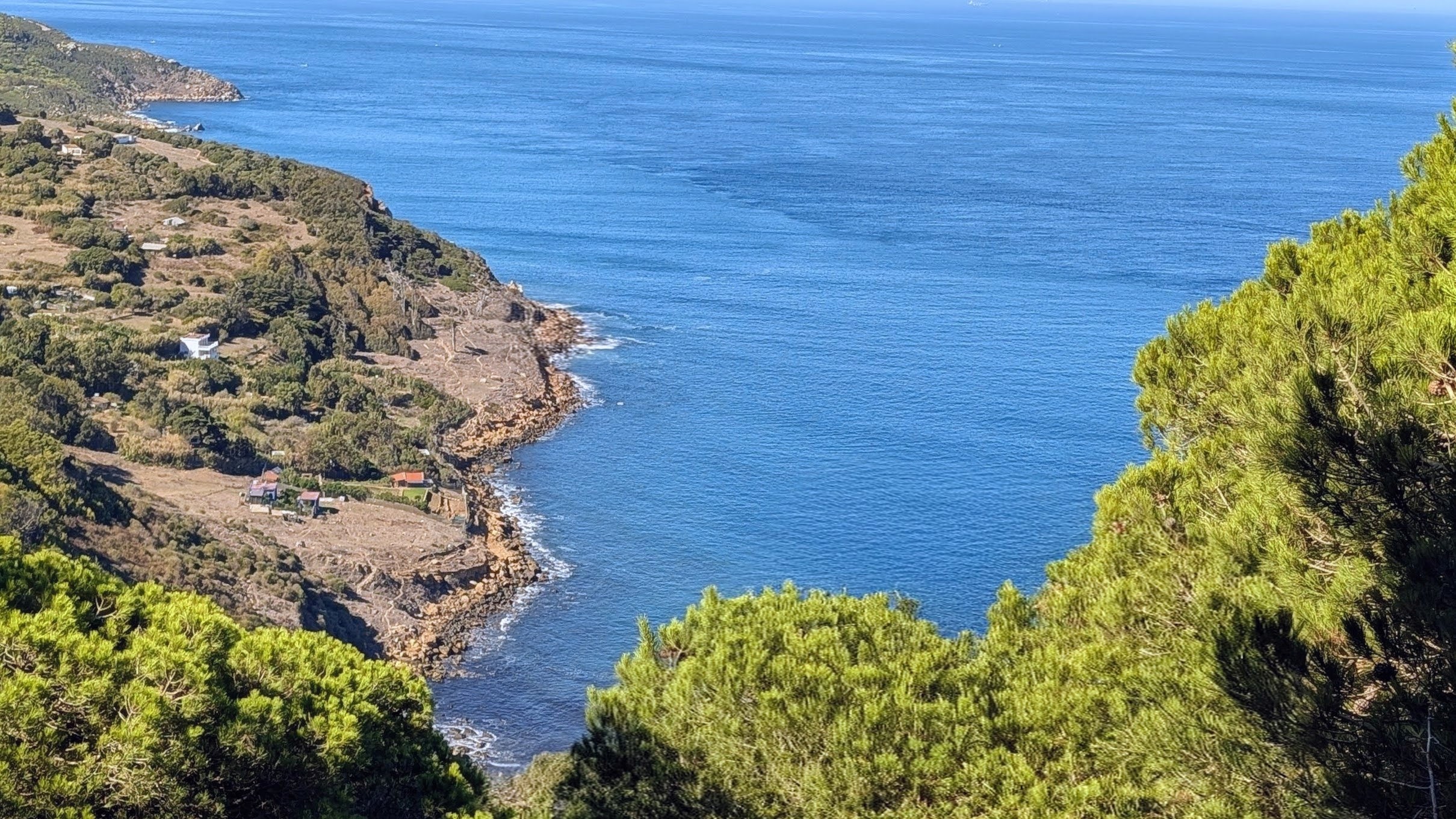
After lighthouse, I used again inDrive and requested a ride to Rmilat Park. Situated between Cape Spartel and Tangier and known as the “lungs of Tangier,” it is a lush forest that sits on the cliffs overlooking the sea. Rmilat has several easy hiking trails with some offering excellent views of the Strait of Gibraltar.
Rmilat Park has scenic hiking trails
The locals from Tangier love to come here for various family gatherings and picnic-style meals in the shadow of eucalyptus and pine trees.
Rmilat Park is a good place to watch local families
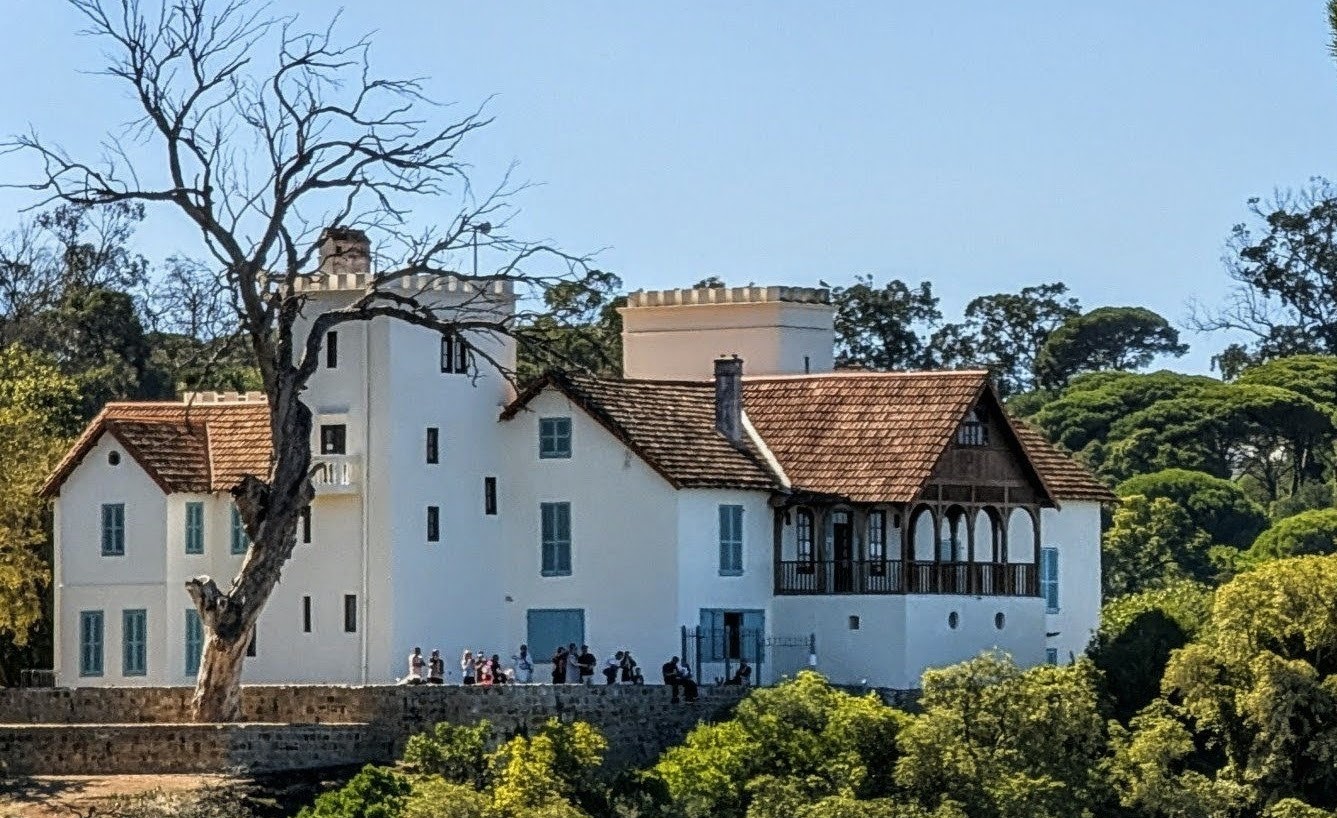
Rmilat Park also has one interesting historic artefact, the 19th century mansion, Villa Perdicaris. It was built by the wealthy Greek-American Ion Perdicaris and became internationally known in 1904 when Perdicaris was kidnapped by the local tribal leader Raisuli. Raisuli demanded a large ransom, safe conduct for his tribe, and political control over two wealthy districts.
In respond US President Theodore Roosevelt deployed warships and issued the famous ultimatum, “Perdicaris alive or Raisuli dead.” Nevertheless, Raisuli ultimately received his ransom and was appointed Pasha of Tangier as part of the deal.
Today, Villa Perdicaris serves as a heritage center and museum offering visitors a glimpse into Tangier’s history amidst impressive botanical gardens.
Villa Perdicaris, an interesting place to visit in Rimlat Park
No trip to Morocco is complete without experiencing a “hammam,” a traditional Oriental bathhouse. For those who are unaware, a hammam (also called “Turkish bath”) is a public steam bath associated with the Islamic world and inherited from the model of the Romanthermae. A visit to the hammam is as much a cleansing ritual as it is a social event. And so, this was the last point on my program in Tangier and the entire trip to Morocco.
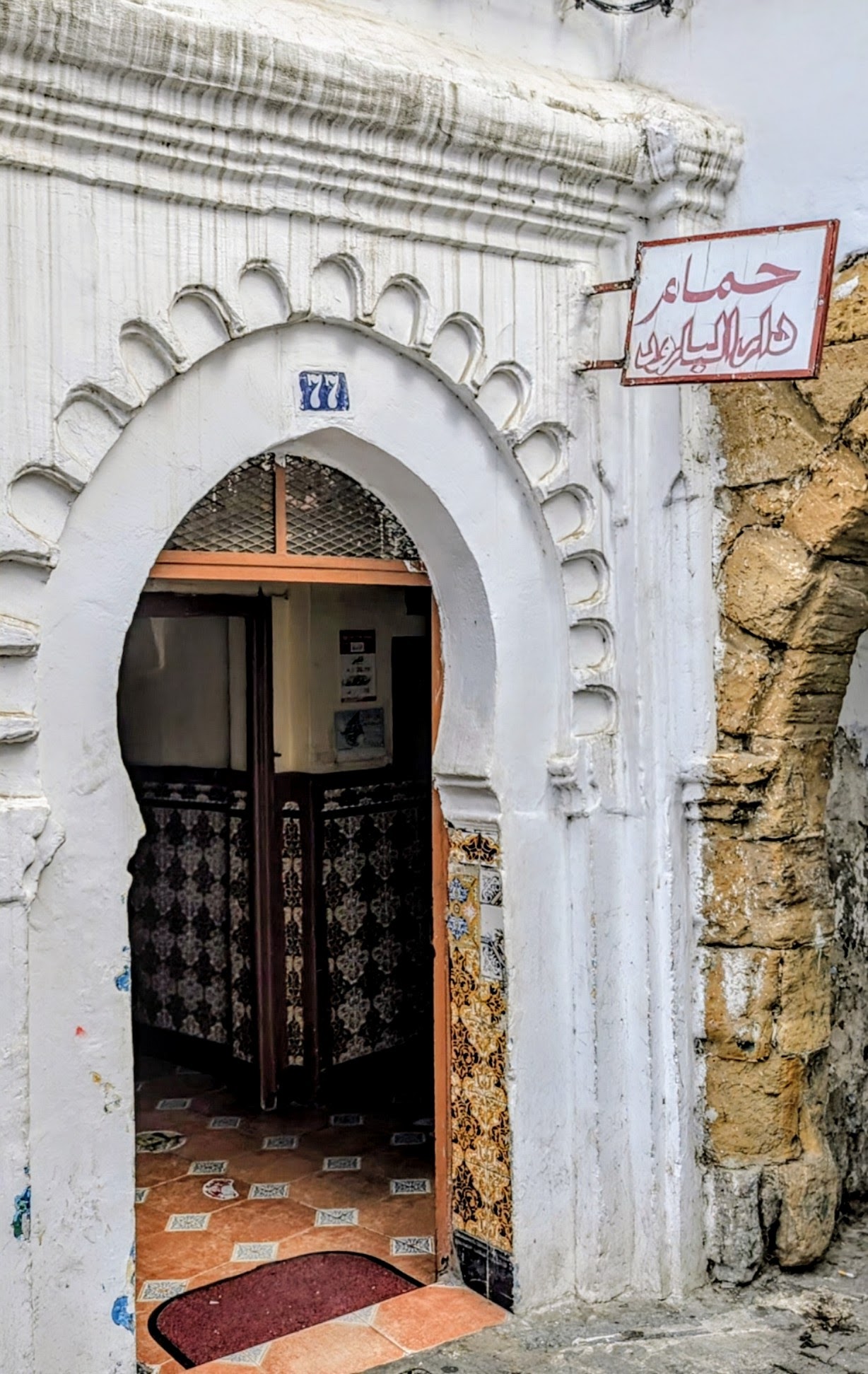
Several upscale hotels in Tangier offer tourists elaborated “hammams,” but I have chosen a place where locals go. Recommended by my host, Yassin, Hammam Dar Baroud was hidden on one of medina’s side streets and was fairly hard to find. Google maps mistakenly showed it at Dar Laghrib Hotel, but actual location was across the street.
Hammam Dar Baroud
For about 150 dirhams / US$ 15, I was assigned a personal bath attendant. An old but lean and muscular man ordered me to take off my clothes and gave me instead a loincloth. Then he led me into a warm and humid room with heated floors, asked to lay down and left. First, I was slightly frustrated without knowing exactly what was going on, but then I relaxed (the warmth of tile floor was comforting), and almost dozed away.
In about 20 min, the man came back with a basin of hot water, soap and rough washcloth. I was given a strong soapy rub, but it was not unpleasant: the man definitely knew exactly how much power apply to each customer (I am a fairly skinny guy). Then I was brought to another room, where he meticulously rinsed the soap off me. The final procedure was a 10 minutes massage, or – probably – a better description would be “twisting and stretching” my body. But again, it was not unpleasant at all.
When I dried myself and got dressed, I felt not only super clean but also strangely energized and rejuvenated. All in all, it was a great experience.
My personal bath attendant in Hammam Dar Baroud
On the way to Ibn Batouta House, I stopped at my favorite Bab Al Madina bakery. I was leaving tomorrow morning both Tangier and Morocco, and the choice for the last dinner was easy: chicken pastilla, the dish which I felt in love with in Morocco.
Back at Ibn Batouta, I sat on the roof terrace and savored the pastilla’s collision of many textures and flavors. It occurred to me that this dish perfectly reflects the nature of Morocco: a fascinating blend of diverse cultural influences, landscapes, and traditions.
Chicken pastillas, my last dinner in Morocco
The next morning, I took the train to Casablanca to catch my flight home. As I approached the station, the sun broke the horizon, casting that vibrating reddish North African light one last time. I was leaving, but knew already that I would be back. And very soon. Until then – thank you, Morocco!”
I am sociologist by occupation (Google me), "perpetual traveler" by nature, and firm believer that life is good. Let's go!
View all posts by Alexei Krindatch




























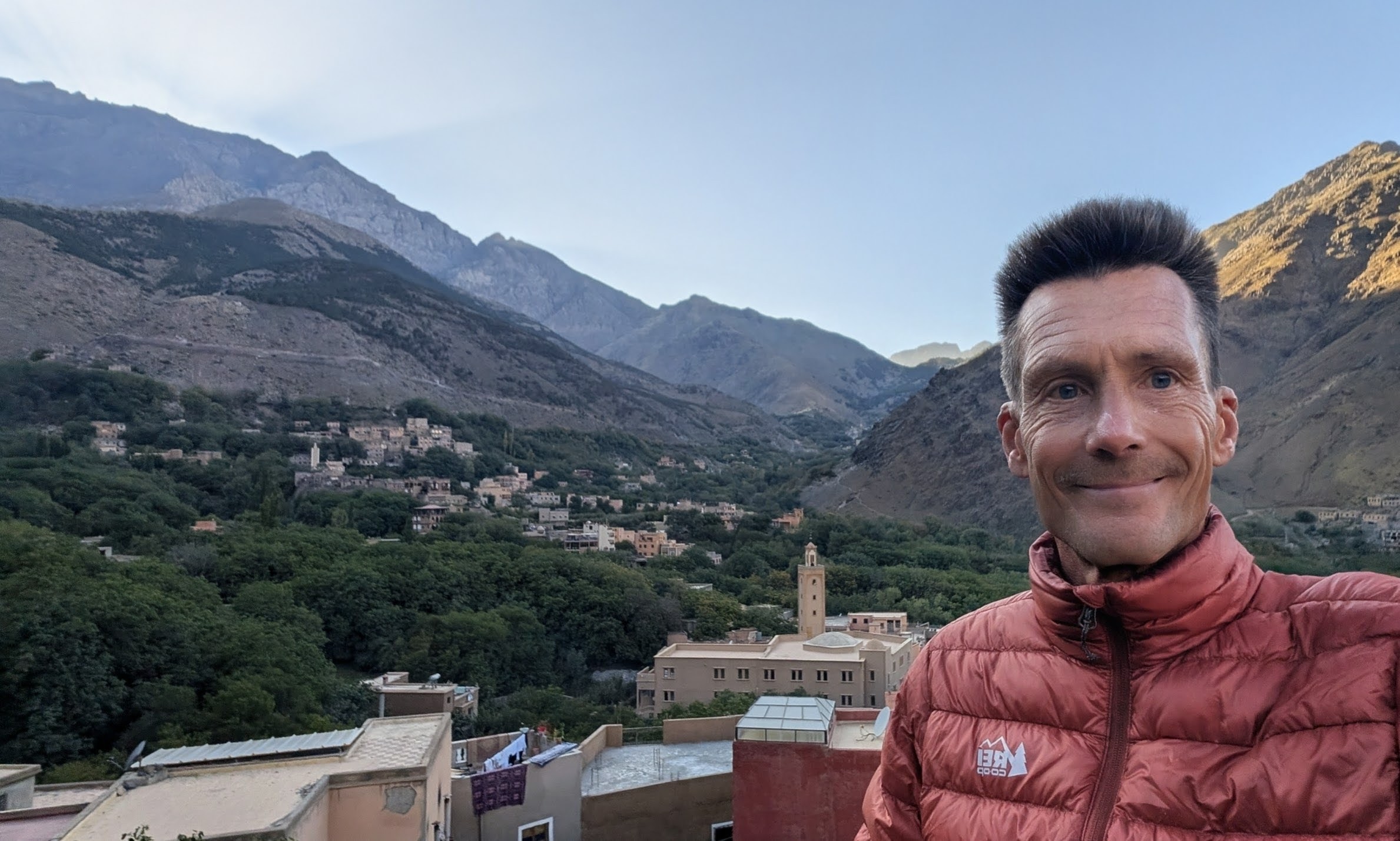








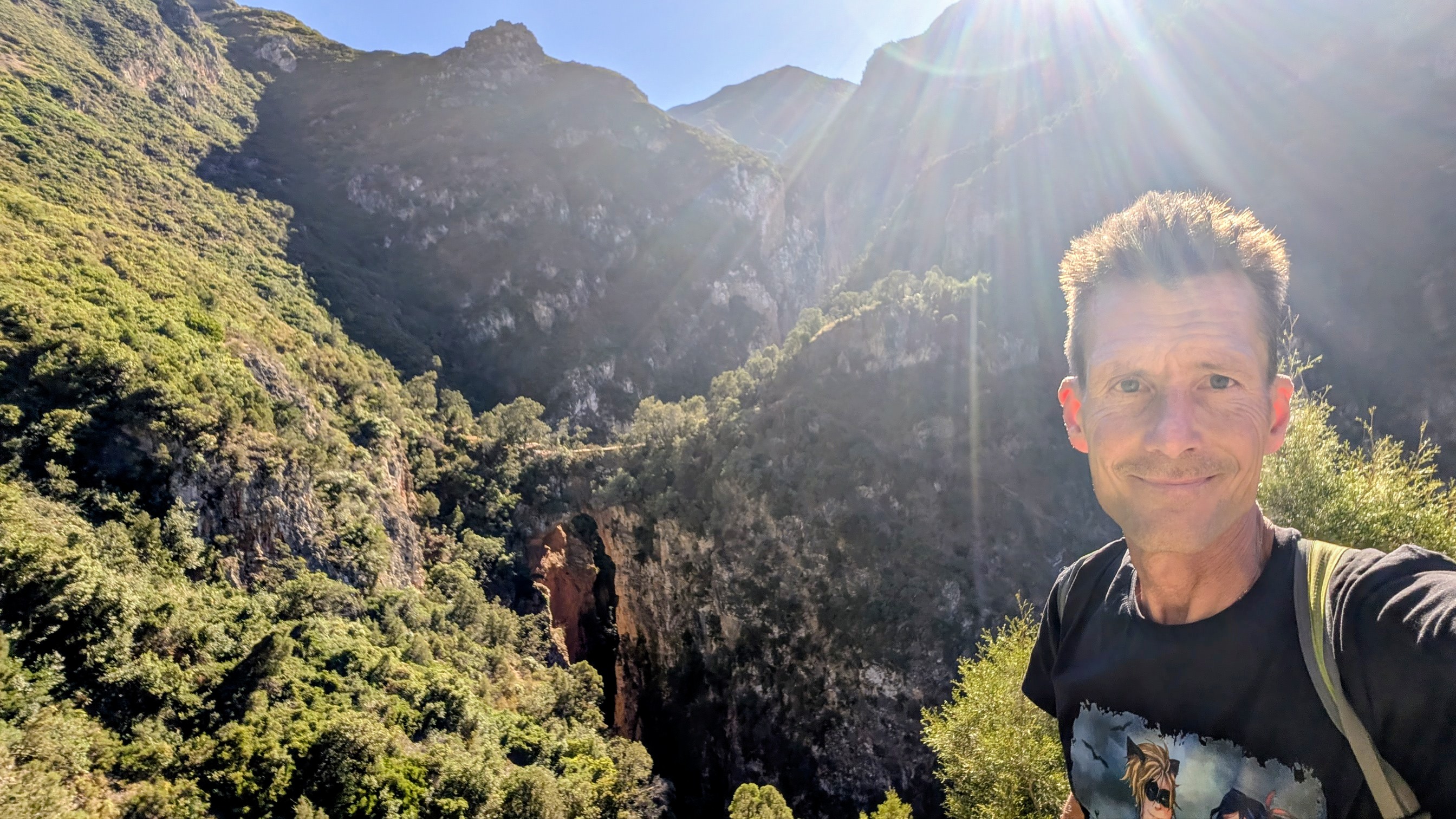

















 Alexei on the Road
Absolutely beautiful!! Thank you for sharing your adventure. God bless you in all your travels my dear brother!!
Fr. Stephen
Sent from my iPhone
LikeLike
I really enjoy your travelogue Alexei, thanks for including me.Joel Williams
LikeLike
Interesting and so detailed! God be with and bless you always! Love, Fr. Joe
Sent from AOL on Android
LikeLike