Trip to Taiwan (April 2025) was among my best travel experiences over the past decade. In this post, you will receive an answer to the question: “Why so?”
Taiwan is an East Asian island nation which lies in the Pacific, with China to the west, Japan to the north, and the Philippines to the south. With a land area of about 14,000 sq mi / 36,000 sq km, Taiwan can be easily circumnavigated by train in just one day. Here is the map.

Unlike some countries in Asia, Taiwan is easy and pleasant to explore. It is as efficient and modern as Japan or Singapore, but the prices for food, accommodation, and transportation are much lower.
Nevertheless, in order to have truly rewarding travel in Taiwan, you need two things: a) to know a few travel practicalities, and b) to be aware of Taiwan’s fairly complex history and culture. If you are thinking about visiting Taiwan, definitely read the first two chapters in the below table of contents.
- Six Tips for Traveling in Taiwan
- Be Aware of These Historic and Cultural Traits of Taiwan
- If You Have Only One Day in Taipei
- Yangmingshan National Park
- Minxiong: Visiting Non-Tourist Place Is a Good Idea
- Tainan: Cultural and Gastronomic Capital of Taiwan
- Hualien: a Gem on the East Coast
- Jiaoxi: Hot Springs Paradise in the Mountains
- Biking in New Taipei
Six Tips for Traveling in Taiwan
1. You will likely arrive in Taipei, the capital of Taiwan, by plane. The airport is easily connected to the city by MRT: the metro/subway system. It takes between 40 minutes and 1 hr to Taipei Main Station, which is in the very center of the city. The trip will cost US$4-6 depending on the type of train: commuter or express.
2. Before leaving the airport, you should purchase and “top up” EasyCard. It is like a contactless debit card primarily used for payments on all public transportation (and also taxis) everywhere in Taiwan. With an EasyCard, there is no need to worry about buying individual tickets: you simply tap it when entering the metro or bus. The price of the ride is automatically deducted from the stored value.
At Taipei airport, the best place to get an EasyCard are the ticket windows at the MRT station. The card as such costs 100 Taiwanese dollars (less than US$3), but then you need to “top it up” – add some funds which you can use for future payments. Don’t worry: if you do not spend all the money during your trip, you will get a full refund of the remaining sum. Conversely, if you run out of funds, the EasyCard can be easily “topped up” at bus and metro stations, and at many convenience stores.

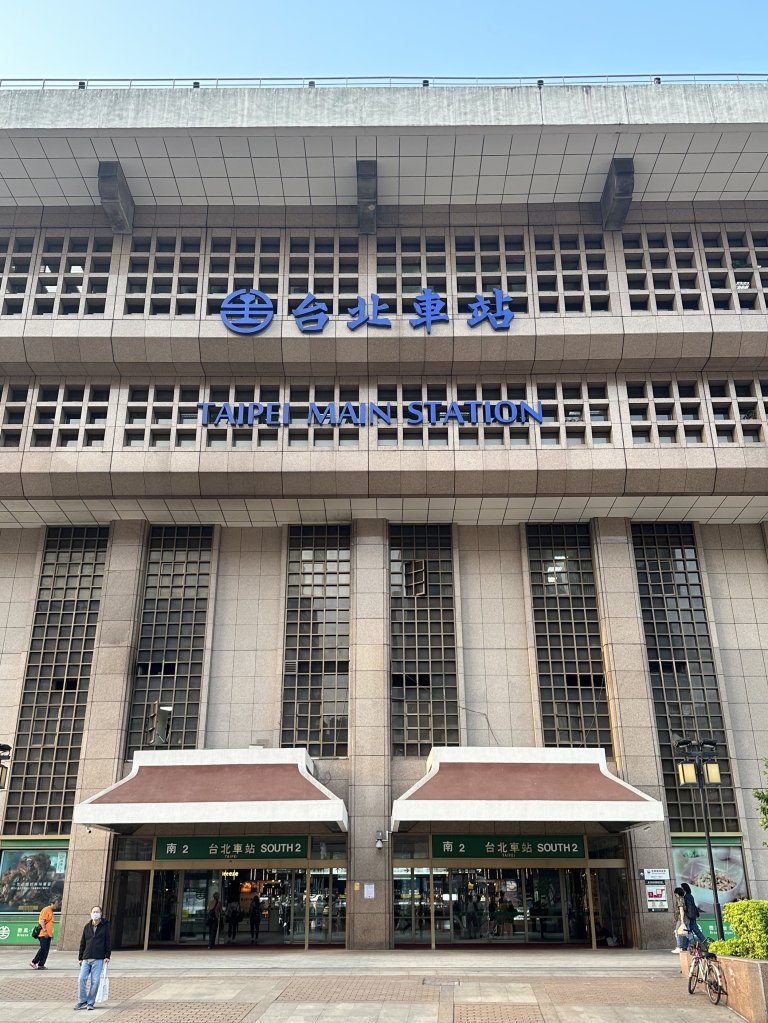
3. “Taipei Main Station” is indeed a principal station, not only for metro/subway (MRT), but also for regular trains (TRA), high-speed trains (THSR) and intercity busses. Geographically, it is also in the middle of Taipei. My recommendation is to find accommodations close to Main Station.
Bear in mind, though, that Main Station is a complex and multi-level system of services, lines, platforms, exits/entrances, shops, etc. For tourists it may feel overwhelming: always reserve additional time to navigate through it.
4. Taiwan has an excellent – modern, efficient, and inexpensive – network of public transportation. In Taipei and some other major cities, the metro/subway is the best way to get around. Take a look at this map of the Taipei MRT and see how extensive it is.

Also, in many cities around the world, traveling by subway may not be a very pleasant experience: stations can be dirty, trains overcrowded, and there may be safety concerns. Do not worry about this in Taipei. Even during peak hours, local residents wait patiently, staying in designated lines to enter the train when their turn comes.
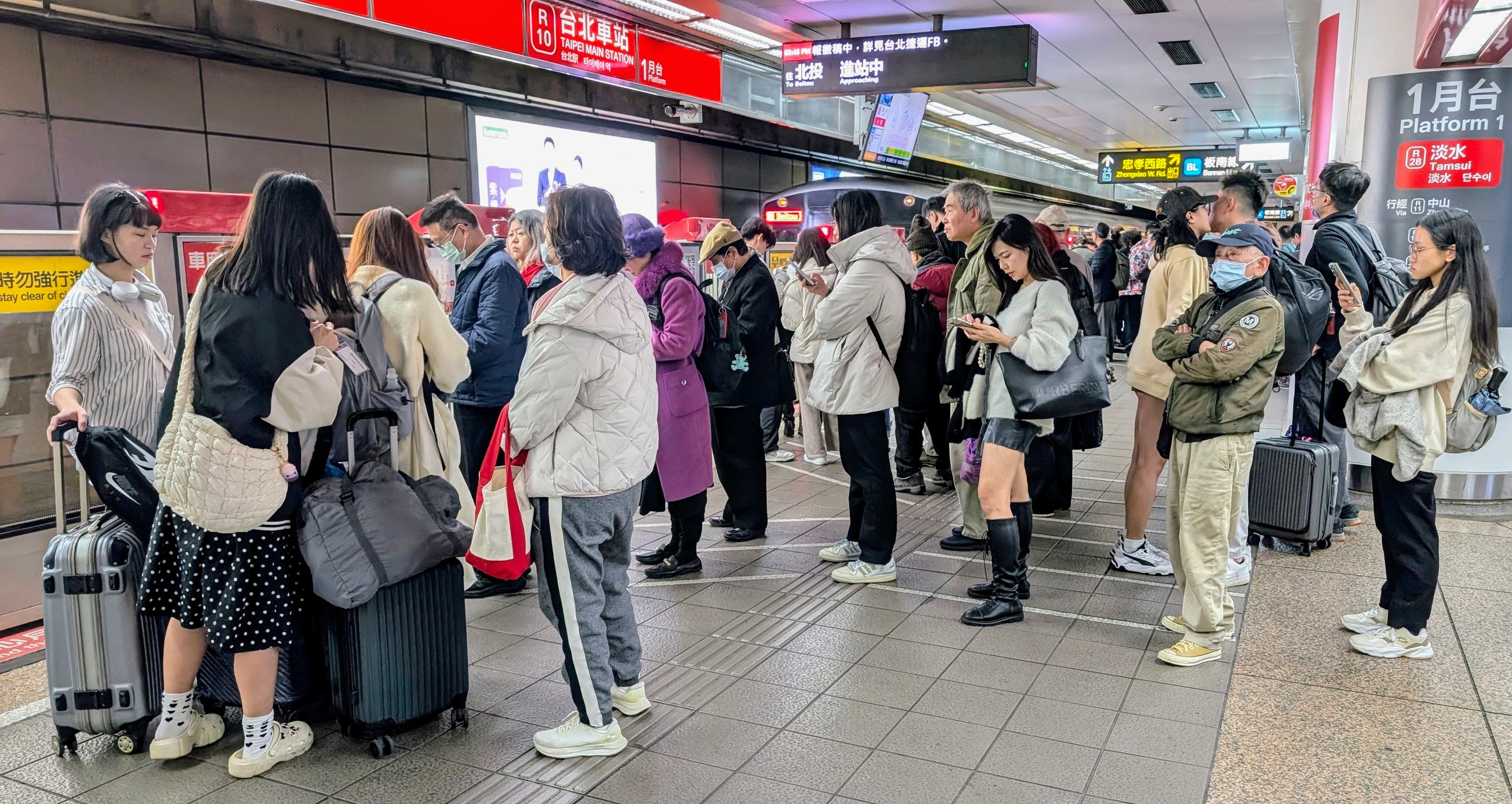
In smaller cities and towns, buses are a good way to get around. Taxis are another option: they are much cheaper than in the US, and drivers charge strictly by the meter. Finally, Uber is also present in Taiwan: simply use your App as if you were at home.
For short intercity trips or in areas not covered by trains, use buses. To do so easily, download an App called iBus (Intercity Bus): it includes all planning tools for getting around the entire island by bus. It also provides real-time information on how to find the nearest bus stop, when the next bus will arrive/depart, possible delays, etc.

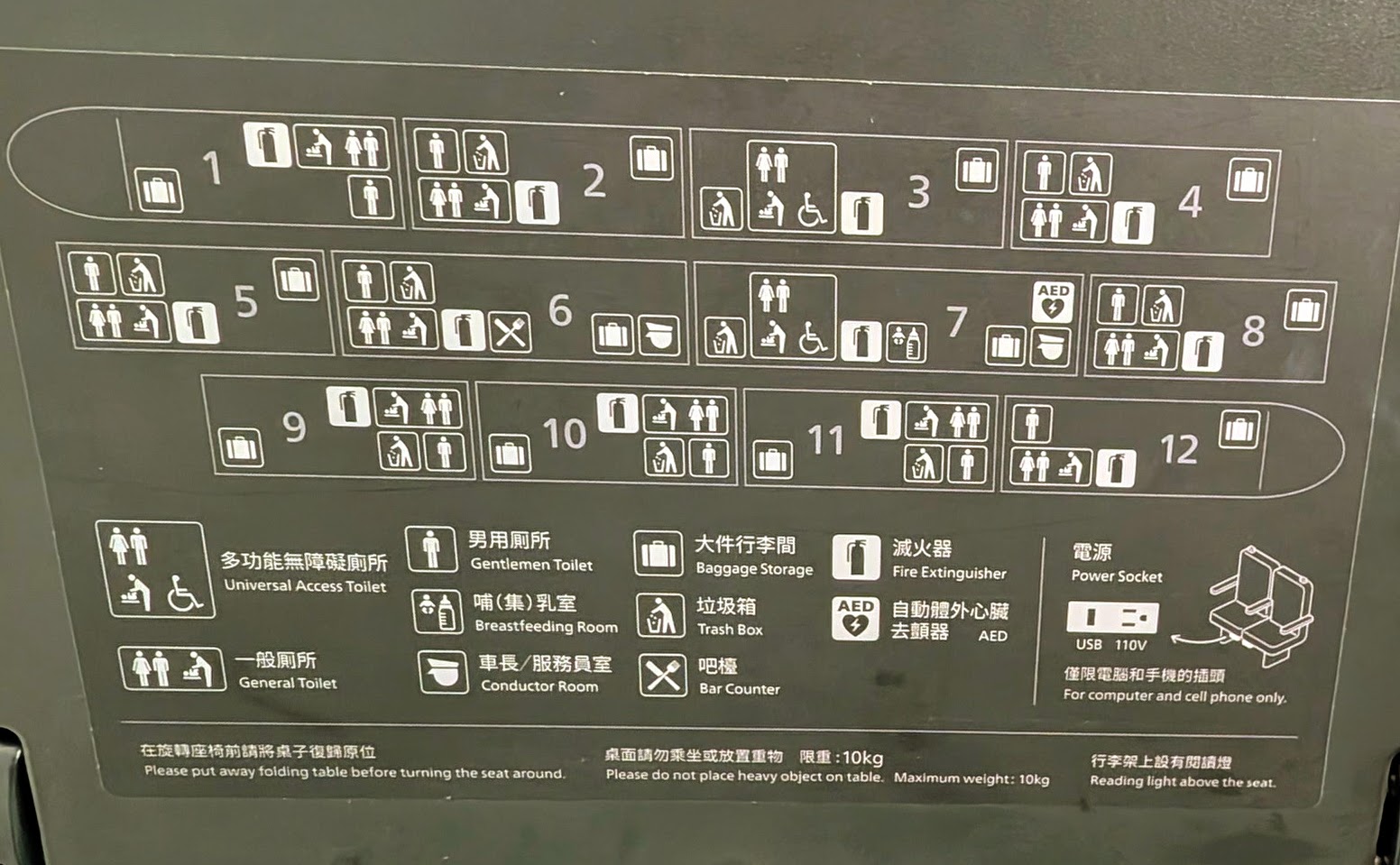
Except for the internal mountainous areas, all parts of Taiwan are served by modern trains: local (no need for seat reservation), express (typically requiring seat reservation) and high-speed (up to 300 km / 200 miles per hour). Here is the website for time-tables and tickets. I mostly traveled by express trains and enjoyed them greatly: very clean and with wide reclining chairs. Also, all info about the services and seats of a train is pictured on the back of the chair in front of you.

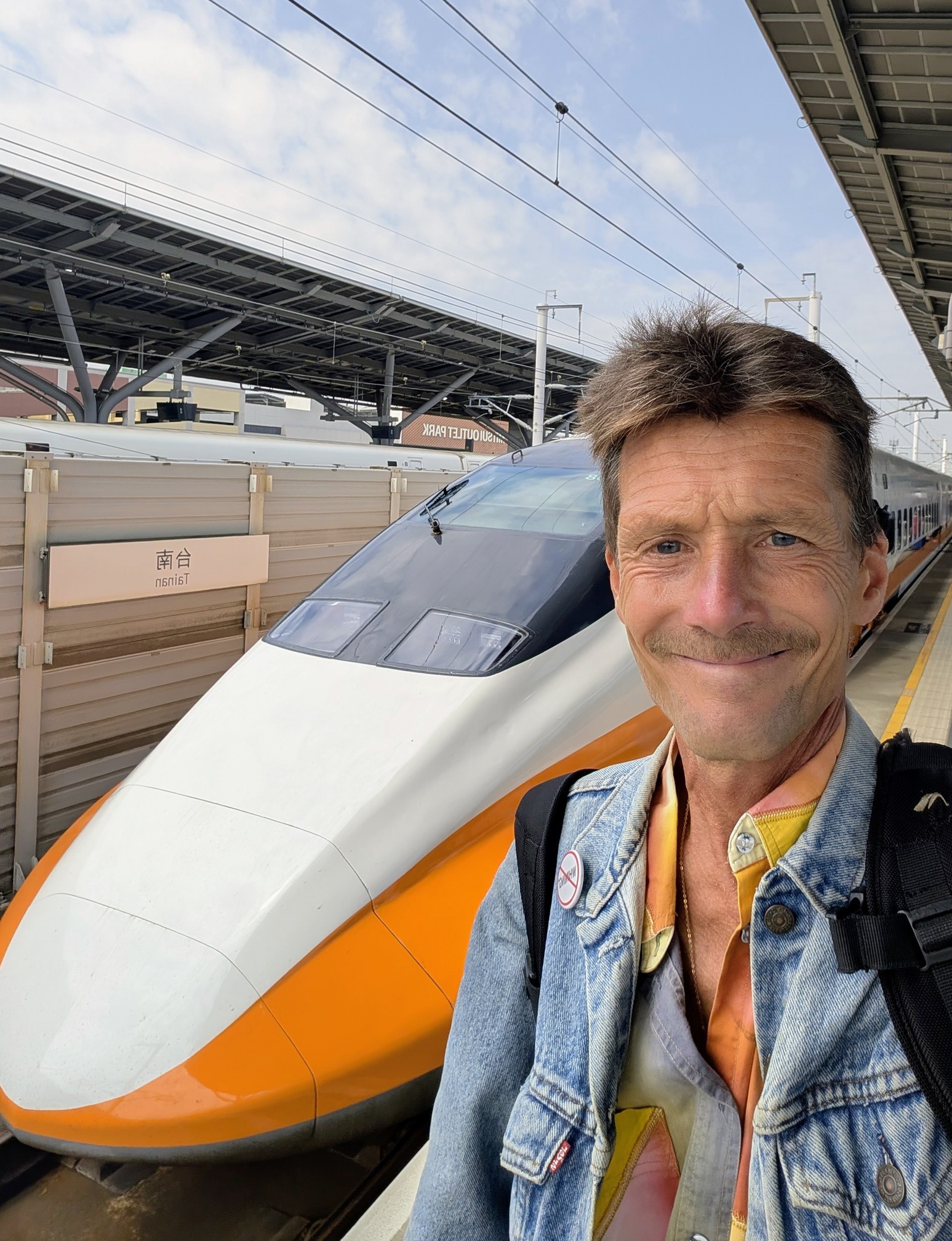
High-speed trains (THSR) connect the two largest cities: Taipei (in the north) and Kaohsiung (south-west). With 220 mi / 350 km travel distance and several stops (2-9), the journey takes between 1 hour 30 minutes and 2 hours 15 minutes. The regular price is only about US$46. Here is website for booking high-speed trains. And one more notice: for whatever reason, on this website, Kaohsiung is called “Zuoying Station.”
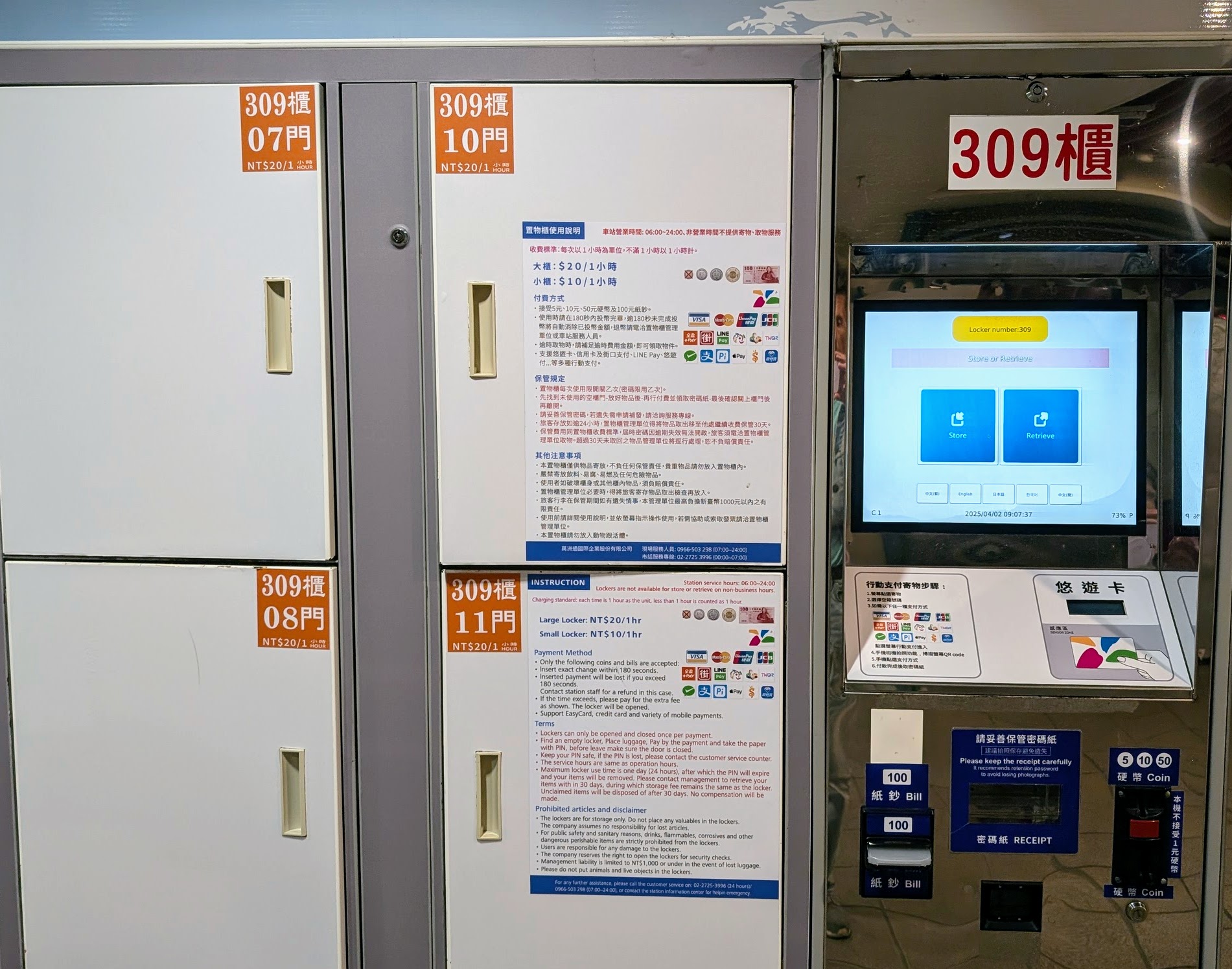
5. Travelers are often challenged with the problem of storing luggage while exploring some place and desiring to spend just a few hours before going to the next destinations. No need to worry about this in Taiwan. Most train, bus, and even metro (in Taipei) stations have lockers of different sizes.
And the same is true about public toilets: typically, there is no problem finding a public toilet in Taiwanese cities.
6. Food in Taiwan is excellent, and “eating adventures” should definitely be part of your plan while exploring Taiwan. Local cuisine is diverse (meat, fish, strictly vegetarian dishes), not too spicy, and hygiene standards are good. Also, you can have a nice meal for a fraction of the price compared to the US or Western Europe. I will write more about Taiwan cuisine later in this post, but here are two overall suggestions.
First, do not disregard street food. In fact, it offers a more authentic experience of Taiwanese dishes than formal restaurants. And it is also totally safe and MUCH cheaper. You will get an excellent meal from stalls like this for no more than US$ 5.


Second, another option for a quick, and yet satisfying meal is the national networks of small convenience stores: Family Mart and 7-Eleven. My friends in the US would be horrified by the idea of eating at 7-Eleven (in US, these are very primitive and limited stores at stations), but Taiwanese 7-Eleven and Family Marts are different. You will find there a good selection of prepared meals (including sushi!) or even hot food items.


Enough about “practicalities.” Let’s talk about a few truly important aspects of Taiwanese history and present-day culture.
Be Aware of These Historic and Cultural Traits of Taiwan
Most people do not know this, but Taiwan’s official name as a country is the “Republic of China,” which was actually the name of mainland China between 1912 and 1949. Today, however, mainland China is formally known as “People’s Republic of China,” while Taiwan “inherited” the old name of the Chinese state. Taiwan’s national flag is also the same one which was used by the mainland “Republic of China” until 1949.
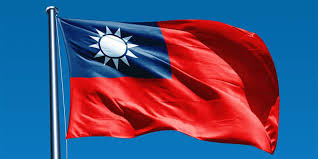
People usually ask two questions about Taiwan: “Is it an independent state?” and “Is Taiwanese culture distinct and separate from Chinese?” Both questions are sensitive, and neither has an easy answer.
De-facto, Taiwan functions as a sovereign state with a democratically elected President and Parliament (the latter has more power). It has its own constitution, military, and currency. Economically, Taiwan’s per capita GDP and PPP (Purchasing Power Parity) are comparable to Japan or South Korea, and close to Germany or France. Advanced electronics and semi-conductors are at the core of the economy.
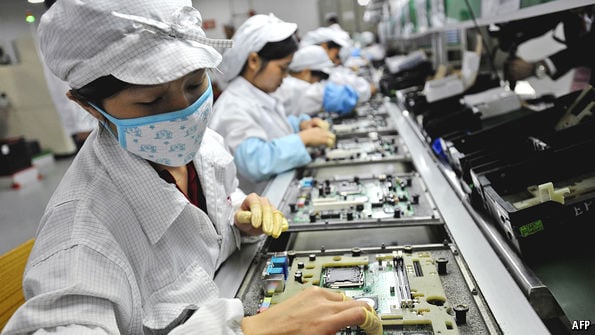
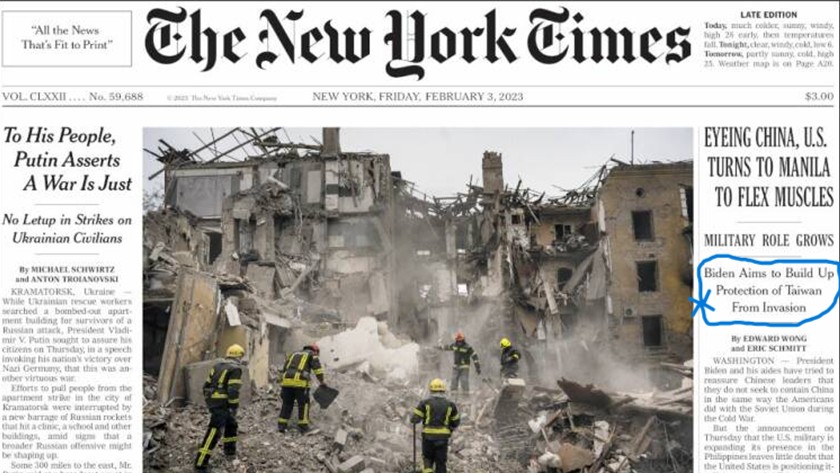
Yet, the United Nations and most countries around the globe (including USA) do not recognize Taiwan formally as a state, because they adhere to the “One China” policy, meaning that Taiwan is part of China.
Yet again, many countries support de-facto Taiwanese independence (USA being a prime example), and Taiwan maintains economic and political relations with many nations through various representative offices which function as quasi-embassies.
The question of cultural identity of the Taiwanese and their relation to Chinese culture is even more complicated. On the one hand, Mandarin, the main language of China, is the national language in Taiwan. However, this was not the case until the 1950s. Prior to that, when Taiwan was under Japan’s rule (1895-1945), Japanese was the official language in education and administration, while native Taiwanese Hokkien remained the most widely spoken in daily life.
Things changed in 1949, when General Chiang Kai-Shek and his troops were defeated by the Communists in mainland China. Then they retreated to and assumed control over Taiwan. The nearly forcible replacement of not only “colonial” Japanese but also native Hokkien by Mandarin language was the policy imposed by Chiang. Although the times of Chiang’s rule are long gone, Hokkien was never given any official status in Taiwan, and it continues to slowly “die out.”
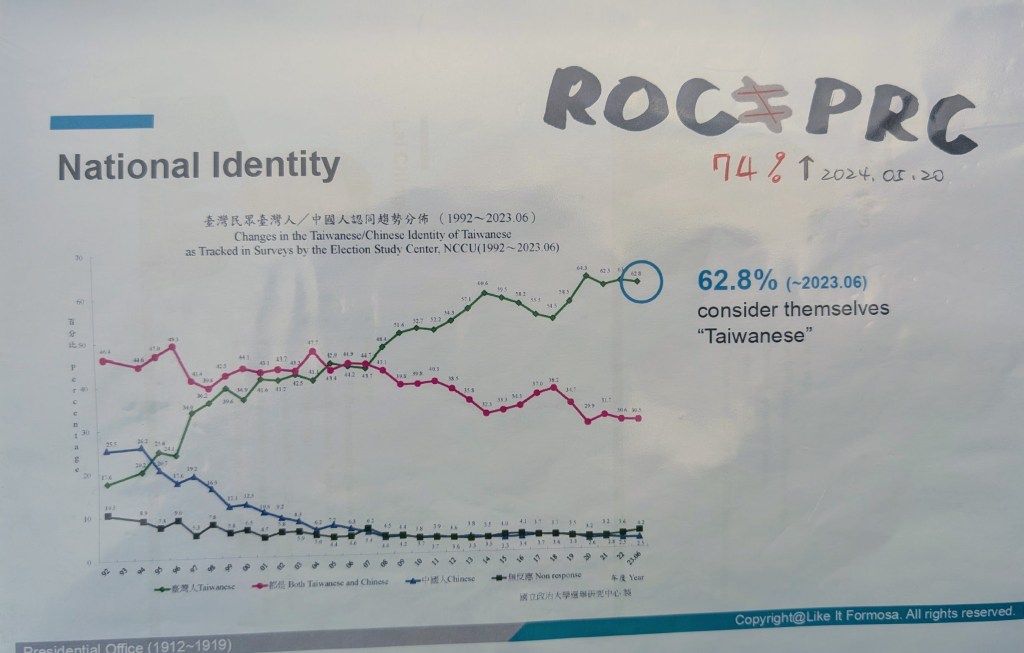
And yet, despite the clear dominance of Mandarin, most inhabitants of Taiwan think of themselves as being different from the Chinese. Look at the survey data below. In 2023, 63% of the island’s population considered themselves “Taiwanese,” 30.5% said that they were “Taiwanese and Chinese,” and only 2.5% felt they were “Chinese.”
Politically, Taiwan has two major party blocks which are known as “blue” and “green.” The “blue camp” favors close ties (or even reunification) with China and emphasizes a common Chinese cultural and historic heritage. Differently, “green camp” promotes Taiwan’s distinct cultural identity and prioritizes country’s full sovereignty and self-determination.
The “Blue” tend to attract older generations while the “green” relies more on younger people, but both blocks are fairly comparable in their influence on life and politics. As of April 2025, out of 113 seats in Parliament, 52 are controlled by “blue” and 51 by “green” camps.

The roots of current conflicting views on Taiwanese culture are actually much deeper than most people think. Here is a “bare bones” account of island’s history. But feel free to SKIP HERE directly to my adventures in Taiwan if it is too much information for you.
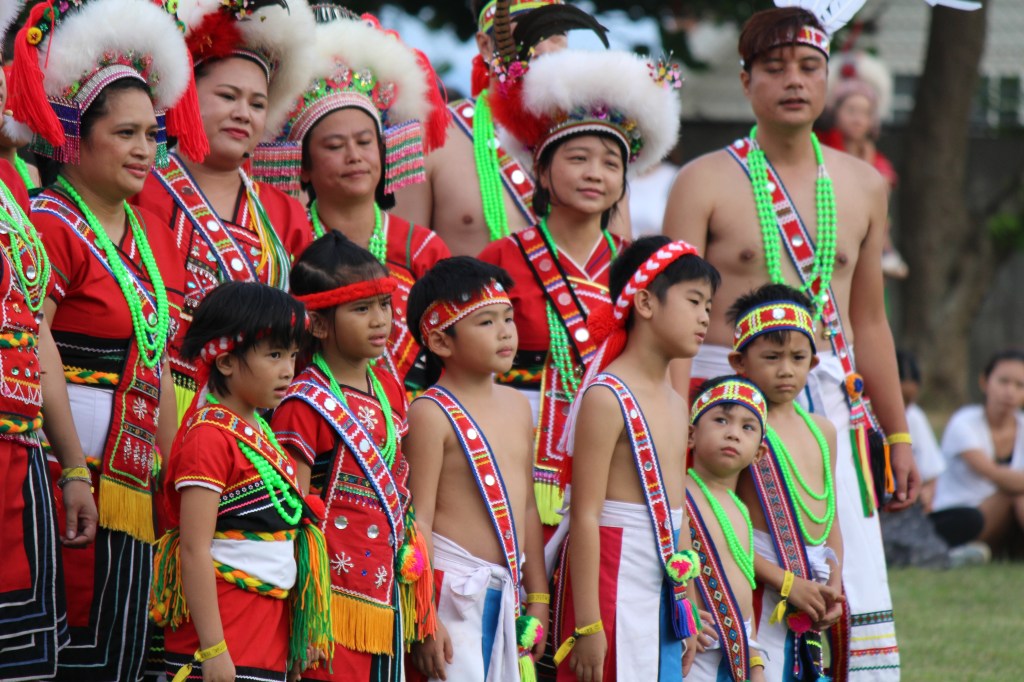
Around 6,000 years ago, Taiwan was settled by people who would eventually become known as Taiwanese Indigenous People. They are anthropologically and linguistically distinct from Chinese, and have close ties to other Austronesian groups. Today, they comprise only 3-4% of Taiwan’s population and live mainly in the mountains of Central Taiwan and on the east coast.
Europeans discovered the island in the 16th. In 1542, Portuguese sailors arrived and called island “Ilha Formosa,” meaning “beautiful island.” By the way, “Formosa” was the name used for Taiwan until after WWII.
In 1624, the Dutch East India Trade Company, established first European settlement, Fort Zelandia, on the southwest coast and near the current city of Tainan. Eventually, the Dutch assumed control over entire island.
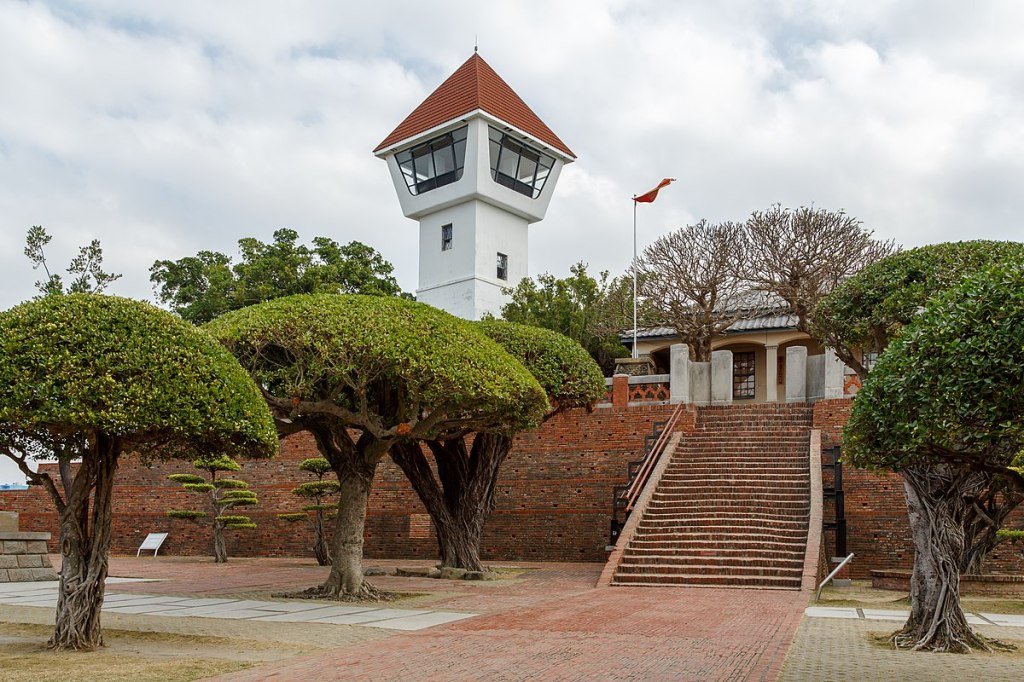
Importantly, the Dutch organized first mass immigration to Taiwan of Chinese from the mainland, because they were much better farmers than indigenous people. The newcomers cultivated rice (for local consumption) and sugar (for export). The vast majority of them came from Fujian province and spoke the language which later evolved into Taiwanese Hokkien.
However, Dutch rule did not last long. In 1661, the prominent Chinese warrior Koxinga expelled the Dutch and took control over Taiwan. Koxinga died in 1662, but de-facto he established first Chinese-led regime on the island. A new influx of Chinese settlers, along with Chinese-style governance, education, and culture defined Taiwan’s later development.

Fast forward through the rest of the 17th, 18th, and most of the 19th centuries, Taiwan remained under the control of mainland China. In 1895, however, the first Sino-Japanese war was lost by the Chinese, and Taiwan was ceded to Japan. The new rulers gave Chinese inhabitants an option to return to mainland China, but very few did so.
The Japanese colonial period changed Taiwan dramatically, resulting in island’s rapid modernization and industrialization. For the first time, a formal education system was established. A number of magnificent examples of colonial architecture continue to remind about “Japanese epoque” in Taiwan. One of them is the office of Taiwan’s presidents, which was originally (1912) built as the headquarters for Japanese Governor-Generals.

In the 1930s, the Japanese began a massive ethnic assimilation project. Chinese-language newspapers and educational curriculums were abolished. Taiwanese music and theater were outlawed. Instead Japanese language and Shinto religion were promoted. But this policy did not last, because Japan was defeated in WWII, and, as a result of 1945 Potsdam declaration, Taiwan was given back to China.
Problem was that China itself was going through political turmoil at this time. Indeed, while Taiwan was under Japan, the monarchy and Qing royal dynasty was replaced by Republic of China. But the new state was unstable, and the bloody 1927-49 Civil War erupted. Two major forces fighting in this war were the Nationalists (Kuomintang/KMT party) led by General Chiang Kai-Shek and the Communists under leadership of Mao Zedong. Mao won, Chiang lost, and in 1949 he evacuated his government and soldiers to Taiwan, assuming full control over the island.

Taiwan became “Republic of China,” while mainland China was renamed by the Communists into “Peoples Republic of China.” Some 2 million people came with Chiang Kai-Shek to Taiwan: mainly soldiers, leaders of Kuomintang party, and intellectual and business elites. This influx not only added significantly to the earlier population of about six million, but it also changed the cultural and linguistic composition of the Taiwanese.
Chiang ruled Taiwan single-handedly until his death in 1975. He remains a controversial figure in the history of China and Taiwan, with both supporters and critics arguing about his times. But one thing is clear: Chiang was an authoritarian and harsh ruler.
The martial law introduced in 1949 lasted de-facto until 1987. “White Terror, ” a policy of mass political repression of anyone perceived as opponents to regime, was abolished only in 1992. The Taiwanese Hokkien language was forcibly replaced by Mandarin which spoken by newcomers from the mainland. Until mid 1980s, Kuomintang was the only party in the country.
Economically, partially thanks to support from the US and other Western nations, in the 1970s, Taiwan experienced rapid economic growth. In 1980s, along with Hong Kong, Singapore, and South Korea, Taiwan became known as one of the Four Asian Tigers.
Beginning in the late 1970s, Taiwan underwent social and political reforms that slowly transformed it into current democratic state. In 1986, the Democratic Progressive Party was established, the first opposition party to Kuomintang, which had ruled for decades. In 1988, Lee Teng-hui became the first president born in Taiwan. A new policy of so-called localization promoted native Taiwanese culture and history and encouraged overall multiculturalism.
In 2000, Chen Shui-bian of the Democratic Party was elected, being the first non-Kuomintang president. Since that time, the two parties have held power interchangeably, both in parliament and in the presidential office.
If you managed to read this historic account, I say: “Bravo!” The bottom line is: Taiwan’s history is complex, and the country’s democracy is young and still evolving. Bear this in mind while traveling there and don’t be surprised when you hear fairly varied opinions from locals on past and present events.
If You Have Only One Day in Taipei
If similarly to me, you have only one day in the bustling capital of Taiwan, you still can see and experience a lot of things. My plane landed at around 6 am, and two hours later I was already at the hotel. If you skipped introductory section, read HERE how to use various kinds of transportation in Taipei and Taiwan in general.
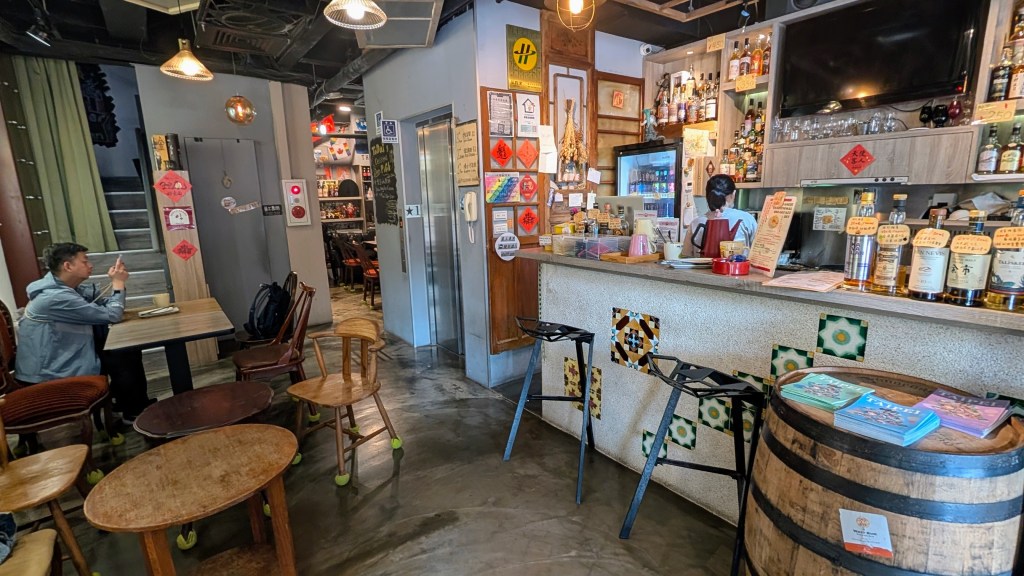
I stayed at the Old Door Hostel (you can reserve it on Booking.com) which is situated right next to Taipei Main metro and train station. Besides convenient location, I was attracted by glowing reviews left by previous guests on both Booking and Google maps, as well as very affordable price (about $ 23 USD per night).

Yes, it was a “hostel” meaning dormitory-style accommodations. But in reality it looked more like a “capsule hotel,” with each bed separated by light walls and curtains, and equipped with private lights, night stand, and even a safe to store valuables.
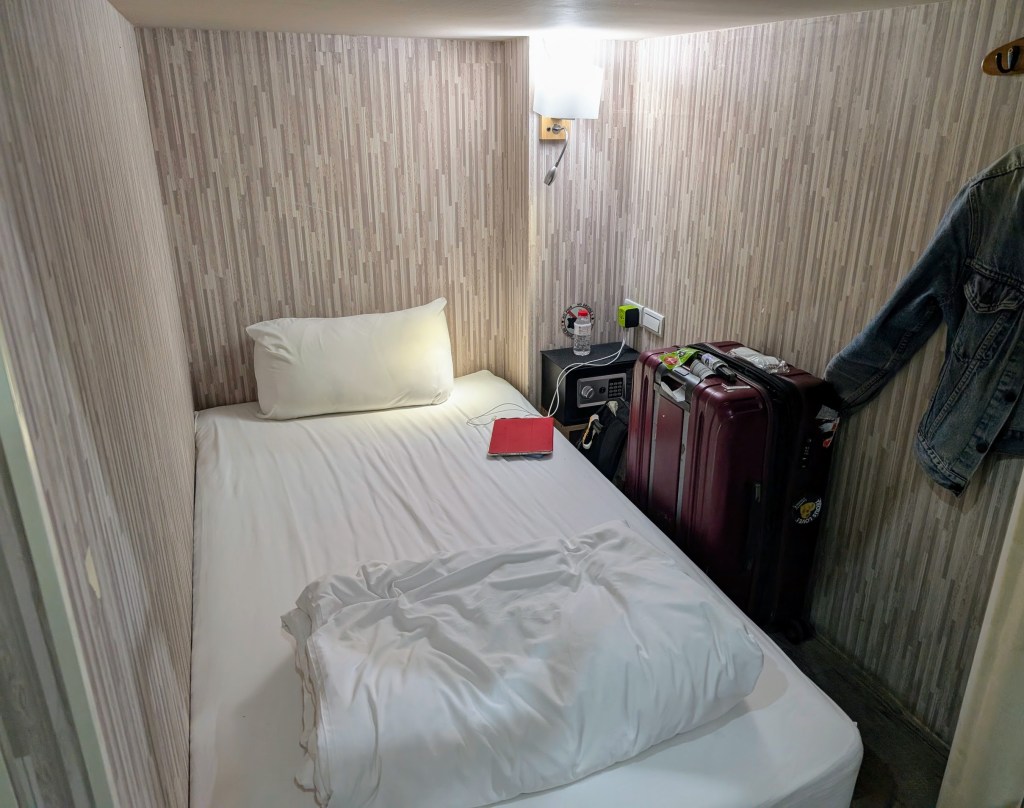
On the top floor, Old Door Hostel has a spacious lounge with kitchen, while cozy lobby doubles as a bar and cafe (by the way, I loved their cheesecakes).
My first destination was Lungshan Temple, perhaps the most iconic landmark of Taipei (it is only two metro stops away from Taipei Main Station). Built in 1738, it is believed to be the oldest of the currently existing temples in Taiwan.
A note about religion in Taiwan. As everywhere in the world, the younger generation is increasingly non-religious. But people who practice religion very often combine and blend Buddhist and Taoist beliefs and rituals. As a result, most temples in Taiwan (including Lungshan) are dedicated to and used by both religions.

Tourists come to Lungshan to enjoy ornate and colorful architecture with dragons, wood carvings, and gold statues. Besides being a place of worship, Lungshan Temple is also a popular spot for various community gatherings. When I arrived there, a group of teenagers was working on what appeared to be a clip for Tik Tok.

Lungshan Temple is dedicated to several deities, but its main “patron” is Guanyin, the Goddess of compassion and mercy. Accordingly, temple’s main hall features Guanyin’s statue.

Lungshan Temple has also a number of smaller altars and rooms: each serving a particular God or purpose. I stayed for a while at one of them observing ceremony conducted by a group of Buddhist nuns visiting Taiwan from the United Kingdom.

Being such popular site, Lungshan Temple may feel overwhelming: too many people visiting and too many ceremonies going on simultaneously. And so my next destination was Dalongdong Baoan Temple, which is more off the beaten path and yet easily accessible by metro. Dalongdong is primarily a Taoist temple, and its main patron is with Poh Seng Tai Tay, the God of Medicine.
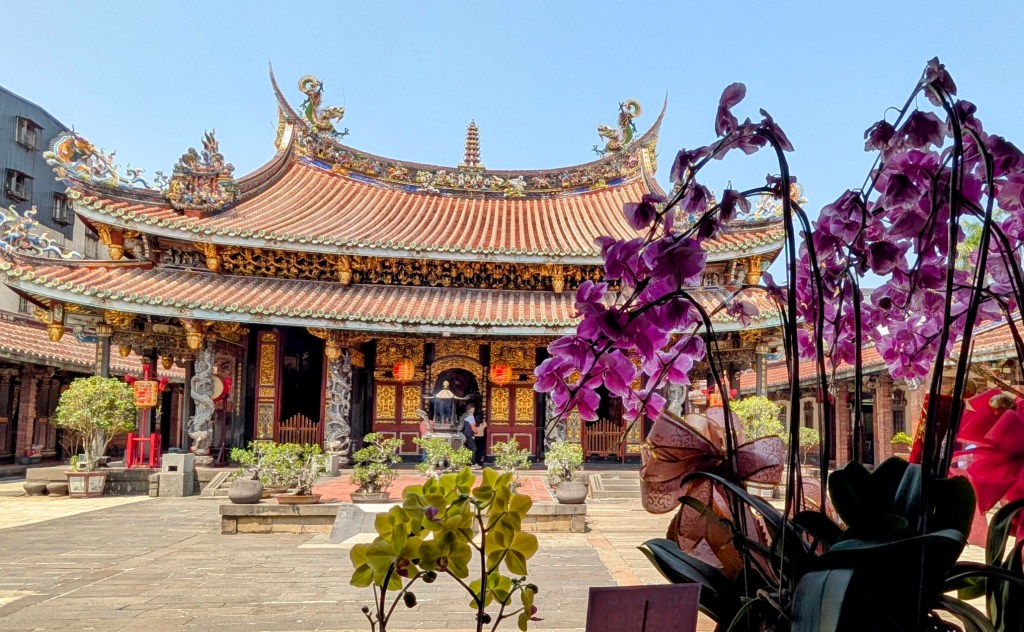
I loved Dalondgong’s atmosphere of serenity and the elegance of its halls and altars.
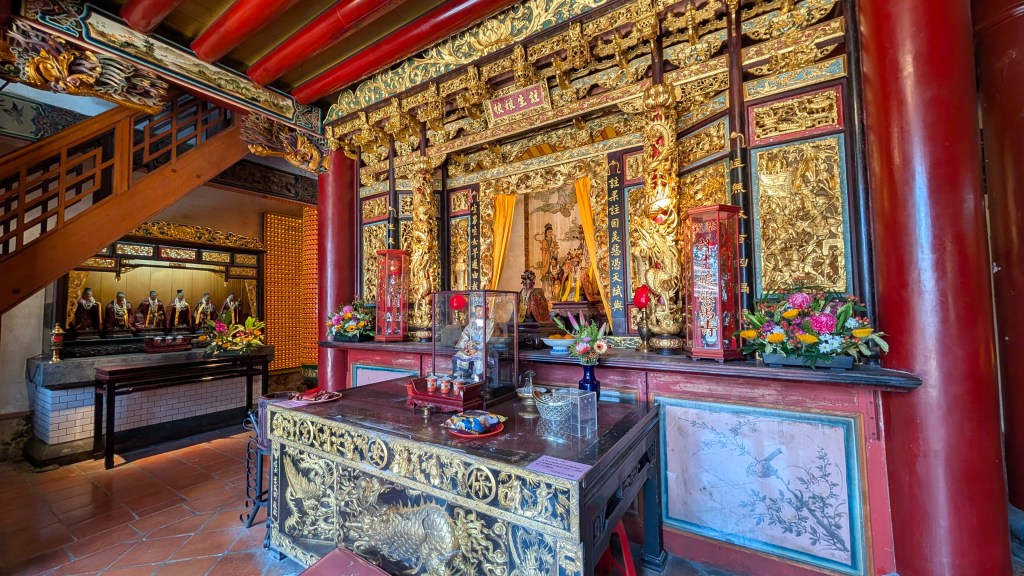

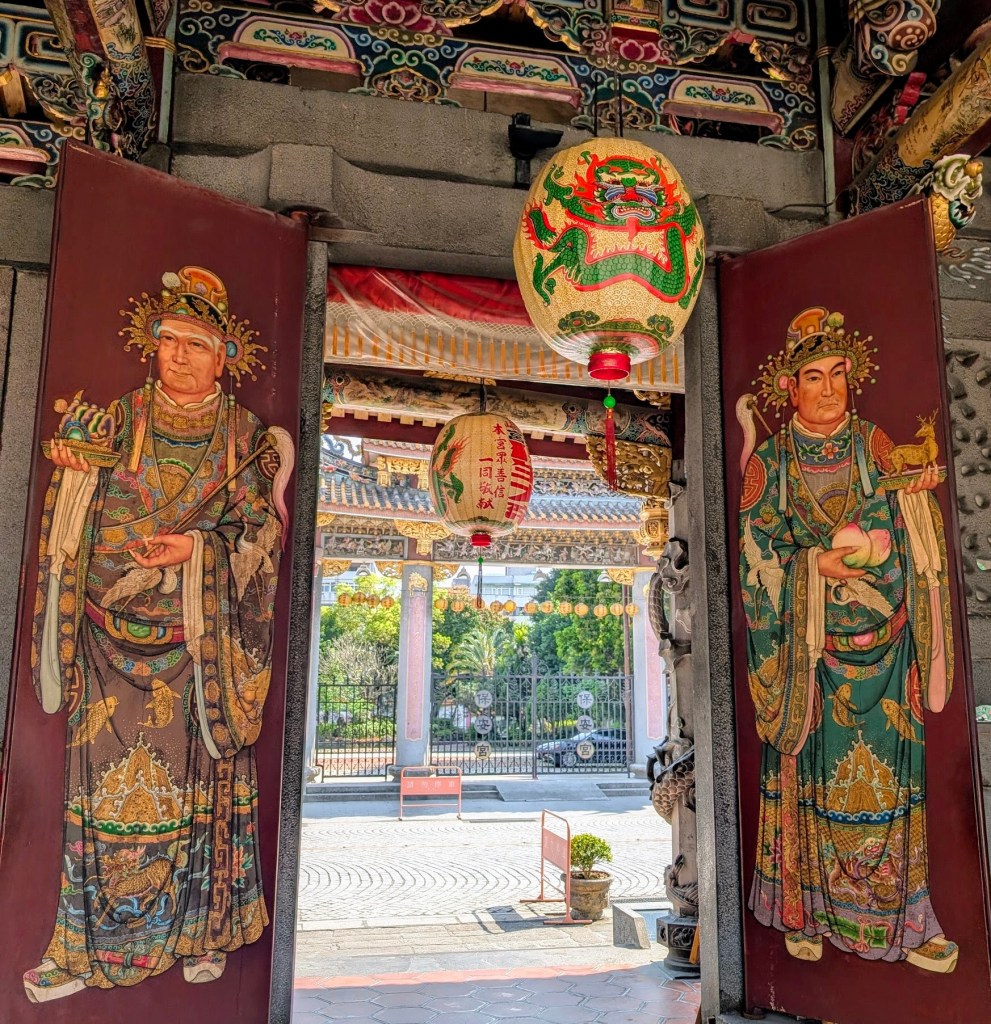
Also, the wall paintings at Dalongdong Temple were just amazing: “graceful” is, perhaps, the best word to describe them. Not surprisingly, Dalongdong is the only Taiwanese temple to receive a UNESCO Cultural Heritage Award.

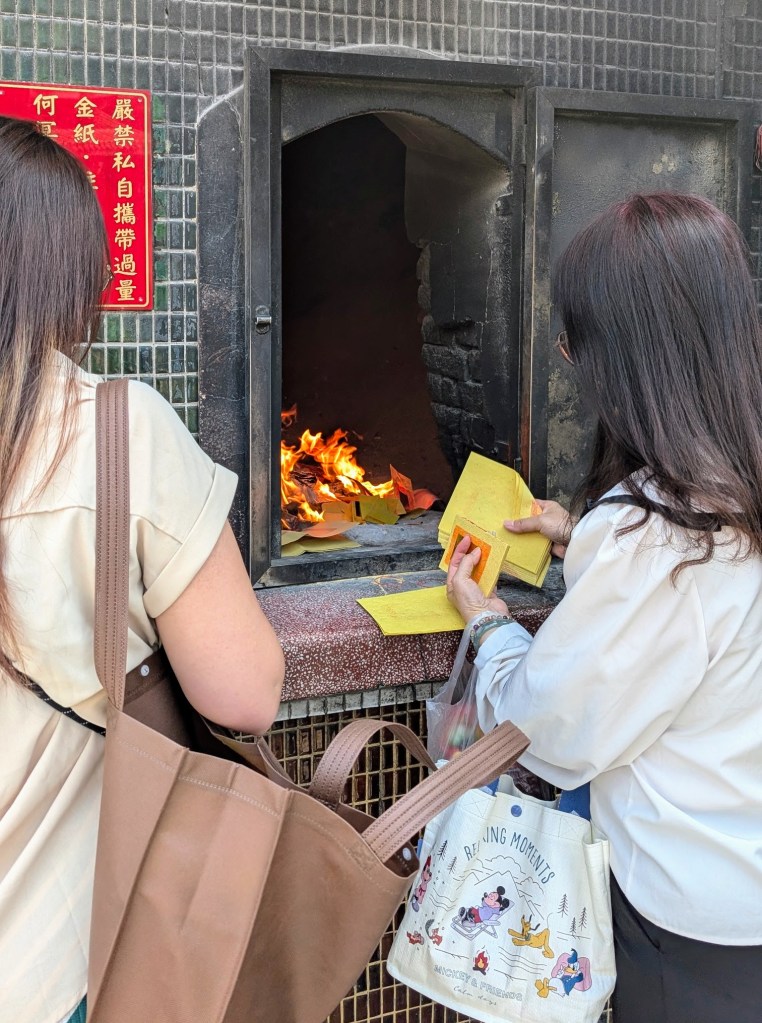
I was about leave, but some interesting ritual attracted my attention. Two young women were burning some papers in a stove inside the temple’s wall. This was a ceremony of burning “spirit money” associated with Chinese folk religions and veneration of ancestors. The idea is that the spirits of the deceased also have needs similar to living people. Burning paper representations of these needs (money, house, car) is a way to provide for your ancestors.
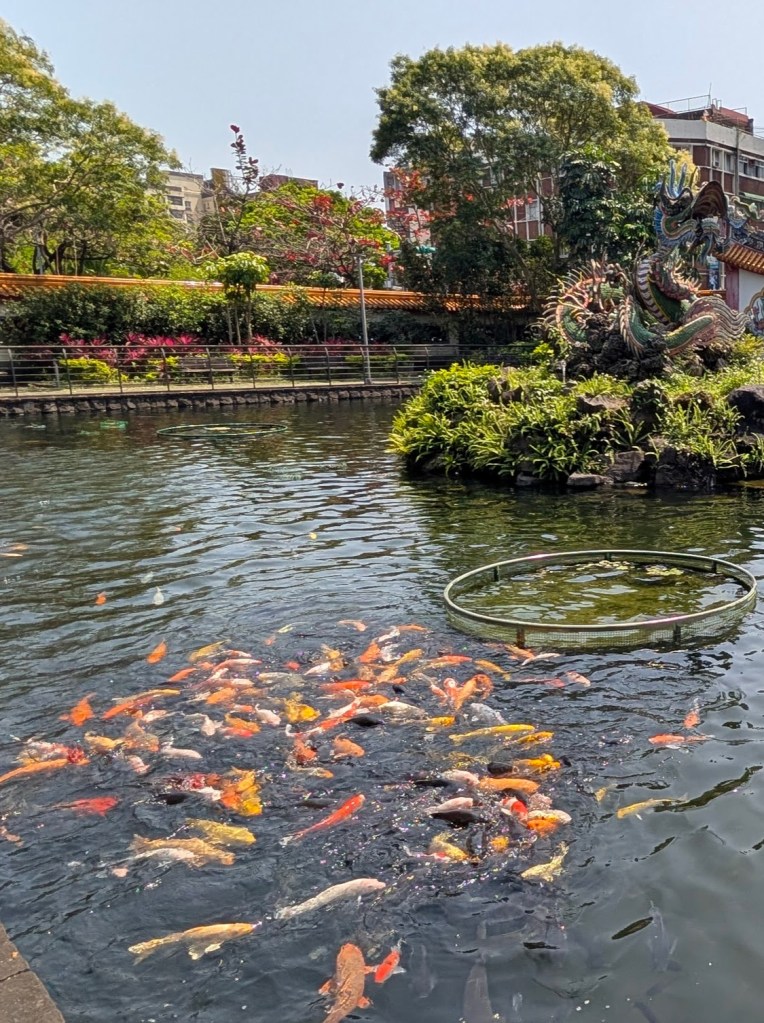
I will give you also a secret tip about Dalongdong Temple. Right across the street, there is a gorgeous walled garden. Find the gates and go inside. The garden belongs to the Temple, but it does not serve any religious purpose: it is simply a quiet place for relaxation, reading, or meeting with friends.

When visiting garden, bring some bread and have fun feeding colorful fishes in one of the ponds.
After hours of walking and “religious inquiries,” I was very hungry. Luckily, close to Dalongdong Temple, a section of Dalong Street (between Kulun Street and Chengde Road) is like a “food paradise” with dozens of eateries and street vendors offering all kinds of Taiwanese dishes.
If this is your first trip to Taiwan, definitely try huge steamed dumplings. Stuffed with different ingredients (meat, seafood, vegetables), they are very juicy and flavorful.

The Taiwanese are big meat-eaters, and many vendors display all possible (and impossible) meat products which will be prepared (barbequed, grilled, boiled) right in front of you.

But if you are a strict vegetarian, no worries: there are also restaurants offering only vegetarian options.


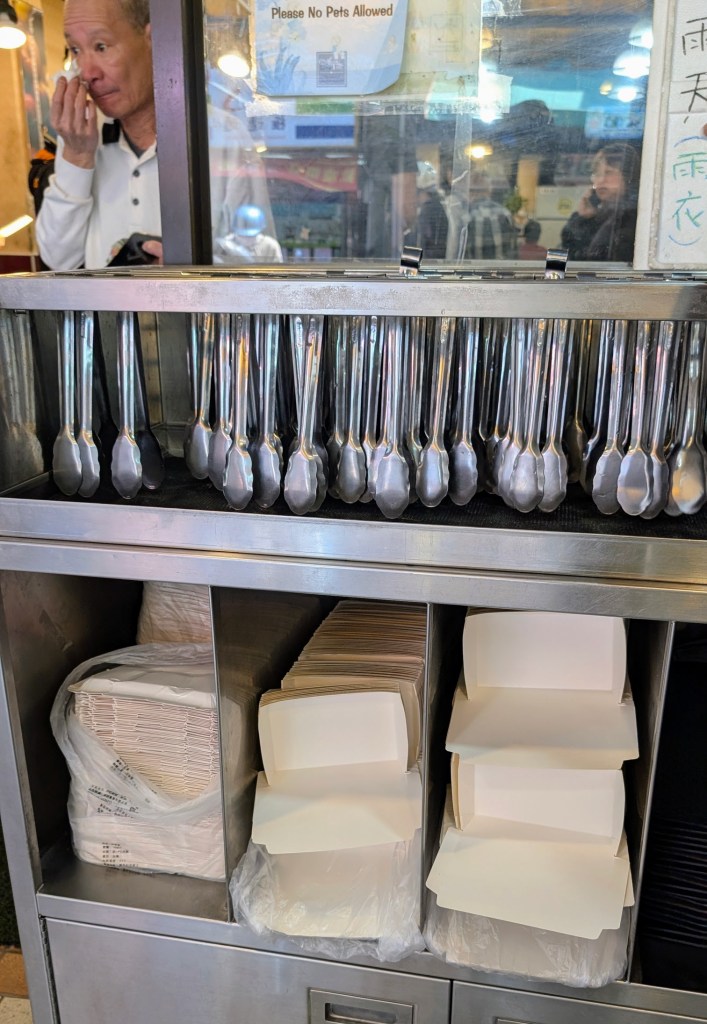
For the first lunch in Taiwan, II have chosen a buffet-style restaurant with a lot of locals queuing in front of it (which is always a good sign). By the entrance, there were paper containers, packed chopsticks, and serving tongs. Customers would take them and go inside.
Inside, a huge table offered a variety of freshly prepared dishes, ranging from strictly vegetarian to heavy-meaty options. Customers used serving tongs and loaded their paper containers with whatever seems appealing to them. For me, the challenge was that it was not easy to figure out “what is what.” Hence, the options were to either be adventurous and try randomly or find someone who speaks English and can answer my questions.
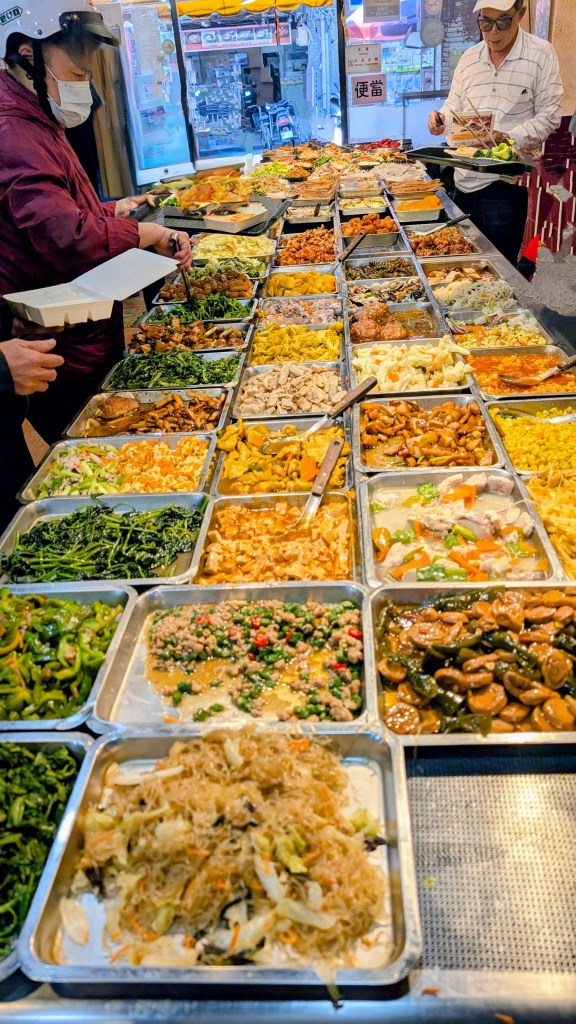
Payment was at the counter the where cashier calculated (I do not know exactly how) the cost of all selected foods. In addition, I was also offered free rice and soup. The price for my meal was ridiculously cheap. Look at the picture below: this nice selection of dishes (combination of seafood and vegetarian) costed about US$3.

There were tables inside the restaurant, but I picked up my container and walked back to Dalongdon Temple’s garden. Having a picnic-style lunch at one of the stone tables there was better than eating at a Michelin-rated restaurant.
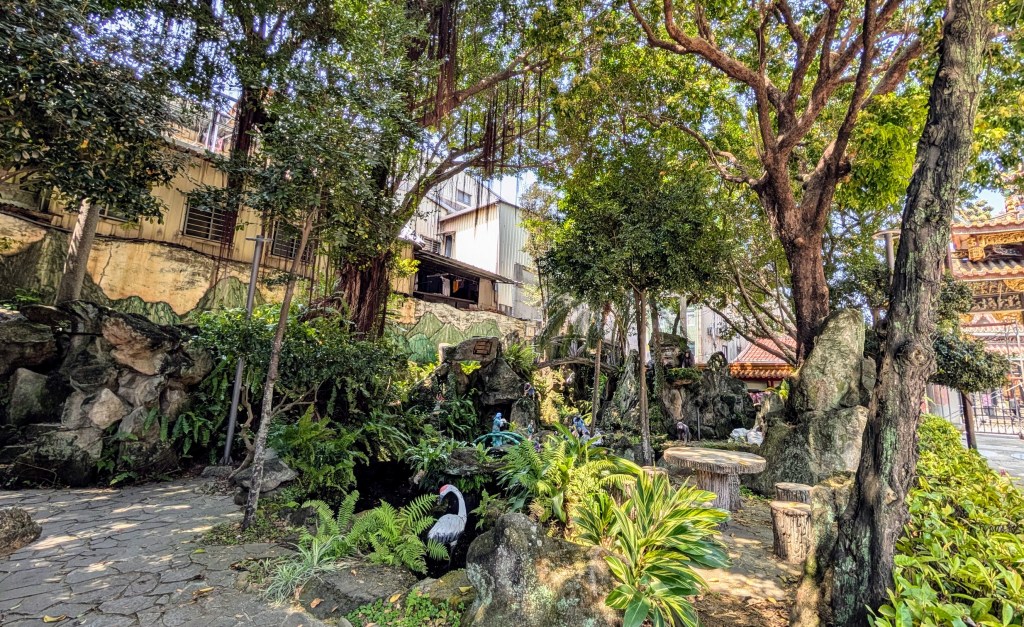
In the afternoon, I continued my exploration of Taipei. Taking public transportation between various destinations was an easy and cheap option, but I preferred to simply walk. First, by doing so, you will encounter many interesting scenes of the city’s daily life, like these old men enjoyng board games or school students playing baseball.

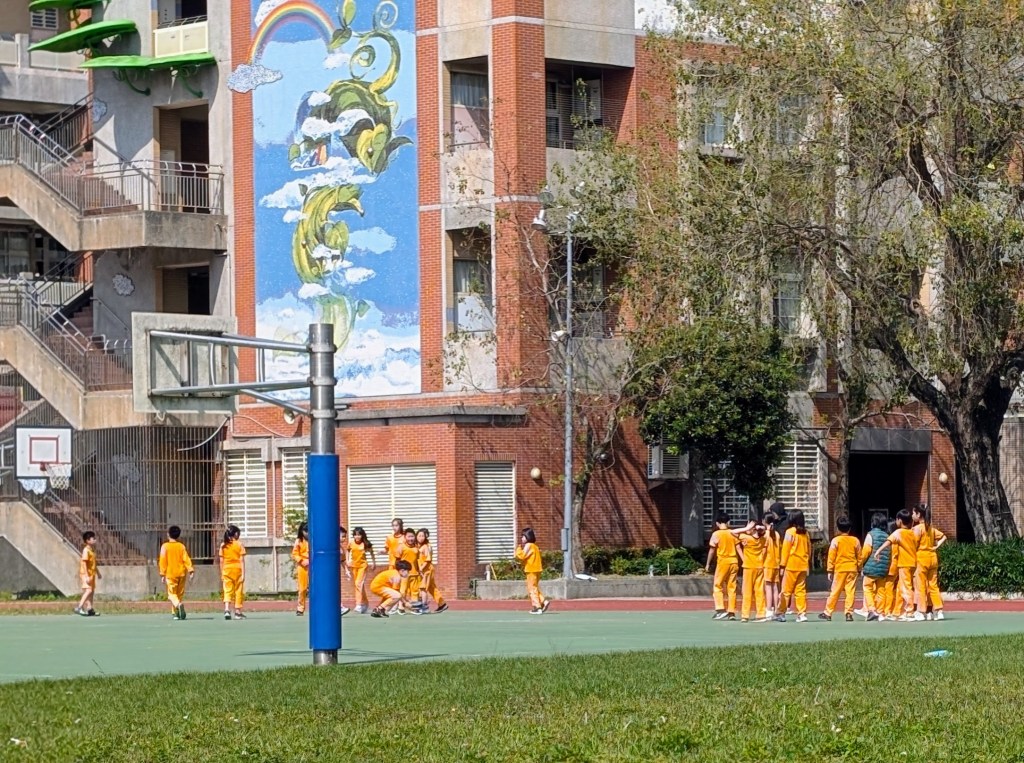
Passing one elementary school, I noted something interesting. Small kids were sitting at a table inside of a bus, and their seats were shaking. It turned out to be lessons in preparation for earthquakes, which happen fairly often in Taiwan.
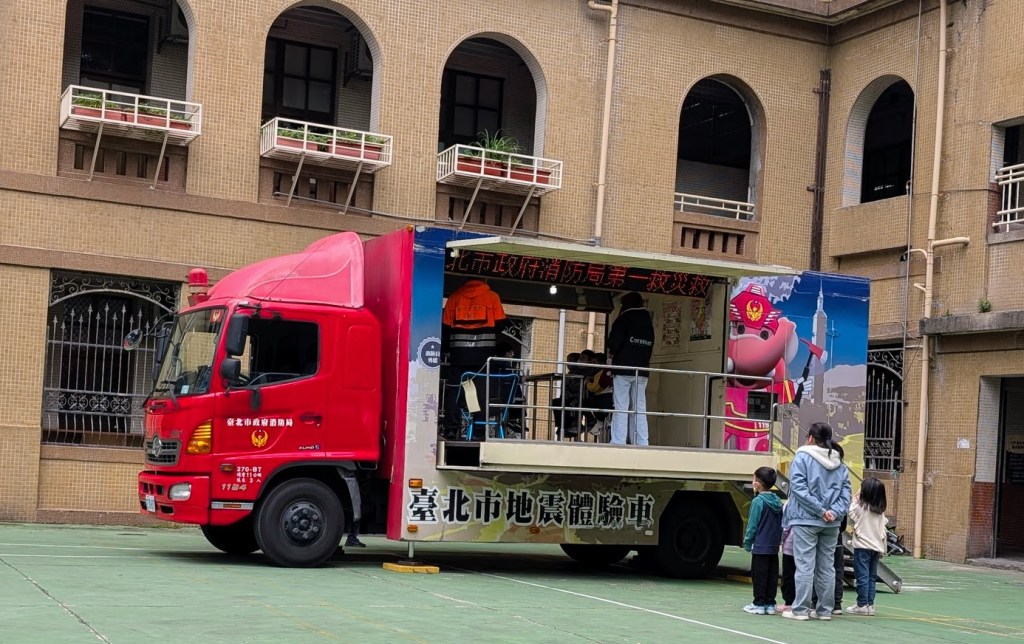
Another reason for walking the streets of Taipei is the interesting examples of architecture which blend “Western” and “Eastern” styles.


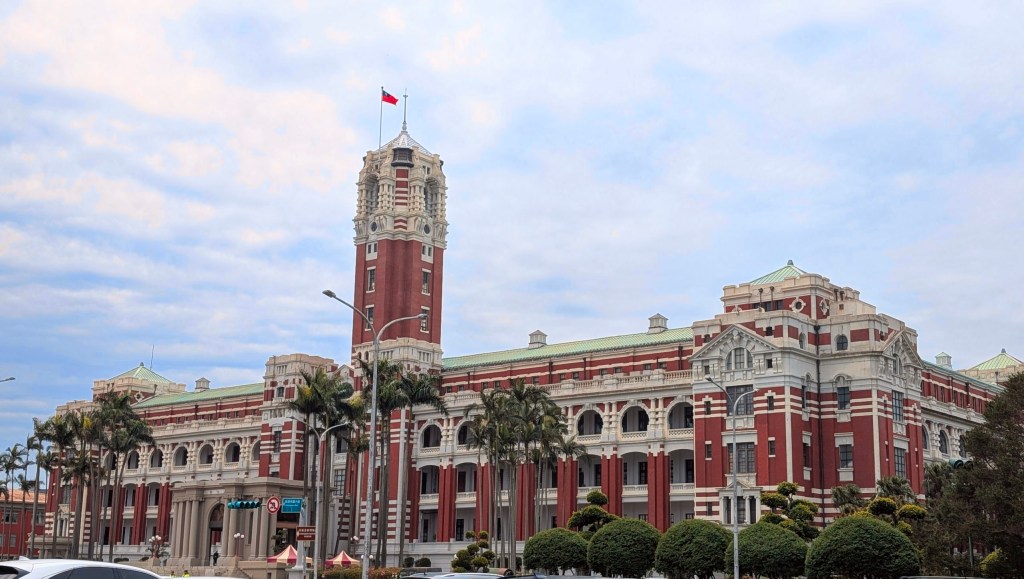
One of my destinations was the building of presidential administration. Built in 1912, it is a fine example of Japanese colonial architecture.
Another great place to visit is the 228 Peace Memorial. It is a combination of park, gardens, ponds and several monuments. This site of remembrance is dedicated to the tragic events of February 28, 1947. At that time, Taiwan was under the rule of Chiang Kai-Shek and his Kuomintang (KMT) party.
On February 28, a brutal crackdown by government agents on a woman selling illegally cigarettes sparkled widespread protests against KMT corruption and authoritarian rule of Chiang. Protesters seized Taiwan’s main radio station situated in the park and broadcasted their message nationwide.
The government responded harshly, arresting and executing thousands of civilians suspected of involvement. Further, this event ushered in a long period of political repressions known as White Terror. Today, 228 Peace Memorial Park is a symbol of both commemoration of the victims and national political reconciliation.

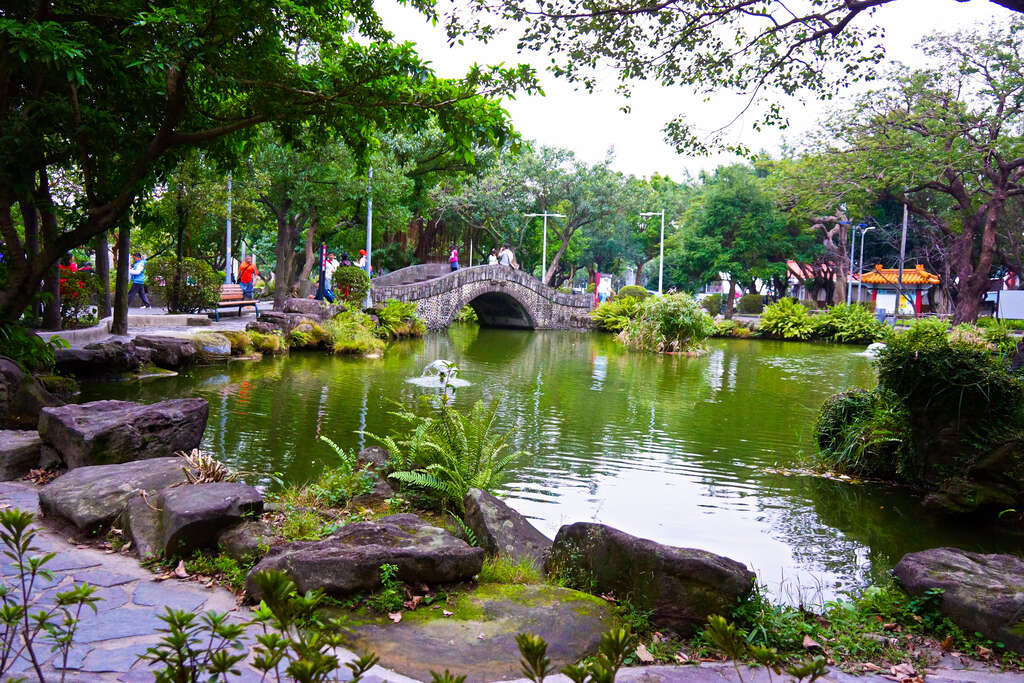
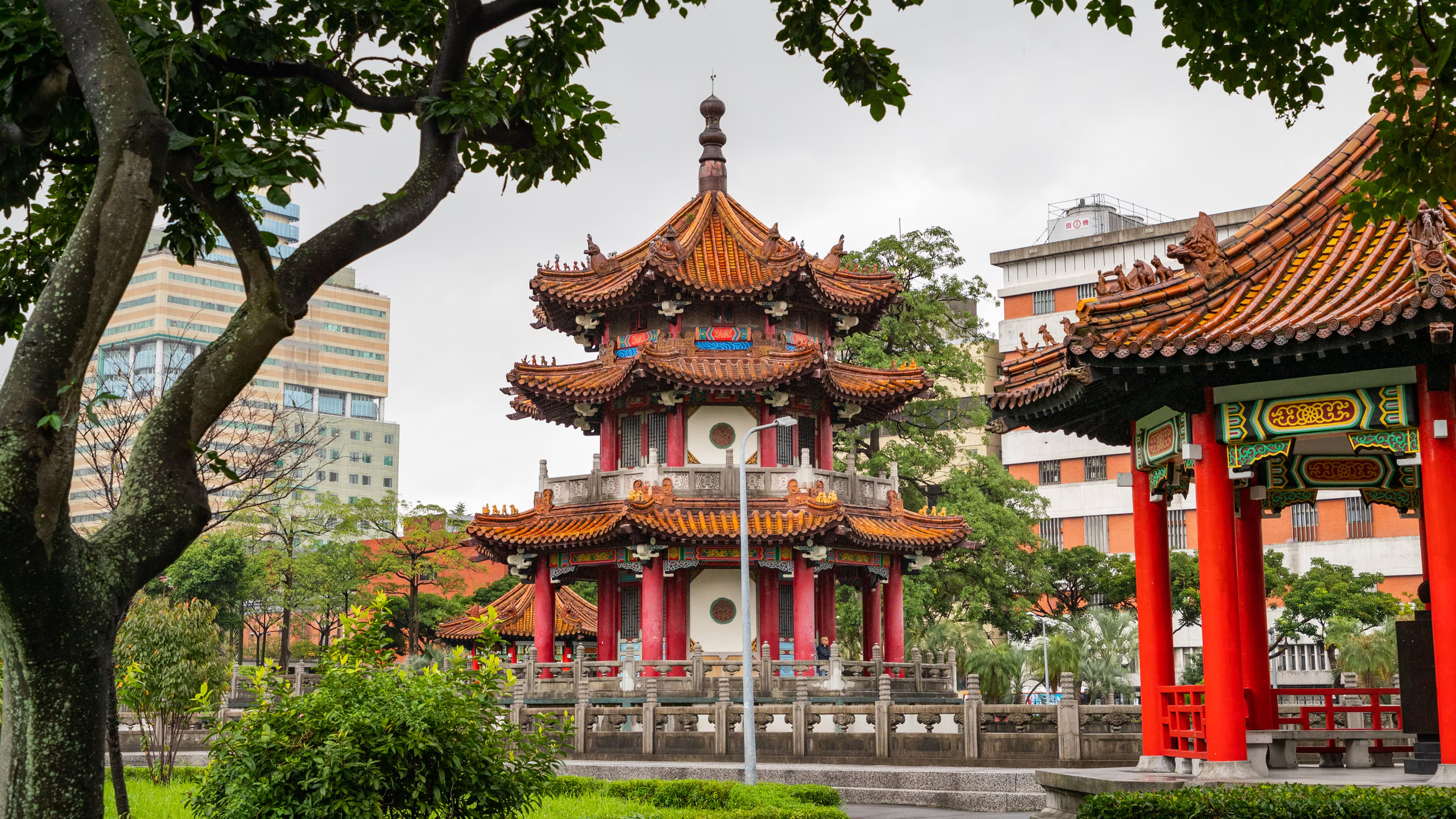
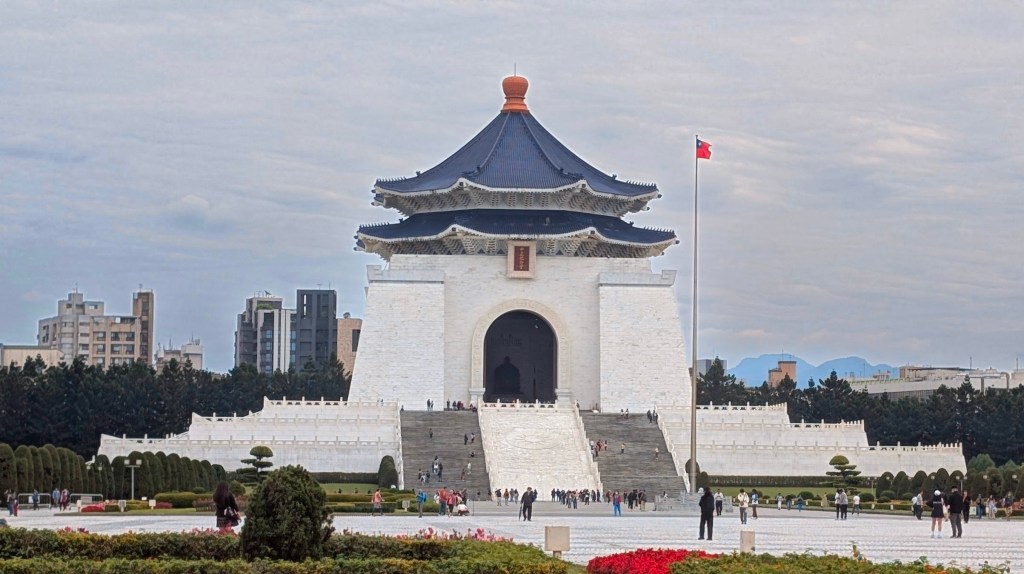
Ironically, less than 20 minutes by walk from 228 Peace Memorial, there is another no less impressive complex dedicated to the man who was responsible for the tragic events of 1947, the Chiang Kai-Shek Memorial Hall. I wrote about Chiang’s authoritarian epoque in the history of Taiwan in THIS SECTION of the post.
After Chiang’s death (1975) and following his will, his body was not buried. Instead, it was frozen, waiting for a time when it would be possible to be buried in his hometown on mainland China. Chiang’s memorial was constructed immediately after his death and continues to attract thousands of visitors regardless of his controversial legacy.
The immense Memorial Hall with the sitting statue of Chiang is somewhat reminiscent of the Lincoln Memorial in Washington, DC. However, the tribute to the Taiwanese “iron fist” ruler is significantly taller being about 75 meters / 240 feet high as compared to only 30 meters / 99 feet in the case of Lincoln monument.
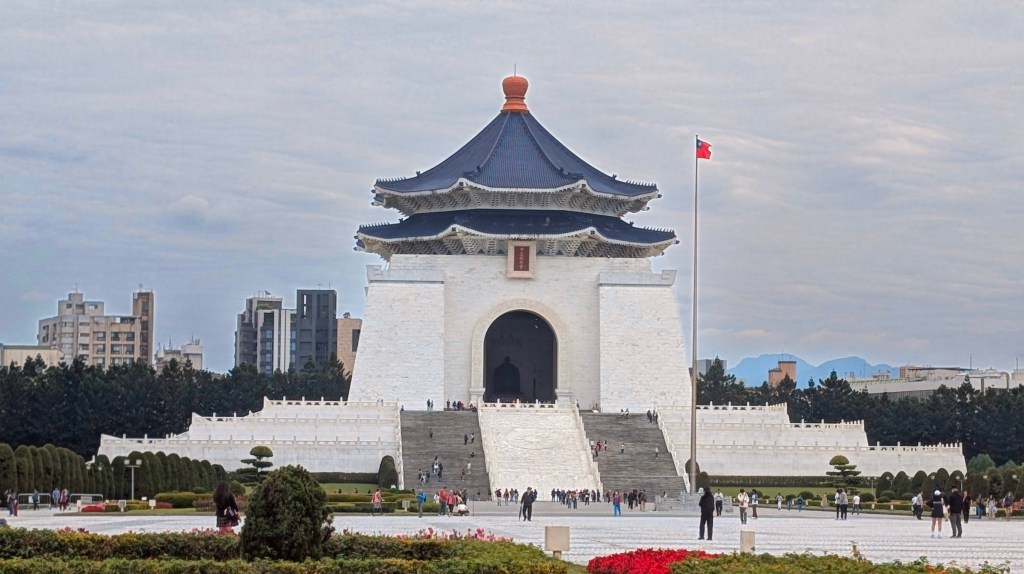
Memorial Hall is flanked on both sides by the ornate buildings in traditional Chinese palatial architecture style. One is home to the National Concert Hall, while the other serves as Taiwan’s National Theater.

The dusk was approaching, and I rushed to the last destination of the day: Elephant Hill (official name is Xiangshan Mountain). It is the best spot to have a panoramic view of the city and catch sunset. To get there, go by metro to Xiangshan station, walk about 20 minutes through the park to “Xiangshan Trail” (there are signs showing directions), and then climb 600 stone steps to the top of Elephant Mountain.
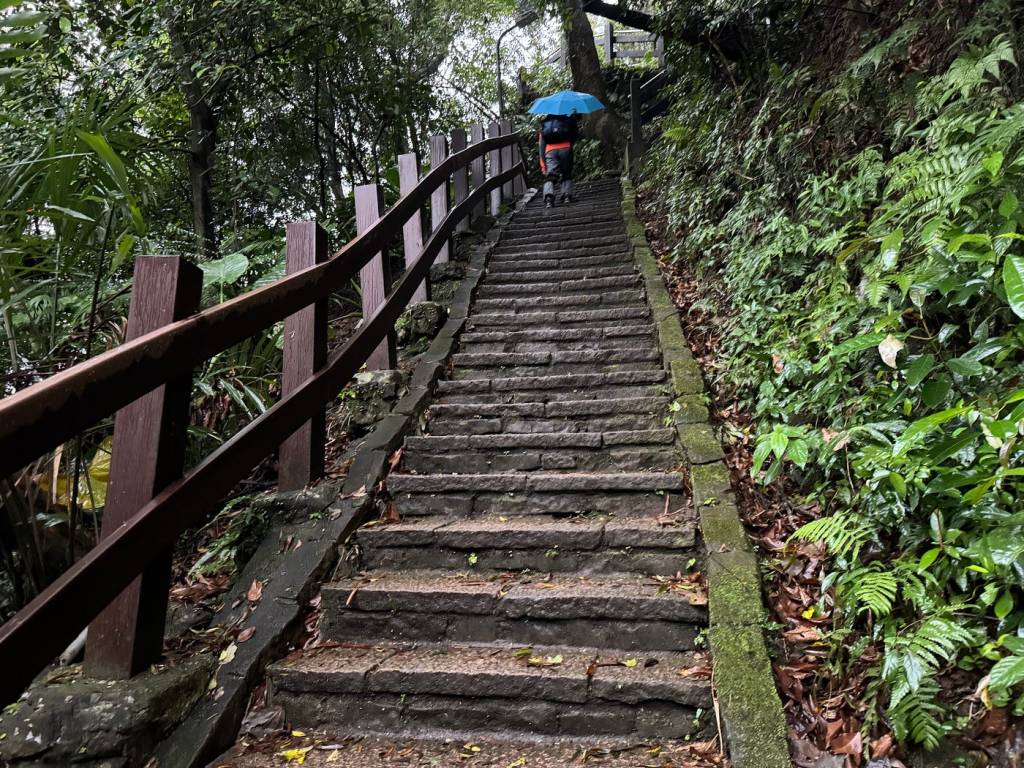
At the very top, there is an interesting bronze monument which represents an elephant. Predictably, the bench at the right side of the monument is a popular spot for taking pictures.

However, the best view of the city is from a place which is a bit lower. About a hundred steps down the trail, you will find several huge stones.
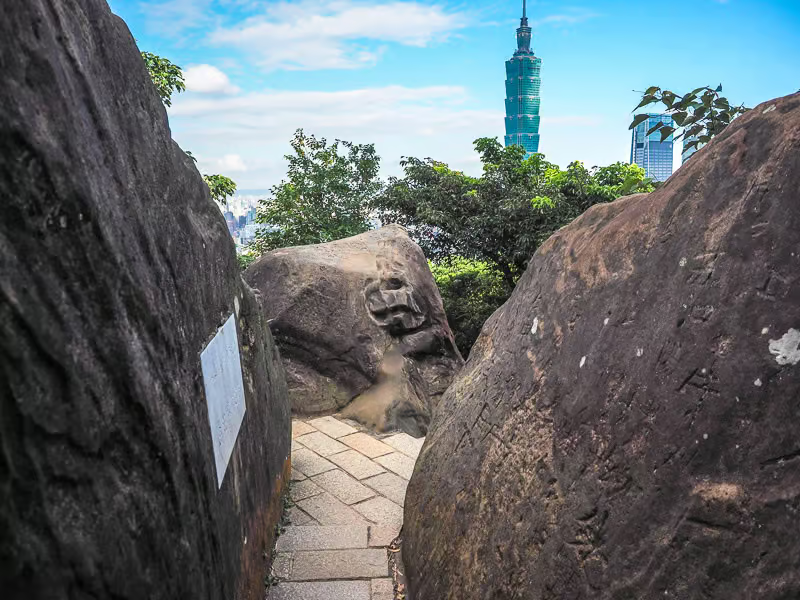
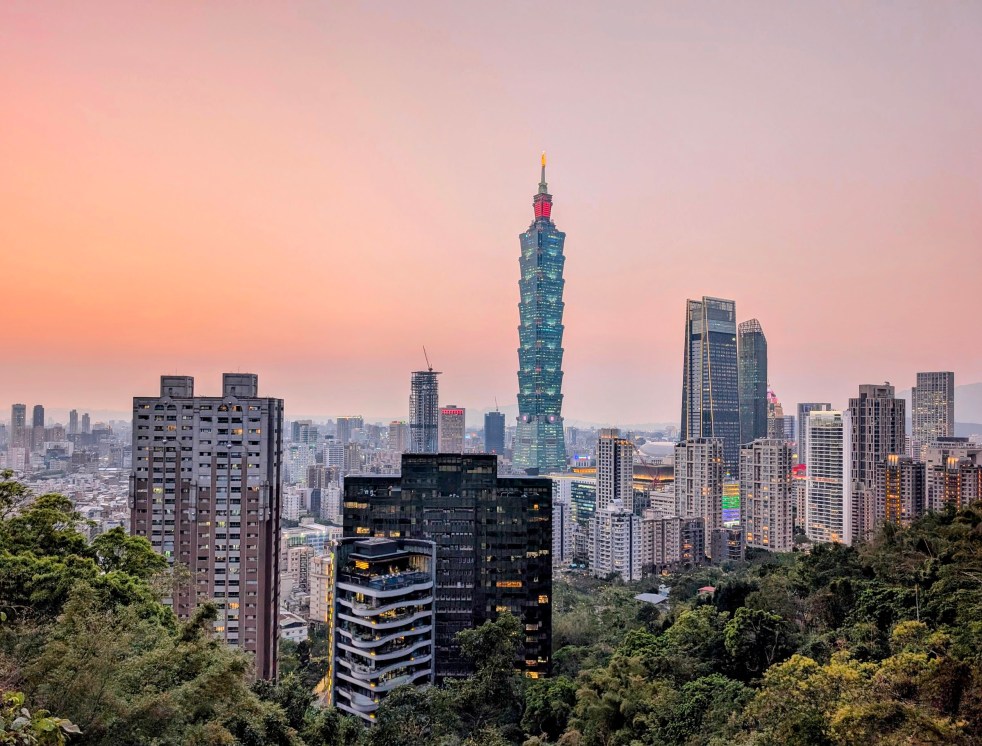
I climbed on one of these rock and enjoyed the sunset with picture-perfect view of the iconic Taipei 101 Tower.

By the way, Taipei’s 101 Tower held the title of the tallest building in the world from its opening in 2004 to 2010. There is an observation deck on the 89th floor which offers a 360-degree view of the city. But I saved that for my next trip to Taiwan.

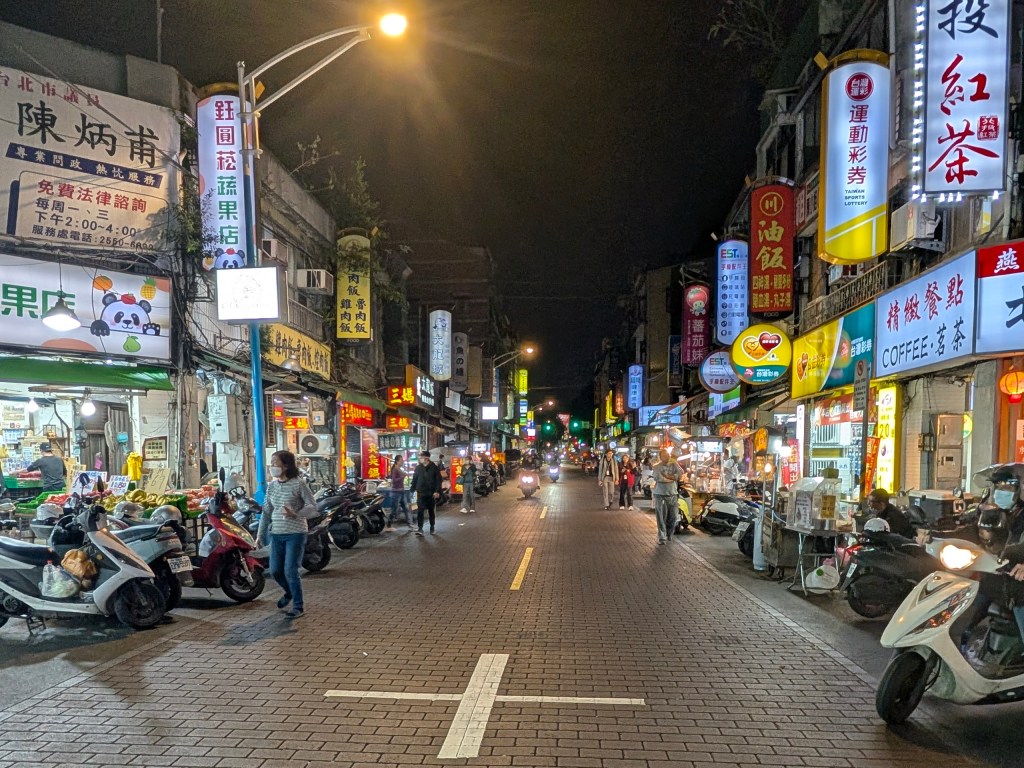
After sunset, I returned to the “food paradise” area on Dalong Street. In the evening, the street turned into one of those Night Markets that Taiwan is known for.
When traveling in Taiwan, visiting Night Markets is a “must experience.” They operate in many cities (Taipei has several of them), bein open after sunset and late into night. Some of them have evolved into purpose-built marketplaces, but most simply occupy sidewalks or entire streets.
Essentially, each Night Market is an eclectic mixture of stalls selling various goods, offering entertainment, but, most importantly, providing a great variety of foods, snacks, and drinks.
My choice for dinner was a hearty dish of noodles mixed with various vegetables and spices which was prepared right in front of me.

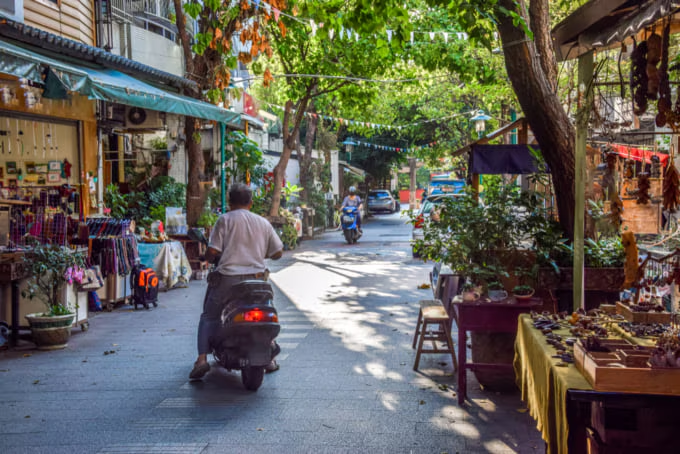
It was late when I walked back to the Old Door Hostel, but the streets were alive with many residents running on their scooters in all directions. During following trip through the island, I would learn that scooters are the most popular and efficient mode of personal transportation in Taiwan’s cities.

Yangmingshan National Park
Taiwan boasts a stunningly diverse natural landscape. Outdoor enthusiasts flock here to experience the dramatic marble cliffs and turquoise rivers of Taroko Gorge, mist-shrouded mountains like Alishan and Yushan, volcanic hot springs, serene lakes like Sun Moon, and a coastline dotted beaches and unique geological formations.
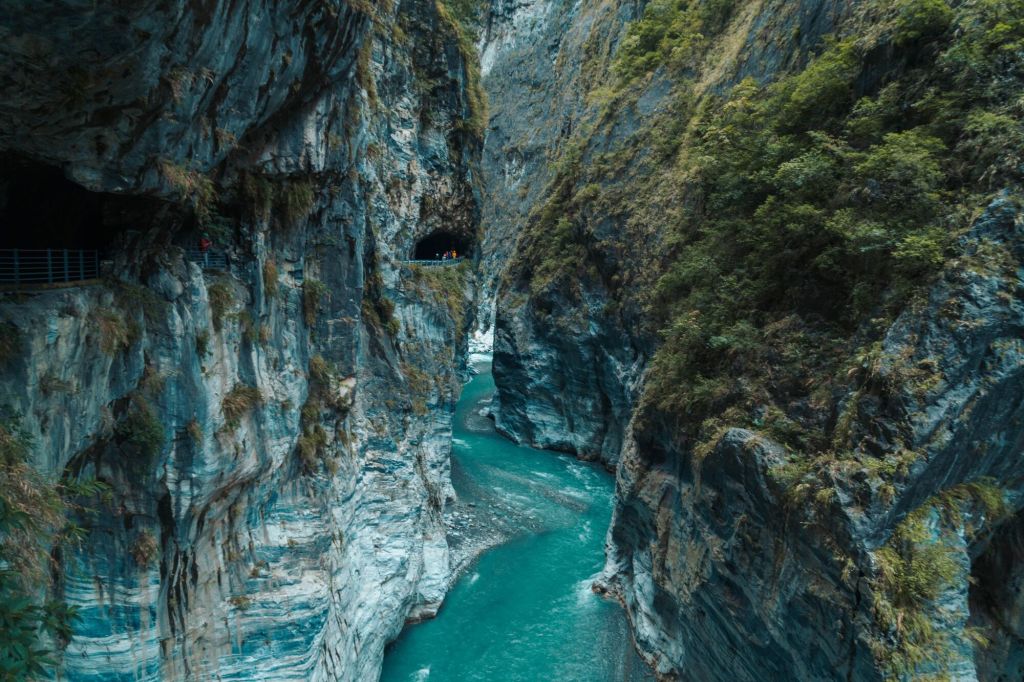
Visiting these natural wonders is easy, because Taiwan has an extended system of well-organized national parks. Some of them (like Taroko or Alishan) attract a lot of tourists, while some are less known, albeit no less attractive: each it its own way.
Yangmingshan National Park is near Taipei and can be easily visited on a day trip. It is known for cherry blossoms, flowers (azaleas, lilies), hot springs, and many hiking trails including Taiwan’s tallest dormant volcano, Seven Star Mountain (3,675 ft / 1,120 m).

The easiest way to go from Taipei to Yangmingshan is by bus #260 from Taipei Main Station. It is a scenic 40 minute ride and the last stop is Yangminshan MTC bus terminal. At the terminal, you need to transfer to #108 bus, which is a shuttle connecting all major areas in the Park.
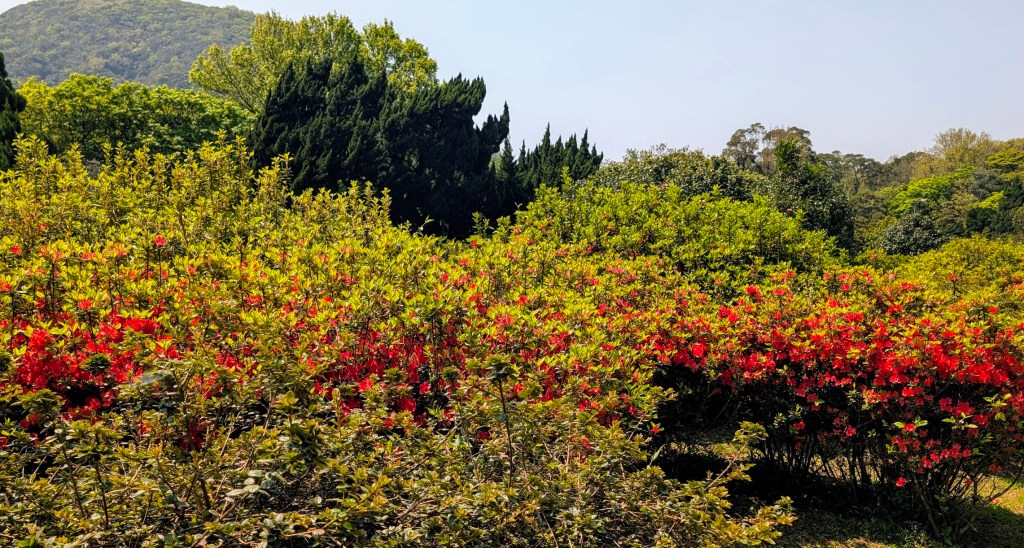
I first stopped at the Park’s information center, told the rangers what I want to do, and they helped with all planning and logistics of going “from point A to B.” From the information center, I walked to Azalea and Camelia Garden. It was early April, and flowers were abundant.

Then a short, 30 minute hike brought me to one of the most photographed parts of the park, the Flower Clock. As the name suggests, there is a clock made out of flowers and, predictably, tons of people making pictures and hanging around.

Regardless of tourist crowds, the area around the Flower Clock is undeniably scenic with flowers and natural streams creating a peaceful and yet vibrant setting.
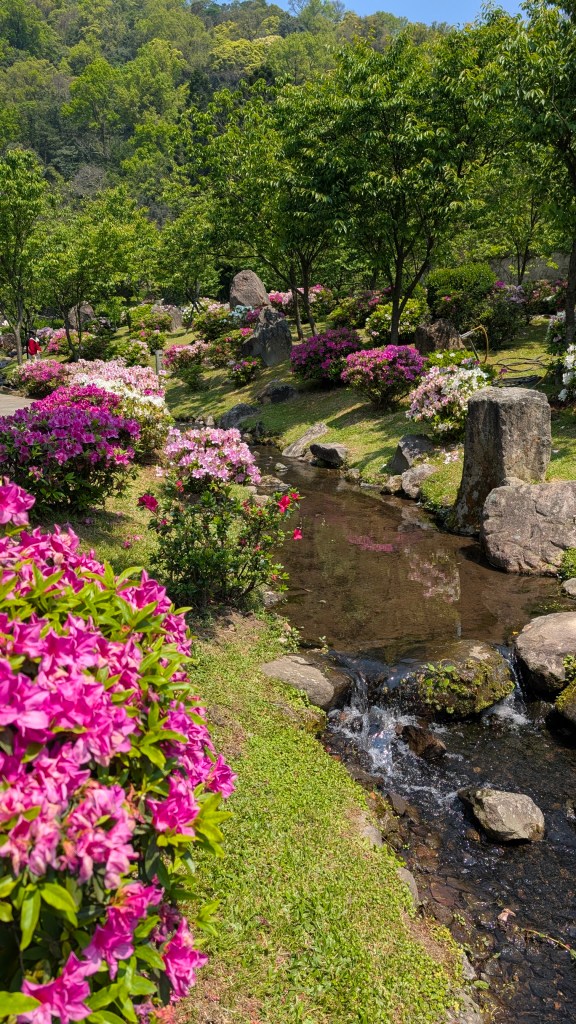

After the Flower Clock, I took a bus to Bamboo Lake, an area of the park which is known for its lilies. From the bus stop, most tourists walk along the only road which is lined with overpriced restaurants and shops selling fresh lilies and all possible lily-related souvenirs.
Instead, I followed the trail which meandered along the stream (trailhead is also right next to bus stop) and into the fields where lilies are grown.


After walking the entire trail (only about half a mile) and crossing the stream, I found a quiet spot with a scenic view of the valleys and mountains. Surprisingly, despite crowds of tourists just a few hundred yards / meters away, very few of them came here.

In the afternoon, I hiked to Datunshan Lookout, which is arguably the best viewpoint in Yangmingshan. There are several trails leading to observation deck, and, with the assistance of the Visitor Center, I have chosen the shortest one: slightly more than one mile. The trailhead was right next to one of the bus stops, and it was no problem to get there.
Alas, while being the “shortest,” the hike was not easy. Most of the trail was a steep ascent via stone steps. It has taken over an hour to reach the final destination.

Yet, reaching finally the lookout was a rewarding experience. Observation deck had telescopes and plenty of explanatory materials about what people see gazing in different directions.

The day was somewhat hazy, but, nevertheless, the view over the entire Taipei in the distance was quite impressive.

I returned to the road, took #108 and then #260 bus, and was back at the Old Door Hostel at around 8 pm. I wrote previously that the Hostel’s lobby includes a lovely coffee shop and a bar. And not just a “regular bar:” it offers great variety of whiskeys produced specifically in Taiwan.
And so, having a “night cap” after a full day exploring Yangmingshan felt like a perfect idea.

Minxiong: Visiting Non-Tourist Place Is a Good Idea
Minxiong is a big town/small city (70,000 residents) in Central Taiwan. Geographically, it is very close to the county capital, Chiayi, which is much larger and serves as a gateway to Alishan National Park. If you google “Minxiong,” you won’t find any particular attractions or reasons to visit. So, why did I decide to go there?
First, I simply wanted to see a “normal” non-tourist Taiwanese town: walk its streets, look at people, shops, and businesses. Second, I am a member of an international organization called SERVAS. Established in the late 1940s in the USA, SERVAS has become a global hospitality network, with people traveling and staying with each other: both domestically and internationally.
Two SERVAS members live in Minxiong, and they invited me to come and spend time with them.

By the way, SERVAS is different from organizations like Couchsurfing, because its purpose is not to simply offer free accommodations. Rather, it emphasizes cultural exchange and understanding of the local life. Essentially, when staying with SERVAS, visitors are treated almost like members of their hosting families.
And so, I felt very excited boarding the direct express train from Taipei Main Station to Minxiong. If you skipped introductory section of this post, read HERE about traveling by trains in Taiwan. Bottom line: riding train in Taiwan is comfortable and pleasant experience.

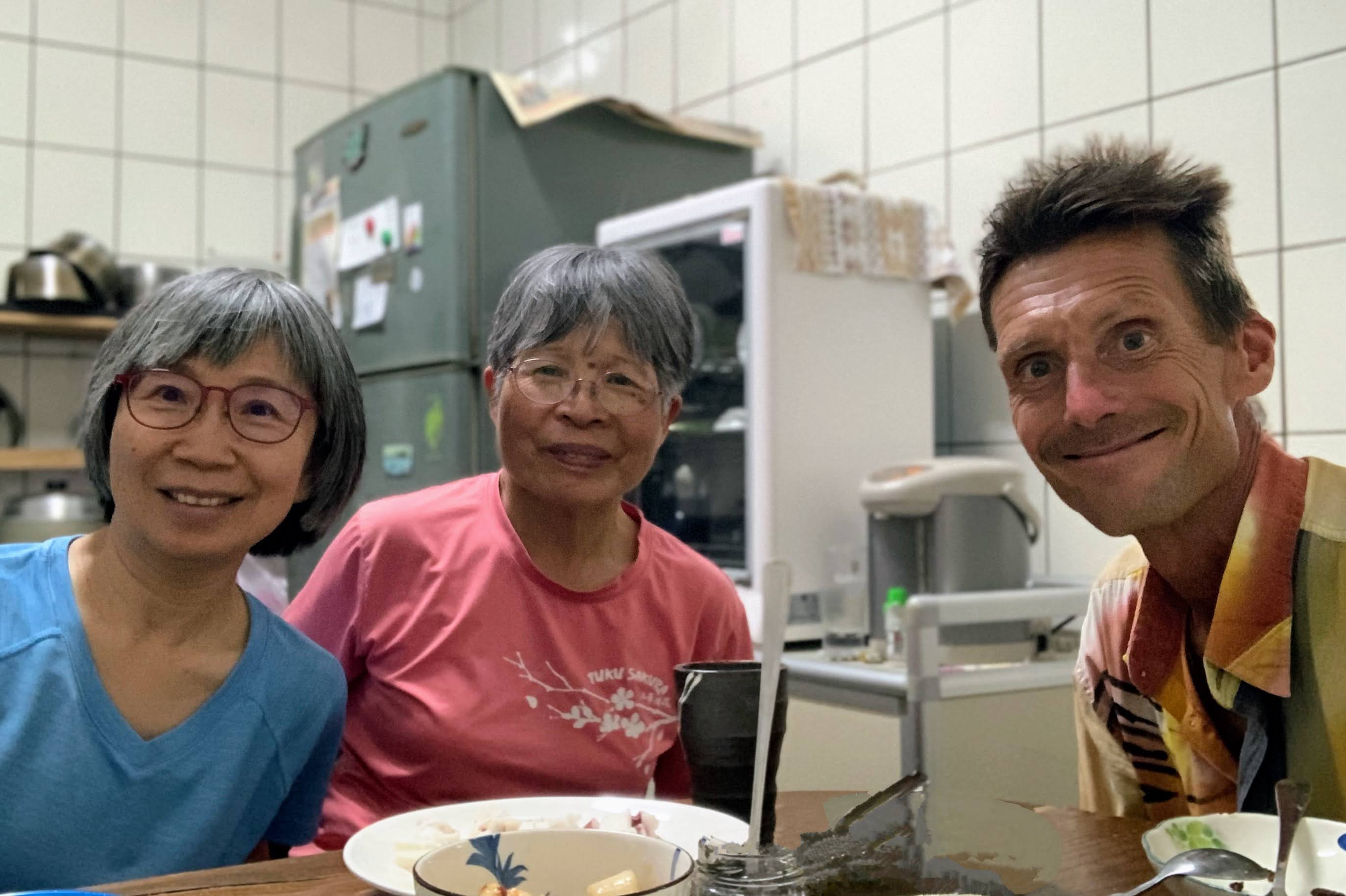
My SERVAS hosts in Minxiong were two cheerful ladies, two retired school teachers, Grace and Kalima. They met me at the station and brought to Grace’s home. We had lunch and a “strategic planning” session on what to see and to do.
Minxiong prides itself as a “pineapple capital” of Taiwan. There is a big pineapple farm near the town, and this was our destination for the afternoon. It turned out to be a lot of fun: almost like a small “Disneyland” with various experiences related to pineapples. In fact, Google maps even show this farm as “Pineapple Hill Culture Park.”

At Pineapple Hill, you can learn quite a few things about this fruit. For example, a lot of people think that pineapples grow on trees. Wrong. They grow from the top of a bush-like plant with spiky leaves.
Also, growing pineapples requires patience. It usually takes 2-3 years for a plant to produce first fruit, and it typically yields only one pineapple per season.

I was not aware that there are so many different kinds of pineapples: varying in shape, colors, flavor, and areas where they grow. Well, folks at Pineapple Hill managed to cultivate quite a few varieties, and visitors can taste “side-by-side” different sorts of pineapples.

Pineapples have a high content of “bromelain,” an enzyme with a long history of use in traditional medicine: particularly, to fight indigestion and inflammation. Also, the ability of bromelain to break-down proteins is the reason for using fresh pineapples in marinades as they help to tenderize meats.
Pineapple Hill has an information center which doubles as a cafe and a shop. Inside, you will be given free samples of pineapple cake (delicious!) and pineapple vinegar (which is more like a drink). And then you can peruse an extensive catalogue of various pineapple-based items produced and sold by the farm: cakes, cookies, wine, vinegar, dietary supplements, ice cream, and much more.

We bought a good supply of fresh pineapples, and the fellow who sold them provided an interesting piece of information. He said that using the top of the fruit, we can grow a new plant. The suggestion was: to twist off the leafy crown, let it dry for a bit, and then plant it in soil.

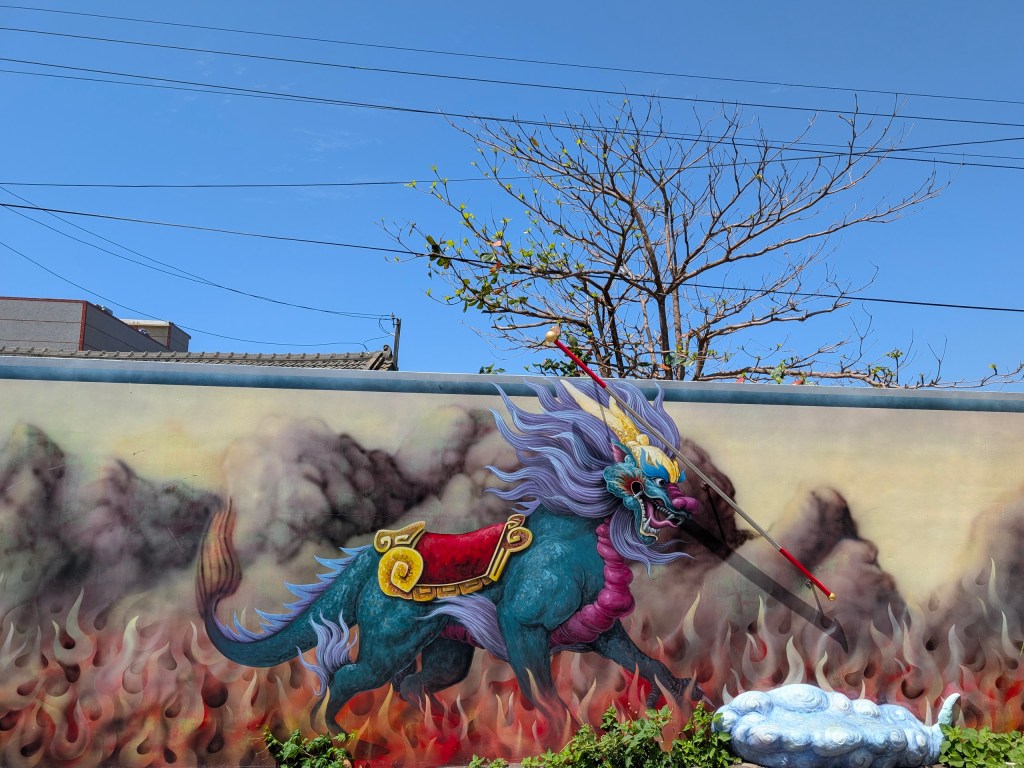
The next day, we drove toward the coast and to a rather surprising place near Kouhu village. Playing with Google maps and photos, I stumbled – purely by accident – upon a settlement which looked like an open-air art exhibition. Walls of the houses and fences were covered with elaborate and large-scale paintings. Neither of my local hosts knew about this place. Here is the location on Google maps.
When we arrived, the village appeared absolutely empty: not a single soul on the streets and no one to ask. Then we spotted a large Buddhist temple, went there, and discovered first portion of wall paintings. And they were, indeed, impressive.
Grace and Kalima explained that many of the images were related to a popular Chinese mythology about the adventures of a certain Buddhist monk who traveled from China to India.

Some of the paintings had an amazing 3-D effect. Like this one.
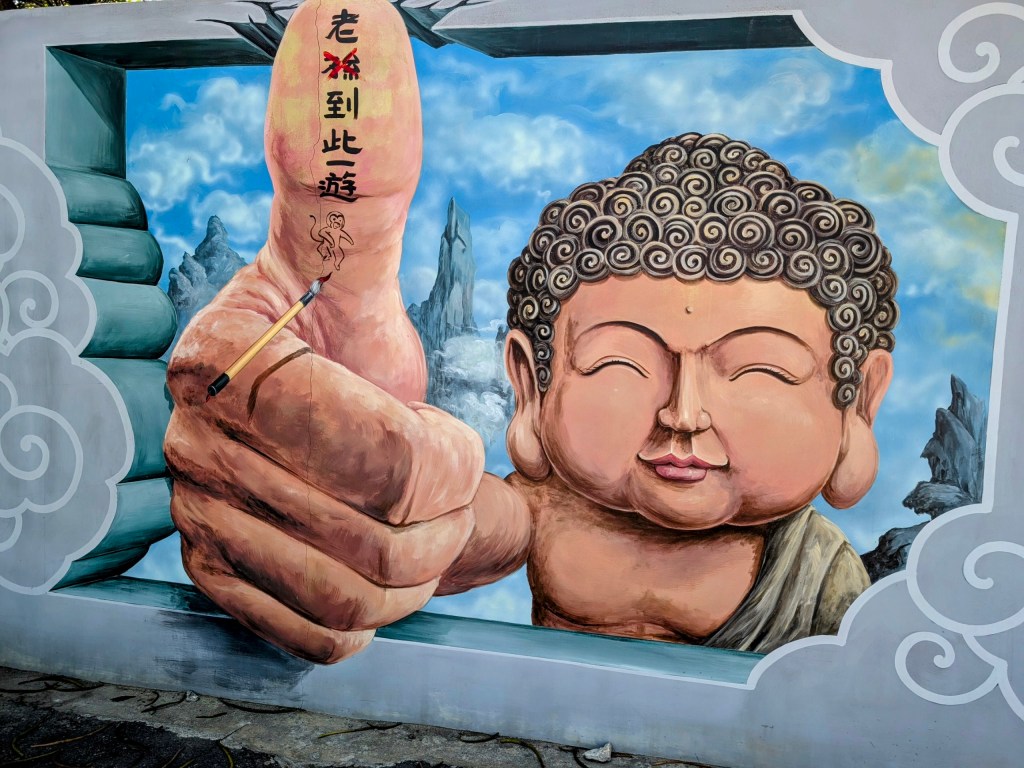
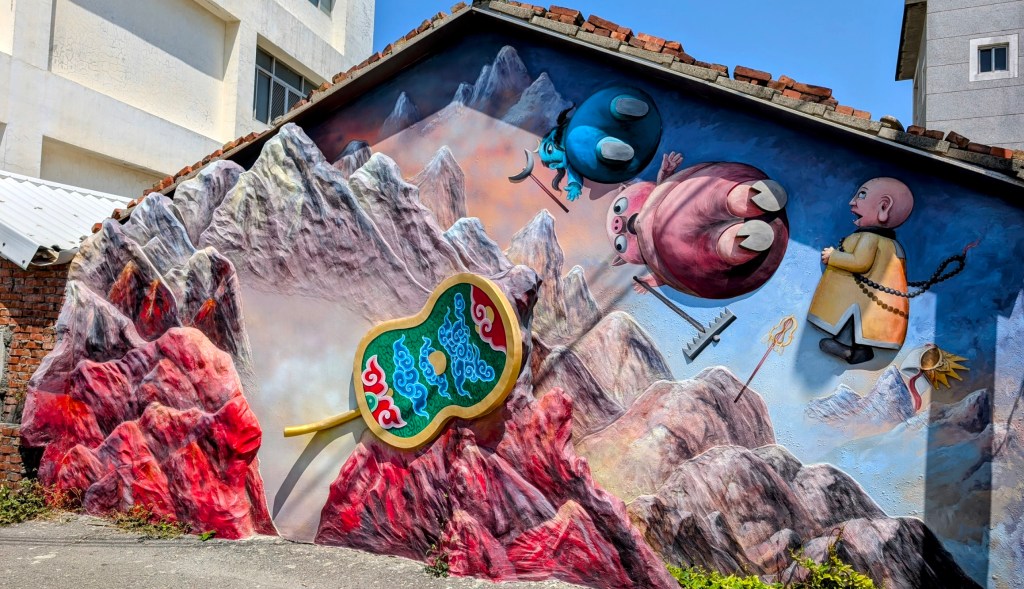
I was especially impressed with one image. Look at the two pictures below. This is actually the same painting, but the photos were taken at two different angles: from the right and left sides.


Desperate to find someone to ask questions, we walked the streets and uncovered more paintings, but not people.
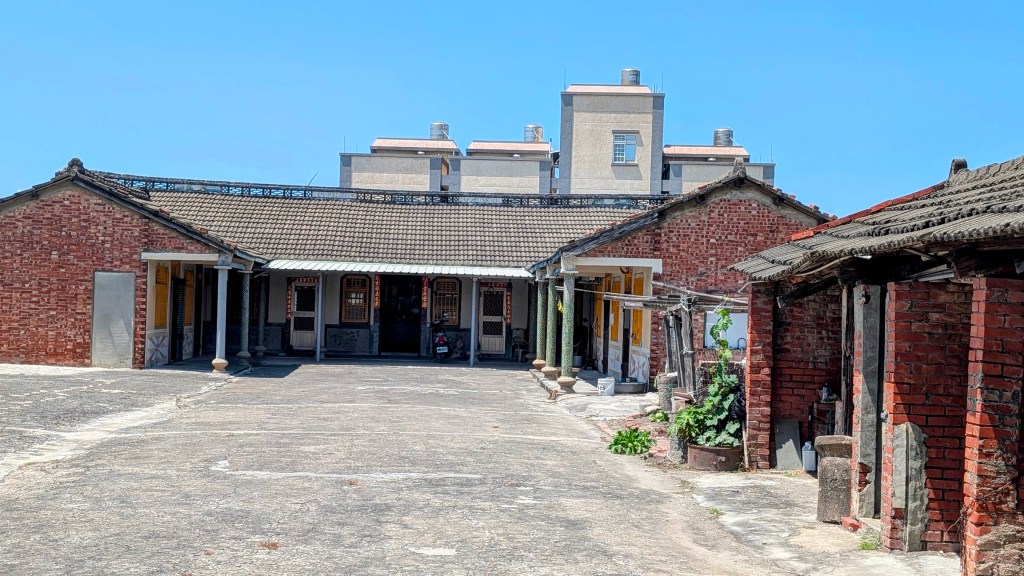
Grace, one of my hosts, stopped at a house which according to her presented a fine example of the traditional local brick architecture.
While we were taking pictures, the door opened and an elderly lady stepped out, the first human being whom we found in this village. She told us that all art works were made by master Zeng Jincheng who is alive and, actually, lives nearby.
And then she told us about living in this village which used to be a flourishing fishermen town (the sea is near), but is now almost abandoned, because all the young people moved away to larger cities in search of better living.

We spent couple of hours in the village and were hungry. Kalima suggested that instead of finding restaurant, we visit her friend who lives only 20 minutes away and who is a genuine master in two very different occupations: carpentry and cooking. Clearly, I was happy to meet another local person, especially, with such a combination of skills.
When we arrived, Itsuki had already started preparations for a rather special dish. What we were about to enjoy was a prized delicacy called “Wuyutsu” or “Karasumi.” It is made by salting an entire pouch of mullet roe and drying it slowly in sunlight.
Itsuki quickly heated both sides of a defrosted piece of Wuyutsu.
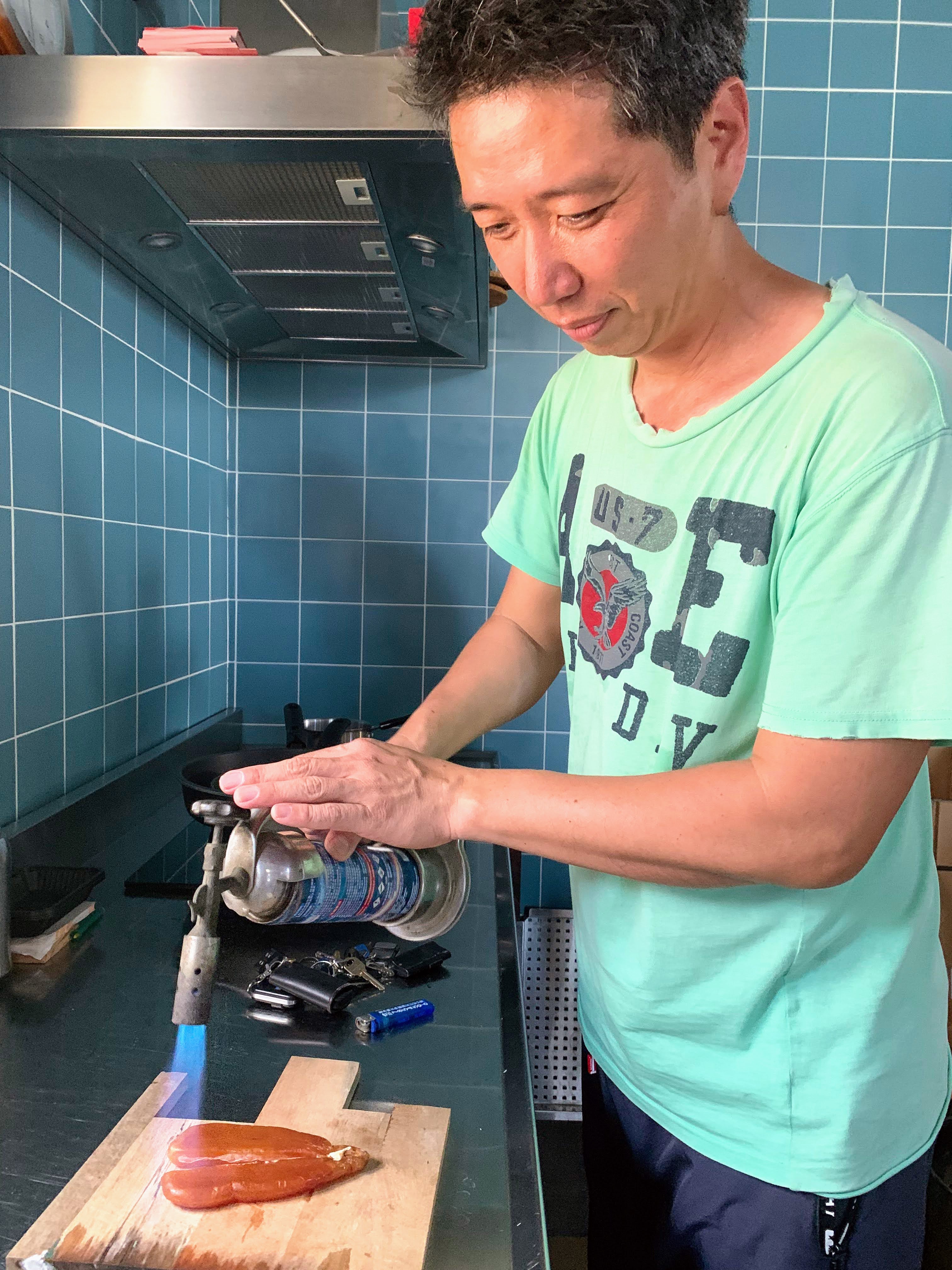
Then cut it into very thin slices.

And then Wuyutsu was served with small wedges of young garlic and apples. This sounds like an unusual combination, but it actually tasted great. Some people compare Wuyutsu to Italian Bottarga, but I personally think that Wuyutsu is much better: softer, and with a richer and more buttery flavor.

What started as a quick lunch, evolved into several hours of conversation and tasting more home-made foods and preserves. The meal was properly “crowned” with – also home-made – plum-based liqueur.
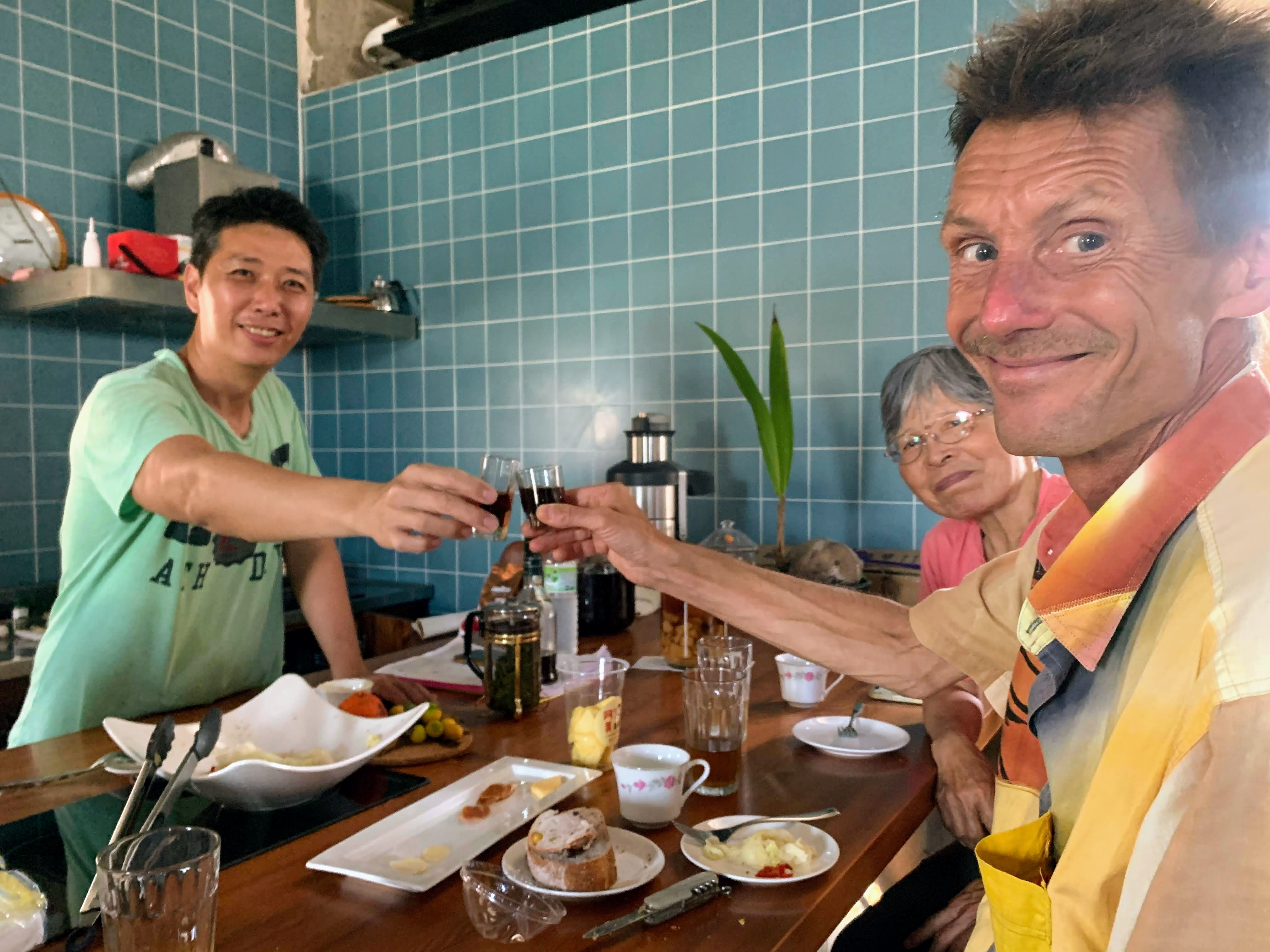
Our host suggested that we hang around for a few hours, and then he would make a full dinner. This was a tempting proposition, but we made already some plans. I wanted to see an authentic working fishing town and we went to Taizi village.
Late afternoon was a good time to be there, because all vessels were in the harbor (most fishermen go into the ocean at night), and I could learn about different boats and fishing methods.
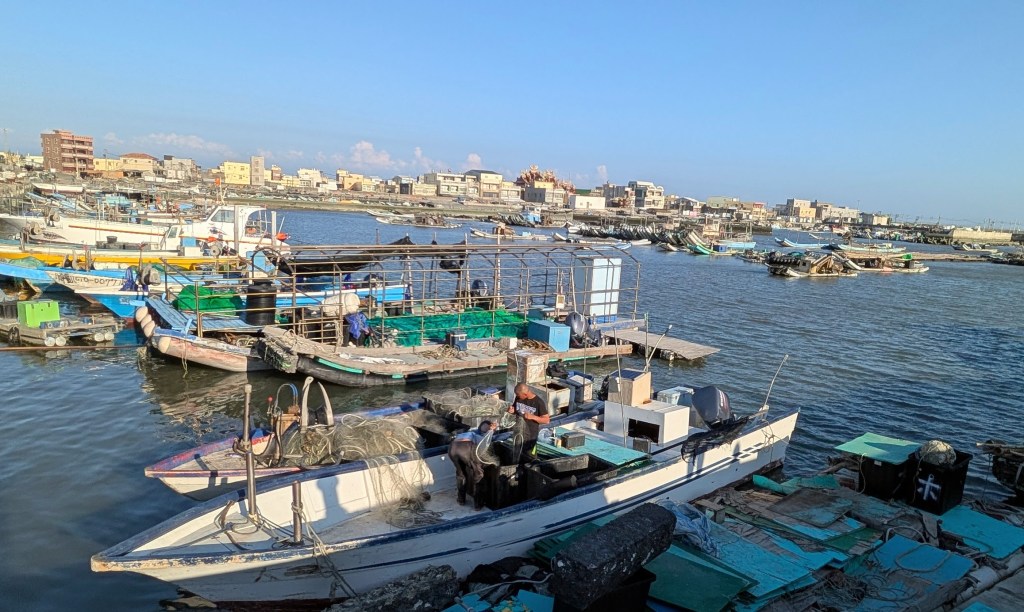
Local people catch various fishes, but oysters are what Taizi is really known for. Oyster-beds are built close to the shore and yet in an open sea. Consequently, the final product can be seen as truly natural “wild” oysters, unlike the ones grown commercially in the ponds.

Grace said that she would make one traditional Taiwanese oyster dish for dinner, and we got a good supply in a store next to the harbor.

Back home, Grace prepared an oyster omelet, one of iconic Taiwanese dishes.

As simple as it may sound, preparing a genuine Taiwanese “oyster omelet” requires good skills and certain ingredients. Starch (typically sweet potato starch) is mixed in a particular manner into the egg batter. Then different local greens and herbs are added, making dish truly flavorful. Depending on regional variations, a savory sauce may be poured on top of the omelet for added taste.

Our dinner was not limited to the omelet. In combination with seared scallops, squid, and sauteed oysters, this was an opportunity to try different kinds of local seafood.

I was immensely grateful to Kalima and Grace for two fun and full of experiences days, for sharing with me their homes, lives and friends. The next day, I left for Tainan. which is considered the oldest city in Taiwan.
Tainan: Cultural and Gastronomic Capital of Taiwan
Located on the southwestern coast, Tainan is considered the oldest city in Taiwan, and it served as the island’s capital for over 260 years (1624-1887). The city has an incredible concentration of historic sites: from colonial Dutch forts to countless ornate temples devoted to various Gods and events.
Beyond its heritage, Tainan is regarded as the “food capital” of Taiwan, offering an astonishing array of traditional dishes. Many Taiwanese also describe Tainan as the “cultural capital” of the nation, because it maintained original folk culture and local traditions better than cosmopolitan Taipei. Finally, compared to bustling Taipei, Tainan is known for relaxed pace of life and laid-back atmosphere.
In the introductory section of this post (look HERE), I wrote about the high-speed (200 mi / 300 km per hour) train line between Taipei and Kaohsiung, with Tainan being one of the stops. I decided to check out this mode of transportation and boarded the train in Chiayi, the city close to Minxiong where I stayed the previous day. The train looks like this.

The ride was amazingly smooth, but unfortunately it did not last long: 40 mi / 62 km were traveled in just 15 minutes.
In Tainan, I was hosted by another SERVAS member, Sophia, who was born, grew up, and has spent all her life in Tainan. A beautician by trade and traveler by the nature, she was eager to show the best places in her hometown.
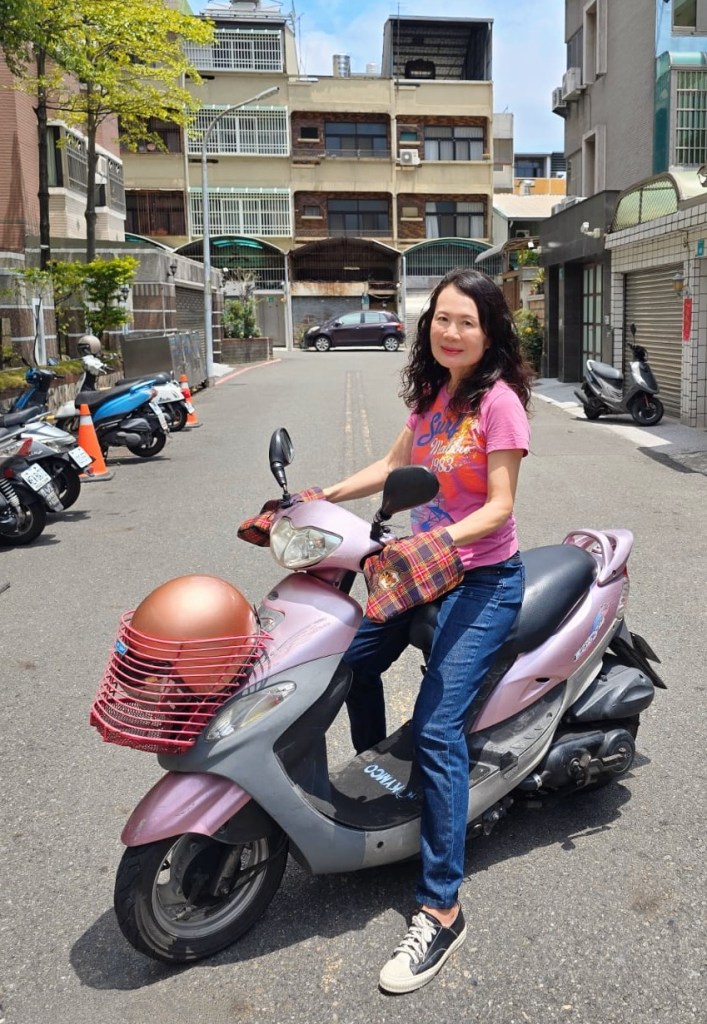
Tainan is a fairly sprawling city, and Sophia offered to ride with her on a scooter, the most efficient mode of transportation in Taiwanese cities.
The first place where Sophia took me was Koxinga shrine and memorial.
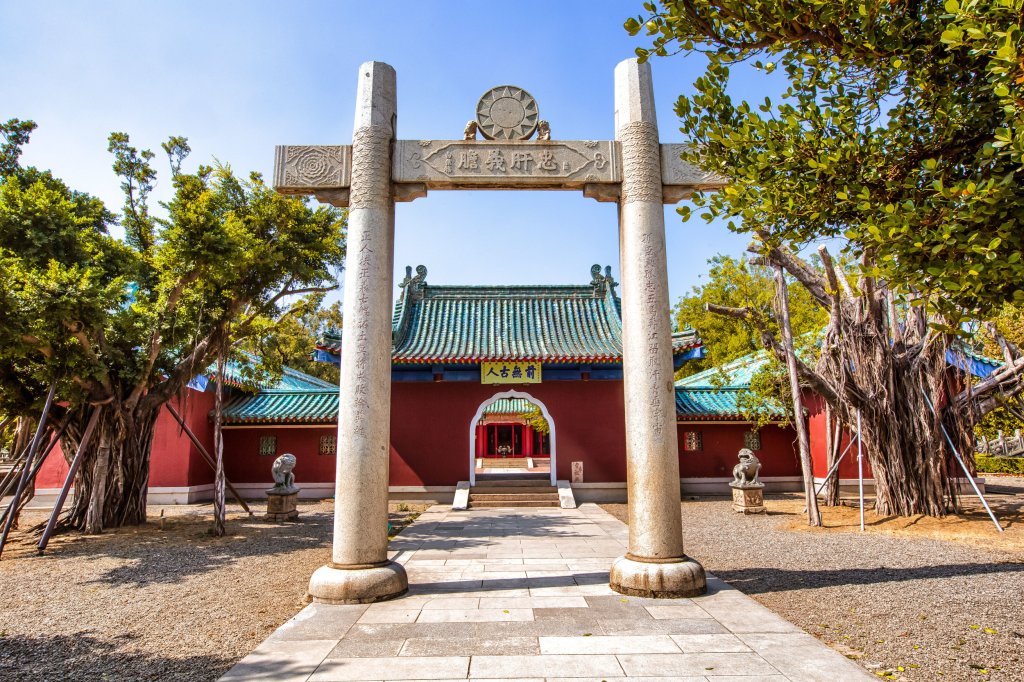
Born in 1624, to a Chinese father and a Japanese mother, Koxinga was one of those charismatic leaders who leave lasting imprints on human history. He grew up at the court of the imperial Ming dynasty. Studying hard and passing through rigorous exams, he was destined to become a fine scholar.
But things changed in 1644, when the capital Beijing fell to rebellion and war erupted between Ming and Qing royal dynasties fighting for power. Koxinga pledged his loyalty to the Mings and, instead of a scholarly career, became a talented general and warrior. Despite several military successes, Koxinga was unable to rescue Mings who were eventually ousted by Qing dynasty.
Koxinga left China and led his fleet to Taiwan which was known back then as “Formosa” and ruled by the Dutch colonists. Historical accounts claim that Koxinga said to Dutch: “This island had always belonged to China, and the Dutch had doubtless been permitted to live there, seeing that the Chinese did not require it for themselves; but requiring it now. It was only fair that Dutch strangers, who came from far, should give way to the masters of the island.”
Native aboriginal tribes sided with Koxinga, and in 1662, the Dutch surrendered Fort Zeelandia to Koxinga, marking the end of Dutch rule. Hence, in Taiwan, Koxinga is remembered first of all as the man who defeated the Dutch.

Koxinga suddenly died at the age of 37, only a few months after defeating the Dutch. Some historians name heat stroke and cold as causes. But the sources from Qing dynasty, the enemies of Koxinga, claim that he died in a sudden fit of madness when his officers refused to execute his son Zheng Jing for having a love affair with his wet nurse, which was a family disgrace.
Despite my absence of interest in complicated Chinese history, I enjoyed visiting Koxinga’s shrine simply learning about his fascinating biography. Also, the shrine has a number of historical artifacts which offer a good insight in realities of everyday life the 17th century China and Taiwan.
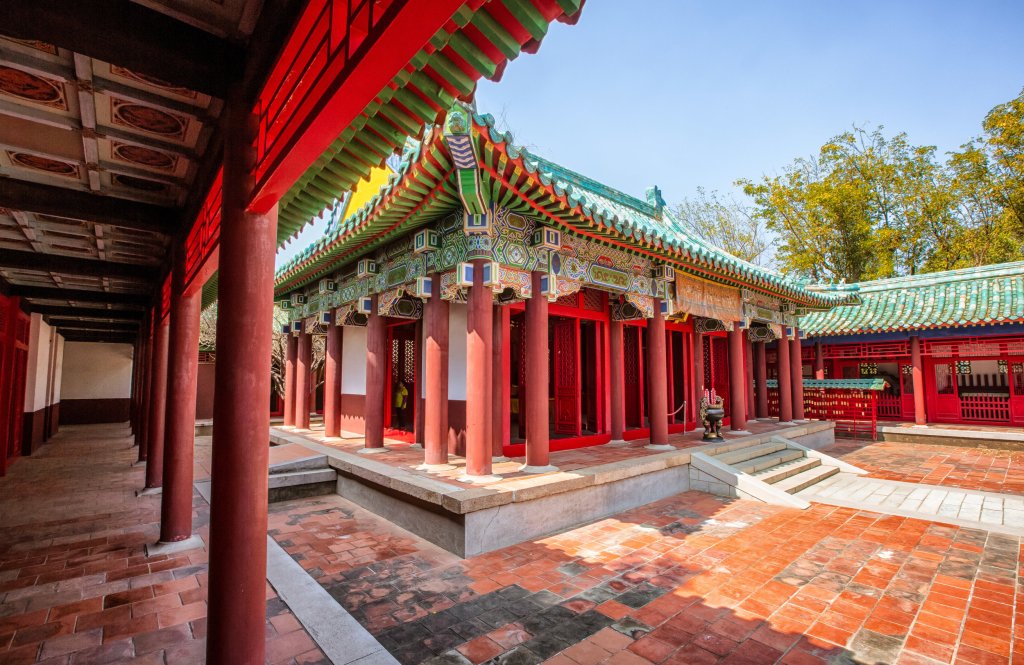
As if to “counter-balance” the historical perspective, Sophia next took me to a place which is a witness to Dutch colonial period in Taiwan, the Chikan Tower. Built in 1653 and known initially as “Fort Provintia,” it served as the administrative headquarters for the Dutch colonists. In the 18th century, Fort Provintia was largely destroyed by an earthquake.
Then, the site was rebuilt and transformed into the current structures, which are Chinese in architectural style, featuring two ornate buildings (Haishen Temple and Wenchang Pavilion), and beautiful gardens with iconic stone turtles bearing steles.


Chikan Tower has interesting exhibits depicting the layers of history associated with this place. But more than the museum part, I simply liked the whole setting: ornate architecture, banyan trees, blooming orchids, and lovely streams with colorful fishes.
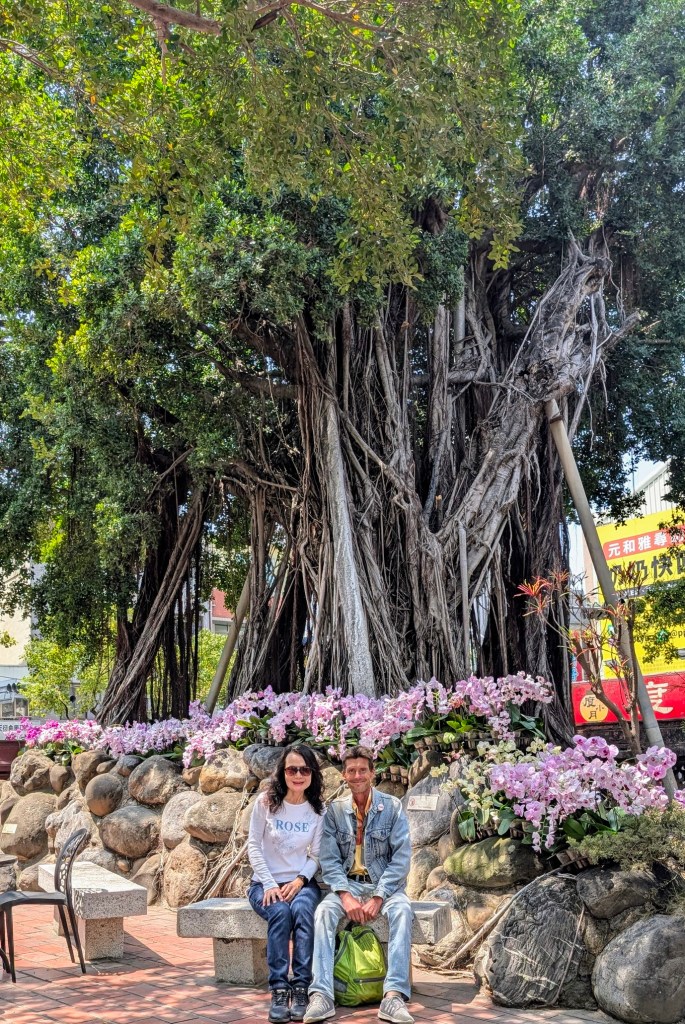

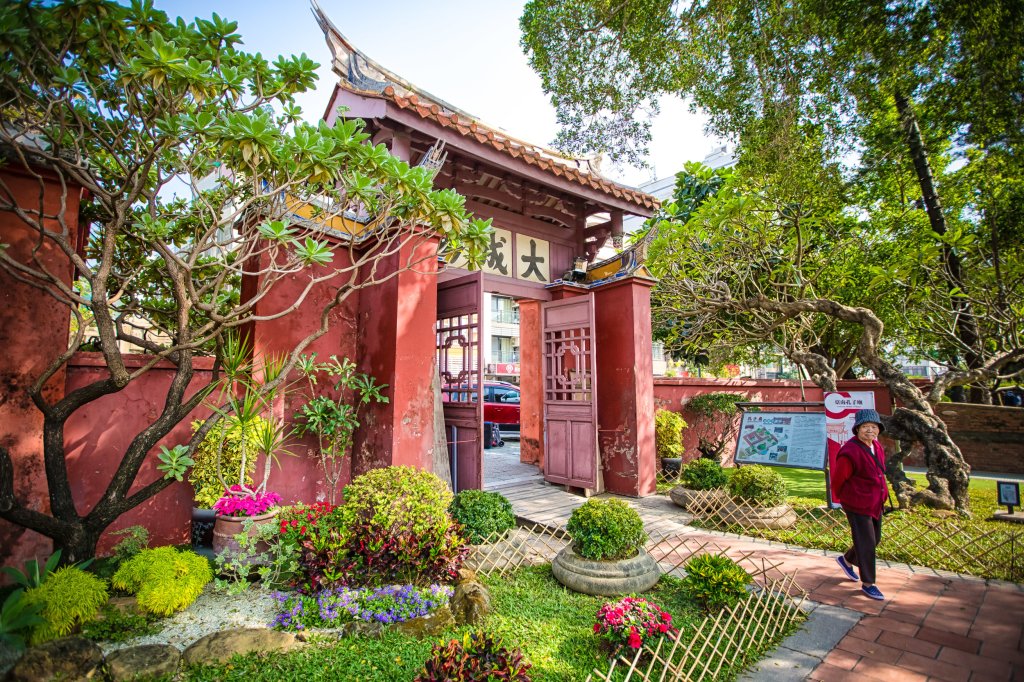
Then my guide brought me to a place which is dedicated to a person who has been and remains highly regarded throughout entire Chinese history and by people from all walks of life: the Confucius Temple.
Confucius (551–479 BCE) was a highly influential Chinese philosopher and teacher. Known as Confucianism, his teachings (some people even call them a “religion”) have profoundly shaped East Asian culture, thought, morals, and ethics for over two millennia.

Confucianism emphasizes four foundational principles of life. Ren (Humanity, Benevolence): the concept of benevolent and kind conduct towards others, encompassing empathy and the desire to do good. Li (Propriety, Ritual): the system of social norms and rituals that govern people’s interactions and maintain order and harmony. Yi (Righteousness, Justice): the principle of doing what is right and appropriate, rather than solely for personal gain. Xiao (Filial Piety): respect for one’s parents and elders, a cornerstone of Confucian social structure.
When we arrived at the Temple, its manicured grounds were nearly void of visitors, and I was anticipating a peaceful stroll through the Temple while learning about the man who shaped Chinese way of thinking and living.

Suddenly, a stream of teenagers flooded the Temple and surrounding area. The kids were wearing some sort of old-fashioned uniforms and carried something looking like wooden backpacks. It turned out to be a ceremony in which middle-school students ask Confucius for good grades in approaching exams.
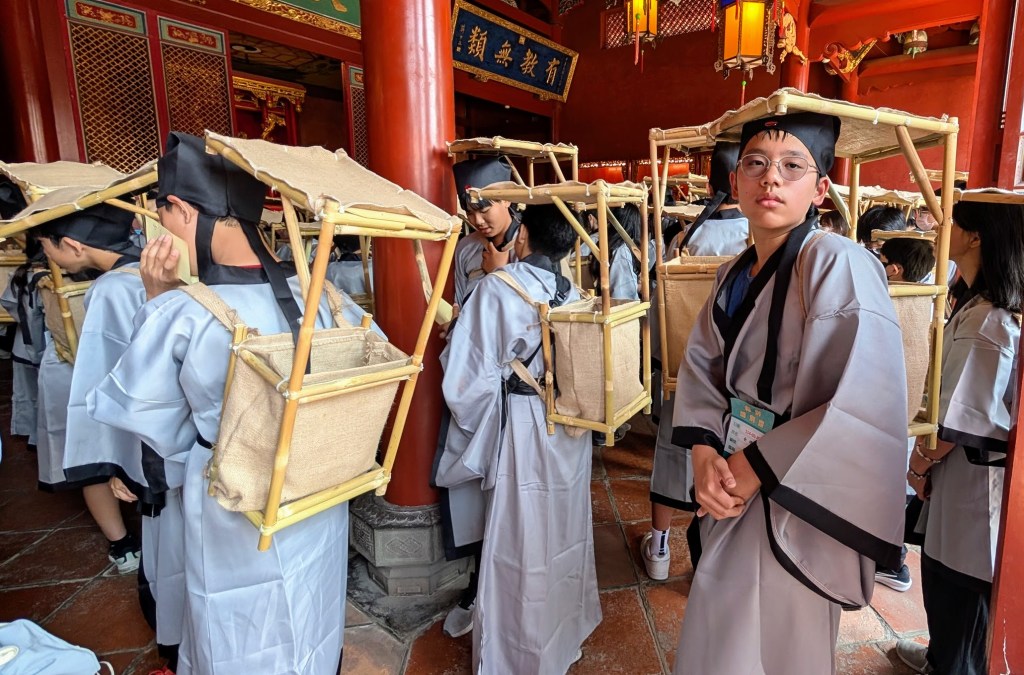
We retreated from the crowds into an adjacent museum. Among expansive exhibits on the history and teachings of Confucianism, one section captured my attention. This was a collection of rather unusual music instruments which were and are still used solely for certain ceremonies associated with Confucius.
The exhibit was “interactive,” so that I was able to play with the sounds and tunes of these devices.

After Confucius shrine, I felt somewhat overwhelmed with too many historic facts and personalities. As if reading my mind, Sophia said: “Let’s go to Anping for lunch.” Anping is another part of Tainan, and it has a distinct vibe of vibrant street life, small shops, and places to eat of any kind. Sophia’s choice was an unassuming corner eatery called “Chen Oyster Roll Restaurant.”

The restaurant was a cafeteria-style and with many kinds of foods, but oyster-based dishes were definitely their main specialty. We selected and split three dishes: an oyster omelet, oyster rolls, and oyster cakes. All three were mouthwatering.

After lunch, it was time to explore “Anping Old Street,” which is lined with shops and stalls selling all kinds of products for which this area is known: foods, folk medicines, drinks, leather goods and much more.
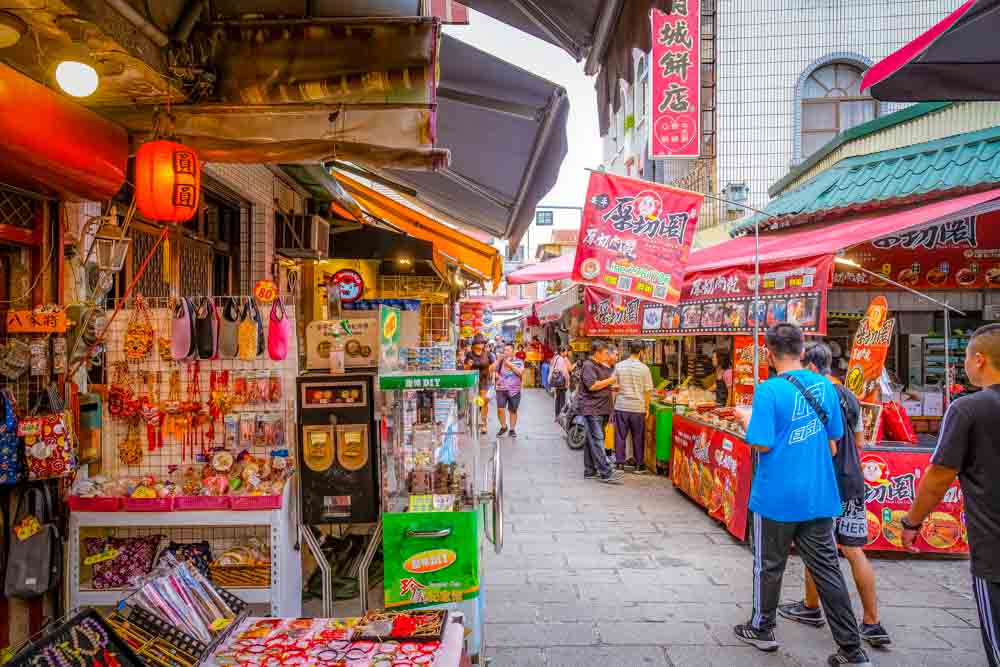
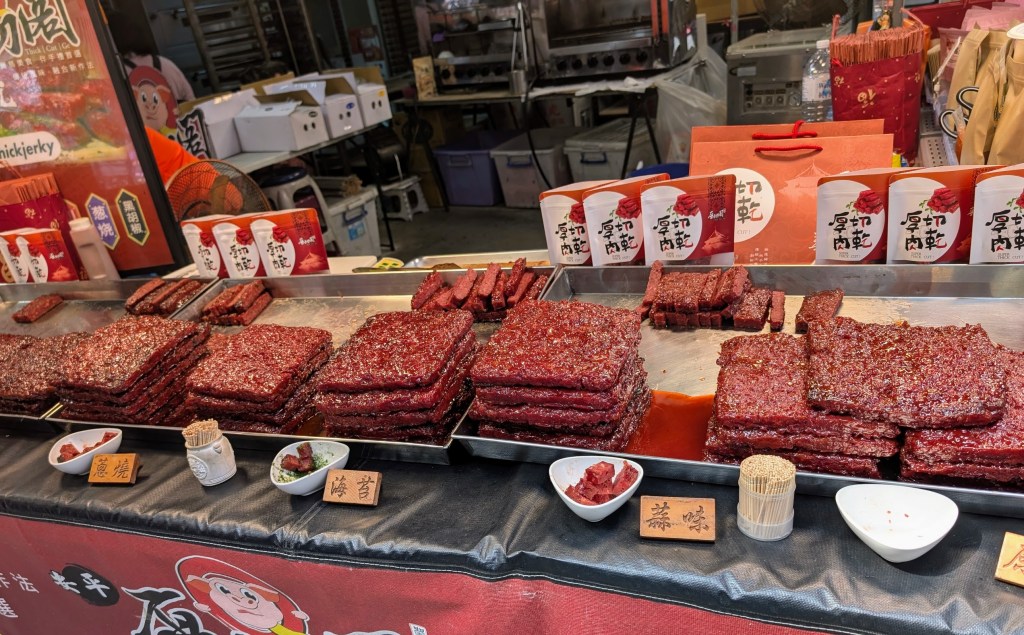
Most food vendors offered generous free samples. In fact, I thought that maybe we should have skipped lunch and simply “eat free our way” through the Old Anping Street. Look, for instance, at this selection of cured meats.
One unique dish you can find and try on Anping Old Street is “Coffin Bread.” Named because it’s shaped similar to a coffin, it’s a hollowed out slice of deep-fried thick-cut toast with blend of a creamy seafoods.

Another dish not to be missed on Anping Old Street is peanut candy rolled with fresh cilantro. Sometimes, peanuts are substituted with peanut ice cream. It sounds like a strange combination, but trust me: this blend of sweet, crunchy peanut brittle with the fresh flavor of cilantro is very vibrant and pleasant. Look at this short video on Tik Tok
We spent a couple of hours walking Anping Old Street, chatting with vendors, and exploring all the goods and foods. I ended up buying a supply of differently cured squids: a great snack when you are on the road.

Then we saw a group of people who looked like Western tourists and followed a guide wearing a badge saying: “LIke It Formosa.” As it turned out, Like It Formosa is a company which offers FREE English-speaking walking tours in several cities in Taiwan, including two in Tainan. Well, not completely free: you are expected to tip your guide as generously as you liked the tour’

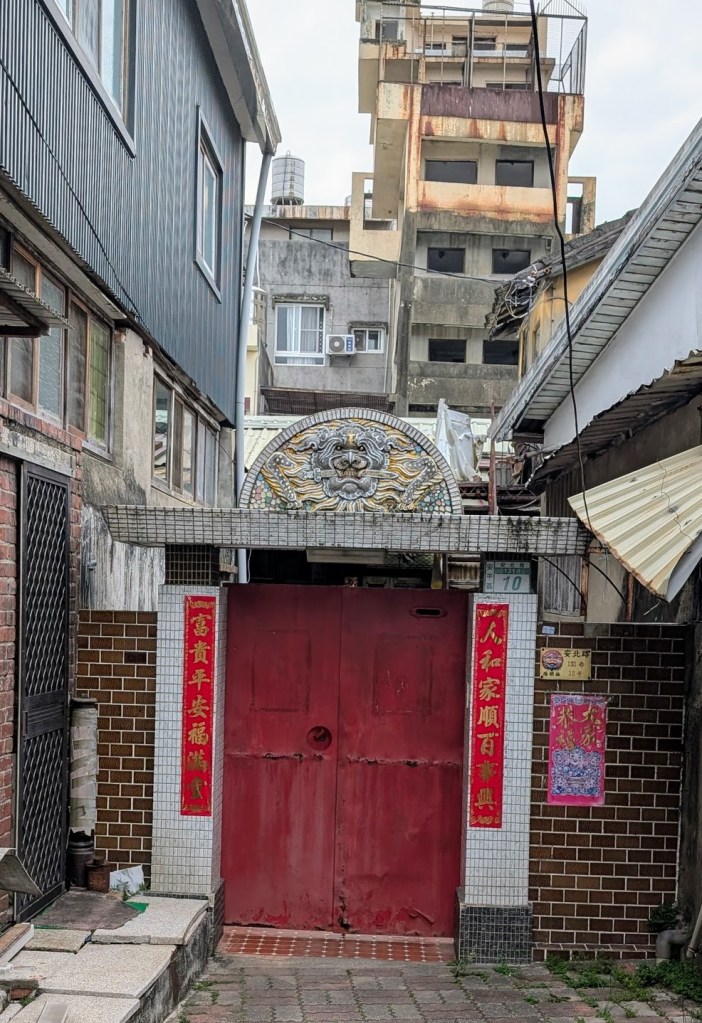
We joined the group, and the tour was top-notch. Two hours of leisurely walking were filled with tons of interesting facts about Anping’s past and present. I was especially fascinated with the story of why many gates and house doors in Tainan bear an image of a lion’s head. But I will not tell this story here: either go to Tainan and find out, or Google it.
If you travel to Taiwan, definitely join a walking tour with Like It Formosa. HERE is their website.
Before going back home, Sophia wanted to show me one more Temple, the Tainan Grand Mazu Temple. Mazu is highly revered and widely worshipped as the Goddess of the sea and the patron of fishermen. Her name translates as “Mother Ancestor,” but she is also affectionately called by many “Mazupo”, meaning “Granny Mazu,” reflecting her close and benevolent relationship with people.
I was glad that we came there: the Temple felt very solemn and peaceful.

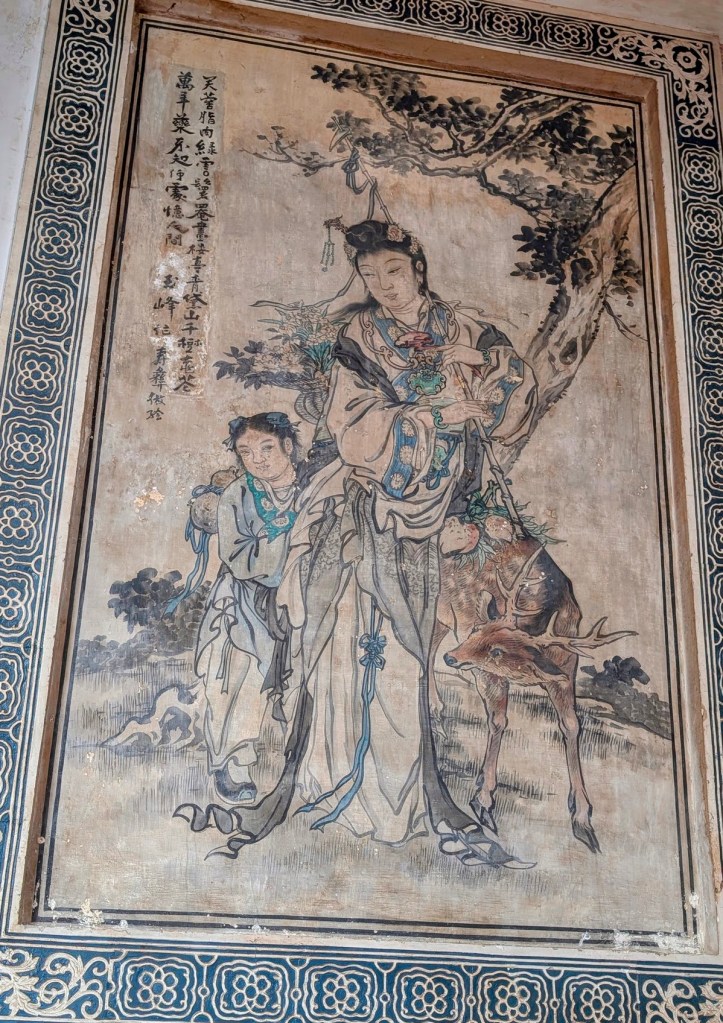
Besides religious objects and sculptures, Mazu Temple also had fine wall paintings.
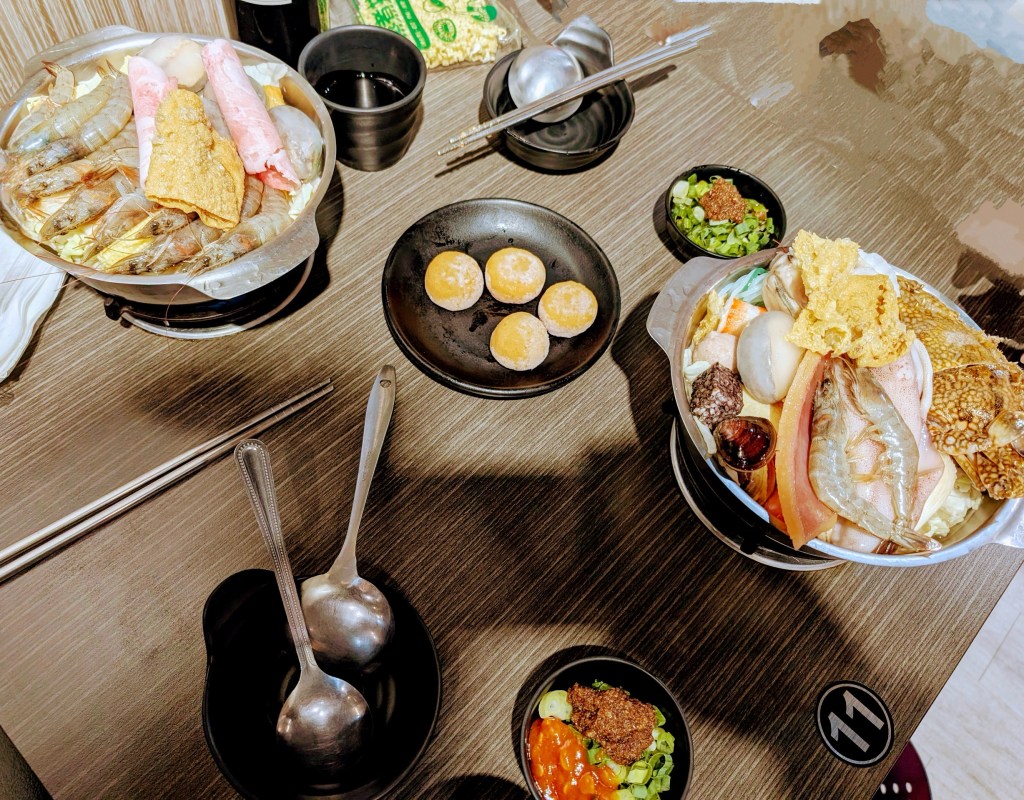
After a day of walking and exploring, we were tired and hungry. Luckily, next to Sophia’s home, there was a good Hot Pot restaurant. Hot Pot is an extremely popular and traditional dining experience in Taiwan. In fact, it is more than a meal: it is a social event, where people gather around a simmering pot of broth to cook and eat a variety of ingredients in it: seafood, meats, vegetables, tofu.
While originally it used to be a large communal pot, now restaurants in Taiwan offer individual mini-hot pots. When eating at such restaurants and depending on dietary preferences, customers order different hot pots: each having a particular combination of a certain broth and ingredients.
The ordered pots with broth are put on the burners which are built-in into the restaurant’s tables, and all ingredients are put aside. People cook, eat, chat, order more ingredients, etc.: all-in-all, it is a fun and satisfying experience.
Hualien: a Gem on the East Coast
The trip to Taiwan wouldn’t be complete without exploring the east coast, which is renowned for its natural beauty: towering green mountains with lakes and canyons, pristine coastline with sheer cliffs plunging into the Pacific, rocky coves with unusual geological formations, hot springs, and picturesque beaches.
Also, I wanted to circumnavigate the entire island by the train. And so, from Tainan I took a ride to Kaohsiung (Taiwan’s second largest city on the southwestern coast), and then to Fangliao, Dawu, Taitung and final destination, Hualien. Here is a map of my train trip.

The journey was about five hours and with constantly changing scenery: valleys, rice fields, mountains, the ocean. And the whole trip, in a modern car, with wide reclining chairs, individual tables, etc. costed less than US$ 20. The only regret was the weather: rainy and hazy – not the best time for taking pictures.


In Hualien, I walked (5 minutes) to the “Lazy House” hostel. When finding Lazy House on Booking, I was attracted not only by the location and glowing reviews from guests, but also by the interesting decorations of the hostel: bright murals, vintage posters, and music instruments. It looked really cool and cozy.

Besides dormitories, Lazy Hostel has some private rooms. I paid about US$40 per night for one of them and was very pleased: the room looked brand new, painted in relaxing light colors, and with high ceilings creating a feeling of wide open space.

When I arrived, no one was at the hostel’s lobby (which functions also as a bar and common space for the guests), except a cute little dachshund.

As I learned later, named in honor of former US president, Obama (the name of the dog) became a real fixture of Lazy House and was treated almost like the hostel’s co-owner.

Before dinner, there was one project to accomplish: to get a good haircut. Don’t be surprised: Taiwan has excellent barber shops. For a fraction of US or European price, local hairdressers will make you look really nice. I walked to a place which I found based on reviews and pictures posted on Google maps, and in less than 20 minutes this cheerful woman put my hair in perfect order. Price? About US$7.
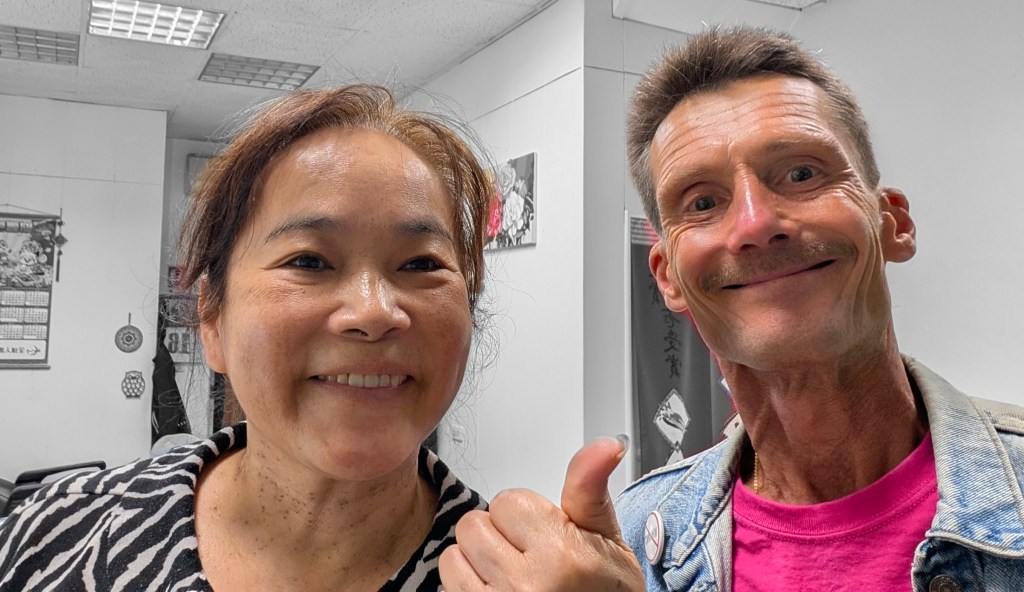
If you come to Hualien and need a good haircut, here is the location of this barbershop.
In the section on Taipei, I wrote about Taiwan’s famous Night Markets, streets and quarters lined with vendors which stay open late into the night and offer all kinds of food and, sometimes, entertainment. Hualien has a sprawling Night Market and this was my destination for the dinner.

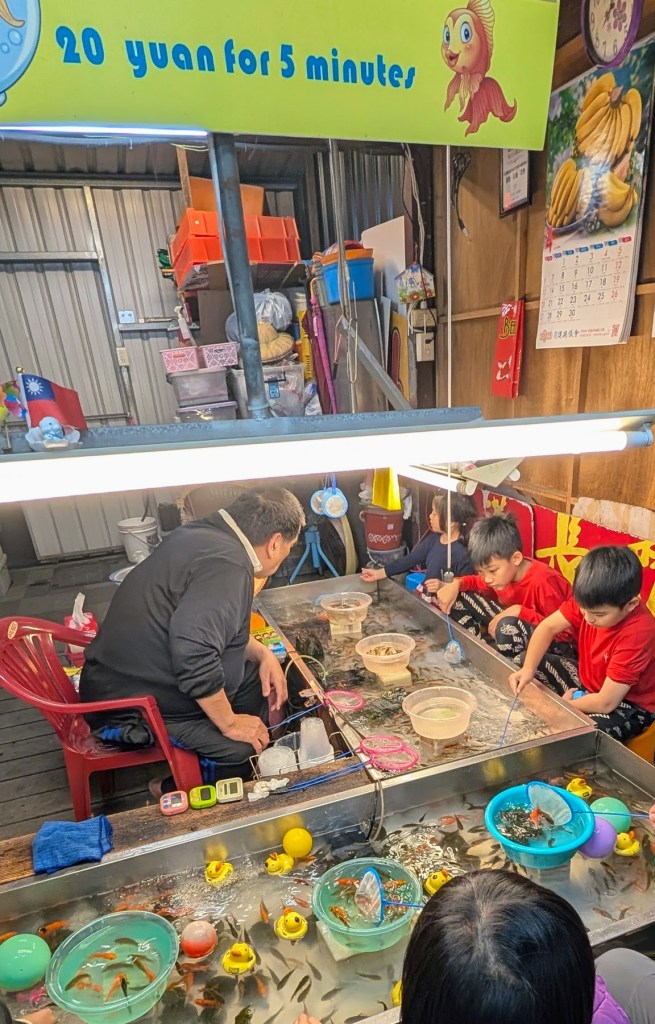
One of the shops offered something which I have never seen before: “fishing lessons” for small kids. The boys definitely had a lot of fun.
As at any Night Market, there were tons of foods and fresh produce of all kinds.

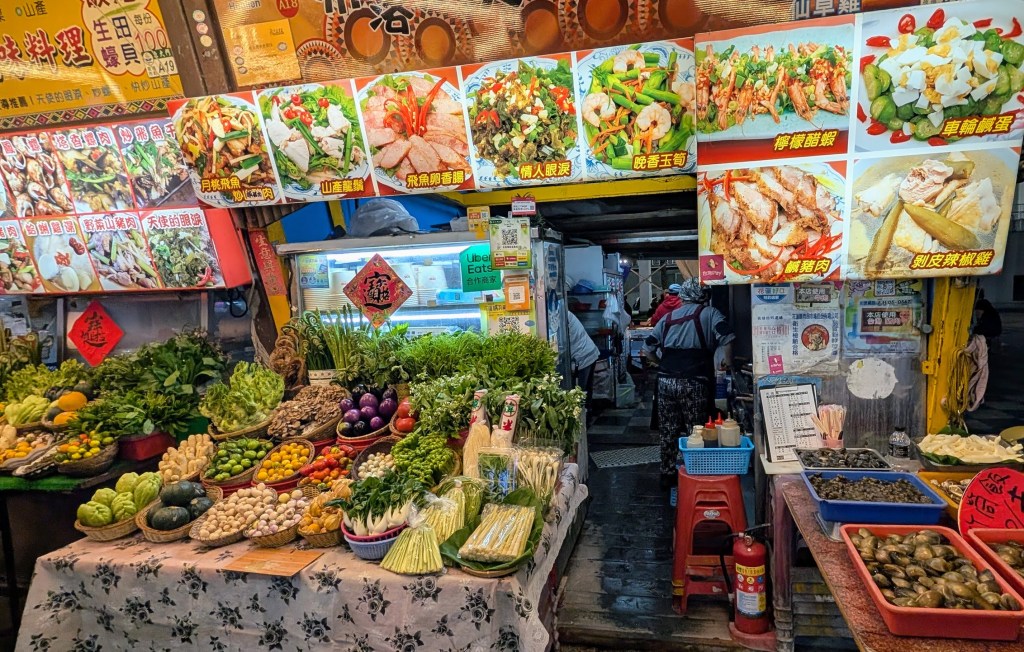
I made my choices, assembled plate, and dined with other patrons under a huge tent.

When I returned to Lazy House, the hostel was quite alive with young people hanging around, chatting, and browsing their social media. It was tempting to “join the party,” but I had big plans for tomorrow and retreated to my room.

Most tourists come to Hualien with a sole purpose: to visit Taroko Gorge National Park. Carved by the powerful blue-green Liwu River, Taroko Gorge is renowned for its steep marble cliffs, deep valleys, and impressive geological formations. In Taiwan, Taroko is often referred to as the “second Grand Canyon.”
But I have been several times to a real Grand Canyon and was more interested to see the coastal areas, which have a reputation of being the most scenic in Taiwan. From Hualien, highway #11 goes south and winds along the shores of the ocean.
At Hualien’s bus station, I took a bus to a place on the coast called Shitiping. If you skipped the introductory section of this post, I wrote HERE how to plan bus trips in Taiwan and pay for them. The bus was comfortable and with big windows: perfect for a scenic ride.

What I have seen en route to Shitiping was pleasant, but nothing super-special. Although living in Northern California, I may be slightly spoiled by the Californian ocean scenery.

My final destination, however, was truly stunning. Essentially, Shitiping is a place which has literally everything that coastal landscapes may possibly offer. Combined with adjacent tiny islands, the wide-open panoramic views created a picture-perfect setting.
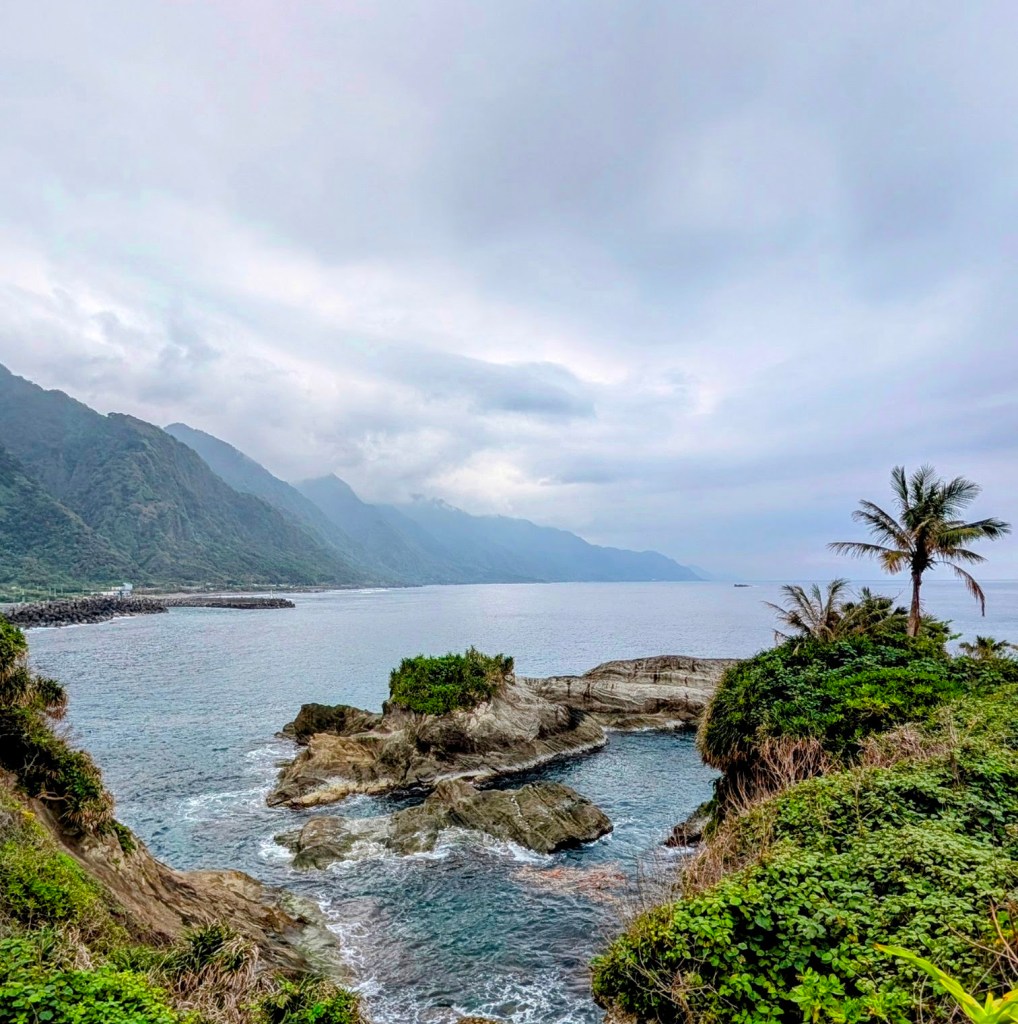
Whimsical rock formations jutted out into the ocean like the claws of a crab.

Through cracks in the rocks, the ocean ejected geysers of water no less impressive than any volcanic fumarole.

Millions years of weathering have carved baths-like hollows in the rocks.

The layers of upheaved and solidified magma lined the shores.

I climbed on top of a rock and sat there for nearly an hour, simply absorbing the stern and yet mesmerizing surroundings.

And then, in the distance, I noted a couple: perhaps, a father and daughter. They were fishing and looked like being fully “at home” in this unusual place.

I lost track of time and missed the return bus. The next one was only in three hours. But what appeared to be an unexpected failure turned into good luck.
I walked along the coast and found a protected from wind black sand beach. It was covered with dry wood, and the colors of the tree trunks made a great combination with the distant green mountains. I sat there, had a picnic lunch followed by a short nap.

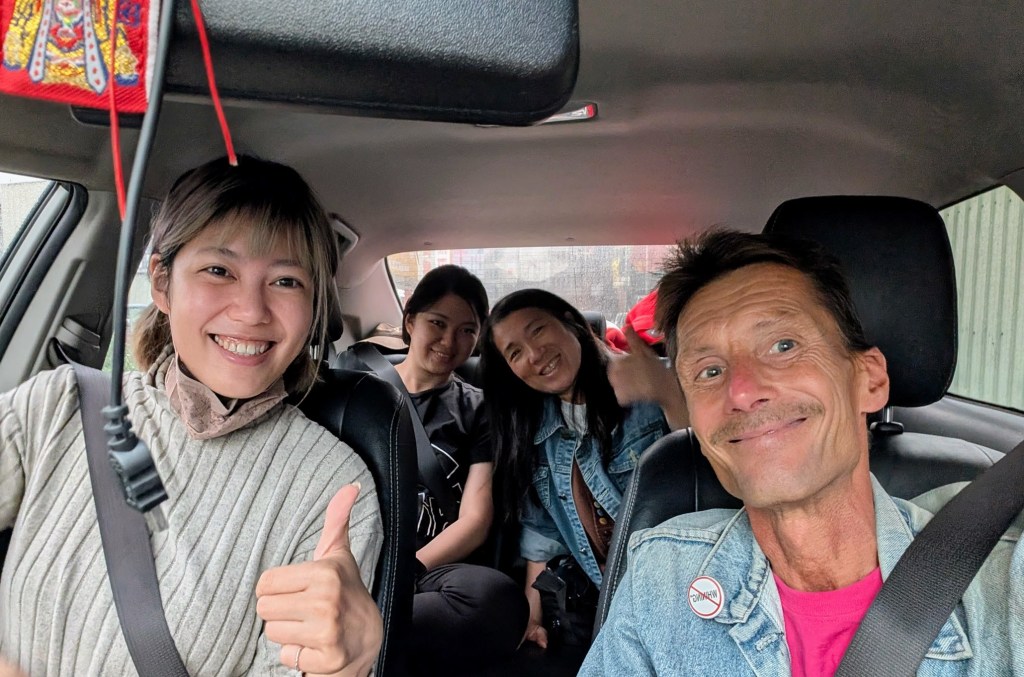
Then, I walked back to the road and decided to hitchhike rather than simply wait for the bus. In literally five minutes, a white Toyota stopped and picked me up. The people in the car, a mother and two daughters, were driving to Taipei, but they did not mind not only giving me a lift to Hualien but also to bring me straight to Lazy House.
Only one of them spoke a bit of English, and my Chinese is, of course, “zero.” Yet, using Google Translate, during the one-hour ride, we managed to discuss variety of subjects: from world affairs to the pop-music scene in Taiwan. And we laughed a lot.
The last evening at the hostel was reserved for conversation and a meal with Angela, the founder and owner of Lazy House. She grew up in Hualien, but after finishing college went to work in Australia for a few years: mostly, in the hospitality business like coffee shops, bars, etc. While abroad, the idea surfaced: to open an affordable guesthouse in HUalien which would cater specifically to young international visitors.
Her friends donated most of the furniture and equipment, helped with decoration, and Lazy House opened its doors ten years ago. When COVID hit the travel industry, Angela launched a new project: she added to the hostel a vegan restaurant – the only vegan place to eat in Hualien. And it was a success story: the restaurant became popular among both the hostel’s guests and local residents.

In 2024, Hualien was hit by a powerful earthquake. The hostel was full of guests, but, unlike many nearby buildings, it stood firm and did not have any damage. Angela told me how different the reactions were among her international visitors: from understandable fear to sentiments like “Let’s have an earthquake party!”
The unfortunate outcome of the earthquake was the destruction of many trails in the National Park, resulting again (as at COVID times) in reducing the flow of international visitors to Hualien. But Angela did not lose her heart. In fact, she told me: I have a new project coming up. When I asked “What would this be?”, she smiled and said: “Come back and see for yourself.”
Jiaoxi: Hot Springs Paradise in the Mountains
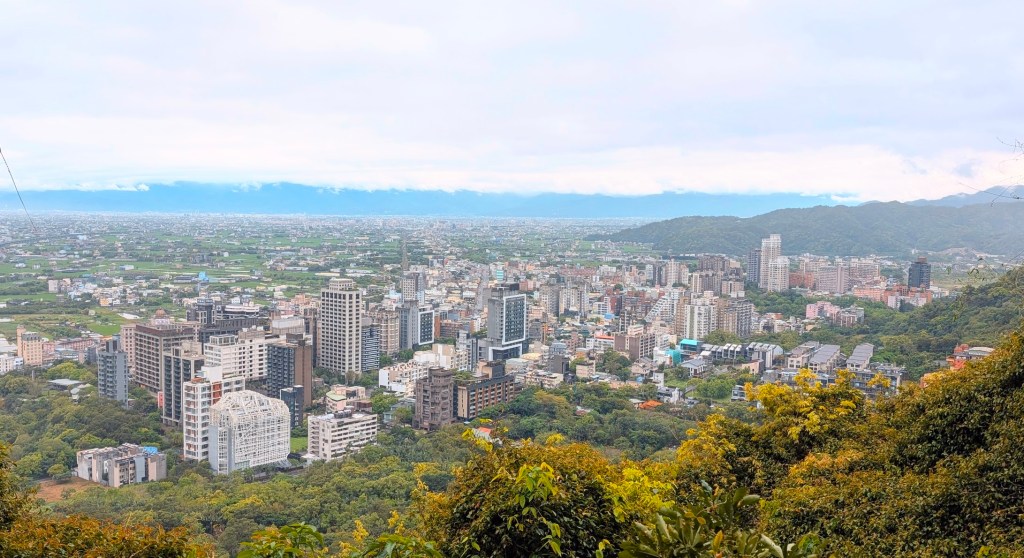
From Hualien, I took a train (1.5 hours, US$8) to Jiaoxi, a resort town in northeastern Taiwan. Jiaoxi is known for hot springs and mineral-rich baths which are believed to have many beneficial effects on the skin and overall health.
Jiaoxi also has an appealing natural setting where plains meet mountains, offering hiking trails, scenic lookouts, and waterfalls. Unlike Hualien, Jiaoxi is a popular destination mostly for domestic tourists. During two days there, I saw only a handful of European faces.

My accommodations were at Meizhou Hot Spring Hotel, a budget guesthouse in a very convenient location. Neither the elderly lady, the owner of the hotel, nor her nephew spoke a word of English except “Thank you!” During my stay, I would say them “Good morning” or “Good evening,” but the inevitable response was always: “Thank you!”
After checking in, I walked the streets in search of a quick lunch. One of the fun tourist experiences in Jiaoxi is cooking your meal in naturally boiling water. In the picture below, a vendor sells various raw food items. The couple in the back cooks whatever they bought from him in a small pool which is fed by a hot spring.

But I had a better idea about lunch. Jiaoxi is known for its tomatoes and Sansing green onions. One local food favorite is green onion pancakes. They are like pan-fried flatbreads filled with finely chopped green onions and other ingredients, offering a crispy crust and a juicy, flavorful inside.
I found a street vendor who made onion pancakes in three versions: only green onions, mixed with pork, and mixed with shrimps.

I ordered the original – only onions – version and was not disappointed: the pancakes had a very thin crust and generous amount of very tasty filling.

In the afternoon, I went for a hike to Wufengqi Waterfalls and then along Shengmu hiking trail. The trailhead is on the outskirts of Jiaoxi, and it has taken only 5 minutes by taxi (about $US3) to get there. Alas, the observation deck for waterfalls was closed due to reparations. Even worse the weather changed: the sun disappeared in the clouds, and drizzling rain began. But I decided to continue anyway.
The first portion of the hike was on paved road, and in about 0.3 mi / 0.5 km I arrived at a Catholic religious site, the Sanctuary of Our Lady of Wufengqi.

Roman Catholics constitute only 1.5% of Taiwan’s population, but the impact of the Catholic Church on Taiwan’s development, especially social services and education, is quite strong. The Church has established and operates universities (Fu Jen University, Providence University), many schools, hospitals, and clinics.
The Sanctuary of Our Lady of Wufengqi was built in 2005 following an alleged apparition of the Virgin Mary to a group of hikers. Besides a rotunda-like chapel, there is an information center (it also offers some food and drinks), nicely manicured grounds, and a carved in-stone grotto with a sculpture of the Mother of God.

Religion aside, the Sanctuary offers excellent unobstructed views of the area. While observation deck for Wufengqi waterfalls was closed, the view from here, at a greater distance, was even better: the waterfalls looked like a part of a gigantic composition created by nature.
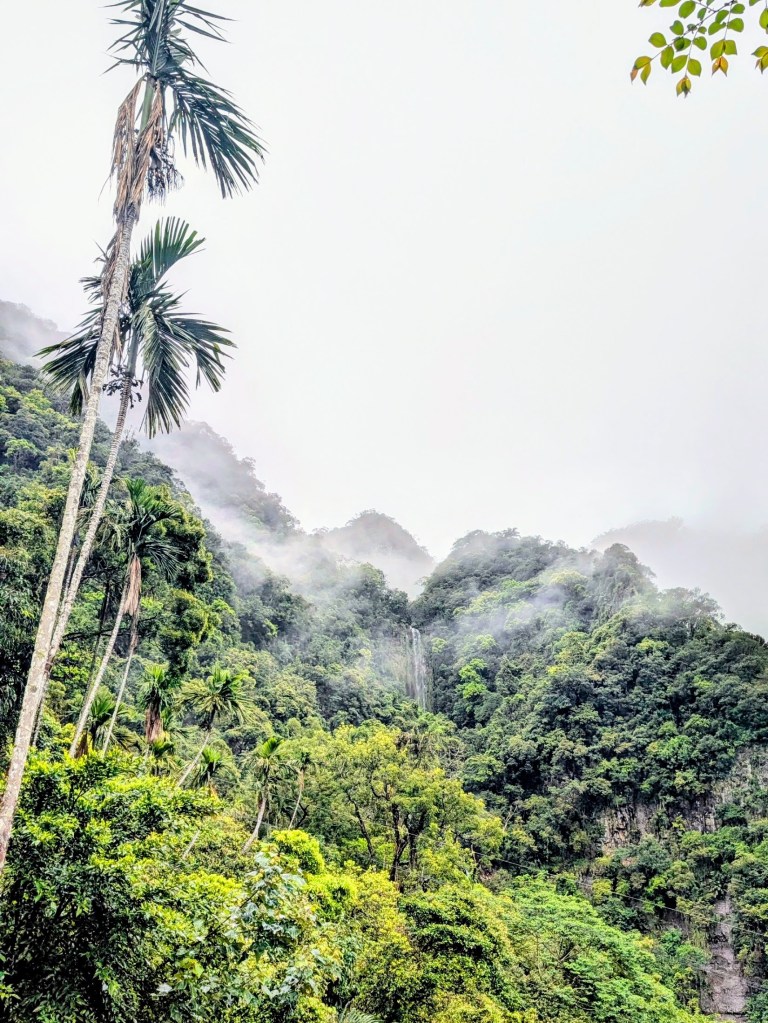
In the other direction, Jiaoxi was visible as if in the palm of your hand.

Past the Sanctuary, the paved road became a real hiking trail. It was well maintained, and the hike through the forest felt like a leisurely walk. Besides, it was spring, and patches of bright flowers were everywhere.

In about 2.5 mi / 4 km, the trail arrived at a covered rest pavilion and a bridge. From here, the last portion of the hike is known as “Marian Trail,” and it is regarded as a pilgrimage route for Catholics. Marian Trail is short (1 mi / 1.6 km), but it is steep, with most of it being hiked via stone steps.

The end of the trail is on the ridgeline of the Xueshan Mountains, at an elevated platform that overlooks the Lanyang Plains. Regrettably, when I reached this point, the weather decided NOT to cooperate completely. Light drizzle became a shower, and thick fog made any photography useless.
Then, in the distance, I noticed the statue of the Mother of God and stone steps leading to a group of buildings.

As if answering my need to find a place to wait out the bad weather, these buildings beyond the statue were refuge huts which were built to shelter hikers like me. Inside, I found utensils and equipment for cooking.

A wooden sleeping platform indicated that people spend nights here while going on multi-day hikes. A map in the shelter showed directions for continuing hikes to Mt. Sanjiaolun and other destinations.

After about one hour, the rain stopped, and I returned to Jiaoxi. If you want to hike Shengmu Trail and do this comfortably, with a break at the end, plan on about 5 hours round trip.
Back in Jiaoxi, cold and with wet feet, I was desperate to have a bath in one of the hot springs. Many hotels in the town offer private small hot pools (typically, inside a room with a shower, etc.) which are fed by natural hot waters.
But I wanted a different experience: something in a more natural setting and with the possibility to meet other people. The best option for this is “Forest Bath,” a commercial hot spring complex which is open 24 hours.

Located right in the midst of the town, Forest Bath is, yet, surrounded by greenery and trees: it feels like being in a fully natural environment.
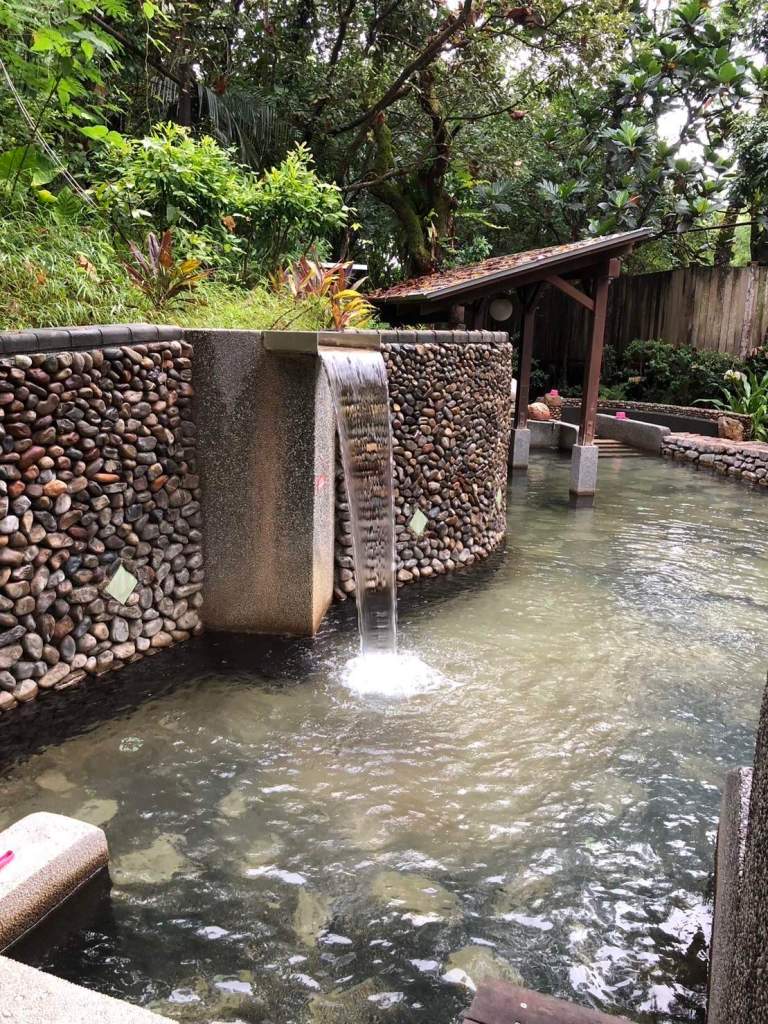
The entrance fee is about US$10, and it is a clothing-optional and gender-separated facility. What I liked in particular about Forest Bath was a wide variety of pools: with differing water temperatures and each designed in its own manner.

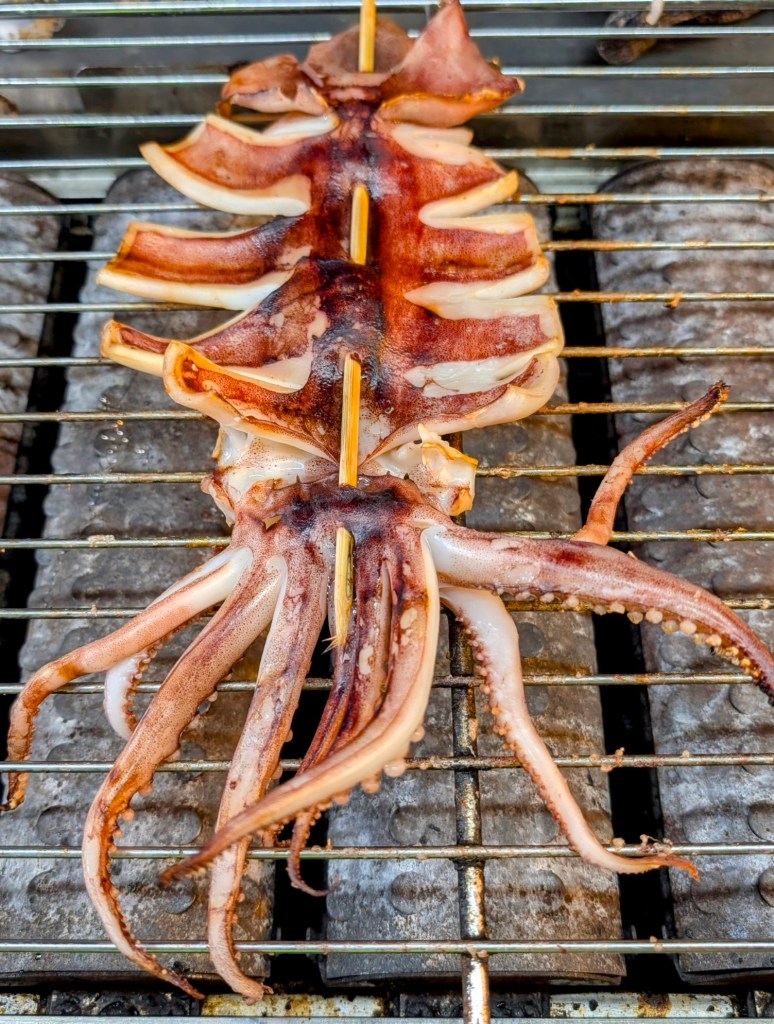
After hike and exposure to cold and rain, two hours in Forest Bath resulted in such relaxation that I was barely able to walk to my hotel. Going to restaurant for dinner was not appealing at all. I simply stopped at a street food stall, ordered grilled squid and was fully satisfied with this simple meal.
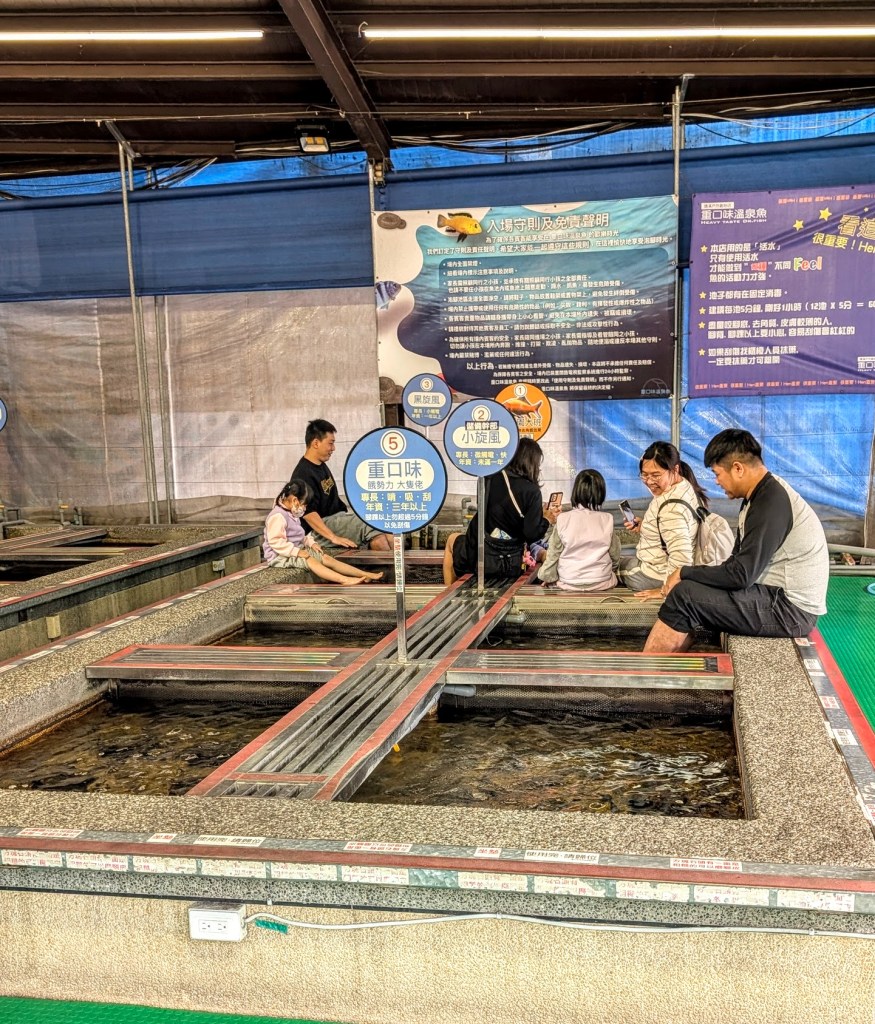
The next day, I first strolled through the town watching people and checking out various shops. One of the popular tourist experiences in Jiaoxi is to bath your feet in warm pools filled with small fishes. Called “doctor fish,” they gently nibble away dead skin cells, providing exfoliating spa experience and allegedly improving blood and lymph flow.
Jiaoxi is very pleasant to walk around. It has many green alleys which are paralleled by warm pools and streams with. Visitors take off their shoes, sit, put their feet in the water, and spend time chatting and “doing nothing.”

After a couple of hours the town, I went on another hike, the Paoma Historic Trail. But first I needed to get some supplies for a picnic. One of the good options for this kind of things is Yih Shun Shiuan bakery (find it on Google maps). It offers a huge selection of baked goods: from sweet pastries to savory breads with all sorts of fillings.

The trailhead for Paoma Historic Trail is only a 30 minute walk from the center of town, or 5 minute cab ride. It is indeed a “historic” trail, because in the past it served as a logging path and also saw some military action.
Stretching for about 4 mi / 7 km, the trail loops along the slope of the mountains with gentle and easy ascents and descents. And it offers good views of Jiaoxi, the Lanyang Plains and, on clear days, Turtle Island.
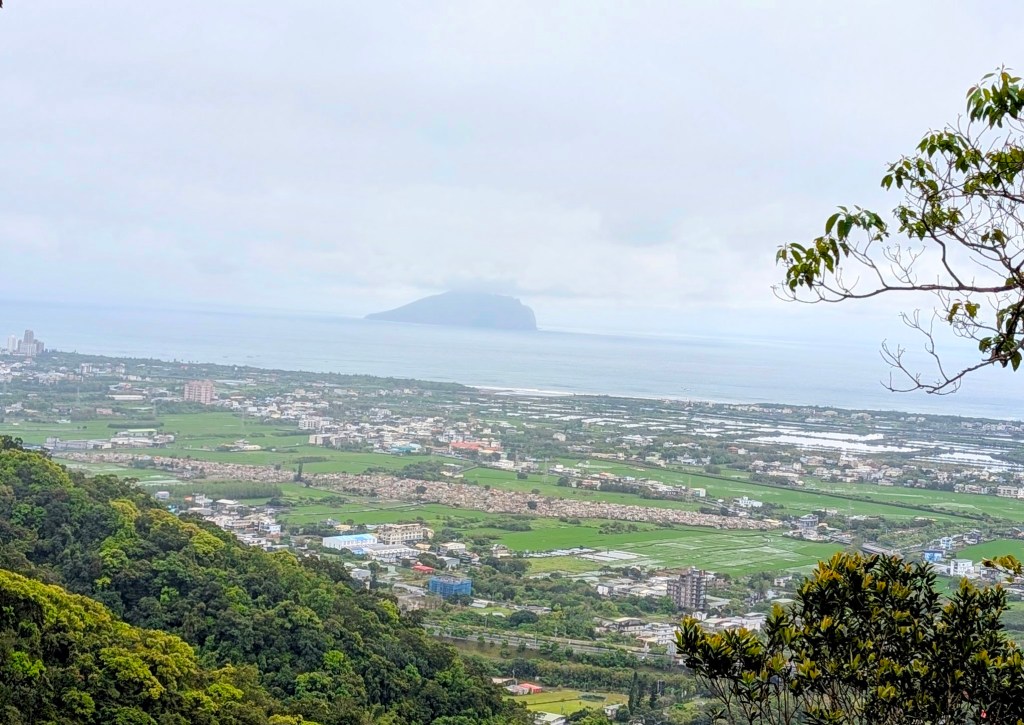
A number of stations along the path have explanatory signs about what visitors see or where they are, making the trail a real “educational walk.” I did not go the entire length and ended my hike at the small Temple devoted to some local God of the forest.
Inside, I found a bunch or aromatic sticks for burning and the text of a prayer (in Chinese and English) asking this God to protect travelers. I burned a stick, read the prayer and walked back into town.

Besides Forest Bath, Jiaoxi has another option for enjoying thermal baths in a communal setting. Near the town’s tourist center, there is a public swimming pool with several adjacent hot pools.
This place is not as posh as Forest Bath, but then, here one can meet local residents (rather than tourists), who come here with entire multi-generation families. Proper bathing clothing is, of course, required. By the way, the water in the swimming pool was fairly cold which made for a good interchangeable experience: swimming, getting cold, warming up in a thermal bath, and repeating the cycle.

For my second and last night in Jiaoxi, I wanted some special dining experience. The choice was a restaurant called Bando. Its menu was more elaborate and portions smaller than in a typical Jiaoxi eatery.
I ordered another green onion pancake, baby octopus in spicy red sauce (also with green scallions), and oysters steamed in flavorful broth with bamboo sprouts. But the highlight of the meal was a dish made with pickled mango and passion fruits: very refreshing and invigorating.

My trip to Taiwan was almost over, but not quite yet. One more experience awaited: going on a bike ride with locals in New Taipei City, a large modern municipality surrounding Taipei proper.
Biking in New Taipei
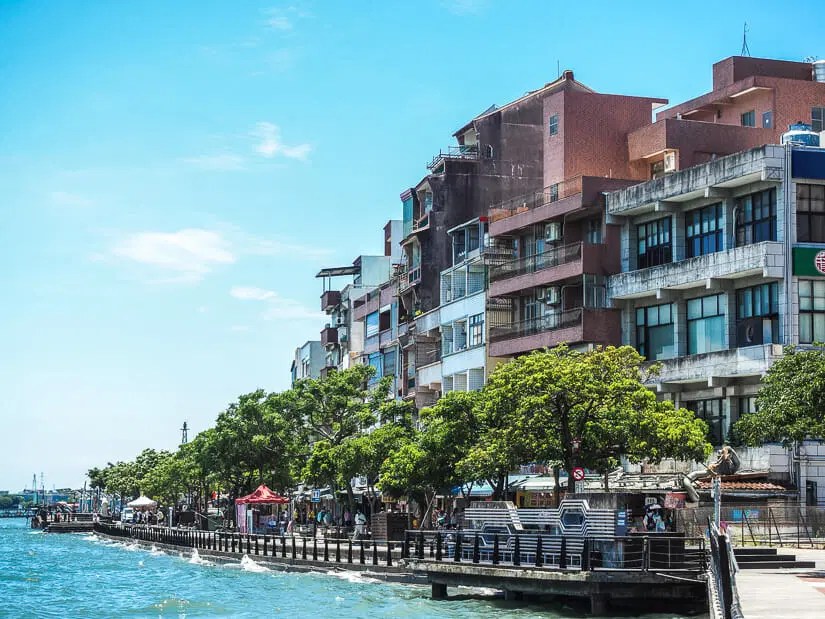
When tourists explore Taiwan’s capital, they usually focus on its historic areas and disregard newer parts and suburbs. Meanwhile, some of them offer a lot for curious visitors. Tamsui District in the northwest of New Taipei City (which surrounds Taipei proper) is a prime example of such a place.
It is known for attractions along the Tamsui river, historic sites (Fort San Domingo, Tamsui Old Street), bustling markets, and a ferry port with connections to many destinations. And it is also very easy to reach from Central Taipei: simply take the MRT (metro) red line from Taipei Main Station to the last stop, Tamsui.
I wrote already about my participation in SERVAS, a global hospitality organization. One of SERVAS members who lives in Tamsui invited me to stay with his family for my last day in Taiwan. Being a devoted bike rider, Thomas also organized a group of other SERVAS members to go together on a bike tour along the Tamsui River.
In the morning, on his scooter, Thomas drove me to the Tamsui metro station, our starting point for the trip. As with many metro stations in Taipei, Tamsui has a huge underground garage where we left the scooter for the rest of the day.

Then we walked to a place where a lot of bicycles were parked, being available for rent. Several companies in Taipei offer this service, and they all have their own Apps and a network of spots where people can pick-up and drop-off a bike. Payment is done by Easy card (see introductory section) and the prices are very cheap: for 4 hours, I paid less than US$3.

From the metro, our journey was along the Tamsui river and towards the town of Guandu. The first portion of the trip was on the “Mangrove Ecology Trail,” which is home to northernmost mangrove forest area. The path was well-maintained and easy to ride, while surrounding lush vegetation created a fairly scenic setting.
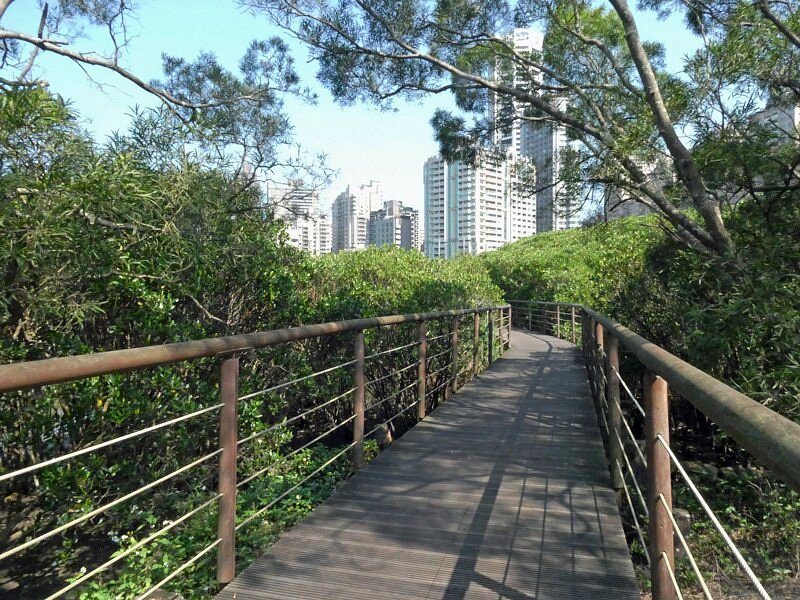
The trail had many explanatory signs about plants and wildlife, but I simply absorbed the views of the mangroves, the river, the Bali District on the other side, and the distant mountains.
In about 4.5 mi / 7 km, we arrived at our first stop, Guandu Temple. Devoted to Mazu, the Goddess of the Sea, Guandu Temple claims to be the oldest temple in Taiwan (originally founded in 1661) although most sources give historical priority to Lungshan Temple in Taipei.
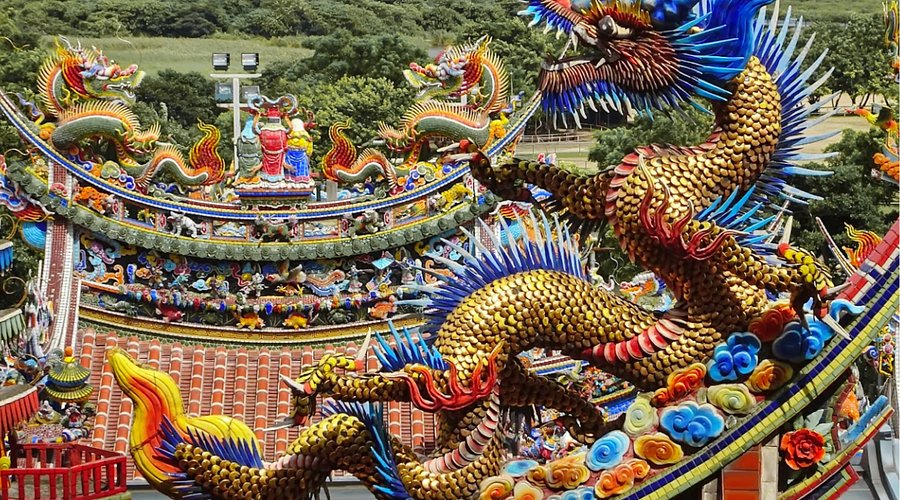
Regardless, Guandu is impressive and worth visiting. The Buddha cave, an 80-meter-long tunnel adorned with 28 statues of devas (Buddhist spirits), leads to a shrine with a thousand-armed statue of Guanyin – the Goddess associated with compassion and mercy.

Inside, Temple amazes visitors with its rich decorations: carvings of dragons and other figures, stone lions, and colorful murals.
After Guandu Temple, we turned around and back-tracked along the river for about 0.7 mi / 1 km, reaching Guandu Bridge. It looked a little bit like a miniature Golden Gate Bridge in San Francisco.
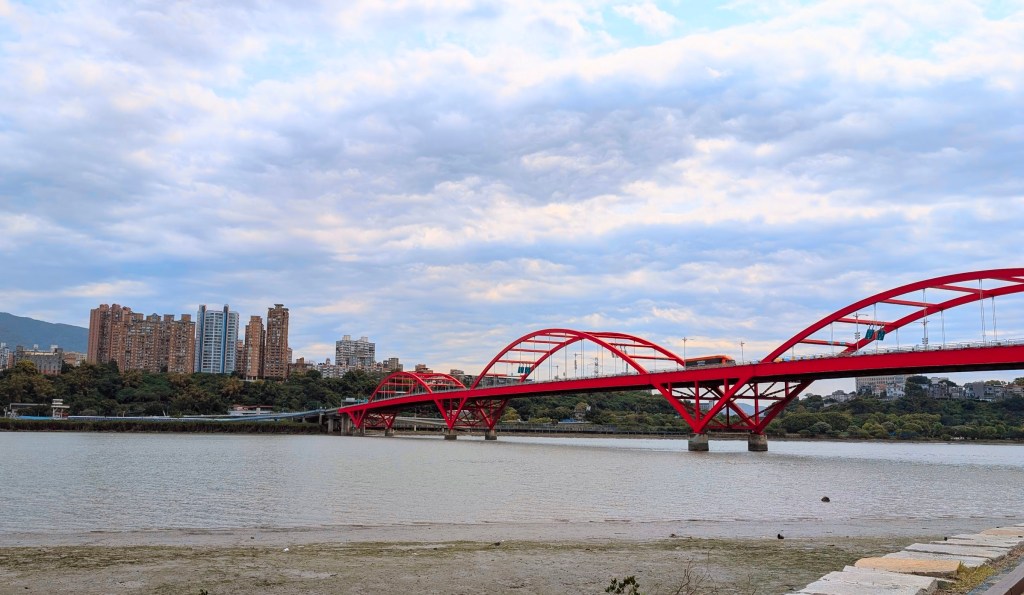
We crossed the bridge and made another stop. It was a good spot for a view along the river.

And sure enough, the bridge offered the perfect background for our group picture.

From the bridge, we headed back, but now along the other side of the river. In a couple of miles (about 3 km), we stopped at Mommouth Coffeeshop. Right next to the river and with outdoor tables under shadowy trees, it was a good place for a quick lunch.
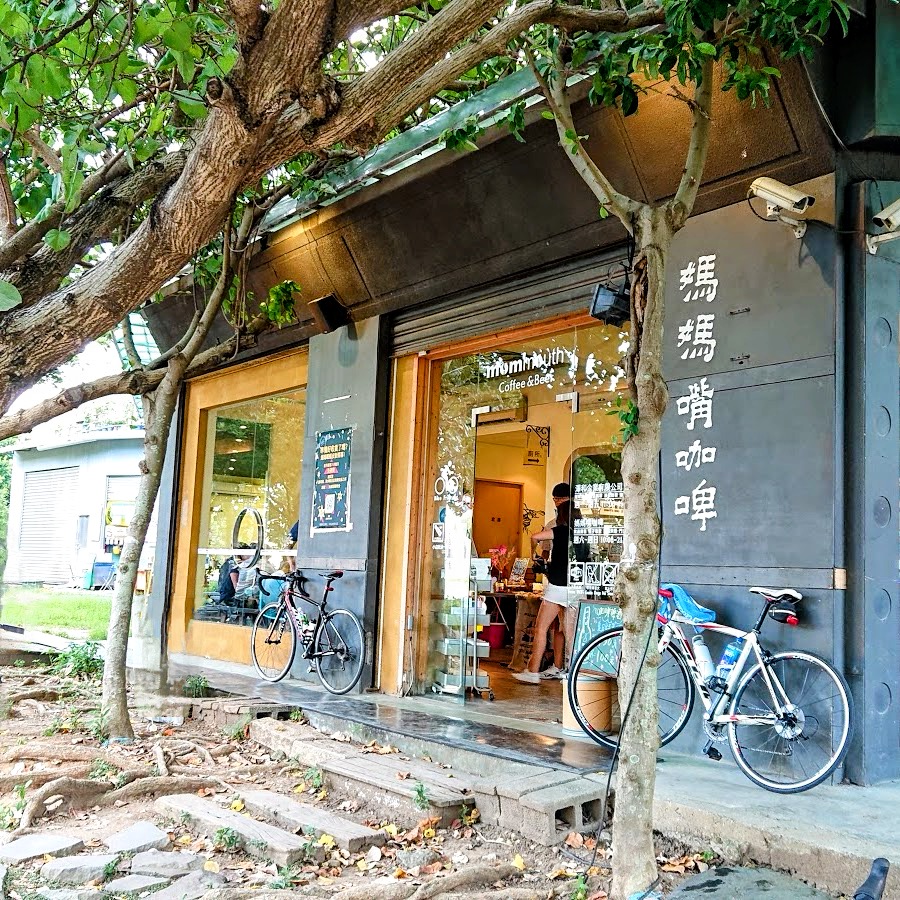
The selection of coffees, teas, and snacks at Mommouth was also very satisfactory.

After Mommouth Coffeeshop, the remaining bike ride was very short, with the final destination being the town of Bali. On this last stretch, the bike path goes right next to the river offering a pleasant cooling breeze from the waters.

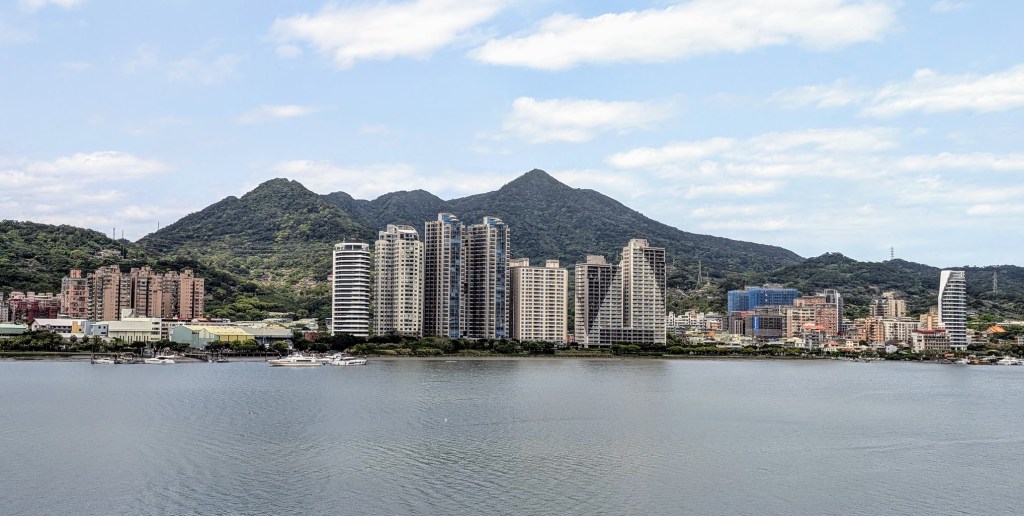
And then we arrived in the town of Bali which is right across the river from Tamsui. Residents of Taipei often come to Bali, because it is very close to the city and yet has a feel of the small town in the countryside. The green riverside area, views of the Tamsui River, parks, and some preserved historic houses and streets converted Bali into a hub for leisure and culture.

Bali also lays claim to a couple of food specialties. It is known for fresh mussel dishes prepared in various ways and a fried pastry called “Shuangbaotai,” often referred to as a “twin donut” (because “Shuangbaotai” literally translates to “twins” in Mandarin Chinese).
I bought one of these “twins” and tasted it. The donut was only slightly sweet, with a distinctly crispy and crunchy outside and a soft and satisfyingly chewy inside. A good snack, especially when freshly prepared in front of you!

We were almost done with our trip, but not quite yet. The concluding part was taking a small ferry boat which frequently operates between Bali and Tamsui.
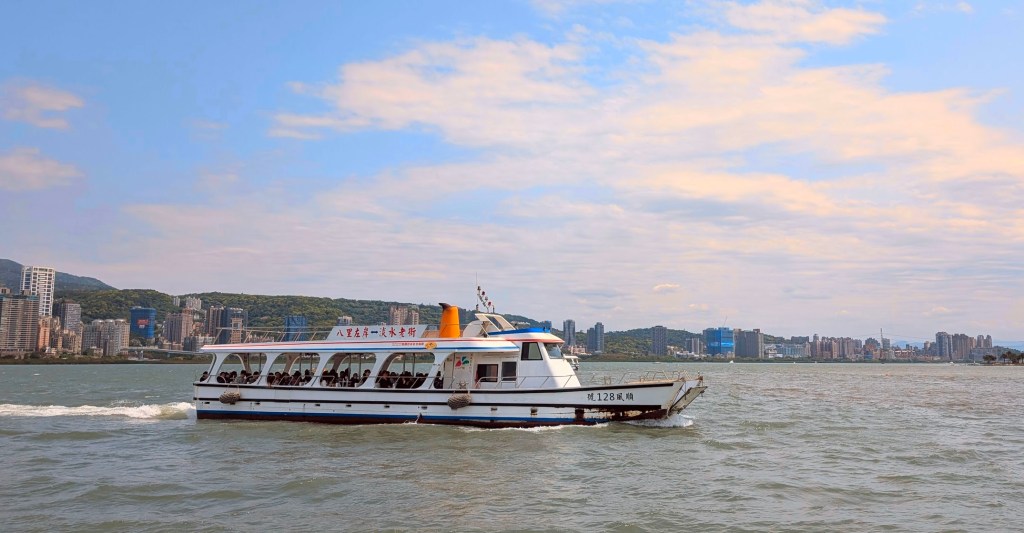
Unfortunately, the ferry ride back to Tamsui lasted only about 10 minutes. Indeed, if possible, I would have stayed on the boat for an hour or so: simply enjoying the breeze, the wide open waters, and the panoramic views of both Bali and Tamsui districts.

Back in Tamsui, we parted our ways. I was immensely grateful to my trip companions, the Taiwan SERVAS members, who created such a memorable day for me.

I spent my last night in Taiwan with Thomas and his family. After dinner, I took the elevator to the last floor of his apartment building, and walked to the roof. The skies were very clear, and I could see far away in all directions.
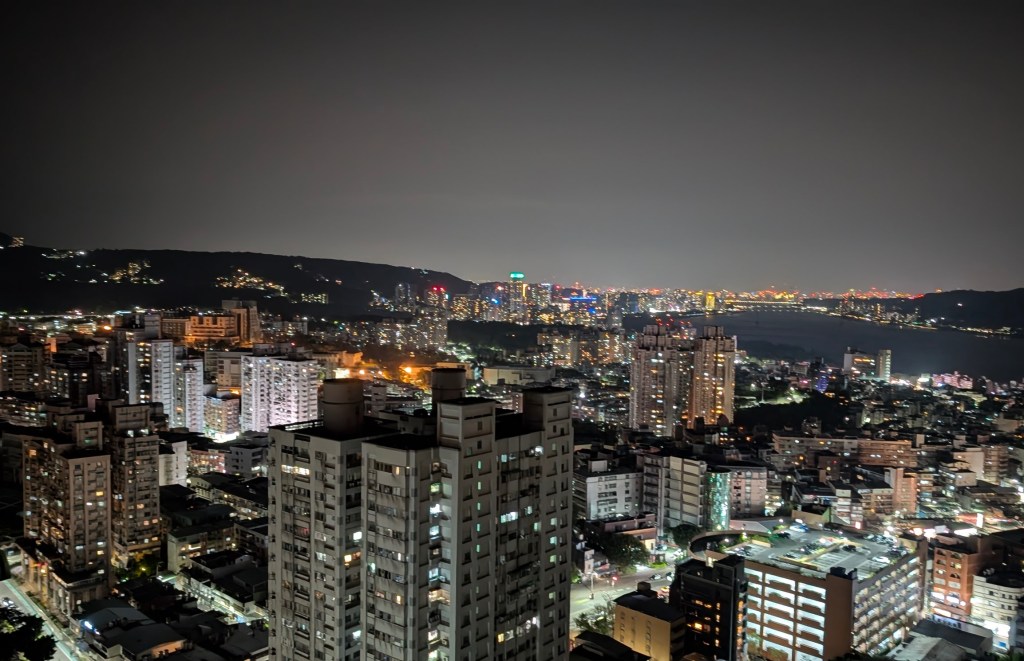
My flight back home was in only a few hours, but I was already thinking about coming back to Taiwan, the country which offers so much: pristine and diverse nature, rich cultural heritage and history, interesting traditions, vibrant markets, and great food.
But more than anything, I was thinking about the people whom I met here and who made the trip so full and rewarding: Grace and Kalima, Sophia, Thomas, Angela, the mother and two daughters who picked me up on the road to Hualien, the folks who run the Old Door Hostel, and many more. Big thanks to all of you, and, perhaps, we will meet again.

 Alexei on the Road
prime! Analysis: Understanding the Historical Context of [Current Conflict] 2025 palatial
LikeLike
Christ is Risen! Wonderful to read the information you Provided. Your trips are well prepared and executed. May God continue to provide you with the means and ability to see the world. Keep sending us your travel log and insights.
LikeLike
Hi, Alexie—-Christ is risen! I enjoyed your massive amount of info on your trip to Taiwan! My wife and I were there for over 3 weeks in early 2024. Our son and his Taiwanese wife and their daughter live there. We loved it and would love to go back again, but probably won’t as they plan on moving to Cleveland where we live this September. Partly over concerns about what the mainland regime may someday do.
Anyway, I was surprised you didn’t mention anything about Orthodoxy there. There are two parishes, both in Taiwan. One Russian, one Greek. My son and family are very deeply involved in the Russian parish (they use 3 languages—Chinese, Russian, and English.) Their priest had to be out of the country while we were there so I had the privilege of serving the liturgy and preaching on 2 Sundays. A wonderful church—growing with catechumens just like our parishes in America!
So I just wanted to make sure you know that our Orthodox Faith, although small in Taiwan, is growing! It was exciting to be with them!
God bless you!
In Christ,
Father Andrew Harmon, retired and assistant priest
St. Matthew Antiochian Church
North Royalton, Ohio
LikeLike