


I suspect the title of this story triggers three questions: Where are the Aeolian Islands? What is this whole business with the ‘Seven Sisters of Fire’? And why bother going there for Easter?
Below is the table of contents – the outline of our journey, followed by the answers to these questions.
- How to Reach Aeolian Islands
- Five Big Historic Facts About Seven Small Islands
- Sweet and Salty Gourmet Treasures
- Salina: Green Island
- Stromboli: Island of Eternal Fire
- Lipari: White Island
As part of Italy, Aeolian Islands are an archipelago of seven small islands in the Tyrrhenian Sea, north of Sicily. Some people even think of them simply as a cultural and geographic extension of the Sicilian “mainland.” In reality, however, with a total population of about 15,000, each of seven Aeolians has a unique identity that reveals itself in distinctive landscapes, economies, and styles of living.

As for the “sisters of fire,” Aeolian islands are not exactly individual islands, but the “tips” of one massive underwater mountain range of volcanoes. To put things into perspective, 95% of this mountain range remains submerged in the Tyrrhenian Sea, while the islands we can walk on are the “lucky” 5% that rose above the surface.
The powerful volcanic fire which gave birth to seven Aeolians is fully extinct on only three of them: Salina, Alicudi, and Filicudi. On Panarea and Lipari, the volcanoes are in a “sleeping” mode, while Stromboli and Volcano greet visitors with all kinds of seismic activities: eruptions, flowing lava, smoking fumaroles, thermal waters, etc.

As for my desire to witness Easter celebrations on Aeolian Islands, just bear with me for now. You will find out about it later in the story.
How to Reach Aeolian Islands
The bad news for people who prefer flying over other transport options is that there are no commercial airports on Aeolian islands. The only way to come here is by ferry departing from either Naples on mainland Italy or Sicily.
In the first case (from Naples), you will travel on the big ships operated by the Siremar company. The advantage of this option is the possibility of travelling with a car, and the fact that these big boats are less likely to cancel operations when the sea gets rough (especially in winter and early spring).
The negatives are longer sailing times (I suggest overnight), more expensive tickets, and an infrequent schedule. HERE is the website with Siremar’s timetables and tickets.

The second option is to take a smaller fast craft (hydrofoil) ferry from either the Sicilian capital, Palermo, or the town of Milazzo in eastern Sicily.
Operated by Liberty Lines, these boats are almost like water taxis, offering fast, inexpensive, and frequent transportation between all Aeolian islands and Sicily. HERE is the website for schedules and tickets.

Five Big Historic Facts About Seven Small Islands
The Aeolian Islands have a history that is as explosive as their geology. Despite their small size (total surface area 45 sq miles / 115 sq km) and population (15,500 total), some of the events which happened here had a surprisingly far-reaching impact. I think, the following five facts will be interesting to anyone.
Fact #1. During the Neolithic Epoch (5000-4000 BC), Aeolian Islands were almost like the “Silicon Valley” of that time. This was due to deposits of obsidian, a volcanic glass that was the most valuable “high tech” material of the era, because it was used to make razor-sharp tools.
Lipari (the biggest island) possessed a rare, high-quality obsidian which transformed this island into one of the most important economic hubs in the Mediterranean. Archaeologists have found that Liparian obsidian was used as far away as France, Northern Italy, the Balkans, and Northern Africa.
Fact #2. Lipari is also home to “the oldest spa in the Mediterranean.” On the western side of the island, Terme (“thermal bath”) di San Calogero features a Mycenaean tholos – a beehive-shaped stone structure dating back to the 17th–15th century BC.

Here, the waters heated by volcanic activity have been used for wellness purposes for nearly 3,500 years by ancient Greeks, Romans, and medieval pilgrims. It is hard to believe, but when the most recent spa building was constructed (1872), it continued to utilize the original Greek and Roman terracotta pipes to direct hot water. Similarly, the “tholos” (most ancient part of the complex) was in continuous use as a steam room.
Regrettably, the Terme di San Calogero closed to public bathing in 1975, but you can still see an outdoor Roman-era pool and visit a museum dedicated to the history of the thermal bath.

The good news is that you can experience the Aeolian thermal waters on the neighboring island of Vulcano. It has natural mud baths and hot springs which are open to the public.

Fact #3. People have lived on Aeolian islands since pre-historic times, but their population and culture were effectively “fully reset” by a single catastrophic event. In 1544, the Ottoman corsair Hayreddin Barbarossa laid siege to Lipari, the main island, taking nearly the entire population into slavery. People who lived on other smaller islands either fled to Sicily or were also captured by Barbarossa’s fleet as it moved through the archipelago.
For several years, the islands were deserted until Charles V (King of Spain and Sicily) repopulated them with families from Catania, Calabria, and Spain. As a result, the local culture today is not a linear “successor” of the ancient Aeolians, but a blend of various Southern Italian and Spanish traditions.

Fact #4. In the 20th century, the islands experienced what can be described as a transition “from hell to world fame.”
In the early 1900s, they were so impoverished that half the population emigrated: mostly to Australia and the US. Under the Fascist regime of Benito Mussolini (1925-1943), they were used as a “confino” – a place of exile for political prisoners. Things changed when two acclaimed movies revealed Aeolians to the wide world.
The first was the 1950 film Stromboli (Land of God), directed by Roberto Rossellini and featuring the Swedish-American star of the era, Ingrid Bergman. The international scandal of their love affair (which happened during film production), combined with the cinematic power of the Stromboli volcano, turned the eyes of the world toward the islands. If you have never seen this movie, you can watch it HERE.

It is hard to imagine today, but because of her “improper behavior,” Ingrid was publicly denounced on the floor of US Senate and effectively exiled from Hollywood. During the movie production, she and Rossellini lived in a brightly painted house named Casa Rossa (Red House). It still stands today in the village of San Vincenzo on Stromboli.

Another movie which helped the archipelago become an international tourism destination was the 1994 Italian masterpiece Il Postino (The Postman). Directed by Michael Radford, it is set on Salina island in the 1950s. The film follows Mario, a shy, bumbling man working as a postman. His only task, however, is to deliver mail to the world-renowned Chilean poet Pablo Neruda, who has been exiled to Italy.
As their relationship evolves, Mario learns from Neruda the power of metaphors and poetry, eventually using his new voice to win the heart of the local beauty, Beatrice. Here is the full movie: I greatly enjoyed it.
Nominated for five Oscars, the movie has a powerful, tragic end. What most people do not know, however, is that the film is intertwined with the real-life tragedy of its lead actor, Massimo Troisi, who played Mario.
Troisi suffered from severe heart disease which required a transplant. He postponed his surgery to complete the film, stating that he wanted to do it with “his own heart.” The actor died just 12 hours after shooting the final scene, receiving eventually posthumous Oscar nominations for Best Actor and Best Screenplay.
My favorite scenes in the movie are the dialogues between Mario and Neruda set on Pollara Beach, which was formed by a partially submerged volcanic crater.

Fact #5. The Aeolian islands are so significant to earth science that their names were used as “labels” for various types of volcanic eruptions: Strombolian (describing Stromboli’s continuous, rhythmic bursts) and Vulcanian (referring to Vulcano island’s more explosive and viscous eruptions).
In 2000, the archipelago was named a UNESCO World Heritage site for its “outstanding record of volcanic island-building.”
Sweet and Salty Gourmet Treasures
As anywhere in Southern Italy, food is a big part of Aeolian cultural and social scene. Many local specialties are similar to those found in Sicily. You can read about them in my story about Palermo. At the same time, some delicacies can be legitimately claimed by the islanders as truly “theirs.” Two of them are literally “deep rooted” in the islands’ rich volcanic soil.
The first are capers, the pickled or salt-cured buds of the caper bush. They are prized for a pungent, salty, and tangy flavor which makes them a tantalizing condiment for many dishes.

While widespread in the Mediterranean and parts of Asia and Africa, Aeolian capers are considered the “best of the best.” The nutrient-rich volcanic soil gives them a firmer texture and an intense, complex flavor that is far superior to other mass-produced varieties.


On Aeolian islands you will also find “cucunci” (caperberries), which are the larger fruits of the same plant. Unlike capers, cucunci are often served on their own as an aperitivo (appetizer).

When people visit Aeolian islands and taste local capers, they are inevitably tempted to bring some of this “green gold” back home. The easiest way to do this, and not to worry about liquid rules on the plane, is to buy vacuum-sealed capers that are cured in sea-salt.
In fact, culinary experts believe that salt-cured capers are the superior choice for high-quality cooking. By being preserved in dry sea salt, they undergo a different transformation than those in a jar of vinegar. Salt draws moisture out of the caper bud, concentrating its natural essential oils and resulting in a deeper flavor and aroma.

The second “gourmet treasure” coming from Aeolian volcanic soils is Malvasia delle Lipari, an incredibly aromatic wine produced across the islands, though Salina and Lipari are the primary hubs. It is made from grapes that are left to dry in the sun on cane mats for several weeks. This “passito” process concentrates aromas and flavors.

Known as the “Nectar of the Gods,” Malvasia delle Lipari is honey-sweet and is enjoyed at the end of a meal, often accompanied by piparelle (almond biscuits) or sesamini (sesame cookies).

When I tried Malvasia delle Lipari the first time, I was overwhelmed with aromas of apricots and dried figs; it felt almost like biting through the fruits.
For full disclosure, I am not a big fan of sweet wines, but luckily more and more Aeolian winemakers are making Malvasia wines in the dry “secco” version. Of all the ones which I tried, my favorite was the one produced by Azienda Agricola Colosi Piero on Salina island.

While Capers and Malvasia are the principal Aeolian food-ambassadors, here are four other signature dishes which you must try.
One is “Pane Cunzato.” It is a toasted flatbread topped with all kinds of local products including tomatoes, salted ricotta cheese, olives, anchovies, tuna, and, of course, a generous amount of capers.
Biting through its warm, crunchy crust into the vibrant burst of savory toppings triggers an explosion of flavors. They are as bold and powerful as the volcanic forces that birthed these islands.

The deep waters surrounding the islands contain various fish and crustaceans. One of them is “totano” also known as “flying squid” – the name referring to the habit of leaping from the water to evade predators.
Totanos are much larger than the common calamari, which makes them perfect candidates for stuffing (“ripieni”) with breadcrumbs, garlic, and capers, and then cooking and serving in a rich red stew.

Insalata Eoliana (literally “Aeolian Salad”) is another local staple, especially popular during the hot summer months. It is a fragrant blend of boiled potatoes, cherry tomatoes, red onions, olives, capers, and chunks of locally caught tuna or swordfish – all seasoned generously with wild oregano.

When it comes to desserts, the soul of Aeolian sweets is “vincotto” (cooked wine). While on the “mainland” Sicily people always loved honey and ricotta cheese, the isolation of the Aeolians led to a mastery of grape-must reduction.
If you encounter here pastries or cookies which are dark, spicy (cloves/cinnamon), and have a deep, raisin-like flavor, they are likely “true Aeolians.” I personally fell in love with “spicchiteddi,” the crunchy, not too sweet, aromatic dark-brown biscuits shaped into spirals or snails.

Enough with logistics, history and food. Let’s go to the islands!
Salina: Green Island
With a population of about 2,600 and a territory of 26 sq km / 10 sq mi, Salina is the second largest island after Lipari. Within the Aeolian archipelago, Salina clearly distinguishes itself through its lush landscapes.
Unlike its neighbors with more arid volcanic terrain, Salina has natural freshwater springs, rich vegetation (ferns, chestnut, and poplar trees), and flourishing agriculture.

Salina’s other distinctive feature is its political “independence.” All other islands form one municipality, but Salina is not only on its own but is even further divided into three municipalities. Why? During the 19th century, Salina experienced an agricultural boom. The rich volcanic soil and natural water springs made it the most fertile in the archipelago.
The production of Malvasia wine (exported heavily to the British market) and capers created a wealthy entrepreneurial class. The profits were reinvested into a significant merchant fleet, and in 1867 the residents of Salina distanced themselves from what they viewed as the “colonial” dominance of Lipari.
Then three main villages (Santa Marina, Malfa, and Leni) began quarreling over the allocation of taxes and local infrastructure and decided in 1909 that they were better off being fully independent from one another.

One more fact made me really curious to visit Salina: in 2019, the CNN channel named it the “most beautiful island in Italy.”
Alas, when I arrived by hydrofoil from Milazzo (read about transportation HERE) to Santa Marina, the main village on Salina, the island met me with with a gloomy day and a dreary, drizzling rain.

The good news was that my local host, Marino, was waiting for me in the port with a car. In 5 minutes we were in my “home away from home” – a white-yellow stucco bungalow backed by the forested mountains and with a panoramic view of Mediterranean.

By the way, many local residents rent their houses or rooms to visitors, but they don’t list them on major online platforms like Booking or AirBnB. Hence, it requires some effort to find and arrange accommodations.
“Madile Apartments” (official name of Marino’s property) turned out to be a five-star choice both in comfort and location. If you decide to visit Salina, get in touch with Marino’s daughter via WhatsApp: +39-331-927-0833

Early next morning I woke up to bright sunshine floating through my window. The weather had changed “180 degrees,” and I was eager to explore the island. But first I slowly sipped a cup of steaming coffee, sitting on my open terrace and absorbing the view of the calm sea.

Then, I walked leisurely (10 minutes) to the town’s main square near the port where I had arrived the previous evening.

One side of the square was formed by the yellow church named after Santa Marina, the patron saint of the town. The door was open, and I went inside.

The 18th century interior was designed in an elegant baroque style. Dominating white and light-yellow tones added to the weightless and airy atmosphere.

At the altar, there was the image of Santa Marina – a saint with a rather unusual story. Known also as Saint Marina the Monk, she was born in modern-day Turkey and lost her mother at a young age. Her father decided to become a monk but did not want to leave his daughter behind. So, she cut her hair, dressed in men’s clothing, and entered the monastery as a boy under the name Marinos.
During one of her trips for the monastery, she stayed at an inn where the innkeeper’s daughter became pregnant by a soldier. The daughter accused the monk “Marinos” of being the father.
Rather than revealing her concealed gender to prove her innocence, Marina accepted the blame. She was expelled from the monastery and spent three years living as a beggar at the gates, raising the child as her own.
It was only when she died and the monks prepared her body for burial that they discovered she was a woman. She was proclaimed a saint because of her extraordinary humility and willingness to endure unjust suffering in silence—qualities that the early Church viewed as the imitation of Christ’s suffering.

Back on the square, I noted a wide promenade stretching along the ocean and towards the south. It was as good as any other “starting point” for exploring the island. I decided to see where I would end up and began my morning hike.

Eventually the walkway merged into the real road leading to the village of Lingua which was just a couple of miles away. In about 30 minutes of zigzagging and gradual ascent I was rewarded with a great view: Santa Marina di Salina to the north, and Lingua to the south.


I kept walking towards Lingua and in about 20 minutes reached a seaside cemetery. Wandering among old graves, I was struck by a few observations. The first was how elaborate many monuments were on this ordinary village graveyard.


The second surprise was the quality of the photographs embedded in many gravestones. They were of remarkably high quality and well preserved despite the fact that most originated from before World War II.
Finally, looking at the dates of birth and death, I noted that most people buried here lived long lives of well over 70 years. This was also a surprise because in Italy the life expectancy at the beginning of the 20th century was only about 40-43 years. Whatever the explanation is – “healthy” island living or the historic prosperity of Salina – this cemetery was an interesting site to visit.

After about 10 more minutes of walking, I entered Lingua. The village looked completely abandoned, which was not exactly surprising: the local residents were probably occupied with their daily chores, while the tourists had not yet arrive.
Just so you know: except for Lipari, the real tourist season on Aeolian islands begins typically after Easter weekend. Prior to that, most shops, cafes, and guesthouses are closed for the winter break.

Walking on this sunny, warm day through the deserted streets of Lingua, I felt like the whole place belonged to me alone.
I left the road and continued walking on the pebble beach right next to the ocean. The soothing sounds of water seeping through the pebbles and the spicy sea air brought me into a nearly meditative state.

Eventually I reached the old Lingua lighthouse which sits on a cape protruding into the sea. Besides simply enjoyable hike, there was one more reason why I wanted to see this place. The sprawling lagoon right next to the lighthouse actually gave birth to the name of this island – Salina.
Punta Lingua (the area around the lighthouse) has been used since times of antiquity as a huge salt pond (“salina”) to harvest this valuable commodity for preserving fish and capers.

Later I learned that it is sometimes possible to see the submerged remains of Roman salt pans dating back to the 2nd century AD. On very calm days, the ancient walls and floors emerge from beneath the layer of clear waters.

After exploring Punta Lingua, I checked the time. To my surprise, it was still only 10 in the morning: my day had started really early. I left village and continued walking beyond the lighthouse and along the ocean.

My walk ended with the realization that I was hungry. Since all businesses in Lingua were closed, my food options were back in Santa Marina, and by noon I returned there. There is only one main street in the town (Via Risorgimento) and at this – pre-tourist – season, all open places to eat and shops were located there.
First I discovered a grocery store with the interesting name “Carpe Diem” – a Latin expression which means “seize the day.” Inside, I was pleasantly surprised by the impressive selection of foods: fruits, vegetables, sausages, cheeses, and also many locally made products such as various condiments, preserves, capers, wines, and much more.

The store was owned by a fellow named Maurizio who had a good knowledge of local gastronomy and was keen on introducing visitors to all the Aeolian gourmet items. A nice addition to his boutique shop was a small deli counter run by Maurizio’s wife. Her signature creations were “paninis” (grilled sandwiches) prepared exclusively with local ingredients.
Fast forward: by the end of my stay on Salina, Carpe Diem had become my favorite place for any kind of groceries.

A few steps past Carpe Diem and on the same side of the street, I discovered a small bakery with an impressive variety of freshly baked goods: breads, pastries, cakes, focaccias, and pizza.
This place didn’t even have a name. Here is the picture. I have highlighted blue entrance doors to the bakery.

Unlike Maurizio, the cheerful lady who ran this bakery did not speak any English, but thanks to Google Translate I was able to figure out “what is what.”

After some consultation, I ended up buying crunchy “pane integrale” (bread made of unrefined whole wheat) which had a nice chewy texture and a strong nutty flavor. For dessert, I settled on a luscious ricotta cake – an Italian (and much better!) version of American cheesecake.


Back in my bungalow, I had a quick lunch and then set off to the village of Malfa on the north of the island. Now is a good time to talk about “how to get around Salina.” The island has a surprisingly efficient bus network operated by the C.I.T.I.S. (Consorzio Intercomunale Trasporti Isola di Salina) company.
Buses or minivans connect all villages and run every 1 to 2 hours; just make sure that you know when the last bus departs to your final destination. Best of all, this transportation is very affordable: a ticket costs approximately €2.50 – €3.00 per journey

The distance between Santa Marina and Malfa is only 8 km / 5.5 mi, and in 15 minutes I was there. Perched on a northern slope between two extinct volcanoes, the white-washed houses of Malfa create a visually striking contrast with the deep-green forested mountains.

The bus dropped me in the upper part of the village. From there, I could clearly see the Chiesa dell’Immacolata (Church of the Immaculate Conception) which sits on the Malfa’s central square.
I strolled down to the square and admired the soaring bright pink facade of the church.

Similarly to Lingua earlier this morning, there weren’t many people around, and I continued my walk to “Spiaggia dello Scario,” a pebble beach known for its crystal-clear waters, which makes it a premier spot for snorkeling.
Clearly, in early April, I was not planning to swim, but I decided to check it out for possible future visits. My curiosity was rewarded with an impressive rock formation sitting in the sea and facing the beach.

After the beach, I was ready for the main goal of visiting Malfa. If Salina as a whole is the “green island,” then Malfa is its “green heart” because it is the island’s prime agricultural area and the center of both the caper and wine industries.
Choosing between various wineries and “aziendas” (farms), I decided to visit “Azienda Agricola Virgona.” There were two primary reasons for this choice.
First, it is a truly family-run place with many generations passing down various “secrets” and traditions. Second, this farm is like a “snapshot” of all Aeolian agriculture. Besides various wines (including the famous “Malvasia Passito”), this farm also produces pickled and salted capers, along with various caper-based preserves.


I arranged my visit through Laura (WhatsApp +39-338-261-1521), the daughter of the owners. Laura said that her father, Calogero, and an English-speaking nephew would show me around and give me a taste of everything.
Fast forward: “delightful” is the best word to describe my experience at Azienda Agricola Virgona, both for the quality of their products and the warm hospitality I received

Besides the traditional products that I expected, two items stood out as an “innovative” surprise. One was Malvasia-flavored beer, and the other was the caper jam. The flavor of the latter can be best described as a perfect balance of “sweet-and-sour.”
The natural saltiness and acidity of the capers were nicely softened by the sugar, making this unusual confiture an excellent companion for strong cheeses or cured meats.

I left Azienda Agricola Virgona being loaded with several jars of caper jam and a selection of wines.

After Azienda Agricola Virgona, my first thought was to go back to Santa Marina, but then I realized that there was still enough time for a small side-trip. From Malfa, I took a bus to the village of Rinella on the south of the island. Here is the map.

The final bus stop was in Rinella’s harbor. I disembarked and walked along the pier protruding into the sea.

Then, I walked to the nearby black sand beach, Spiaggia di Rinella. It looked like many other beaches on Salina, but I knew one interesting fact about this spot.
At this beach, from time to time, the underwater volcanic vents emit gas and fumes. Divers and snorkelers often describe swimming here as being inside a giant, warm, underwater bottle of sparkling water.

It was time for dinner when I returned to Santa Marina. My choice tonight was a restaurant called “Trattoria Cucinotta,” another family establishment quite popular among local residents.

Besides good food, another “bestselling” item in this restaurant is its open-air terrace with the panoramic view of the sea.

What did I have for dinner? Well, the most popular fish on both Aeolian islands and Sicily in general is “pesce spada” (swordfish) which can be prepared in many different ways.
This night, I ordered “involtini di spada,” a dish consisting of thin fish slices rolled around a stuffing made of toasted breadcrumbs, garlic, fresh parsley, Provolone cheese, and, of course, inevitable capers.
The assembled rolls are threaded onto skewers and then either grilled (this was my case) or baked. I have had involtini di spada before, and can firmly testify: the ones I got at Trattoria Cucinotta were superb. The combination of slightly smoky fish, aromatic herbs, luscious melted cheese, and “popping” salty capers deserved at least one Michelin star.

The second day was reserved for an epic hike to the “roof” of the Aeolian archipelago – the peak of Monte Fossa delle Felci. It is an extinct volcano and the highest point of the archipelago (962 meters / 3,000 feet). There are two options for conquering Monte Fossa. One is a steep climb from Santa Marina. Although the distance is only 4.6 km / 2.9 mi, it requires about 2.5 hours one way.
The second option is to take a bus to the village of Valdichiesa in the middle of the island and approach the mountain from the other side. This is a much easier way to reach the summit, with the starting point already at an elevation of 300 meters and requiring only 1.5 – 2 hours. I decided to use this option for going up and then drop down to Santa Marina via the steep descent.
The trailhead in Valdichiesa is at the church Santuario della Madonna del Terzito.

Behind the church, I easily found a wooden signpost and the trail. The path was wide and well-maintained; in fact, it looked more like a dirt track used by forestry vehicles. The walk was not only easy but truly pleasant, leading through woods of pine, oak, and chestnut trees.

In a few minutes, I came to an opening in the forest behind me. From here, I could see Valdichiesa, the surrounding Malvasia vineyards, and the church – the starting point of my hike.

In about 40 minutes I arrived at the rest area at Monte Rivi, another extinct volcanic peak. A small stone house (rifugio) was open. Inside, there were a fireplace and benches, making it a good shelter in case of unexpected bad weather. Outside, wooden tables invited hikers to sit and have a picnic.

I was neither tired nor hungry, but I decided to take a break anyway to enjoy the solitude and the fresh air of the spring forest. Walking around rifugio, I discovered a trail junction. One path continued the climb to the summit of Monte Fossa delle Felci, while the other descended toward Malfa – the village I had visited the day before.

After Mount Rivi, a steady climb continued under a canopy of maritime pines and chestnut trees, but eventually the woods gave way to the crater’s signature “sea of ferns and heather.” At this point, an unobstructed view towards the north opened up. From here, I had a clear line of sight down to the Malfa village.

After this vantage point, I continued for another 20 minutes, coming finally to the top of Monte Fossa delle Felci. The area around the summit was covered with bright yellow spring flowers.

The summit itself was marked by a modest cross built atop a pile of stones.

The view from Monte Fossa delle Felci is considered the most spectacular in all Aeolian islands. On clear days, one can see the entire “arc” of the archipelago.
To the south, the neighboring islands of Lipari and Vulcano appeared remarkably close. Directly below, I saw the harbor and the salt lagoon of the village of Lingua as if they were in the palm of my hand.

To the west, in the distance, the silhouettes of Filicudi and Alicudi, the two smallest Aeolian islands, were rising out of the sea. Right in front of me was the volcanic cone of Monte dei Porri, the “smaller brother” of Monte Fossa delle Felci.
By the way, I forgot to mention that before becoming “Salina,” the Green island had another ancient name: Didyme (“twins” in Greek), referring to the island’s two prominent volcanoes which dominate its skyline.

I was about to begin the second part of the hike, the 962-meter drop down to the sea and Santa Marina, but then I changed my mind. Instead, I walked back to Valdichiesa. Why? Because I realized that otherwise I wouldn’t have enough time to visit one more place I wanted to see.
In the introductory section (HERE), I wrote that Salina gained international fame as the filming location for the 1994 Academy Award-winning film Il Postino (The Postman). The most iconic scenes were shot in the remote village of Pollara, where the exiled Chilean politician and poet lived and where he befriended Mario, a young local postman.

Just so you know, in reality, Pablo Neruda never lived on Aeolian islands. He spent his exile on the much more fashionable island of Capri. But watching the movie I was deeply moved by both its plot (a life journey from a simple fisherman’s son to a man who discovers the power of poetic metaphors) and its captivating visual setting in the village of Pollara. So, I wanted to see this place.
From Valdichiesa, I took the bus to Malfa and then changed for Pollara. After zigzagging in the mountains, the road climbed to the edge of the cliffs which surround the village. A view from here was already worth the trip, because of Pollara’s unusual setting. The village sits within a massive half-submerged volcanic crater.

After a brisk descent, the bus arrived at the final stop on the main village square and in front of the pale yellow Chiesa di Sant’Onofrio (Church of Saint Onofrio)

I was not particularly impressed with the church’s outside appearance, but the baroque interior was much more elaborate than I expected.


From the church, I walked to the Casa de “Il Postino,” where Pablo Neruda lived in the movie. The bright pink color makes it quite a landmark against the greenery of the surrounding cliffs.
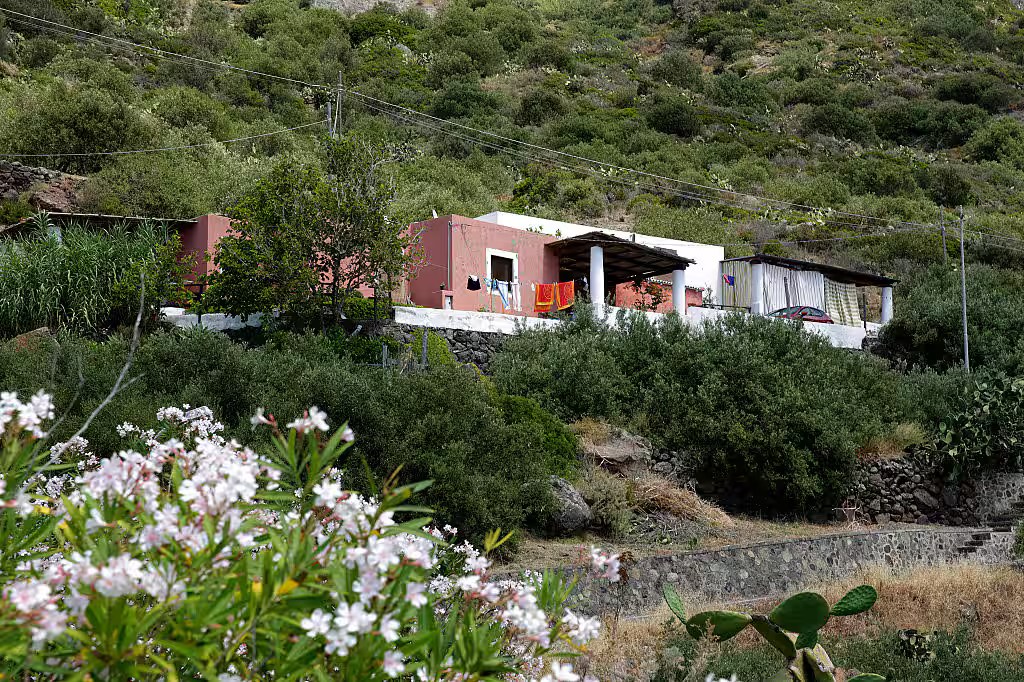
The Casa de Il Postino is a private residence, and you won’t find a museum there, but I truly enjoyed walking around and see the setting of the movie.

My last destination in Pollara was Spiaggia della Pollara, the beach where many gripping conversations between Pablo Neruda and Mario took place.
When I descended to the shoreline, I was met by the impressive “balate.” These are ancient boat shelters carved by fishermen directly into the volcanic rock. In the film, they appear in the opening scenes creating the atmospheric backdrop for the maritime character of the village.

The beach was absolutely deserted and, being by myself, I could perfectly imagine Pablo and Mario being also here and discussing the art and power of metaphors.

My romantic musings came to an abrupt end when I realized that the last bus from Pollara to Santa Marina was leaving in less than 15 minutes. I ran up the path from the shore and back to the village just in time to catch the ride home.
This was my last night on Salina, and the last chance to minge with the locals before leaving the island. One of the popular social hubs in Santa Marina is the pizzeria and bar “Bagghiu Lisciu.” I was told that their pizzas are also top notch culinary creations. So, I walked there and “joined the crowds.”

From the impressive list of pizzas and other dishes, I ordered a calzone filled with Parma ham, provolone cheese, and mushrooms.

Biting into the aromatic, slightly charred crust and savoring the piping hot filling, I was struck by one unexpected thought. Although I had accomplished everything I planned to do, I should have stayed on Salina a couple more days—simply hanging around and drifting along with the island’s unhurried living. I guess I will have to come back.
Stromboli: Island of Eternal Fire
All seven Aeolian islands were “born of fire,” but only one – Stromboli – has remained in a state of nearly continuous eruption for over two millennia, growling and spewing magma every single day. Naturally, I was curious to see how 700 residents of the 13 sq km / 5 sq mi island live literally on the edge of an active volcano.
Before reaching San Vincenzo, the main village on Stromboli, my hydrofoil ferry from Salina made two stops.
The first was at Panarea island. Being the smallest in size, Panarea also has a reputation as the most exclusive one. People told me about its strict car-free policy and a boutique, high-end atmosphere that feels very distinct from its more rustic neighbors.

The second stop was at Ginostra, the village on the southern edge of Stromboli. Accessible only by sea, it looks like an amphitheater of houses completely cut off from the rest of the island by impassable volcanic cliffs.
People live on this “island within an island” with radical simplicity. I was thinking about visiting Ginostra, but put it off for another trip.

My guesthouse in San Vincenzo was only about 15 minutes on foot from the harbor, but I arranged for a transfer because dragging a suitcase up the cobblestone streets wasn’t a very appealing idea.
The role of “taxis” on Stromboli is performed by golf-carts: they are by far the most efficient transportation in the cobweb of narrow streets and winding alleys of the main village. Besides, there aren’t many roads or destinations beyond San Vincenzo, and these small vehicles are absolutely sufficient to get around. Here is the map of Stromboli
My driver, Fabrizio was waiting at the port with his young son, who clearly enjoyed riding along with his father and “screening” the clients. During my stay on Stromboli, I used Fabrizio’s services by simply sending him WhatsApp messages (+39-338-791-9790) and getting a response and ride within a few minutes.

By noon I settled in my guesthouse, the Pedra Residence. When looking at various options on Booking.com and AirBnB, Pedra Residence attracted me because of the number of reviews mentioning its home like welcoming atmosphere, and the deep roots of the owners to Stromboli.

While I anticipated hospitality and comfortable accommodations, the reality actually turned out much more luxurious than expected.
The first floor was occupied by a spacious and well designed studio apartment with a huge bed and a fully equipped kitchen.


In the corner, a spiral staircase led to an open-air terrace on the second floor.
The terrace offered everything a lazy tourist may need on a relaxed, sunny day: a table, soft chairs and a sofa, a hammock, and – most importantly – an unobstructed view of the sea with some small island in the distance.

At reception, I was met by the cheerful young lady Sharon, the manager of the guesthouse and the daughter of the owner. Sharon told me that “Pedra” is the name of her grandmother, the matriarch of the family who is still quite active and involved in all the family affairs. She also proudly mentioned that her Cincotta family was among the very first settlers who came to Stromboli in the 1630s.
I asked whether there was any population on Stromboli prior to that, and the answer gave me the first lesson on what it means to live on an active volcano. Because of seismic activity, in 1343, a massive portion of the island’s northwestern flank collapsed into the sea. This triggered a tsunami so large that it reached Naples, 200 km / 125 mi away, and destroyed the city’s ports.
After this disaster, Stromboli was completely abandoned. Only 300 years later the Spanish rulers of the Aeolians began bringing families from Sicily and Calabria to re-settle the island to create lookouts against pirates and to start agricultural production. And so, the Cincotta family was among the first who effectively “reset” the human history of Stromboli.

I had many other questions, but Sharon sent me to her father, Maximiliano, who also owns Restobar Ingrid, another flourishing family business.
In the introductory section (HERE), I mentioned the surge of public attention to Stromboli because of the 1950 movie “Stromboli, Land of God” with Hollywood icon Ingrid Bergman. During filming, she and Italian director Roberto Rossellini had a high-profile affair. The ensuing scandal was a global media sensation, resulting in Ingrid being denounced on the floor of the US Senate and her “exile” from Hollywood.
Named after her, Restobar Ingrid proudly occupies the corner of the main village square, clearly indicating the high social status of its owner, Max (he goes by “Max”) Cincotta.

I entered, walked through the dining room, and discovered an open terrace on the back. Only at this point did I realize that that the bar is “hanging” on a high cliff with a 270 degree view over the Mediterranean and the island

I asked for Max, but he wasn’t around. While waiting, I ordered a pizza with locally caught tuna and fresh basil leaves. Sitting at the corner table on the terrace and savoring both the pizza and the view, I did a quick internet research on “Max Cincotta.”

Max was the son of Mario Cincotta, widely known as the “unofficial mayor” or “The King of Stromboli.” A truly legendary, albeit polarizing figure, Mario ran various businesses and maintained a fierce grip on the life of the island. Since Mario’s passing, Max has stepped into the role of a man preserving both the family legacy and Stromboli’s heritage.
He gained a good deal of fame after organizing legal action against the Italian broadcaster RAI following a catastrophic event in May 2022. A “movie fire” during the filming of a TV series went out of control, causing massive environmental and economic damage. In the aftermath, Cincotta became a vocal spokesperson for the islanders, trying to obtain a €50 million in compensation.
I was fully immersed into my online research when I realized that someone else was sitting at my table: it was Max.

Max filled me with many facts from Stromboli’s past and present which, but here is one fun story. Apparently, Max knew and worked for Giorgio Armani, the renowned Italian fashion designer and founder of the Armani luxury brand.
One day, Armani came to Stromboli on his fancy private yacht. Naturally, Max invited him to stay in his hotel, but Armani declined politely and insisted that instead Max be hosted on his yacht. So, for a few days, being on his home island, Max played “visitor” on Armani’s boat.

I could have chated with Max until dinner, but it was time to move to the main item on my program: the hike to the crater of the erupting volcano. Predictably, the island’s major draw is “volcano tourism.” People from around the globe want to see the Sciara del Fuoco (Stream of Fire), a steep volcanic slope where lava flows into the sea.
Until 2019, hikers could reach the summit of the crater (924 meters / 3000 feet), but the massive eruption in July 2019 changed the situation. In the aftermath of the paroxysmal explosion and the death of a hiker, a new rule was established: unsupervised hiking is permitted up to 290 meters, and up to 400 meters with a licensed guide.

During check-in at Pedra Residence, Sharon recommended the “Stromboli Adventures” company. I contacted them via WhatsApp and (for 30 Euros / US $35) reserved a spot in the group leaving from the main square.
Depending on the time of the year, the departure time varies, but the concept is the same: to arrive at the observation point in time for sunset and witness the transition from daylight to full darkness, when the volcano flames and flowing lava look especially dramatic.
The total round-trip is about 8 km / 5 miles, and the guides usually choose an unhurried pace with breaks, making this experience possible for most people. Yet, before going on this adventure, you absolutely MUST arrange for three things: good hiking shoes (it can get slippery), a powerful headlight (you will return on the narrow trail in full darkness), and several layers of clothes (in the night, it can get windy and cold at the observation point).

The name of our guide and the owner of Stromboli Adventures was Stefany. Unlike the Cincotta family, she was born and grew up in Northern Italy. Nineteen years ago, she came to Stromboli for a summer job, fell in love with island’s living surrounded by rugged scenery, and stayed for good.

We set off on time, walked through San Vincenzo, and began a gradual ascent to the crater. Stefany told us that it would take about 2 hours to reach the observation point, but this time includes many breaks for pictures and stories.
The nice thing about this hike is that there are not many “ups and downs.” It is more of a steady climb upwards. As for the path, sometimes it looked like a real trail, and sometimes more like a narrow paved road.

By the way, even if you are not interested in seeing the erupting volcano (which is unlikely), this hike is still worth the effort because of the captivating scenery and views of the sea and island.


Stefany was a “five stars” guide in terms of both making sure that everyone was comfortable with the pace and sharing various facts and stories about Stromboli.
I learned, for instance, that the volcano’s rhythmic, incandescent bursts were used as a reliable navigation tool by ancient Greek and Roman mariners, earning Stromboli the nickname “Lighthouse of the Mediterranean.”
Another interesting fact came up when someone criticized the current hiking restrictions. Stefany replied that in her lifetime on the island, the Stromboli volcano has definitely picked up in the frequency and power of eruptions.

When we arrived at the final observation point, it was still early in the evening. I did not see any flames or explosions (only some fumes) and began to doubt that we would see anything impressive.

But when dusk arrived, I heard a muffled growl, and then some flames sparked into the air above the crater.

As darkness fully settled, more powerful and frequent bursts of fire came out of the crater. It definitely felt like the volcano was waking up from its daily rest and getting ready for a working night.

Truth to be told, the intensity of the Stromboli volcano does not increase at night. It may look much more violent after sunset, but this is simply a change in visual perception. During the day, the eruptions appear as puffs of gray ash and white steam because the sunlight washes out the red glow of the lava. At night, the contrast against the dark sky turns even small spits of magma into sparkling, fiery fountains.
After about one hour, Stefany gathered our group and ushered us back onto the trail. The descent was faster than going up to the volcano. Later I learned that the ascending route is somewhat more difficult, but offers good views, while going back home in the darkness is done as easily and quickly as possible.
Back at Pedra Residence, I jumped under the hot shower, warming up and recovering from the cold wind at the observation deck. Standing under the soothing streams of water, I was looking forward to the next day – the day of leisurely hanging around and walking around San Vincenzo – the kind of day I had missed while visiting Salina.
I woke up late, decided to skip breakfast, explore the streets of San Vincenzo, and then find some good place for brunch.


Unlike some popular tourist destinations which are “perfectly polished” for visitors, San Vincenzo looked like an authentic, living village. At the same time, it exuded a welcoming and relaxing atmosphere. I guess partially this feeling came from the light and bright colors in which most houses were painted.

A nice addition to the village scenery was the abundance of lemon trees covered with shining yellow fruits. They were growing both in private gardens and simply along the streets. Here are three interesting facts about Stromboli’s lemons. First, because of the constant deposition of volcanic ash, the island’s soil is exceptionally rich in potassium, iron, and magnesium. It is also highly porous and well-drained, which is the ideal environment for citrus.
Second, the lemons on Stromboli are of the Femminello variety, which can bloom and bear fruit up to three or four times a year. This means the trees in San Vincenzo almost always look “picture-perfect.” Local residents often leave the lemons hanging until the very last moment, allowing the essential oils in the mineral-enriched peel to reach their maximum concentration.
And finally, a historical fact. For sailors, in the past, lemons were not just food; they were a critical medical supply. The British Navy, which frequently operated in these waters, championed the Aeolian Islands as “citrus factories” to supply their ships with natural vitamin C to prevent scurvy.

It was the Saturday morning before Easter, and I stopped by the Chiesa di San Vincenzo (Church of St. Vincent) on Piazza San Vincenzo right opposite Restobar Ingrid.
The current church was built in the 19th-century, replacing two previous structures: the original building of the 16th century and then the 18th century chapel. The last construction project was a massive community effort. Island families who couldn’t contribute money donated their manual labor or provided the mules to haul materials up from the port.

Compared to the exterior, inside the church, I was struck by a much more opulent design and decorations. The colorful, shining marble floors and columns looked simply luxurious.
This sharp contrast between the exterior and interior is also a reflection of what is “native” to this church and what is “foreign influence.” The exterior of Chiesa di San Vincenzo is built from local volcanic materials: basalt, tuff, and pumice.
Differently, the noble polychrome marbles inside were brought from the Apuan Alps in Northern Italy and from the quarries of Custonaci on Sicily.

In the corner, I spotted the statue of the Mother of God. She was completely wrapped in black textile. I did not know why, and nobody was around to ask. As it turned out, this was part of an important ritual which would happen the next morning, on Easter Sunday. I will tell you more in the next chapter about my trip to the island of Lipari.

The intended short stroll through San Vincenzo evolved into a much longer walk, but finally I arrived at the Da Luciano restaurant.
It was shortly before noon, the restaurant had just opened, and I was the first customer of the day. The manager’s wide smile and “Benvenuto!” (“Welcome!”) felt like a perfect prelude to a leisurely meal.

There were two main reasons why I picked this place for lunch. First, similarly to Restobar Ingrid, Da Luciano had a terrace with wide-open views of both the sea and island.


The second and more important reason was the big selection of freshly prepared “antipasti” (appetizers) which were displayed on the counter. Instead of looking at the menu, I simply walked to the counter, asked the manager to explain “what is what,” and then ordered a variety of small portions, transforming my lunch into a food-tasting event.

My gourmet journey was accompanied by a bottle of rose wine made from Nerello Mascalese grapes, which are native to Sicily. Known for its strong, fruity aroma with a spicy hint, and being bone dry, Nerello Mascalese is a good companion for a wide variety of dishes.

After the lunch, a natural temptation arose to have a proper siesta. I even pictured myself taking a long nap in the hammock on the terrace at Pedra Residence. However, this moment of weakness disappeared quickly, because only a few hours were left on the island. Besides, the weather was gorgeous, and I decided to go for two short hikes.
First, I walked north of the village to a place indicated on Google Maps as “Edicola Votiva” – the “Road Chapel.” From Da Luciano, it was a mere 30-minute stroll. Going first through San Vincenzo I passed by another church, Chiesa di San Bartolomeo.

It was open and I peeked inside. A few men were working there on what seemed to be some restoration project.

Past the village, the winding road made its way up, and in about 20 minutes I came to the Edicola Votiva. It was, indeed, a roadside chapel which looked like a small stone grotto.

Inside, someone had placed small figures of Jesus and Mary, a pectoral cross, and a few candles.

Looking back from the chapel, I could clearly see the whitewashed houses of San Vincenzo, surrounded by azure sea and black volcanic basalt.

Returning to the village, I noted a black sand beach below the road which I had somehow missed on my way to the chapel. The beach was right at the northern edge of San Vincenzo.

I went down, removed my shoes, and walked on the fine hot sand along the sea towards San Vincenzo. The beach was perfectly clean: no trash or debris of any kind. Looking on Google Maps, I found that it was Spiaggia Lunga, the best and easily accessible beach on the island.

My second destination was somewhat more demanding. South of San Vincenzo, there was a place called Forgia Vecchia, another crescent-shaped beach. Unlike Spiaggia Lunga, however, it was made of fine pebbles. The reviews on Google Maps praised its crystal clear waters which make this beach a prime spot for snorkeling.
The challenge was that in order to reach Forgia Vecchia, one needed to walk half a mile along the shore, clambering over boulders and rocks, and – from time to time – stepping in the water.
I walked to the harbor, and then along the Spiaggia di Sabbia Nera, the beach adjacent to the port. It narrowed gradually, and eventually I came to the spot where the rocks and stones were right next to the water. Look at the left side of this picture.

And then the “fun” began. Frankly, I underestimated the difficulties and struggled through the rocks wearing an elegant dining jacket and fine shoes. In fifteen minutes, I was sweating, while my leather loafers suffered significant damage.
Nevertheless, eventually Forgia Vecchia came into the view.

Five more minutes and I stepped on the fine, dark pebbles. Yes, it was an excellent spot for snorkeling and it looked entirely secluded, although San Vincenzo was literally “around the corner.”

I was about to take a well deserved break, but suddenly realized I was not alone. Four big goats were lying in the shadow of the slope, watching at the intruder – me. I remembered that yesterday, during our hike to the volcano, Stefany had mentioned a local farmer who once had goats, but decided to let them go.
This was not a good idea, because not being native to Stromboli the goats caused certain damage to the island’s vegetation. The authorities tried to catch them one by one, but many remained astray. These four troublemakers were clearly part of this herd on the run.

I returned to Pedra Residence in the early evening. The final part of the plan was to spend at least some time “doing absolutely nothing” on my fancy terrace.

An early dinner “al fresco” was also planned right here on the terrace. I went to Restobar Ingrid, said goodbye to Max, and picked up a takeout calzone. Combined with the “uova di tonno” (tuna roe) brought from Salina and another bottle of Nerello Mascalese—this time a red—it made for an epic “last meal,” perfectly appropriate on the eve of Easter.

Next morning, before sunrise, my designated driver, Fabrizio, brought me to the harbor to take the earliest ferry to Lipari, the main Aeolian island.

Waiting for the boat and watching the blazing sun orb rising above the horizon, I thought about the people I had met here who call Stromboli home: Sharon, Max, Fabrizio, and Stefany.
Stemming from different generations and walks of life, they were all genuine champions of this tiny “exploding” island, taking great pride in sharing their love for Stromboli with strangers. In my case, they fully achieved their goal: I was leaving, but I was already thinking about coming back. Soon.

Lipari: White Island
If Salina is celebrated as the “Green Island” for its lush vegetation, then Lipari, the main island of the archipelago, is known as “L’Isola Bianca”, the White Island. The nickname comes from the extensive pumice deposits.
The old quarries on the northeastern side of the island created landscapes of stark white dust and cliffs that look from a distance like the newly-fallen snow.

Unlike Salina and Stromboli, I did not plan to really explore Lipari. I had only one night here and came with the sole purpose: of seeing the celebration of Easter, which was reportedly quite spectacular and colorful.
As Lipari town was coming into the view from my ferry, I quickly checked basic statistics. With 10,700 residents, this island was not simply the largest, but it accounted for more than two-thirds of all Aeolian residents. Similarly to its six smaller brothers, Lipari was also properly crowned with the crater of an extinct volcano.

I arrived at Lipari harbor well before 8 in the morning and had plenty of time to check into my guesthouse and to ensure I didn’t miss anything from the Easter festivities. After the guesthouse, I walked to Piazza Giuseppe Mazzini, the main town square, and the old City Hall.
This City Hall gained international attention in 2013 due to the “Bikini ordinance” issued by then-Mayor Marco Giorgianni. Wearing bikinis, swimming trunks, or being shirtless in the town center was strictly prohibited, resulting in significant fines (up to 500 Euros / US $600).
The regulation was designed to “restore decorum and modesty” reflecting the traditional and even conservative spirit of Aeolian islands.

The City Hall is just steps away from the Lipari Castle, which isn’t just a fortification. Rather, it is a fortified “city within a city” that sits on a volcanic rock above the sea.
The area around the Castle has been continuously inhabited since the Neolithic period (around 4,000 BC), making it a rare “layered archive” of Mediterranean history for archaeologists.

As you can guess, the Castle is the host of various historical monuments, buildings, and museums. I stopped quickly at the exposition devoted to obsidian, razor sharp volcanic glass and “high tech” tool material of the ancient world. In the introductory section (HERE), I wrote about Lipari’s role in supplying obsidian far beyond the Mediterranean.

After obsidian expo, I walked along the Castle’s massive walls. They were built in the 16th century in response to the devastating 1544 raid by the Turkish pirate Barbarossa, who had enslaved almost the entire population. Until the 1700s, for safety reasons, the island’s residents lived exclusively within these walls.
History aside, these walls offered commanding views of Lipari town and the island.

At around 11, I walked up giant stone steps up to the St. Bartholomew Cathedral (also inside the Castle) which is the main hub of the Easter celebration.
The current Baroque church was constructed in the 1650s, but it sits atop a massive volcanic rock that has been used as a sacred place for 6,000 years. The foundations of the Cathedral rest on the ruins of an ancient Greek temple.

When I entered the Cathedral, the festive worship service was in full swing. Yet, moving quietly around, I checked out two unique treasures of this church.
One is the “Silver Ship,” a masterpiece of Sicilian silversmithing known as “U Vascelluzzu.” Its history goes back to the 17th century, when Lipari was devastated by a famine. According to the legend, a ship full of grain arrived miraculously just as all remaining residents were praying together to St. Bartholomew, the patron saint of the island.
To commemorate this event, a silver reliquary was made in the shape of a 17th-century galleon. Created from 30kg / 66lb of silver and 2kg / 4.4lb of gold, it holds a small piece of skin, believed to belong to St. Bartholomew.

The second treasure of the Cathedral is the hidden Norman Cloister. Following Arab rule, a group of Benedictine monks arrived at Lipari in the 11th century to establish a monastery and restore the Christian faith. It took nearly 50 years to complete the project, including the “Cloister” – the central courtyard of the monastery.
Remarkably, the Cloister wasn’t built with entirely new stone materials. Instead, the monks scavenged fluted columns from ancient Roman villas and temples that had been part of the acropolis centuries earlier.
After the 1544 sack by Barbarossa, the Cloister served as a cemetery and was eventually totally forgotten, being covered by earth and debris from landslides and earthquakes. It was rediscovered in 1978 by a young boy who noticed the tops of ornate capitals sticking out of the ground.

I joined the Easter worship service in the Cathedral when it was already in its final stage. Then I noted something interesting.
Two men sitting in front of me were dressed in long white hoods, white robes, and short black shoulder capes.

These men were not priests or monks, but regular people who belong to one of Lipari’s ancient brotherhoods, specifically the Brotherhood of Our Lady of Sorrows. These centuries-old religious associations (confraternite) manage the island’s most important cultural and ritual events.
The combination of white and black clothes has a deep meaning. The white robe (Alb) symbolizes purity. The black shoulder cape (Pellegrina) signifies mourning and penance, specifically reflecting the “Sorrows” of Mary.
Finally, the white hood (Cappuccio) is the most crucial component. In Southern Italy and Sicily, dating back to the Middle Ages, the hood is a symbol of humility which was worn to ensure anonymity. In the spirit of true charity and penance, the identity of the person performing the ritual was hidden so that “the right hand does not know what the left is doing.”

The service was over, and I ran (yes!) to the square in front of the old Lipari harbor. My goal was to secure the best spot for witnessing “U ‘Ncountru” (“The Encounter”) – the most dramatic moment of the Easter celebration on Aeolian islands.
During U ‘Ncountru, two processions start from different points: one with the statue of the Risen Christ and one with the statue of Mary. The latter is clothed in a black veil as a symbol of mourning for her crucified son. On Lipari, Jesus was carried from St. Bartholomew Cathedral, while the Mother of God came from the Church of St. Giuseppe at the harbor.

The two statues came together in Marina Corta square, where I and thousands of other people were waiting. At the moment of the “encounter,” Mary’s black veil was whipped away, revealing a bright dress underneath and indicating the end of mourning as she met her resurrected son.
To add to the festive spirit, dozens of doves were simultaneously released, scattering like fireworks all over the square.

Afterwards, the two processions merged and began moving back to the Cathedral. At this point I noticed many members of other religious brotherhoods. Some of them were wearing red capes (Brotherhood of St. Bartholomew) and some blue; each color representing an association with its own history and mission on the island.
Similar religious brotherhoods existed in the past in many parts of Europe, but eventually faded, becoming irrelevant for modern times. In the Aeolian Islands, however, they have survived perfectly.
The main reason is that here they are not merely the decorations of religious festivals. Instead, people see them as guardians of the traditions, and as a way for local families to maintain a connection to their history and, with membership being passed down from father to son for generations.

While the crowds continued to celebrate on Marina Corta or moved with the procession to the Cathedral, I went to the Church of St. Giuseppe – the one from which the statue of Mary came to the square.
At this time, it was completely empty, and I stayed for a few minutes in the cool sanctuary, saying my prayers in front of a small grotto with yet another statue of the Mother of God.

Back in the fresh air, from the steps of the Church of St. Giuseppe church, I had a perfect view of the very heart of Lipari: the old harbor, the Marina Corta square, and the Lipari Castle. The crowds began to disperse, and I knew what would happen next.
Everyone would join either family or close friends for an abundant and long festive meal: either at home or in a restaurant.

Because I was by myself and the idea of fighting for a table in overcrowded restaurants was not appealing, I walked around the crescent-shaped harbor, found a bench, and had a picnic-style lunch accompanied by a view on the Church of St. Giuseppe and Marina Corta.

My “urban solitude,” however, did not last long. I was joined by a group of young people. It appeared that they were friends (or relatives?) who lived on different islands, so Easter was a perfect occasion to get together.

For the remaining few hours on the island, I had some plans, but wasn’t sure whether it would be possible to accomplish everything. First, I roamed the narrow streets of the old town which were now absolutely devoid of people.


Then, I left the town and began walking towards Belvedere Quattrocchi – reportedly the most stunning viewpoint on Lipari. It takes about 50 minutes, and the walk along the main road is easy but nothing particularly interesting on its own.
Belvedere Quattrocchi (“Four Eyes”) is a lookout with a wide view over the turquoise waters towards Valle Muria Beach, the rugged coastline cliffs, and in the distance the neighboring island of Vulcano.
From here, one can also see two volcanic rocks known as Pietra Lunga and Pietra Menalda rising from the Tyrrhenian Sea.

The final intended destination was more difficult to reach. I wanted to go to the Chiesa Vecchia di Quattropani (Old Church of Quattropani) on the north side of the island. From there, one can have another panoramic view over the sea and Salina, the island, where my journey started. The problem was the distance: another 7 km / 5 mi – a bit too much for walking considering the remaining daylight time.
As I was pondering the options, a well-beaten jeep stopped. In good English, an old man behind the wheel asked if I needed a ride. Dominic, the name of the driver, was going home and exactly where I wanted to go: to Quattropani. As we drove there, he told me about his work in Australia (hence the English) where he lived for several decades before returning to his home on Lipari

After all the churches that I had seen on this trip, the 16th-century Chiesa Vecchia di Quattropani wasn’t particularly impressive. The building looked fairly humble both outside and inside. Nevertheless, it is a popular pilgrimage place because the church is dedicated to “Madonna della Catena” – the “Madonna of the Chain” – referring to a 14th-century miracle.
According to tradition, in 1392, in Palermo, three innocent men were condemned to death and led to their execution. But a sudden, violent storm forced the executioners and the prisoners to shelter in a small church. While inside, the men were tied to the columns with heavy iron chains. They began to pray fervently to the Virgin Mary, asking for her intercession. Miraculously, their chains shattered and fell to the ground.
When the guards saw this, they reported the event to King Martin I, who declared it a divine sign and pardoned the men. From that day on, a cult of the “Madonna of the Chain” spread widely across Sicily and Aeolian islands.

What definitely did NOT disappoint me was the rivetting panorama – the view from the square in front of the church. In fact, I liked it more than the lookout at the Belvedere Quattrocchi.
From this high plateau, I had an “all-in-one” sight of the northern part of Lipari and the entire Salina. Looking at the “Green” island – the starting point of the trip – I felt that my journey had come full circle.


My six-day trip was short, but it was like a deep-dive into the distinct identity of the Aeolian Islands and their inhabitants. It was no wonder any more that the people I met were so proud of their unique heritage, shaped over centuries by rugged nature, self-reliance, and a strong sense of community.
The next day, I took the hydrofoil back to Palermo. The busy streets of Sicily’s vibrant capital were a stark contrast to the relaxed pace of the islands. Don’t get me wrong: I love Palermo (read my earlier story HERE). Yet, I felt a sudden temptation to escape the realities of modern life and head straight back to the Aeolians. Very likely, one day I will. About author.


Thank you Alexei for this delightful “caper” of yours. I have not watched the movies but maybe I will find the time in the near future. Sr. cecelia
Good to hear from you Alexie after many years. I have followed your studies on American Orthodoxy. Intersting hitory of the Aeolians. We especialialy like capers in some of our meals so thank you . American Orhodox churches now experiencing big growth. Outsiders with little or no Christian coming to us freely. Most seeking the authenticIty of Orthodoxy. Others seek our Fatherly image. Talk to Fr. Hans Jocobse of St. Peter O.C. in Ft. Myers, Fl. He has the best knowledge and experiencChrisr, es with this big important trend in Evangelism. Lee Love in the Risen
Alexei….a wonderful travel tale. I enjoyed teading it. Uou should pulish all your travel writings….they are efucational, indpiational and delightful. Keep moving around the world. Be well. You are a man of all continents.